

UPDATED ON SUNDAY, SEPTEMBER 20, 2026 TO NOTE RESPONSES OR LACK THEREOF…
Publisher’s warning: This is another experimental investigative essay written in the Iain Sinclair-Alan Moore-MetaModernist-Maximalist-Psychogeography literary tradition wherein everything is intentionally rendered in greater depth and literary flourish, only now I’ve infused this crop with Hunter S. Thompson-style Gonzo journalism and an enthusiasm for making points through the juxtapositions of YouTube embeds. For an example of the monstrosities produced in this method: See this 10,000-word investigation into Natalie Harp’s family going back to the 1500s: “Natalie Harp: the White Supremacist Sex Witch Who Is the Most Powerful Woman in the World.” This excessive length, detail, and ornamental prose is intended for rhetorical effect. Yes, I know it will be easier when broken down into shorter installments. The point is for it to be difficult, not for it to be easy. A more systematic presentation will come later as the Bullshit Salesmen series proceeds. For now, take in this heavy dosage as your Doctor of Journalism has prescribed. The point is to see all 47 at once. Then the pattern emerges. Learn to the see the patterns and you will see the bullshit everywhere.
The War on Bullshit Must Continue. Bullshit is poisonous and should not be consumed.
”Rick and Morty” may no longer wield the cultural weaponry it did during the 2010s, but the show’s first few seasons really do still hold up, much like how early episodes of “The Simpsons” can still punch you in the face.
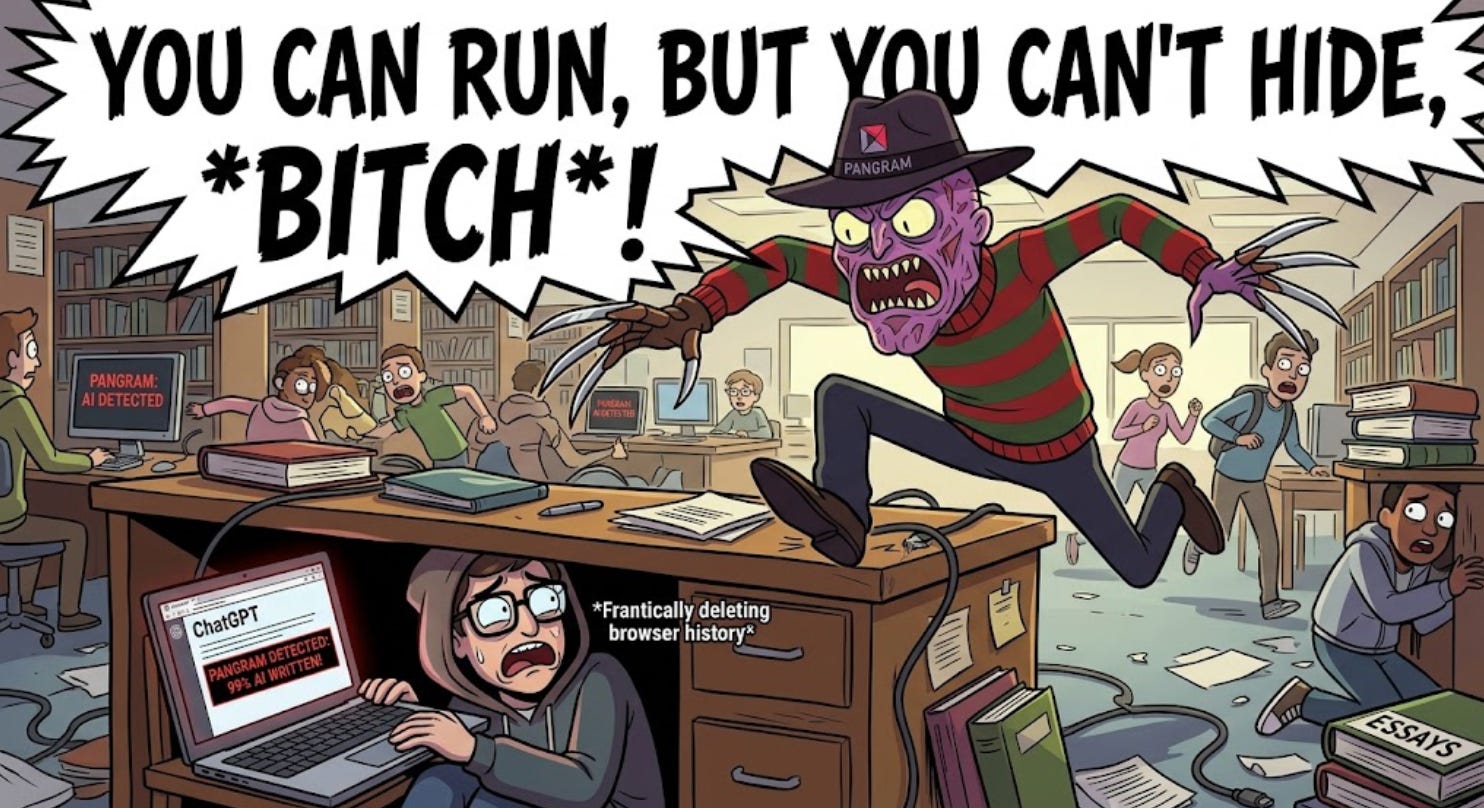
My favorite character during those years was and remains Scary Terry, a parody of Freddy Krueger who appears in the second episode which also satirizes Christopher Nolan’s “Inception,” as Rick and Morty travel through characters’ dreams.
Scary Terry is known for his catch phrase, as many early “Rick and Morty” characters were like Mr. MeeSeeks, my second favorite character, introduced in episode 5 of season 1. Throughout the episode Terry yells as he chases our heroes:
“You can run, but you can’t hide, bitch!”
For some random reason, Scary Terry — and the other “Scary” Krueger-style characters who appear in his dreams — call people “bitch” a lot, even when it’s not an insult. Like, it’s just a normal thing they say, like punctuation:
For reasons that may now appear obvious to those following my mischief on Substack Notes the last few days, Scary Terry’s catch phrase has dashed around my cerebrum a bunch as I have begun an investigation into concealed AI authorship on Substack following discovering the strange phenomenon, which I first documented here on August 30:

I noticed that two pro-Israel Substackers I followed and admired had published articles where they had deliberately chosen to disable the Pangram software added recently that allows readers to scan for how much synthetic text appears the article.
This seemed so silly to me. How could a writer not understand the obvious implication that a reader will make when they disable Pangram?
Why refuse the breathalyzer if you didn’t drink that vodka?
Anyone can understand that the writer wants to hide the number which will appear. They are ashamed that the number is not 100 percent “Fully Human-Written.”
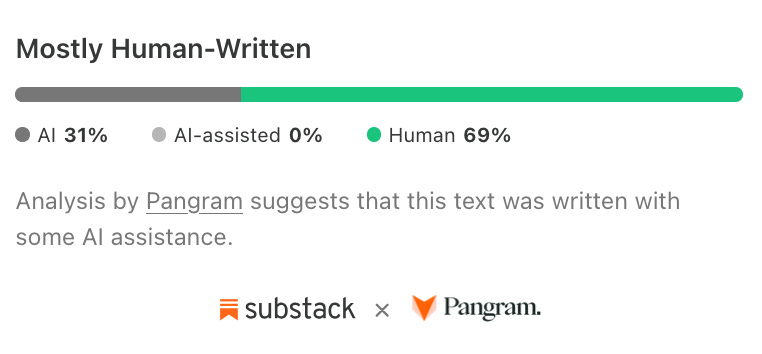
Here’s what you see if you use Pangram on the above article or on this article you are reading now. And it’s what I saw before I published it. Every writer can do the scan before they publish their pieces:
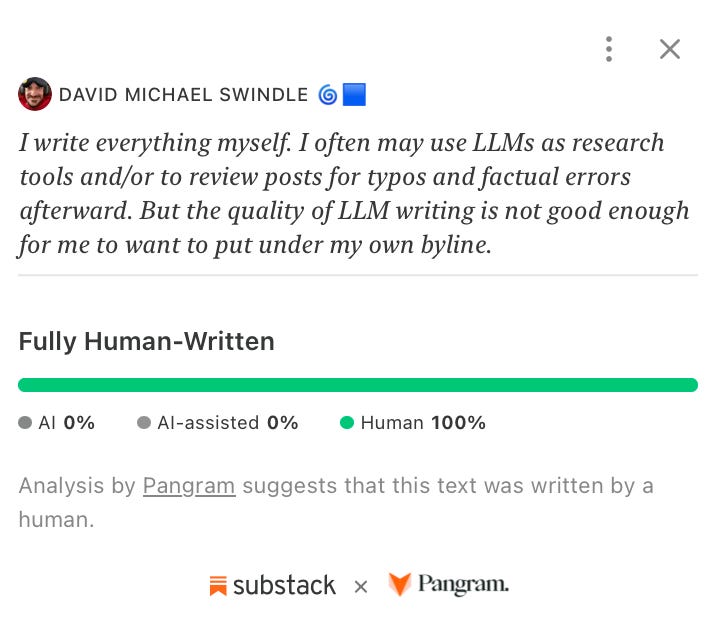
So the fact that we as writers can scan text before we publish it, means that we can now scan not just our own work, but anyone’s.
Now we can see who on Substack or anywhere else online has plagiarized from an LLM.
Yes, let’s start using the scarlet P word — the kiss of death in journalism, literature, and academia — to discuss undisclosed AI writing.
Note how undisclosed is the operative word here.
Using AI as a tool to write is not unethical.
Presenting AI writing under the pretense that you wrote it yourself is unethical as hell.
Last year I wrote a whole series exploring how writers and creatives could use AI. I’ve chosen to remove the paywall on this one:

My position then still makes sense today:
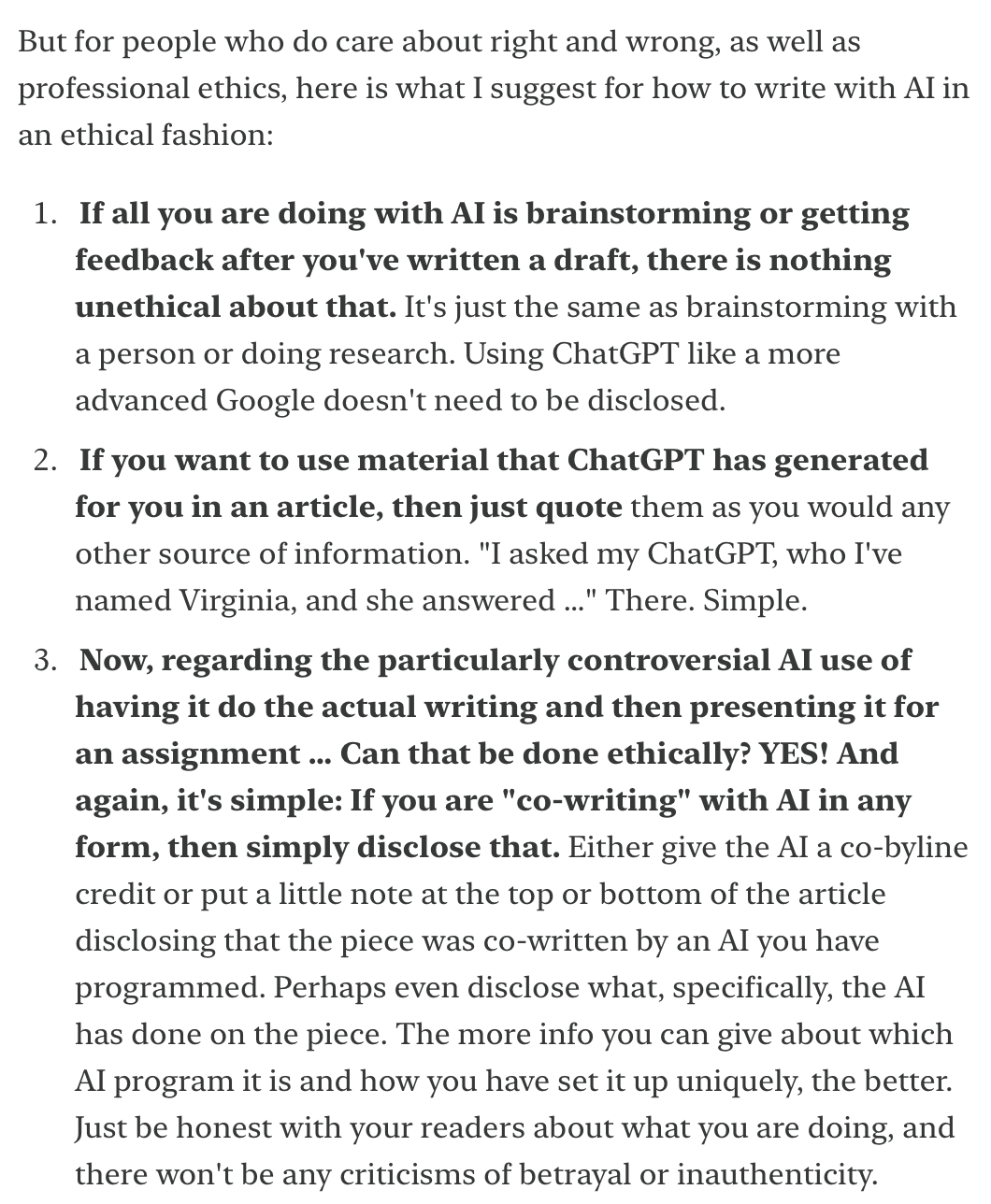
Now with Pangram, every writer can disclose if they are co-writing. In the little AI statement that appears above, then they can simply declare “I use AI to help me write my articles.” If they want to go into detail about it then great, but a bare minimum disclosure like that, followed by allowing the reader to see the percent of AI authorship is sufficient to meet ethical requirements.
If you write an article with a human co-author then you should disclose that.
If you write an article with an AI co-author then you should disclose that too.
Simple.
And the vast majority of writers on Substack agree. Almost every post that you check with Pangram will come back with a percentage revealing how much AI is in it. Thus, it’s weird for a writer to choose to disable Pangram.
Why are they so self-conscious about this?
Because it reflects back that they are more interested in “being a writer” and the world perceiving them as “a serious writer” rather than simply engaging in the act of writing.
Those of us who have loved writing since childhood, choose to write our own articles because we love the process and the act of writing in and of itself. Doing this is not just about producing something coherent which others can read, but also making our own thoughts coherent for ourselves.
Writing is thinking. The deeper you can write, the deeper you can think.
And those who choose to skip the manual writing process thus skip the thinking process. Hence why writing that comes from LLMs seems so generic and predictable. The writer was not discovering anything for themselves as they wrote it. The computer was just guessing what “the most likely” thing would be.
LLMs simply are not good at creative writing. Those of us with degrees in the topic and who have worked professionally in it can tell. They are good at guessing at what is generic, but they almost never can generate compelling, original thoughts.
And that’s the reality of who you find below.
The Substack writers here chose to disable Pangram in order to conceal that the article(s) they published were AI-generated in whole or in part.
The price for them doing this is that they are all now in line to join New Age guru Mitch Horowitz and right-wing podcaster Ben Shapiro in my ongoing “Bullshit Salesmen” series where I dedicate an article to debunking the harmful lies and bogus career persona of a single writer:


“Welcome to your nightmare, bitch!”
Without further delay, here are 47 notable Substack accounts which engage in this deceitful practice. I’ve organized them by type as they fall into disctinct categories, each offering their own sickly flavor of bullshit. I have also included my public requests for comments and individuals’ responses. As further responses come in then this essay may be updated.
In writing and investigating this story I have abandoned a conventional journalistic approach. Usually if you are writing a story about someone engaged in something unethical or dishonest, you contact them privately and quietly to request comment.
I’ve abandoned that. I’ve just asked people in the comments of articles and on Substack Notes to explain themselves during the research process itself. I’ve published on Notes images juxtaposing the screenhot of the deactivated AI scanning with the Pangram percentage that I manually did myself and then asked for explanations. This has now created a clear public record of the question. If they ignore it, then everyone can see.
Understand the bigger picture here with doing this exercise: the writer doing this is revealing just one symptom in a deeper disease in their thinking.
People who will BS their readers about their AI use will BS their readers about other things. So for most of these accounts here — a handful will be spared — a much more thorough investigation and critical essay will follow.
Here are the categories and how many people fall ito them:
Left-Wing BS Merchants: 17
Right-Wing BS Merchants: 2
Religious BS Merchants: 8
Zionist BS Merchants: 4 (yes, I’m calling out people in my own movement too)
Cultural BS Merchants: 10 (one is a writer I’ve published and now cut ties with publicly over this)
Technology BS Merchants: 6
We’ll begin with the largest category of offenders…
17 Left-Wing BS Merchants
Part of the simple purpose of this study has been to see if there are any obvious patterns in which writers choose to attempt concealing their AI use.
When going through and doing the raw reserch looking for writers who did this, the plan was not to consciously think about who all the people were. I was just gathering the data with the intent to simply go back and examine them later, once I had the initial collection of people.
So it was not until I’d collected everything that the obvious, glaring reality jumped out: this is a very heavily left-wing phenomenon. Seventeen out of 47 is huge. (And many of the people in the cultural and technological categories would qualify as left-wing too, but politics is not their main emphasis.)
Once I saw this disparity, I went out and sought to correct it, going and checking numerous conservative Substackers I knew and seeing if there was anyone of note I had missed.
And there was. And I was devastated when I found out it was her.
But first, here are seventeen subtacks pushing varieties of left-of-center ideology and hiding that they’re using AI to do it. Eight of these I had already subscribed to and read for years, many long suspecting they relied on AI.
1. Adam Kinzinger
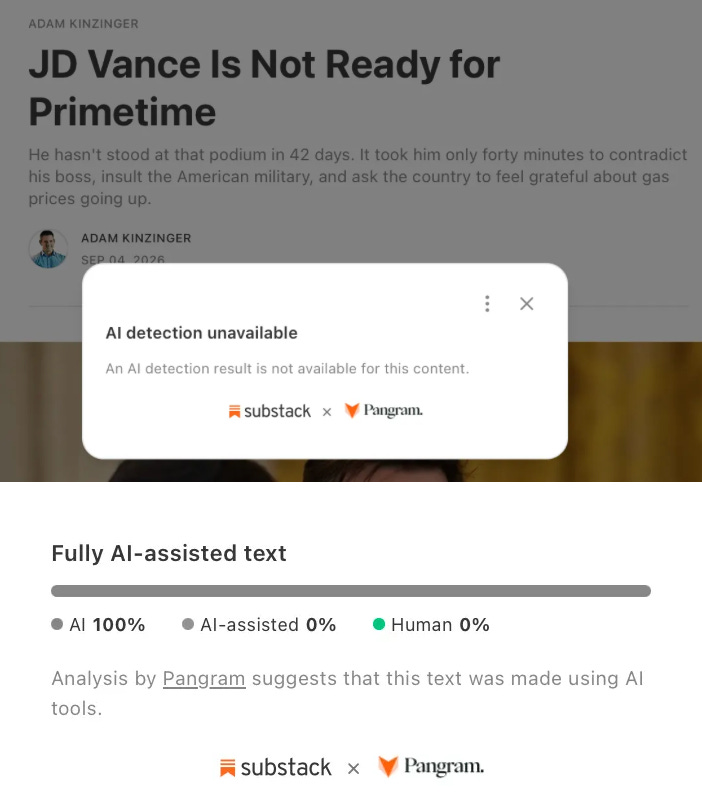
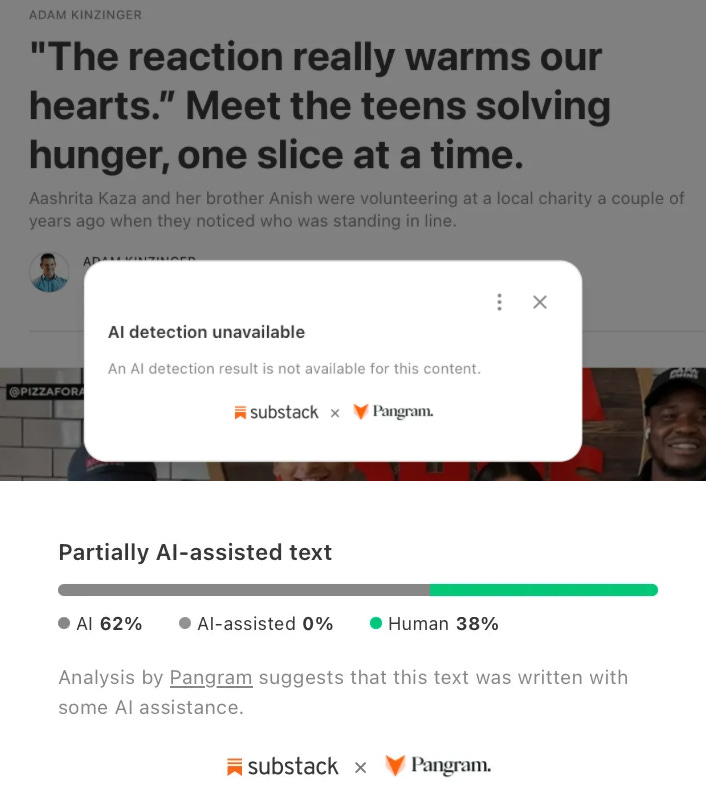
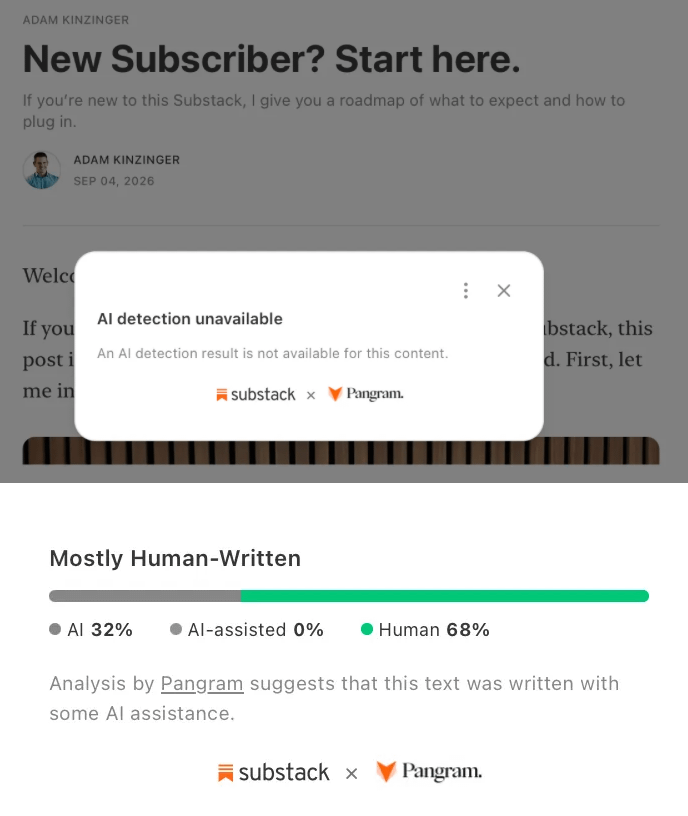
Adam Kinzinger is one of those figures who has long inhabited similar ideological space as me: the hawkish, ex-Republican, #NeverTrump cohort clustered around The Bulwark. However, even though I’ve often agreed with things he’s had to say, he’s long seemed like just another typical politician, inauthentic and ingenuine, boring and bland.
The Pangram scans of his articles reveals as much:
I made a public request for comment about this post:

He did not respond.
Kinzinger may have emerged out of the GOP, but at this point he — like many in the #NeverTrump cohort — have gone so far to the left they are now the equivalent of center-left Democrats.
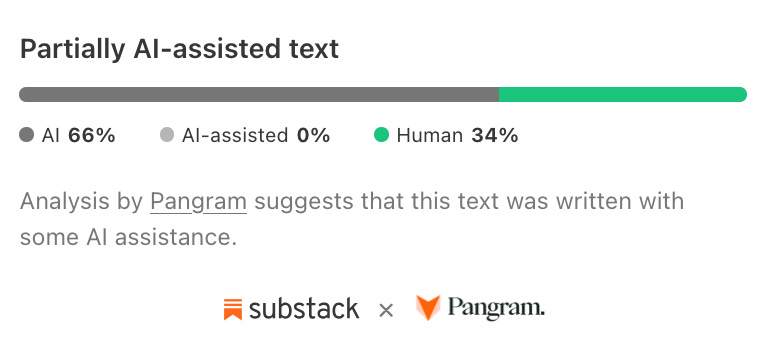
SEPTEMBER 20 UPDATE: Kinzinger continues to engage in this practice:

I was not familiar with Heather Delaney Reese, the left-wing blogger and podcaster up next, until seeing her listed high on Substack during the research for this investigation. She apparently has a background in lifestlye blogging, which I can respect having edited the PJ Lifestyle section of PJ Media from 2011-2015. I will always have permanent solidarity with my fellow lifestyle bloggers past and present.
However, what Heather is doing here is unethical. And she totally knows it.
2. Hope for America with Heather Delaney Reese
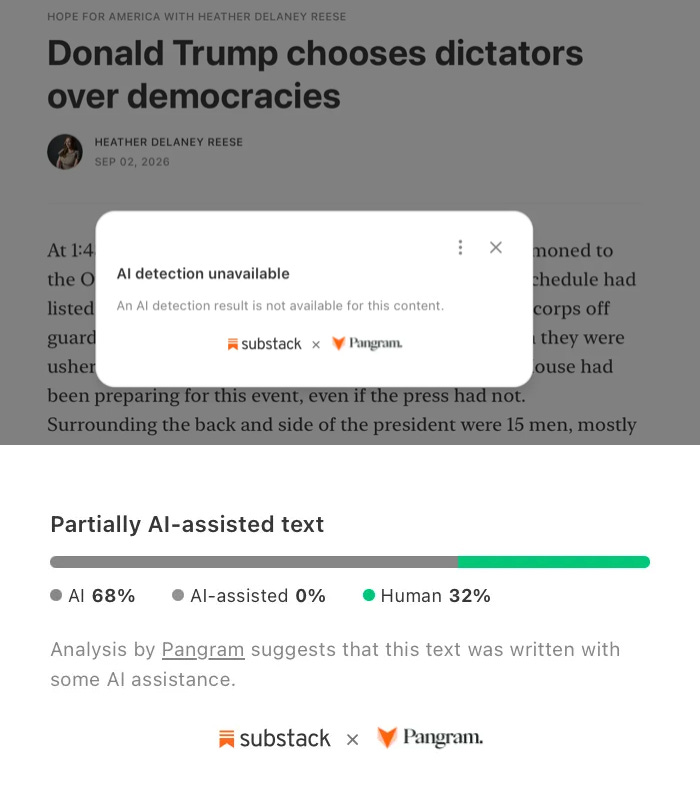
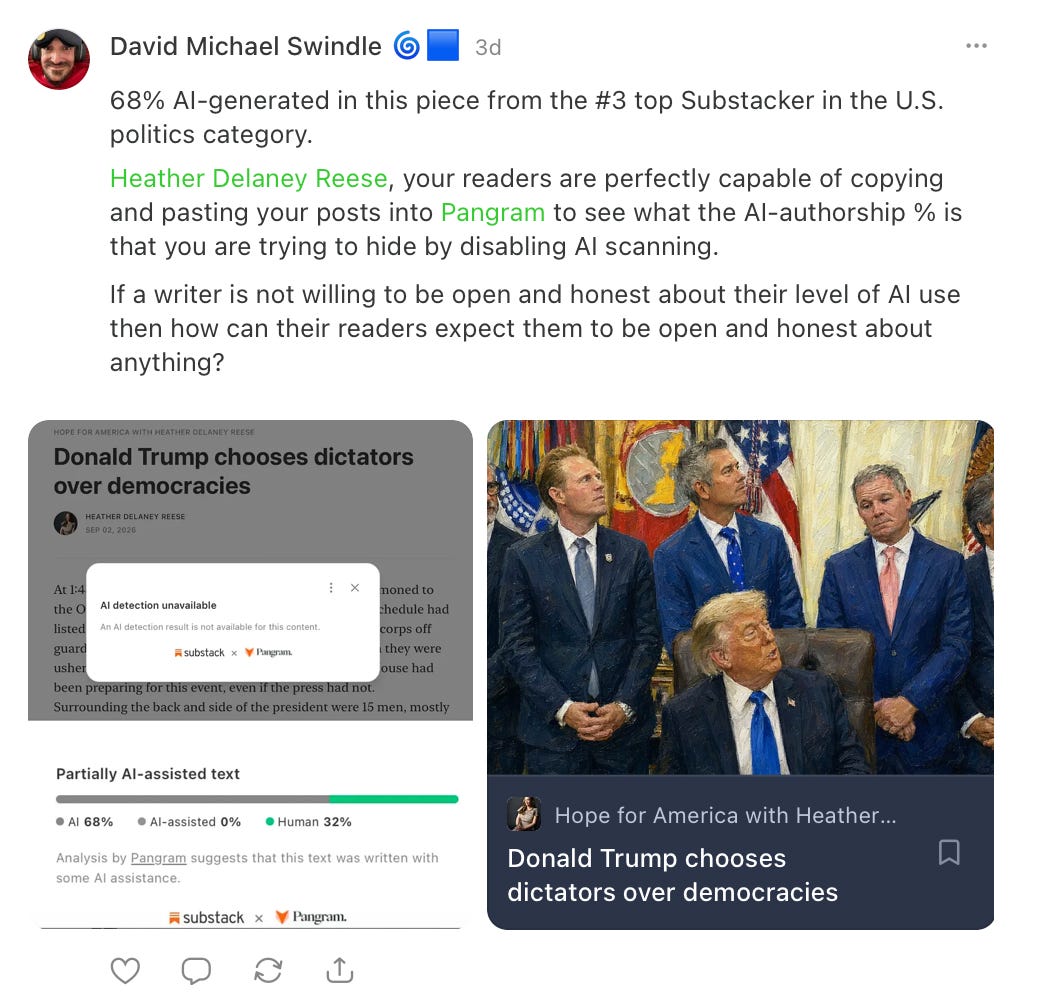
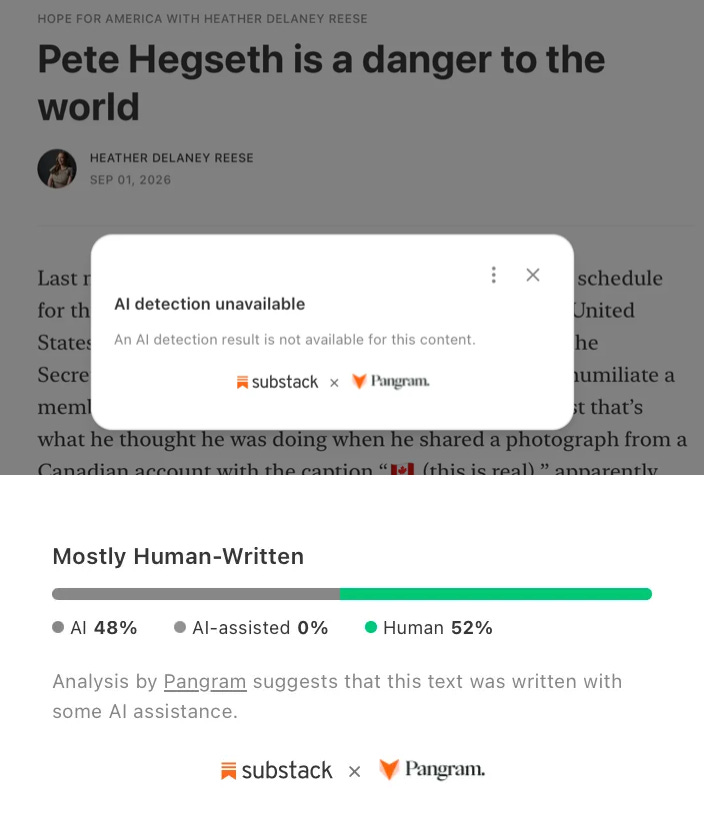

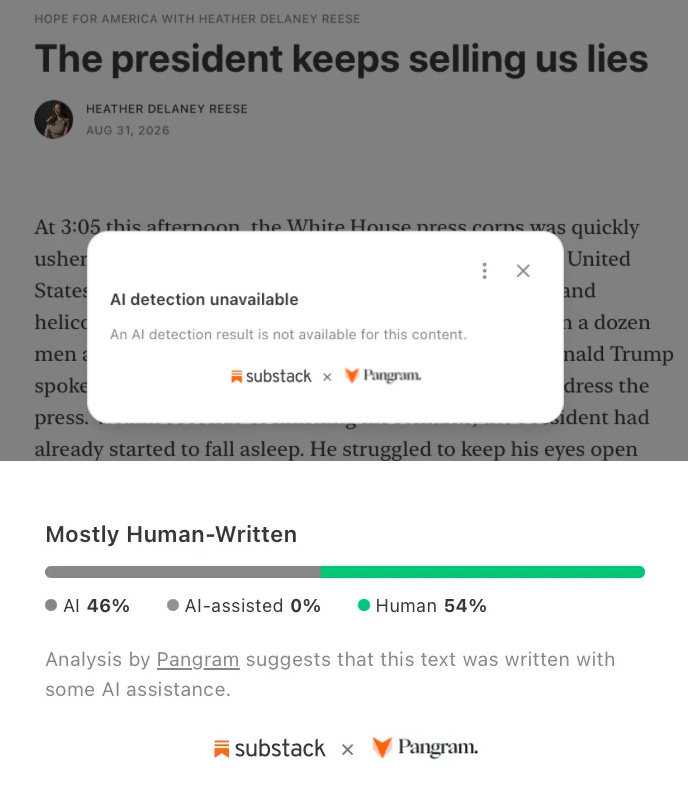

Heather Delaney Reese did not bother to respond to any of my notes calling out her obscured AI usage. She did something else which said even more.
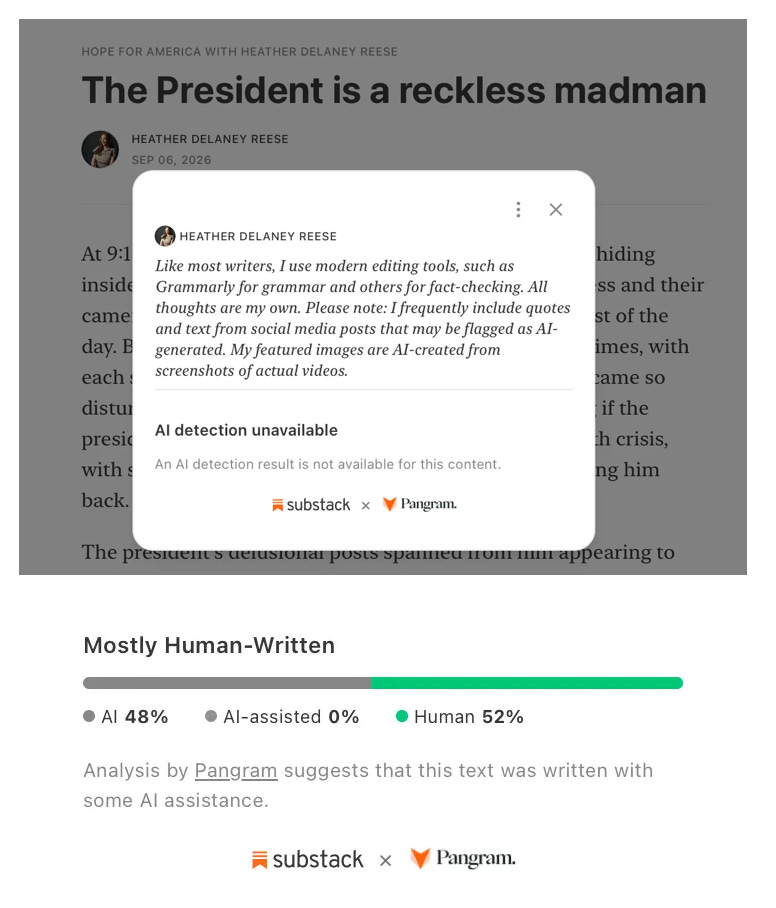
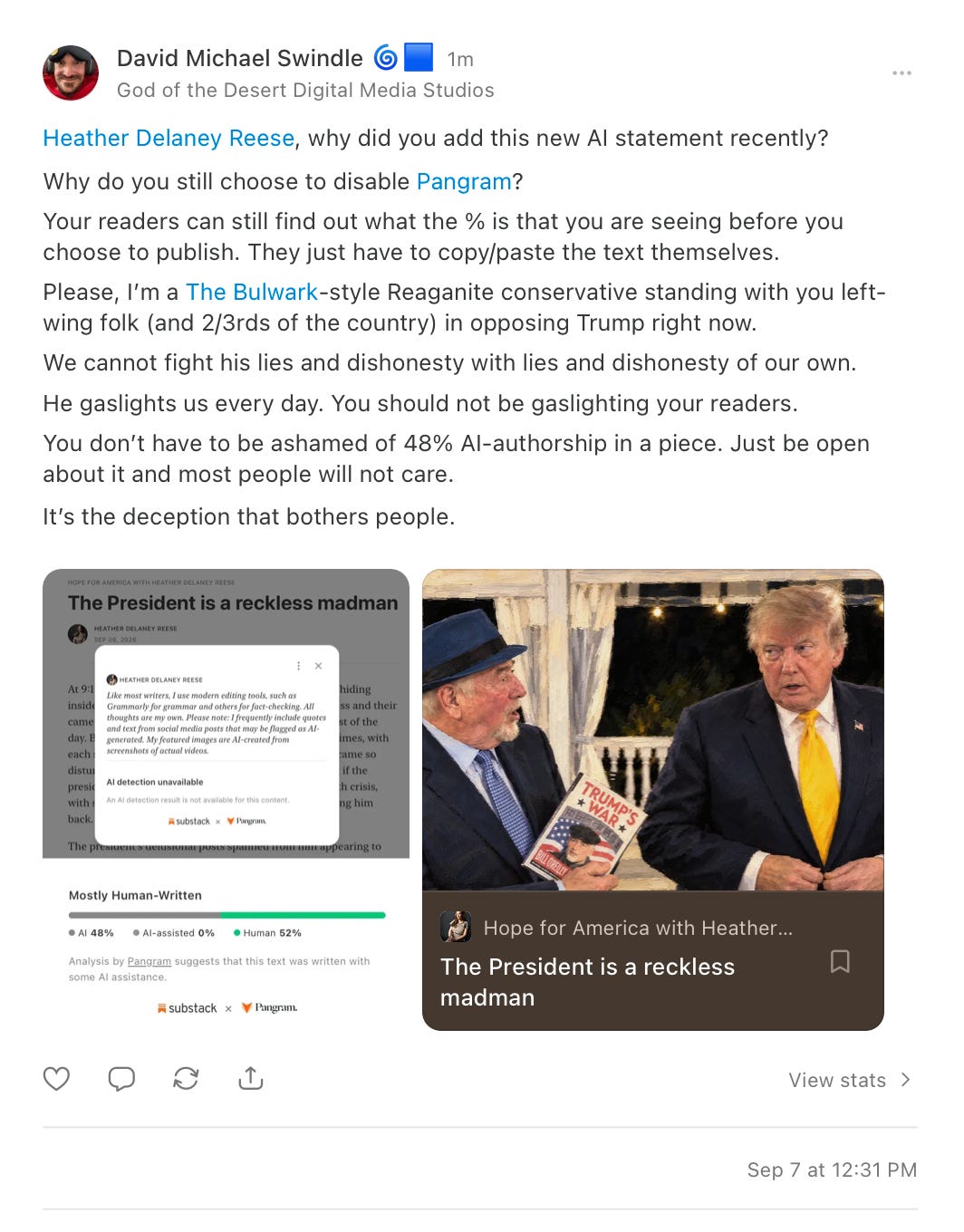
Interestingly, as the investigation concluded on Monday, Sept. 7, I noticed that Heather had now added an AI use disclosure, though she still chose to keep Pangram disabled.
SEPTEMBER 20 UPDATE:
Since this article’s publication, more of Heather’s pieces have allowed for Pangram scans, such as her piece today on how “Donald Trump is being forced to face reality.”

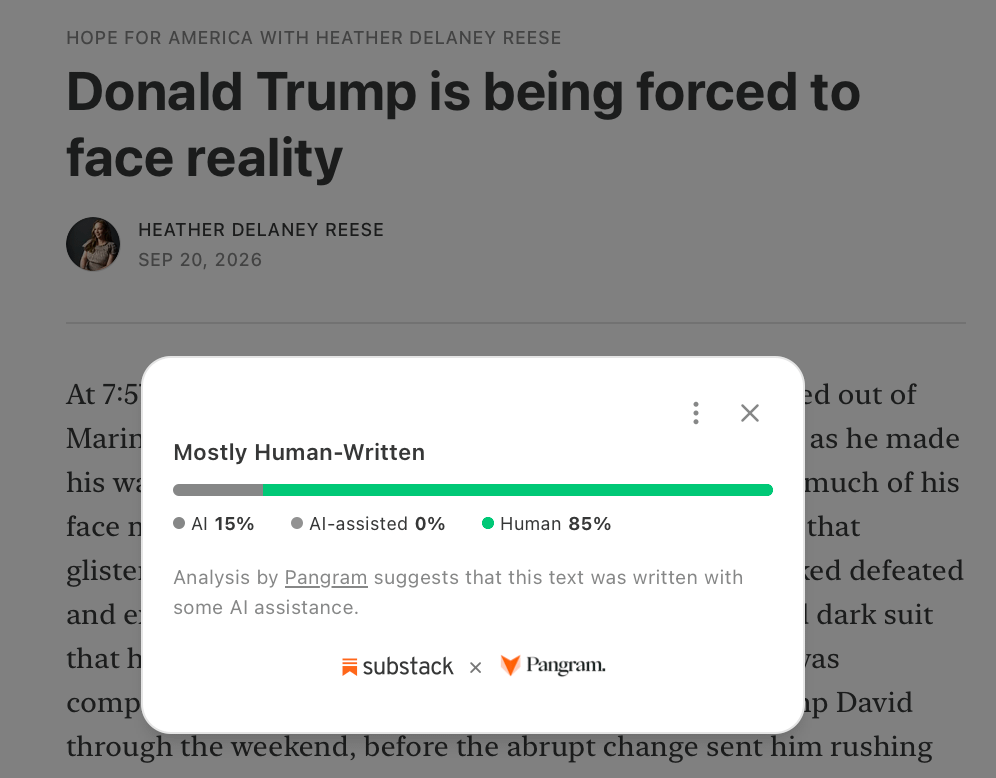
Heather, I found this be a pretty dry and boring piece until you got to the part about your family’s recent health scare with your husband Pete. You should write much more about that experience. It warrants a standalone piece.
However, I’m still seeing a number of pieces with Pangram disabled. This does not appear to be a consistent practice yet:

So Heather will remain on the list, unfortunately, until I receive affirmative confirmation of her intent to cease disabling Pangram.
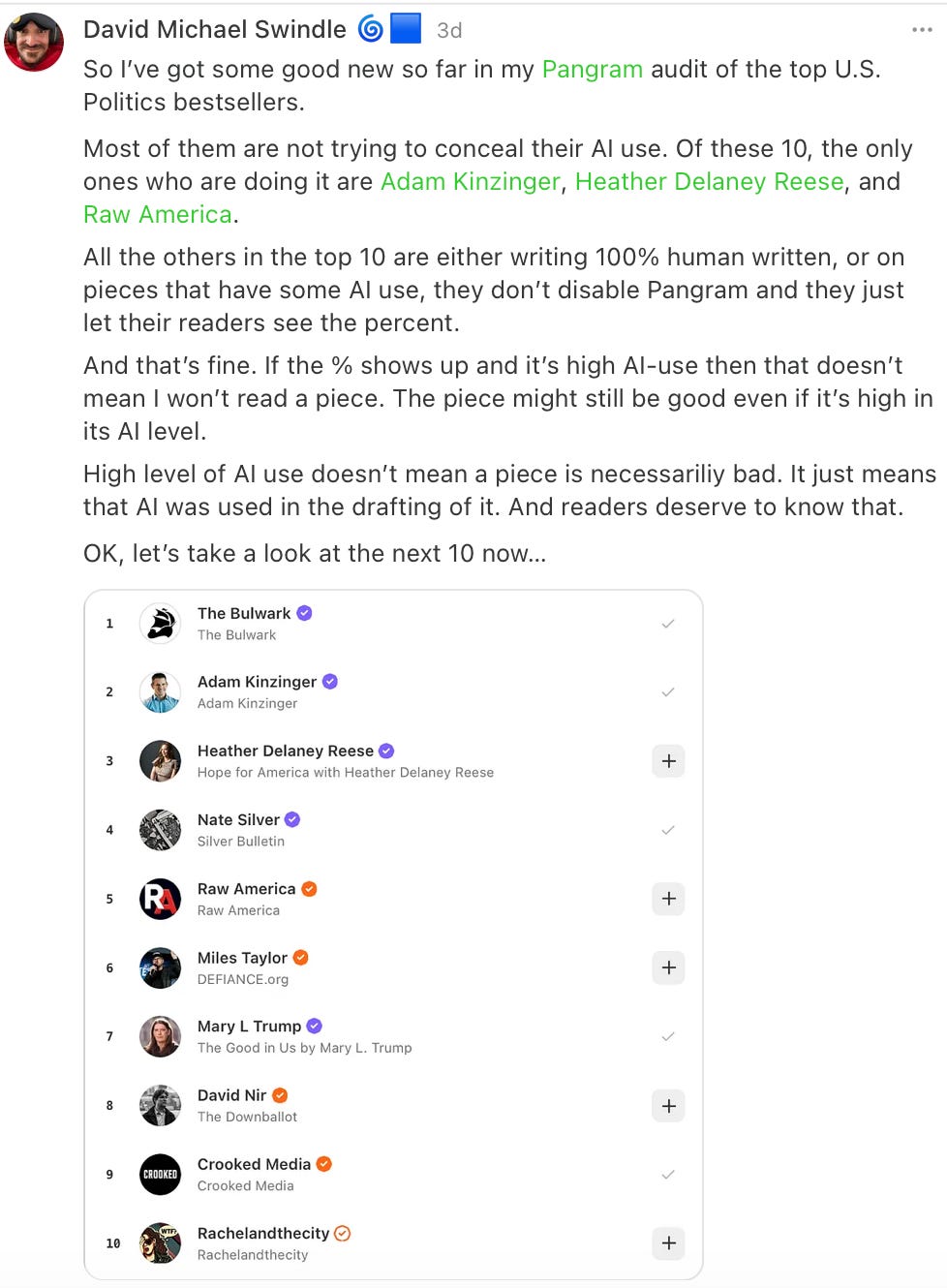
It’s worth keeping in mind here, that this approach with disabling Pangram is a minority position, as I noted while surveying the political categories:
3. Mike Brock
Mike Brock is a left-wing podcaster and “essayist” who has grown a large following on Substack.
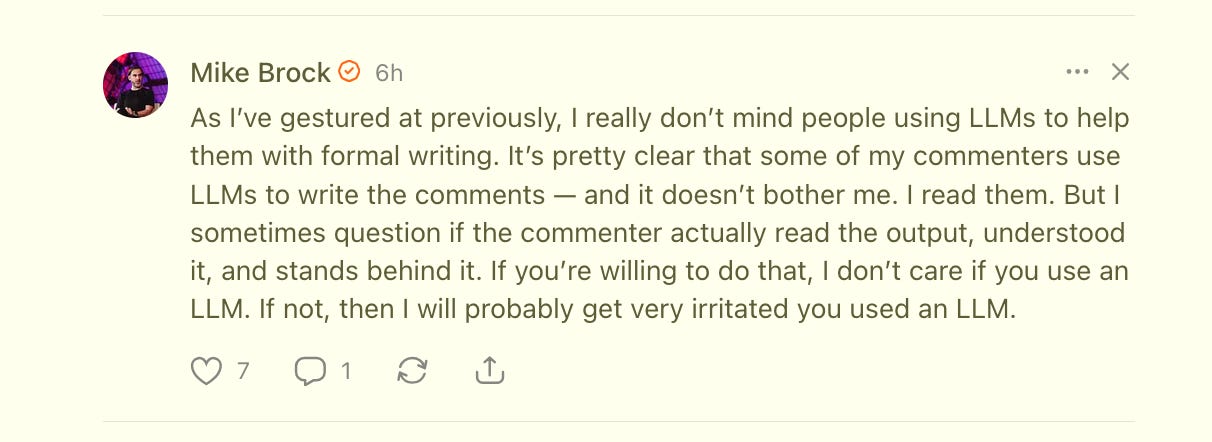
This recent note he published seems particularly ironic given what I uncovered and revealed to him:
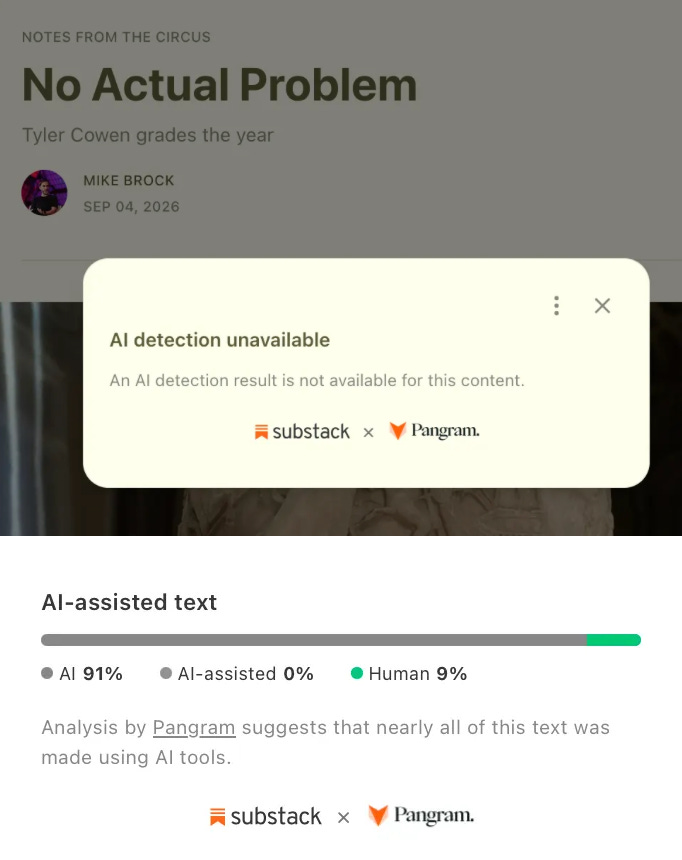
Here’s an example of how his pieces appear when one attempts to scan them, and then a common AI authorship estimate:
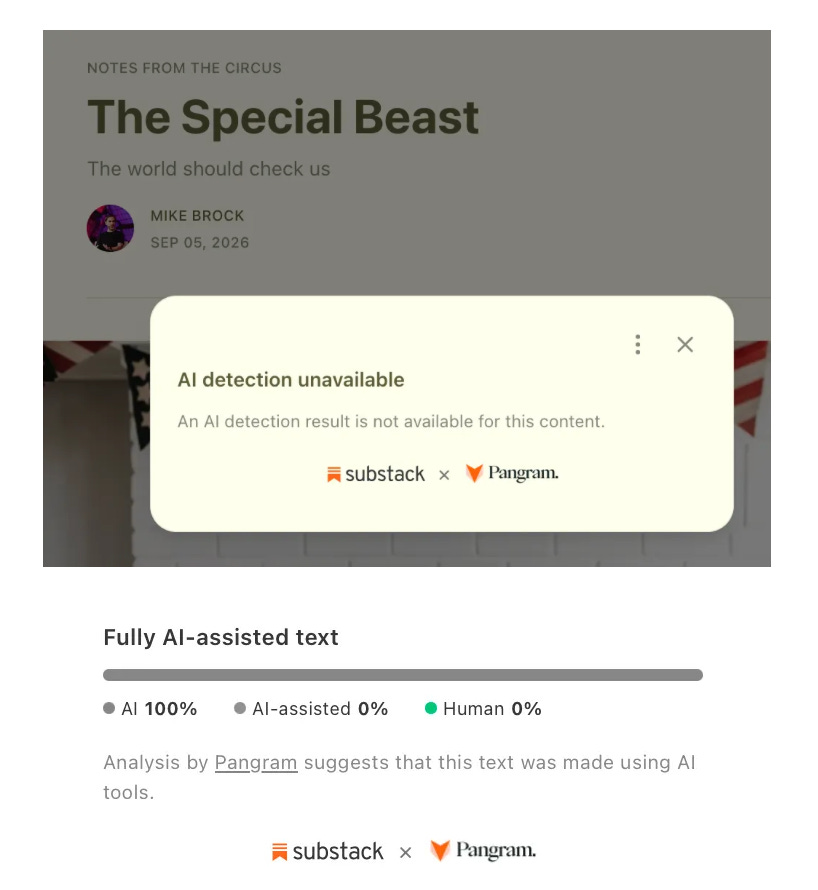
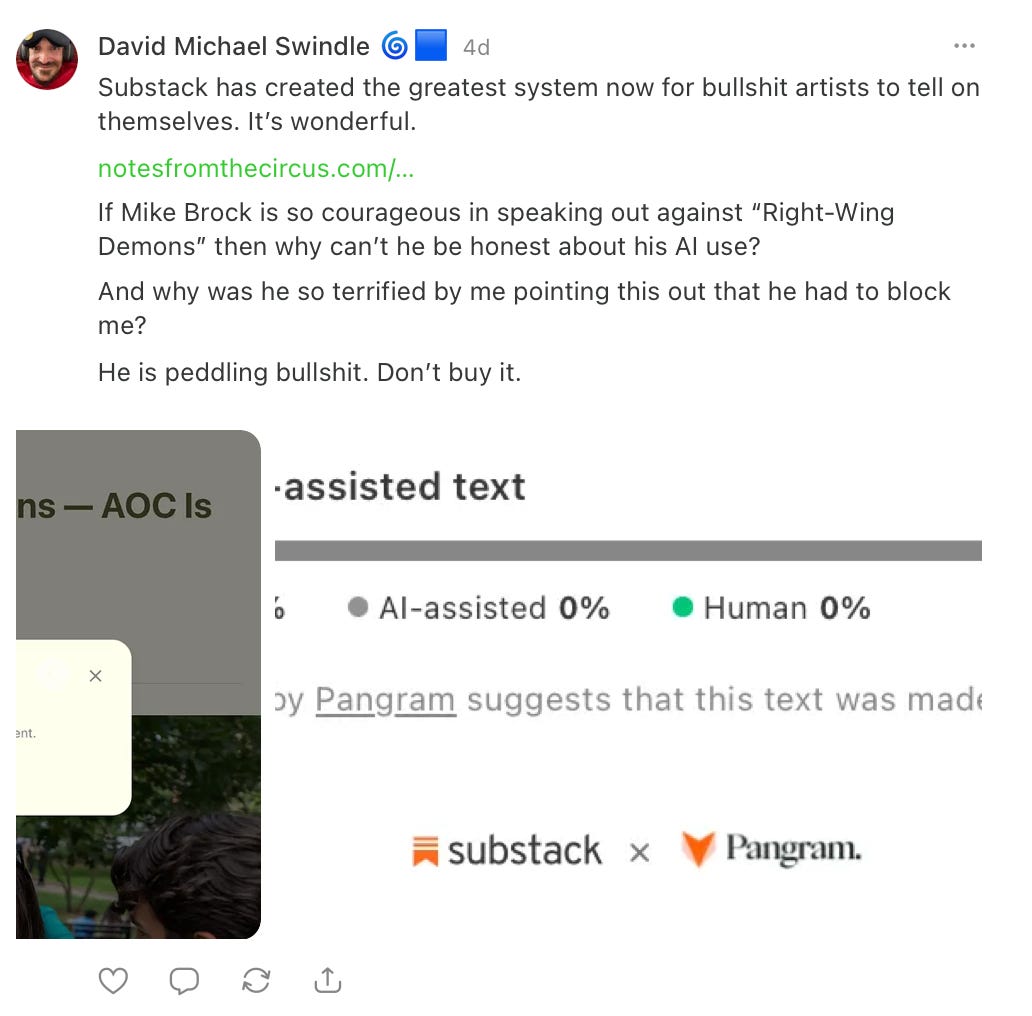
I showed the AI authorship percentage on Notes and this inspired him to block me, as anticipated:
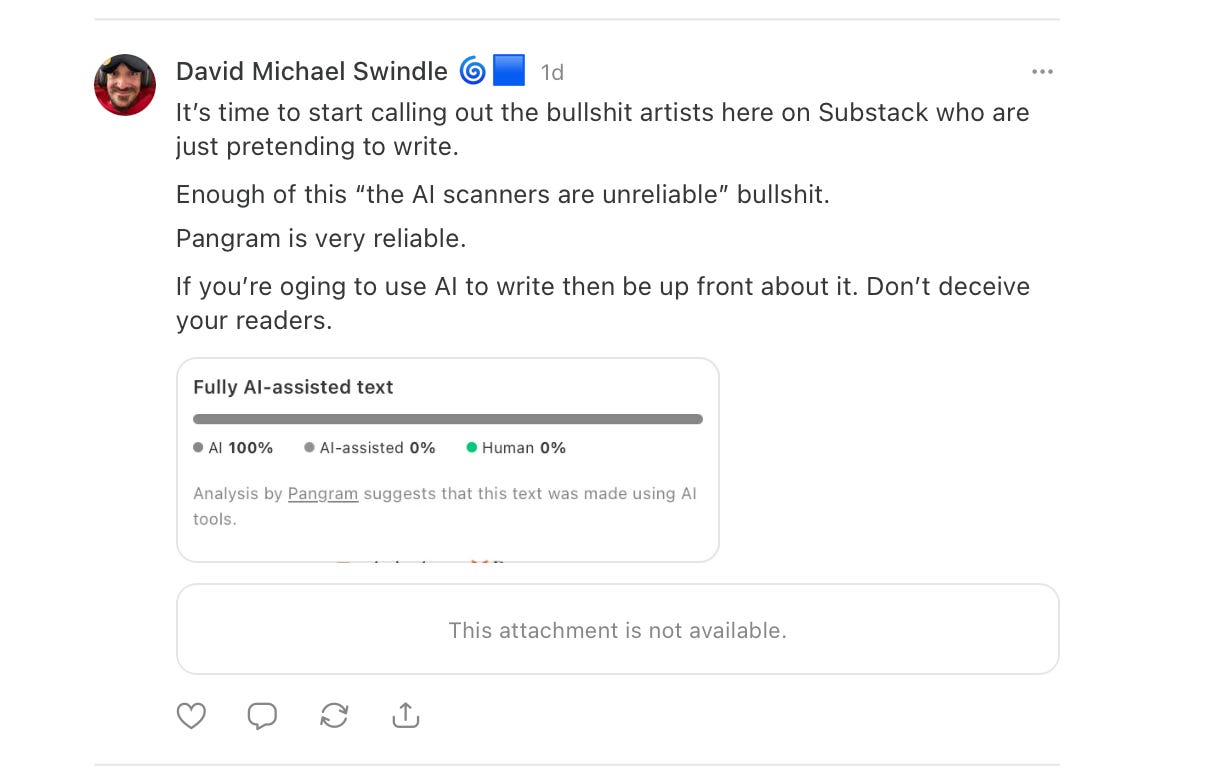
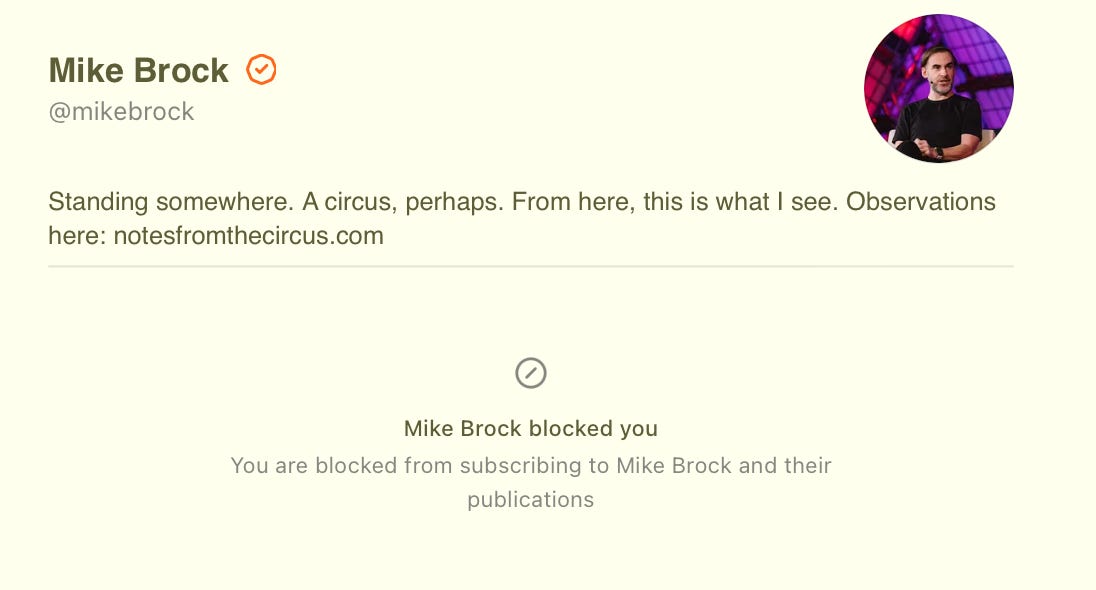
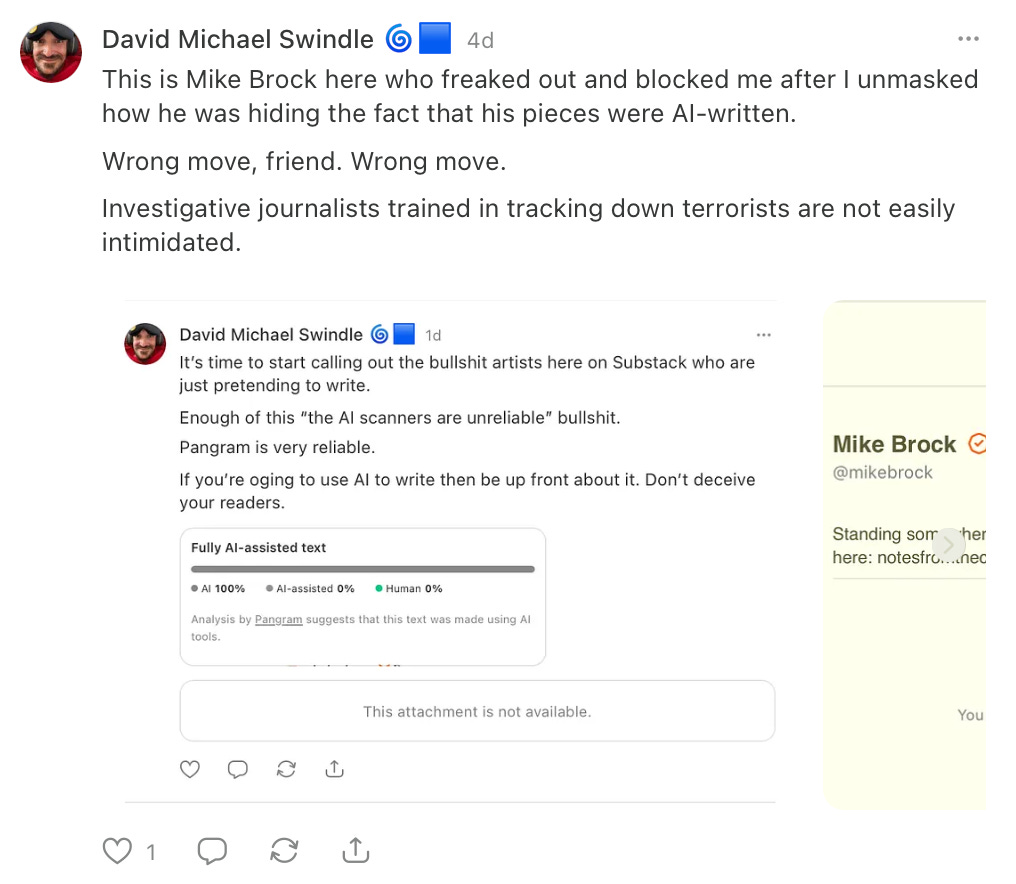
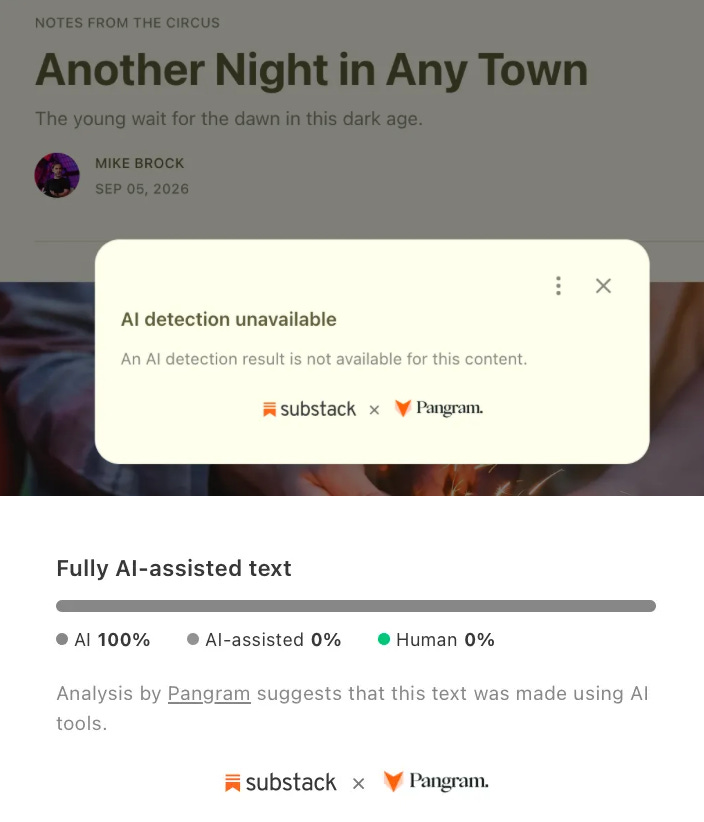
I’m not sure that I mind that Brock has chosen to block me.
I just got so tired of him always lecturing down from the mountain to we poor mortals back down on earth.
I’ve developed a very high tolerance for hearing people spout left-wing ideology. It’s the arrogance, narcissism, BSing, gaslighting, and egg shell egos which irritate me the most.
SEPTEMBER 20 UPDATE:
Mike Brock continues to deceive his readers:
The next guy on the list guilty of concealing his AI use is another wildly popular progressive blogger and podcaster.
4. Dean Blundell
I’ve long subscribed to Dean Blundell’s newsletter not because I particulary care for him or the way he writes, but rather just becaue of the stories that he covers and the information they contain. He’s one of the big anti-Trump voices these days with more than 81,000 subscribers.
Yet long before Pangram emerged, one could smell the AI wafting off of his articles like too much old sweat in a moldy locker room:

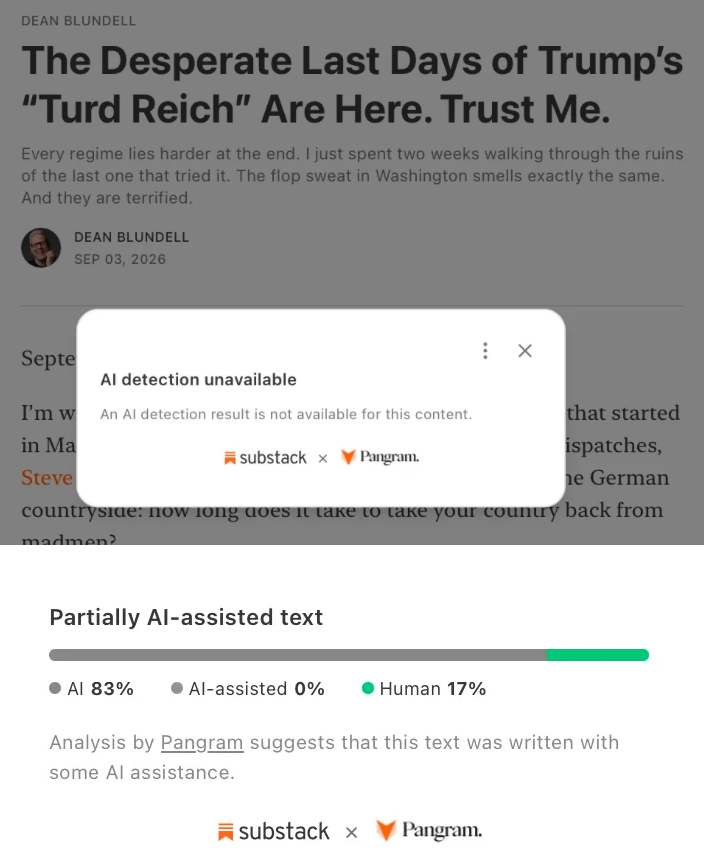
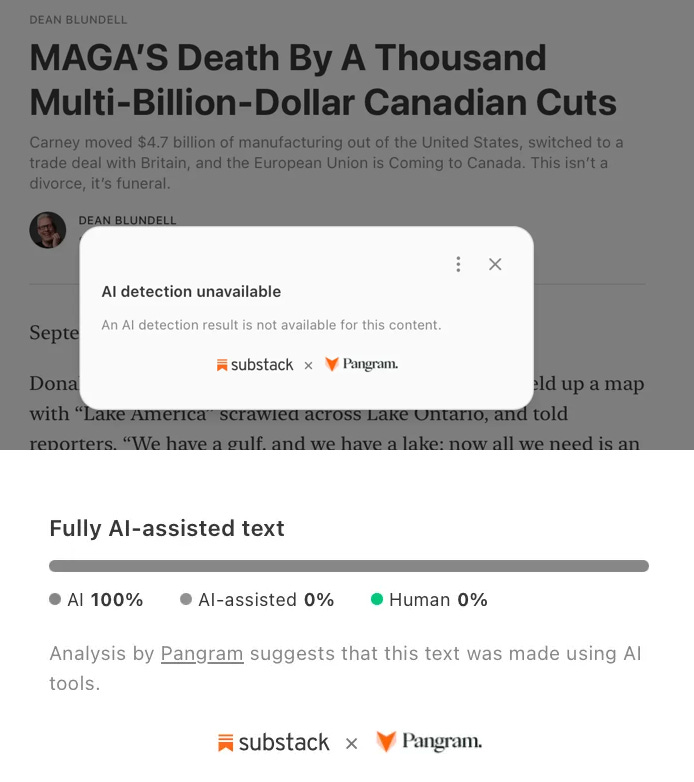
SEPTEMBER 20 UPDATE:
My goodness, I feel like Jack Skellington discovering Christmas Town. What’s this?!
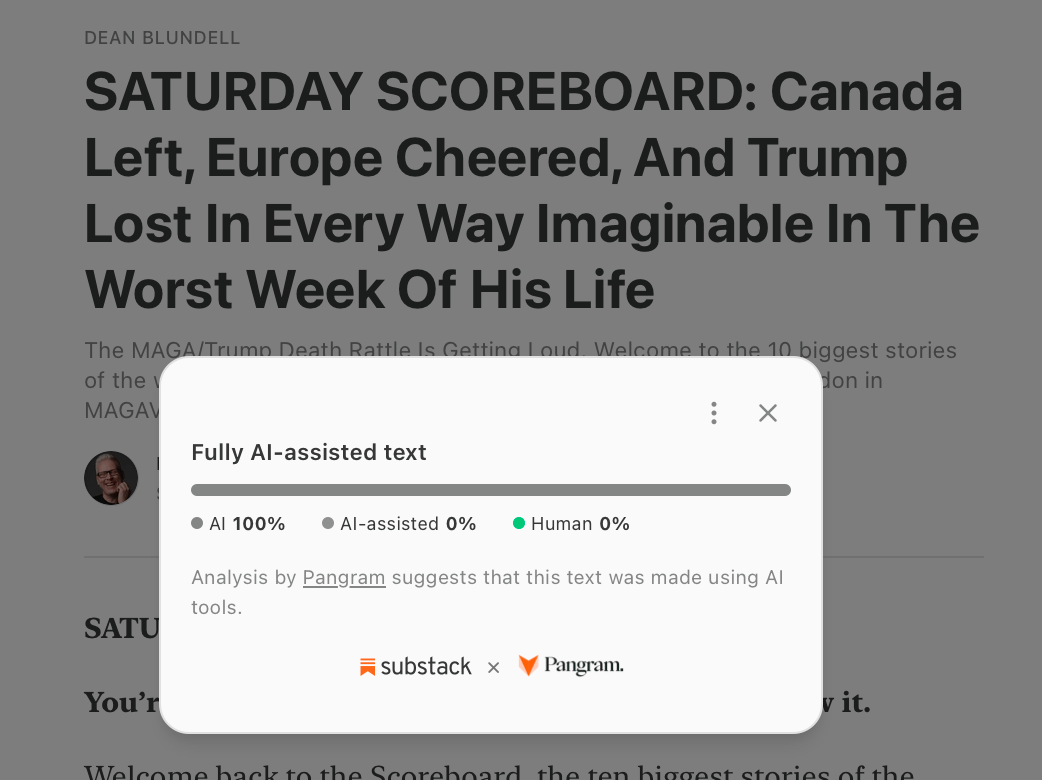
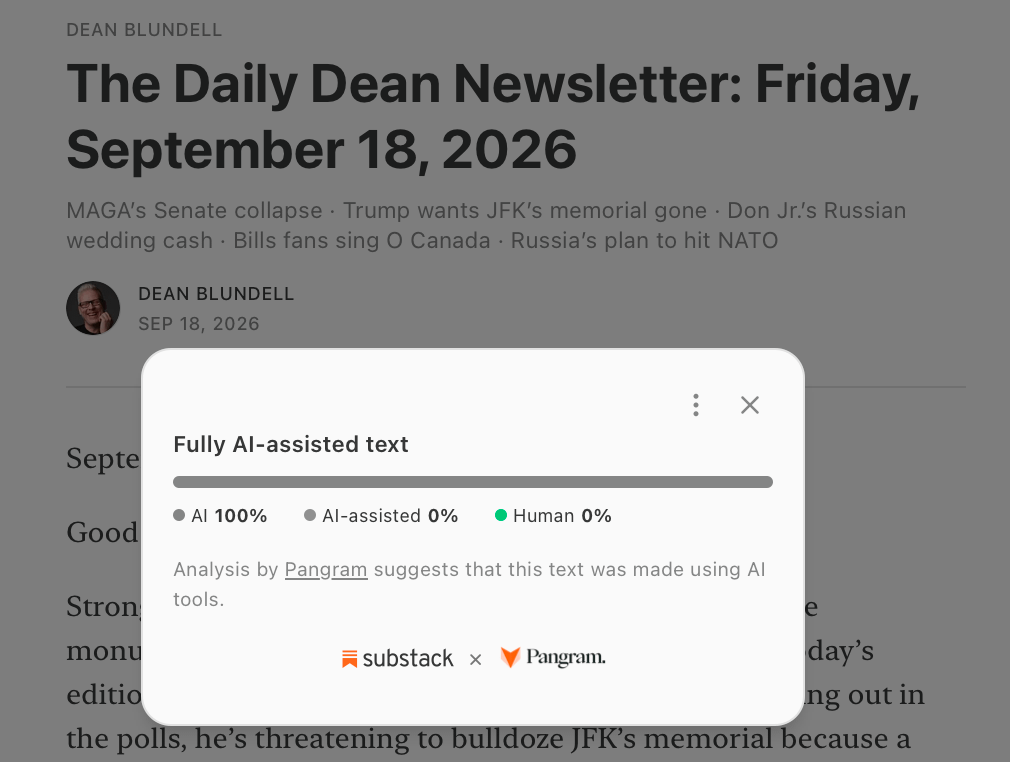
Is he going to come clean now or did he just forget to disable Pangram?
But then my hopes were dashed:


So as with Heather, while I’m encouraged to see Pangram disabled in some recent posts, I’m going to want some affirmation from them that they do intend to stop in the future before removing them from the upcoming Wall of Shame list.
The next Substacker so stupid as to attempt this is someone Woody Harrelson played in an HBO TV movie which I never got around to watching because it just sounded so deeply unpleasant to endure.
5. Steve Schmidt
History lesson time for the Gen-Zers distracted and bored in the back of the class:
Steve Schmidt served as campaign manager for the doomed Republican candidate who would lose against then-Senator Barack Obama in 2008, Senator John McCain. When HBO made “Game Change,” a TV movie about the campaign, then Harrelson played him.
When Trump arose, Schmidt became one of the loudest voices opposing him.
As wth Kinzinger, while I could often sympathize with some of his anti-Trump arguments, Schmidt always also left me with a sense of inauthenticity. Perhaps it just rubs off after spending so much time babysitting politicians for a living? Maybe inauthentic people choose to be around other inauthentic people since it makes them feel more comfortable? Take your pick.
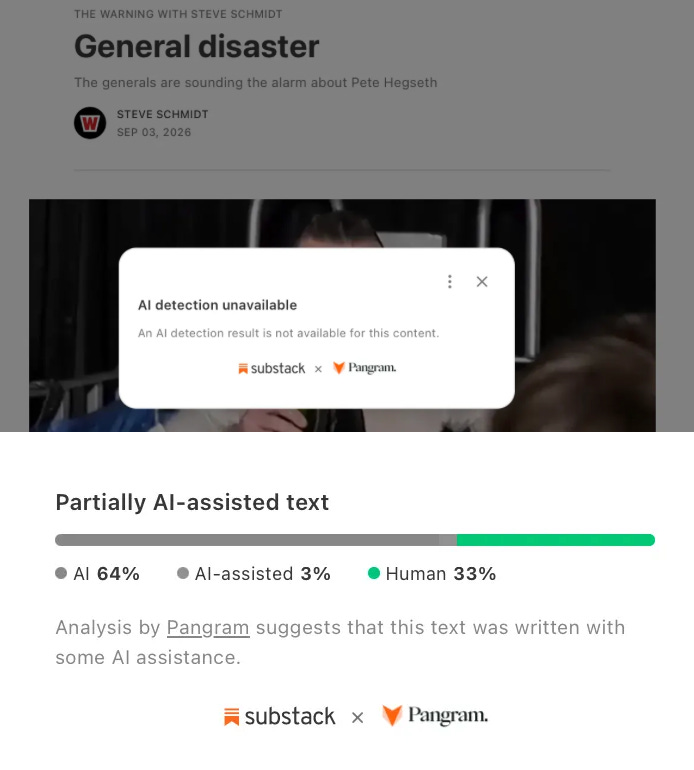
This is a portion worth quoting from the above article in which the writer chose to conceal the text’s primary author:
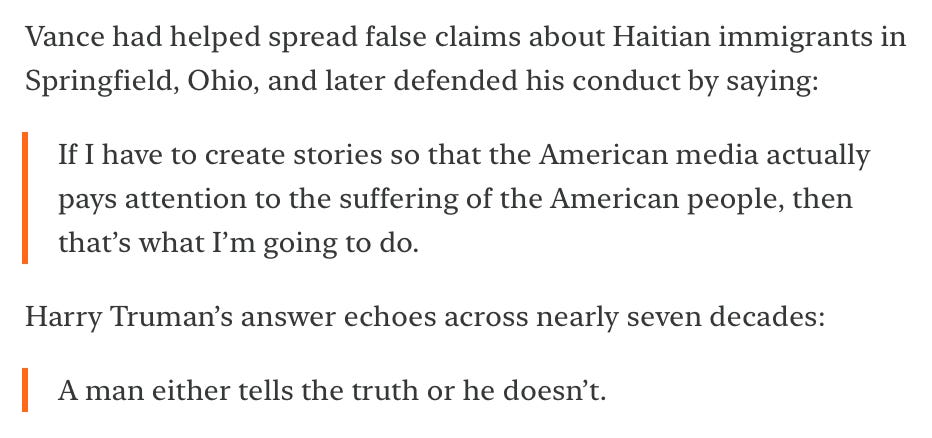
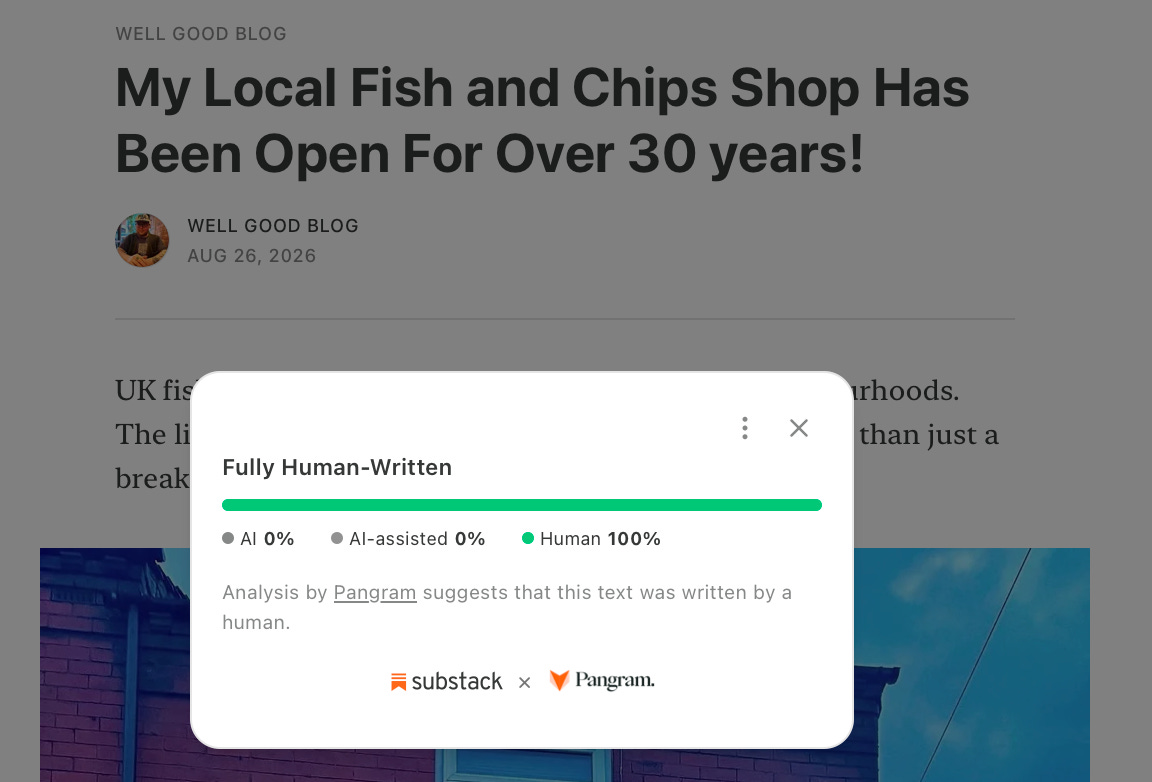
The vast majority of the Substacks surveyed during this investigation did tell the truth. They did not disable Pangram to conceal their AI usage.
SEPTEMBER 20 UPDATE:
Schmidt continues:

Here on Substack, a lot of poor people are trying to build media businesses with their authentic writing and their authentic selves. The people on this list aren’t among them.
Give Well Good Blog a subscribe. He’s one of my favorites on here.

6. Erin Brockovich
Well, this was an absurd shock:
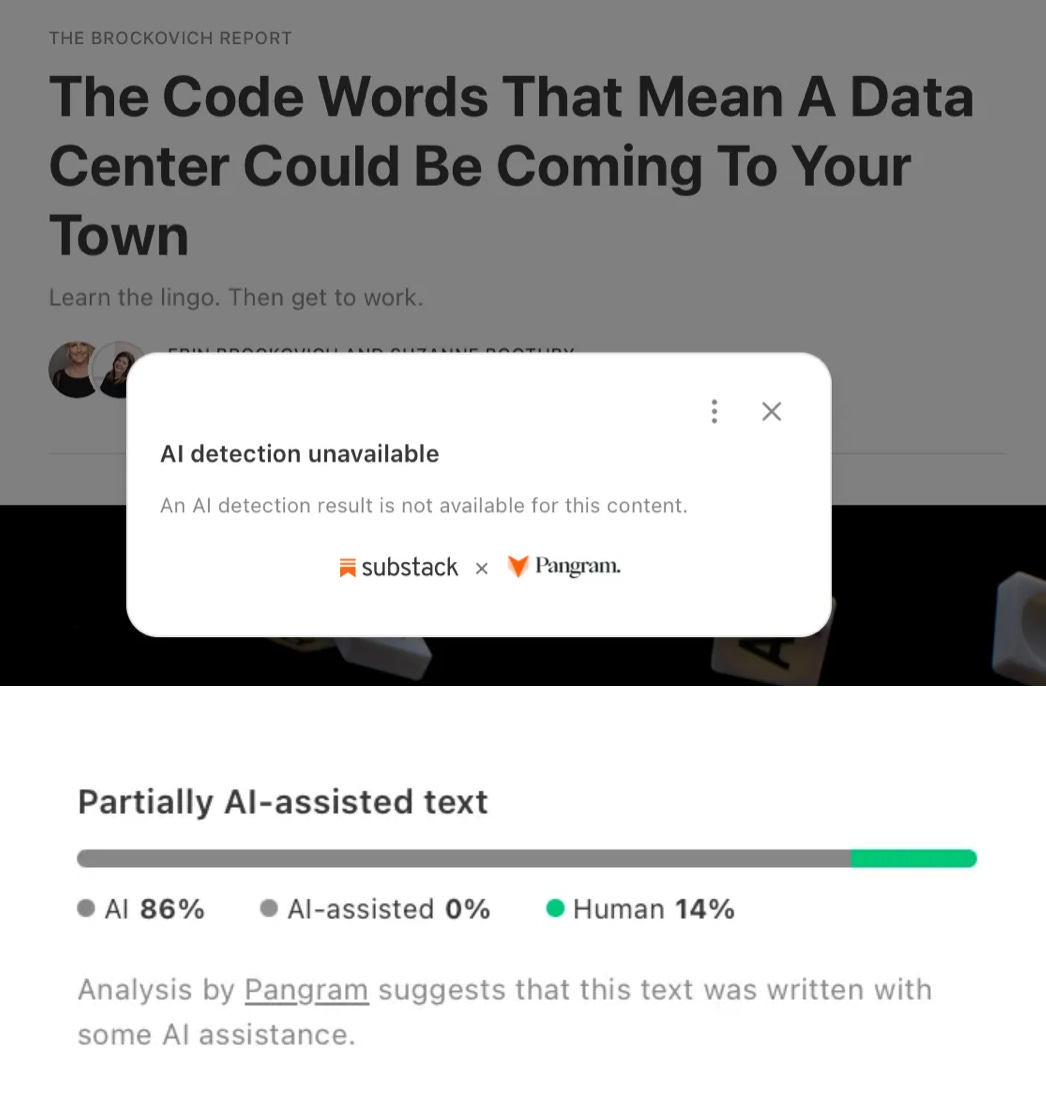
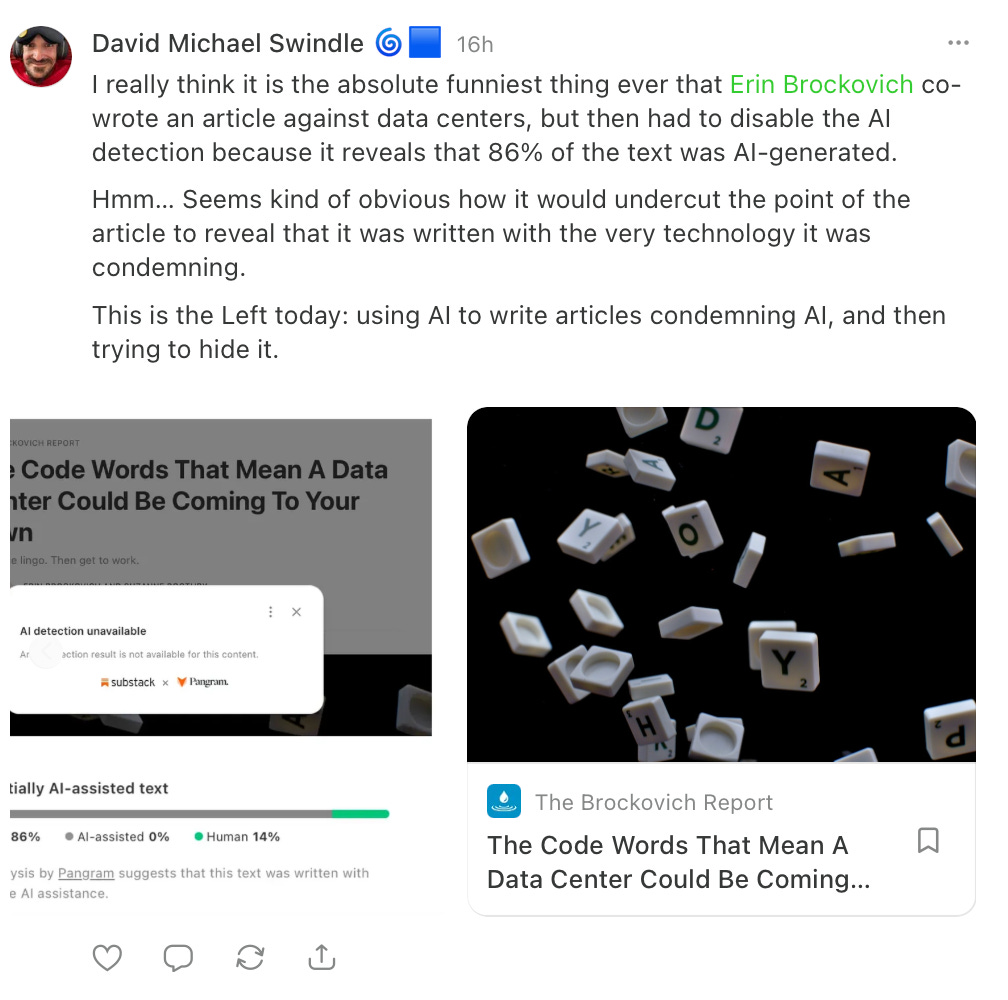
It’s beyond parody!
“Famous left-wing environmental activist made famous by an Oscar-winning Julia Roberts performance uses AI to write an article opposing AI, then attempts to hide using AI.”
How could it be more obvious that someone doesn’t believe what they say than they use the tool that they’re condemning?
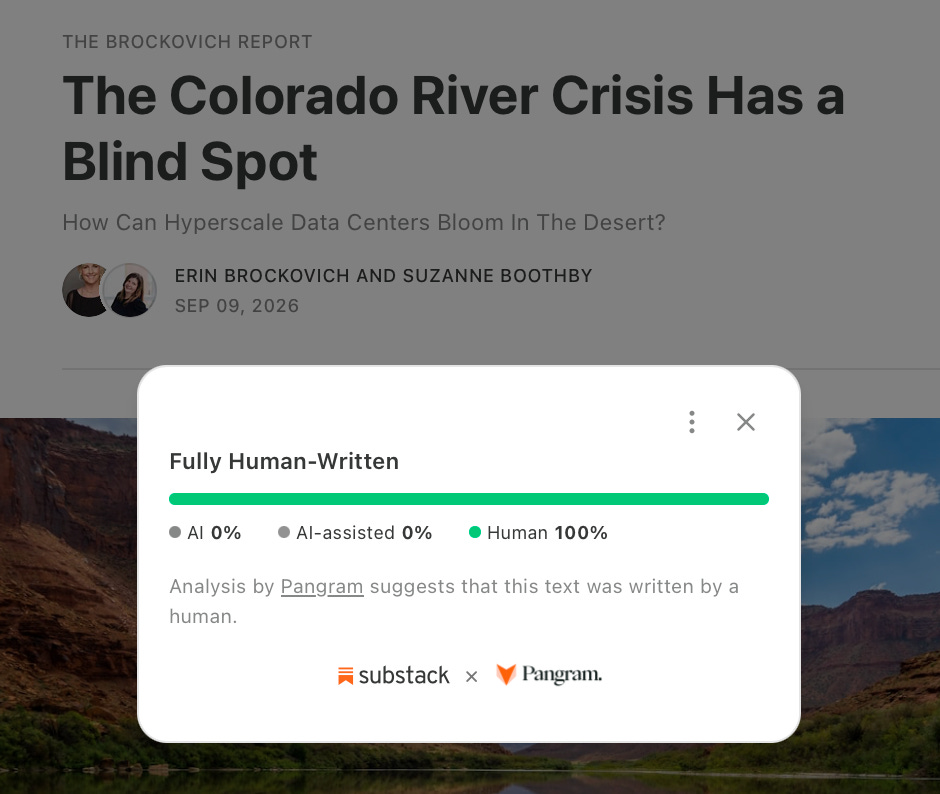
Update on Monday, September 14, 2026:
Following the publication of this article, Erin Brockovich and her co-author Suzanne Boothby published their next article on September 9 without disabling Pangram and presenting a 100% human-written score.
SEPTEMBER 20 UPDATE:
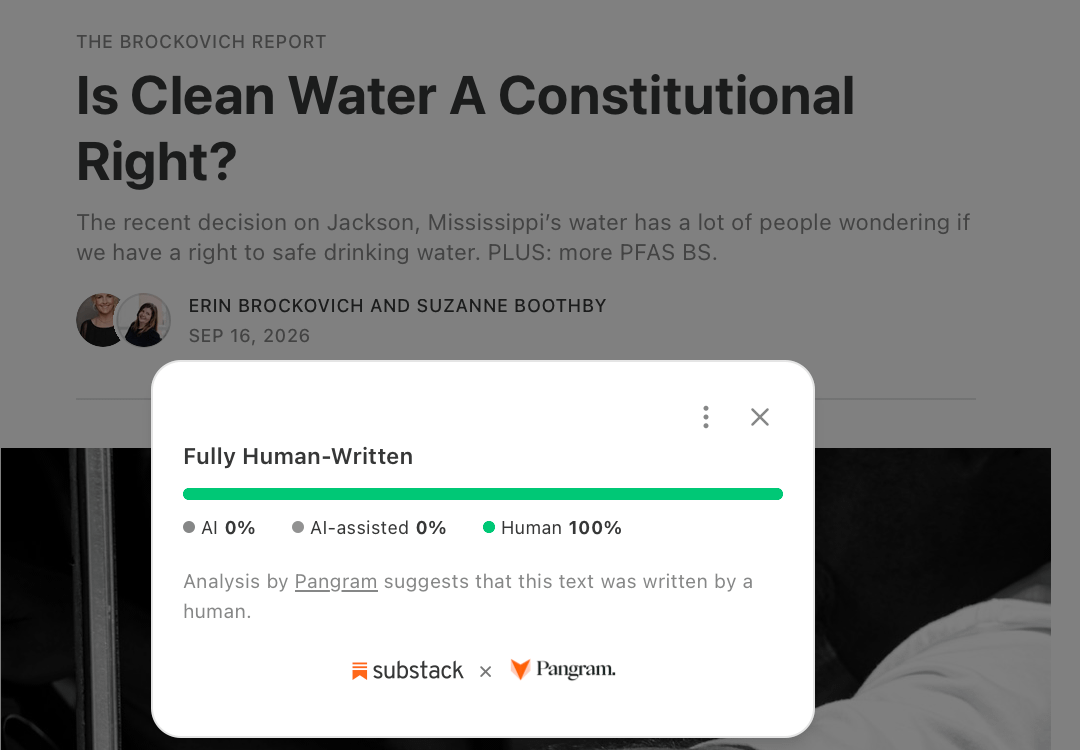
Excellent. All pieces published following this article have had Pangram enabled — and both came back 100% human-written too.
Thus, Brockovich and Boothby will not appear on the Wall of Shame, the first on the list to now escape.
7. David Pakman
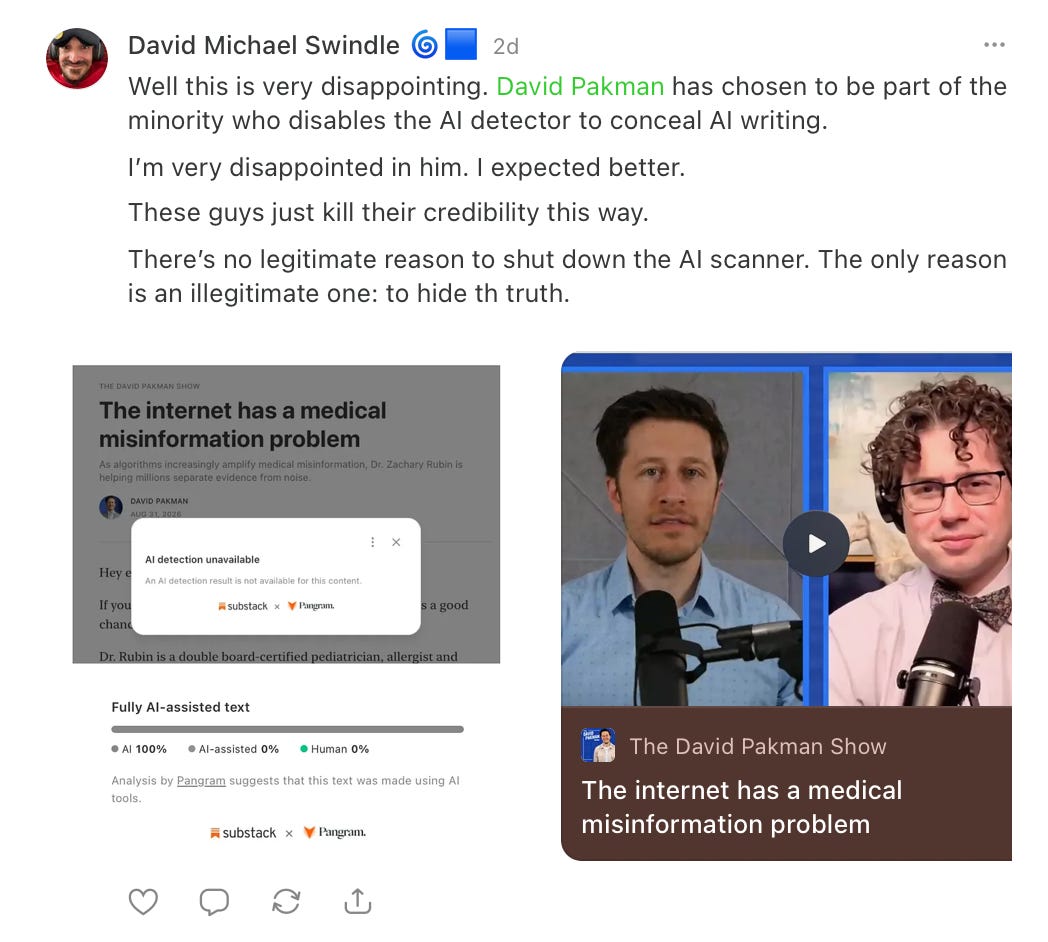
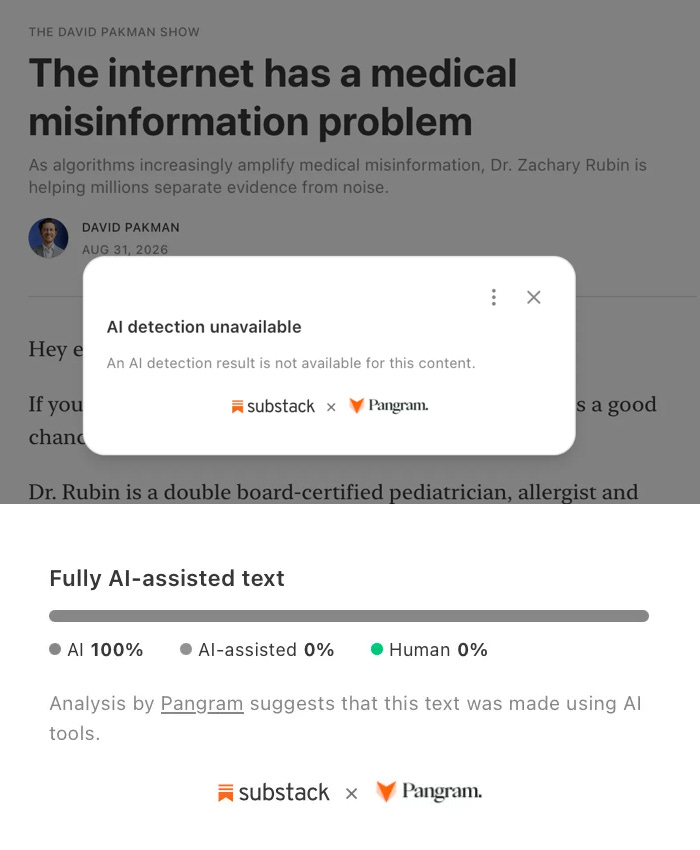
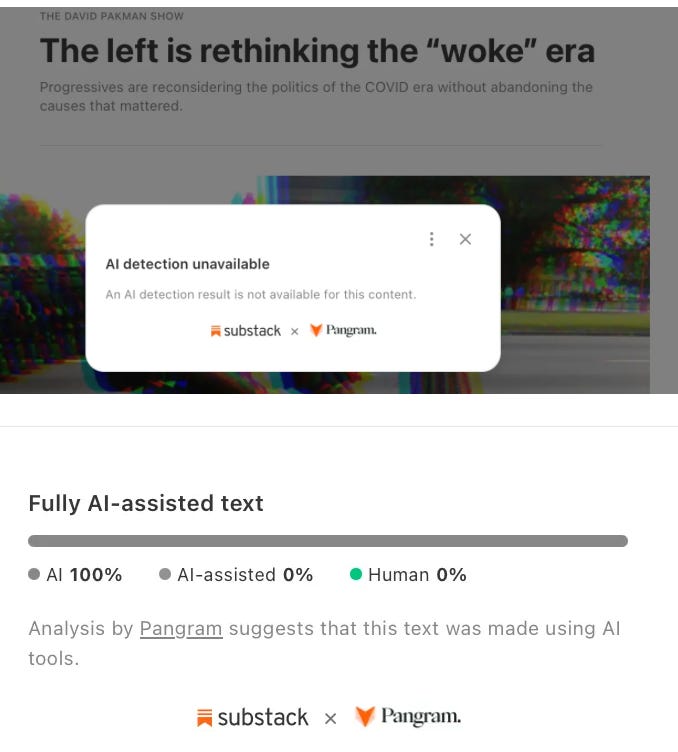
I was really bummed with having to add David Pakman to the list. I’ve always enjoyed watching his show. This is a hit to his credibility for me and I probably won’t watch him as much now.
SEPTEMBER 20 UPDATE:
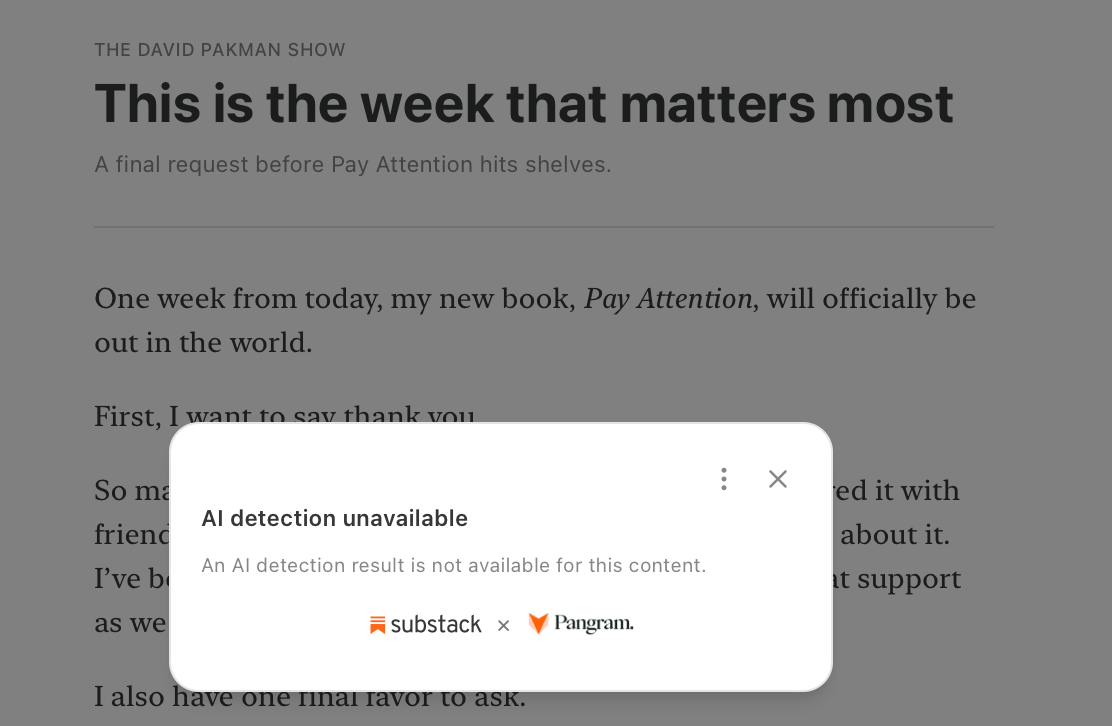
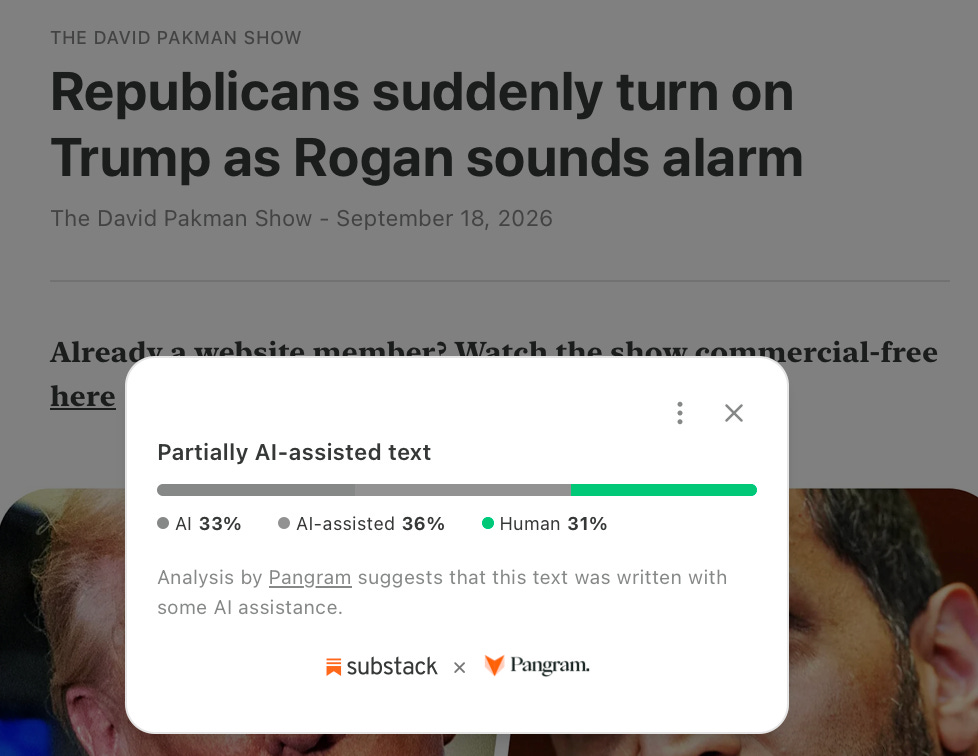

Unfortunately, Mr. Pakman will remain on the Wall of Shame until I receive positive confirmation of his intent to cease disabling Pangram.
8. Hunter Biden
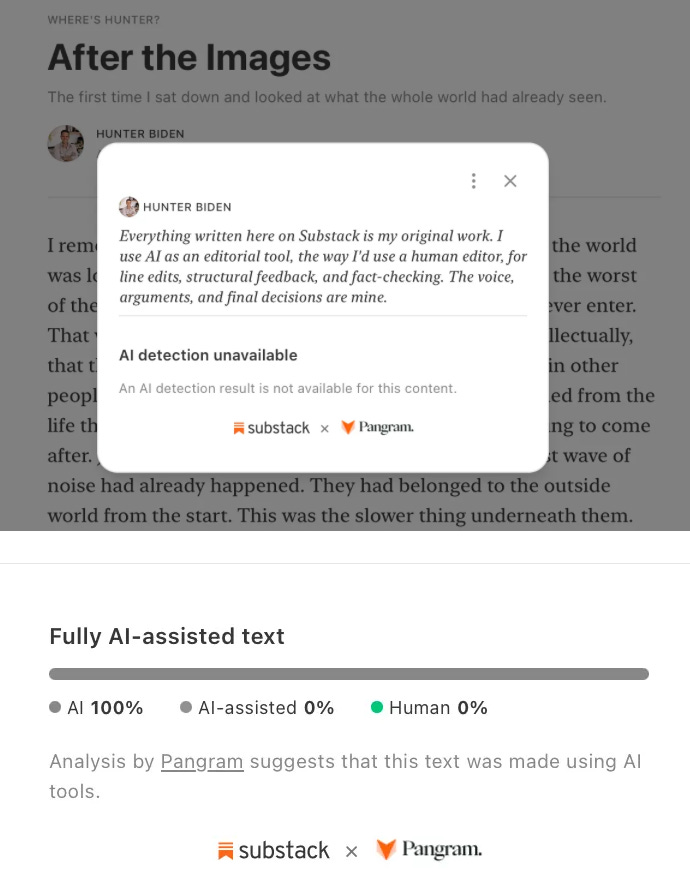
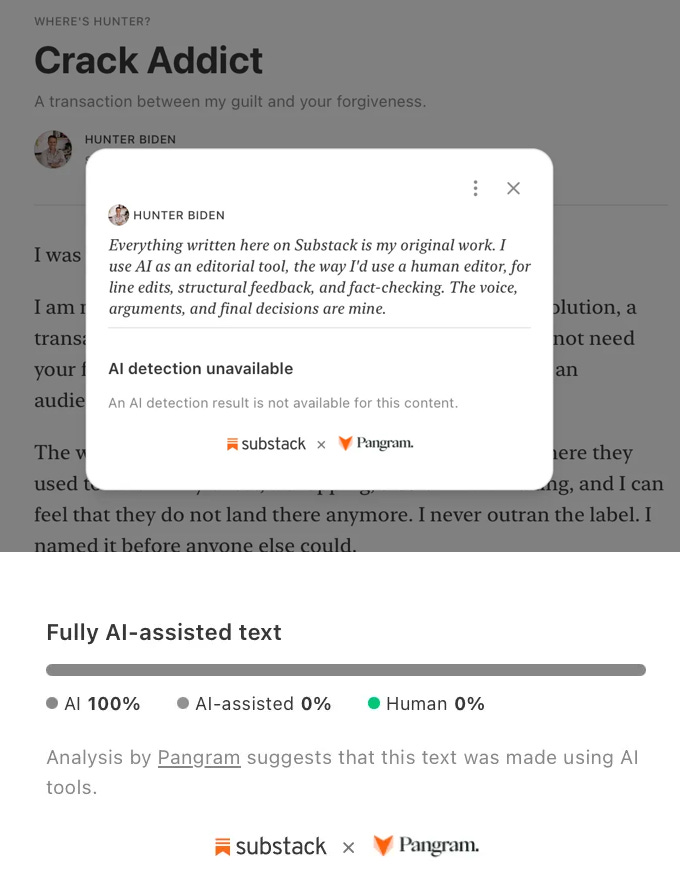
All of these years, I have steadfastly avoided writing about Hunter Biden, publicly at least. In private, on rightwing list-servs and behind-the-scenes calls at nonprofits, I was clear and often as strident as I am publicly on other topics: all the “discourse” around him is a manufactured distraction and a waste of time. It always has been. All the time the Right spent obsessing over Hunter was time wasted that should have gone toward actual threats to America.
Hunter is one of the great tragic figures of American history. That is how he wil be remembered in the generations after his death. It just breaks my heart to think about him and watch him debase himself even further given how desperate for money he is now, as we all seemingly are. His appearance on the list simply signifies that.
SEPTEMBER 20 UPDATE:
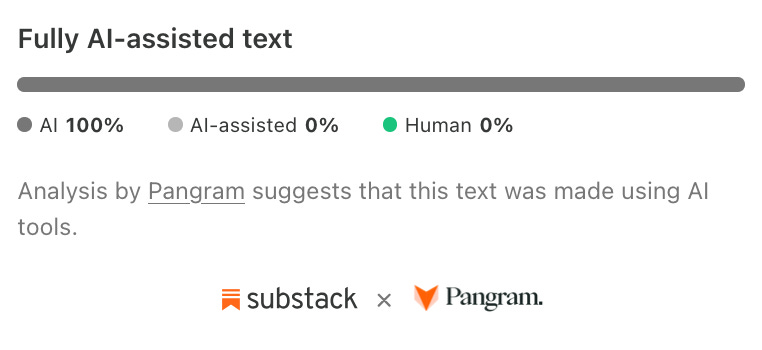
Hunter’s most recent piece is a paid one, so only the excerpt is scannable and it comes back as:
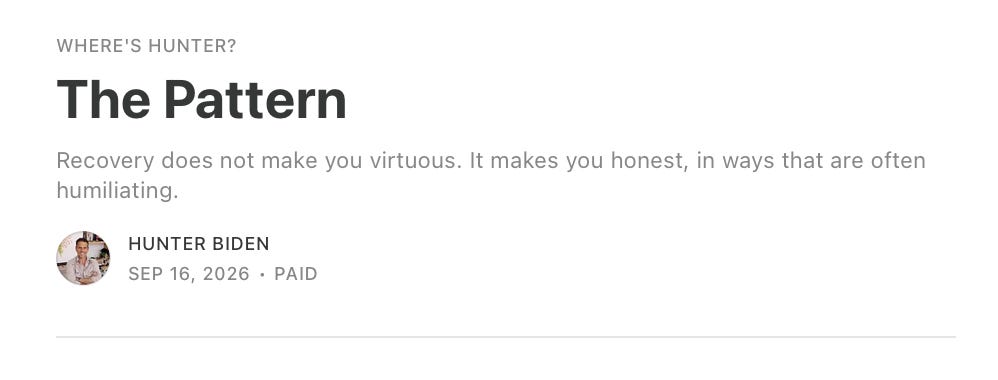
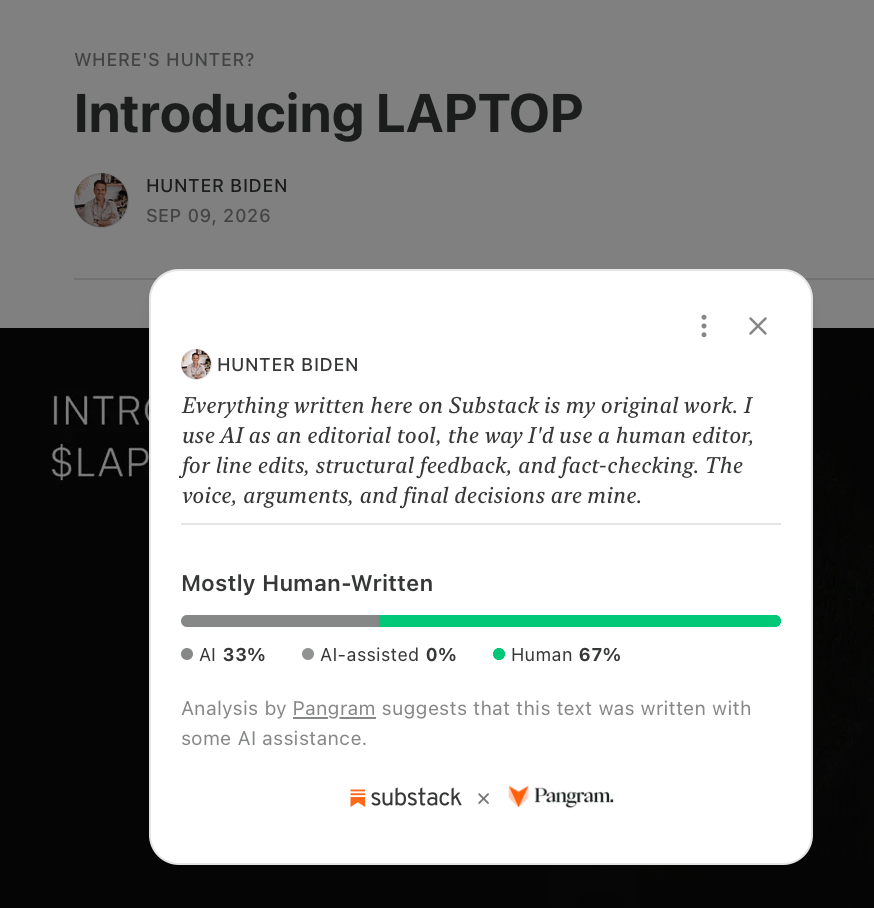
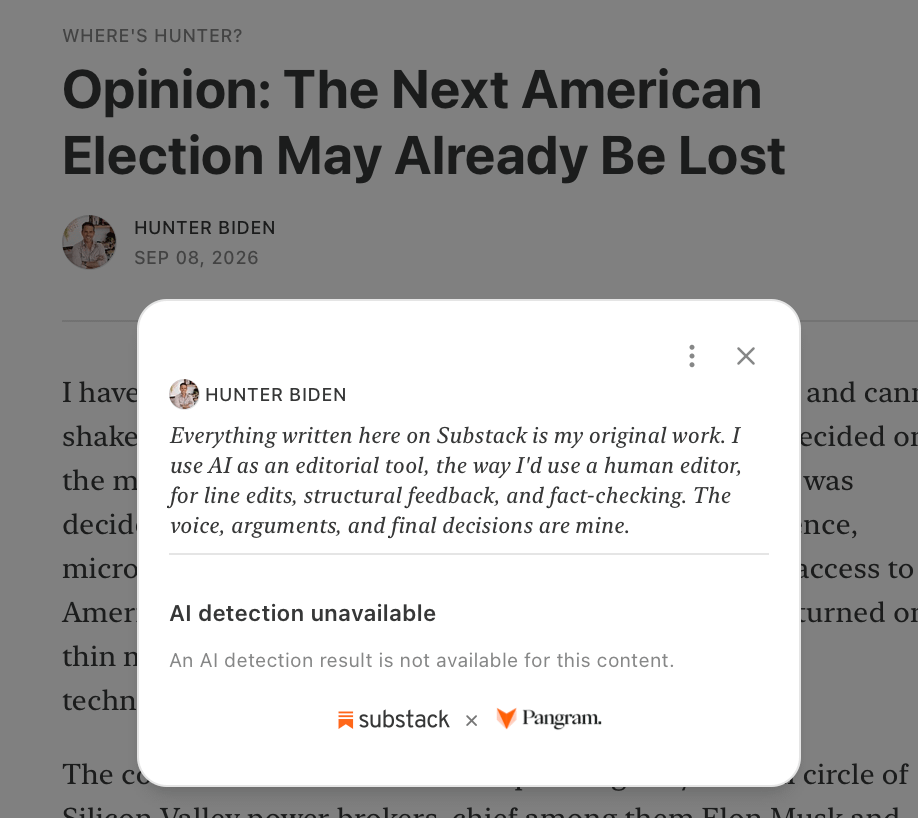
This is the first piece I’ve seen of his where Pangram was enabled, interstingly two days after this article was first published:
9. Christopher Hale



I’ve really enjoyed Christopher Hale’s writing a lot. This was disappointing to see.
However, in a way it reflects too what I had come to see from Christopher’s Substack, that it had gradually become more and more of a partisan publication rather than a religious one. I’d signed up for a Substack with a Pope focus and it gradually devolved into any other left-wing, anti-Trump venue.
SEPTEMBER 20 UPDATE:
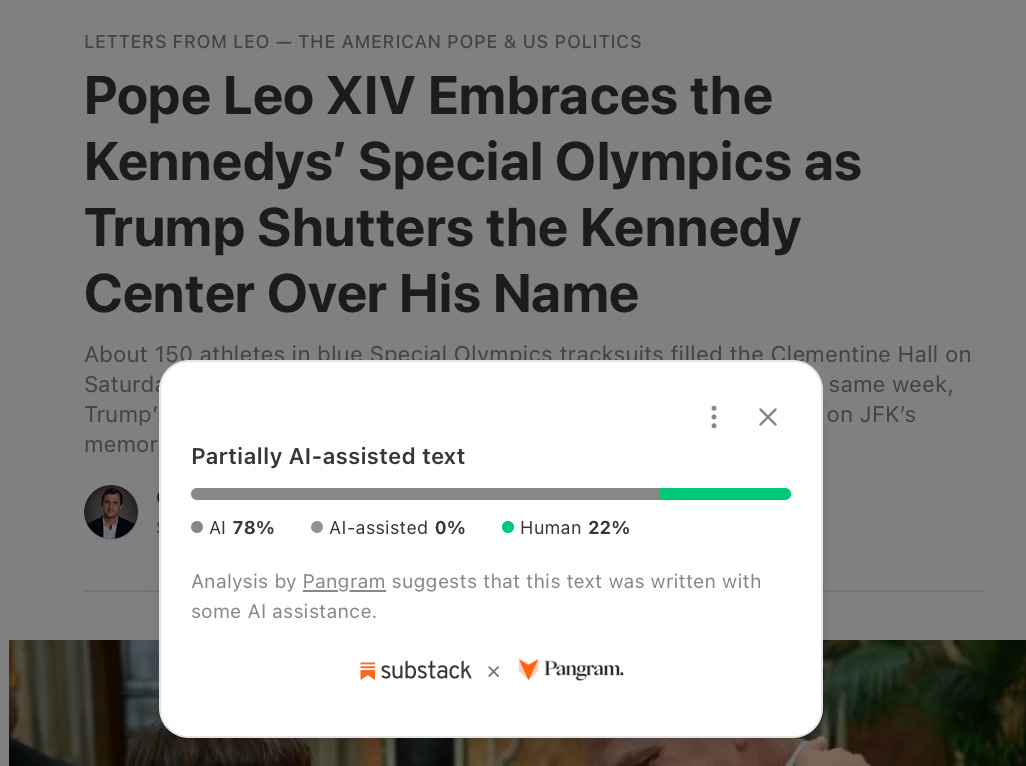


I’m so disappointed that I have to include you on the Wall of Shame, Christopher. Please contact me when you decide to enable Pangram consistently so I can remove you.
10. Mike Nellis
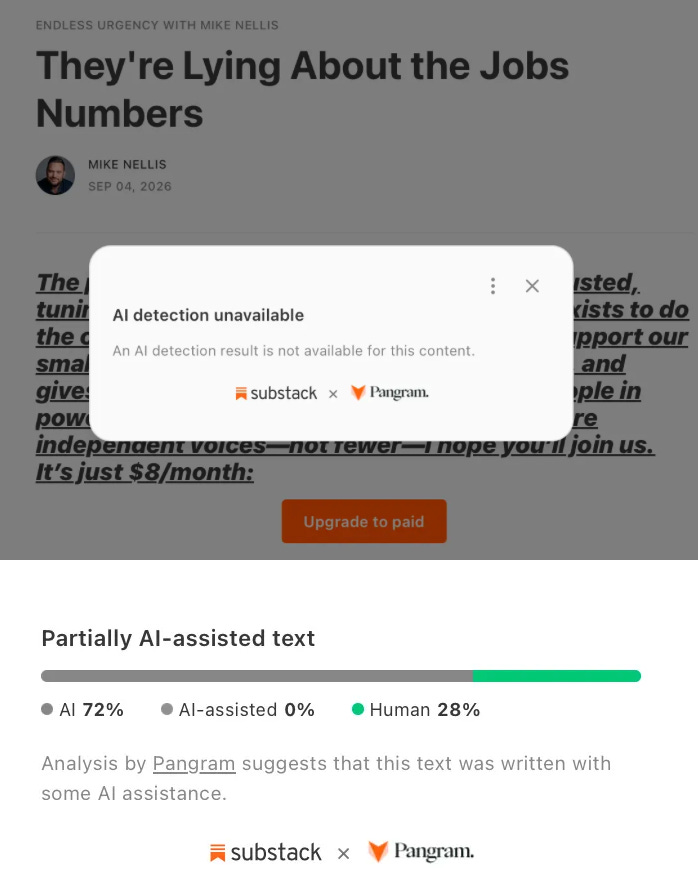
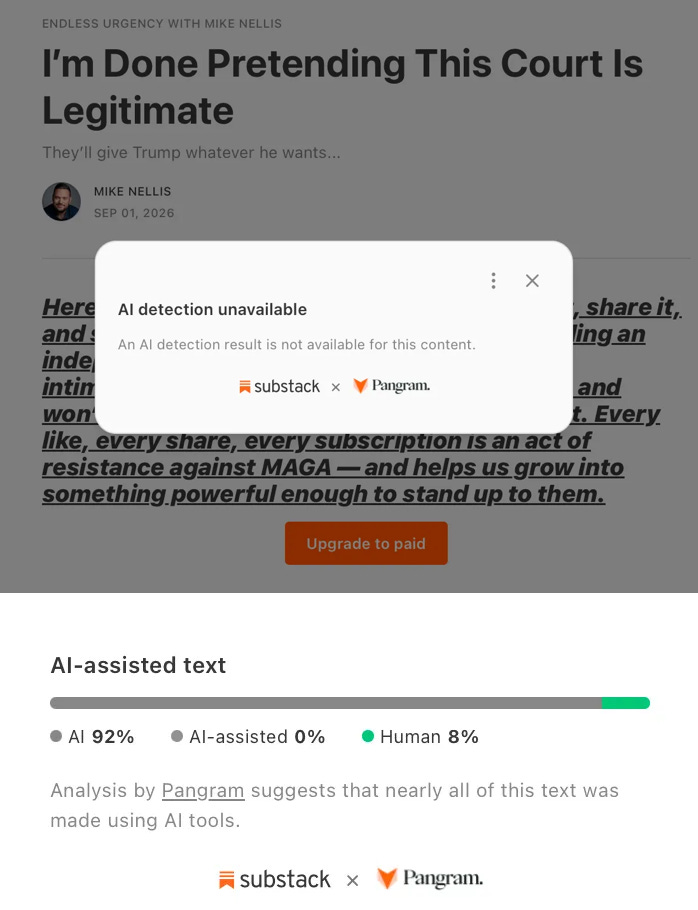
I was not familiar with Mike Nellis’s work until the search began for popular top sellers to audit. It would appear that few of his readers are familiar with it either.
SEPTEMBER 20 UPDATE:
The Pangram disabling continues, so Mike will remain on the list.
11. Andrew Springer

Andrew Springer and I had tangled months ago long before Pangram dropped out of the sky to bring Justice and Deliverance to We Who Drown in the Slop Sea.
His Substack is “the Jesus Movement” and mine is “God of the Desert Digital Media Studios” so of course we were bound to collide. While I initially appreciated his critiques of Evangelical theology, soon it became clear that his own views about Jesus were even worse. Socialism is his true religion and he has dedicated his Substack to arguing that Jesus was a first century Bernie Sanders. It’s so dumb because it is so easily refuted. All I had to do was point out that Andrew’s beloved author who has debunked Evangelical Christianity for decades, Bart Ehrman, disagrees with that framing of Jesus, long arguing that “apocalyptic prophet” is the more accurate frame, as described here:
But is it even necessary to take the time to explain why Andrew’s left-wing caricature of Jesus is wrong when the screenshots prove he does not believe the ideas enough to argue them himself?
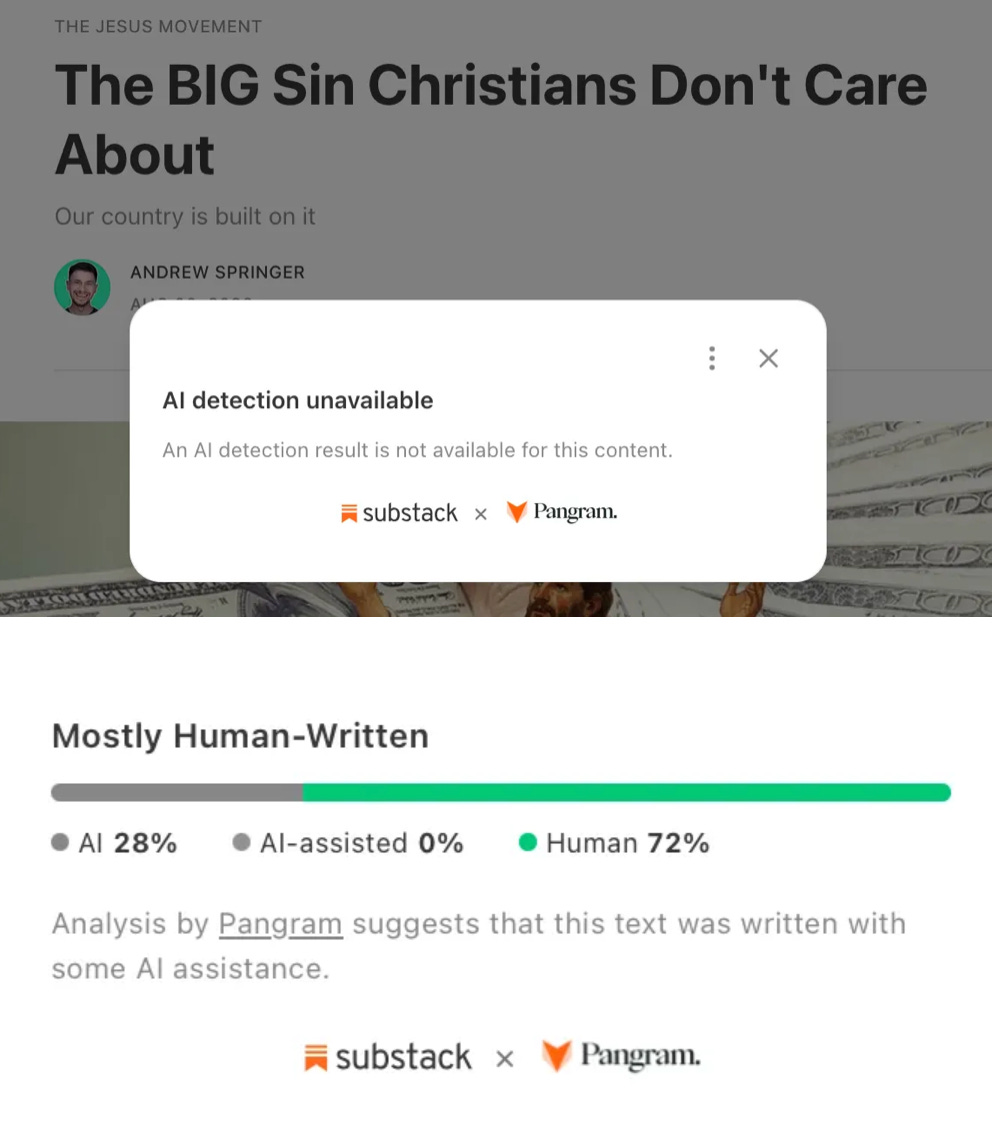
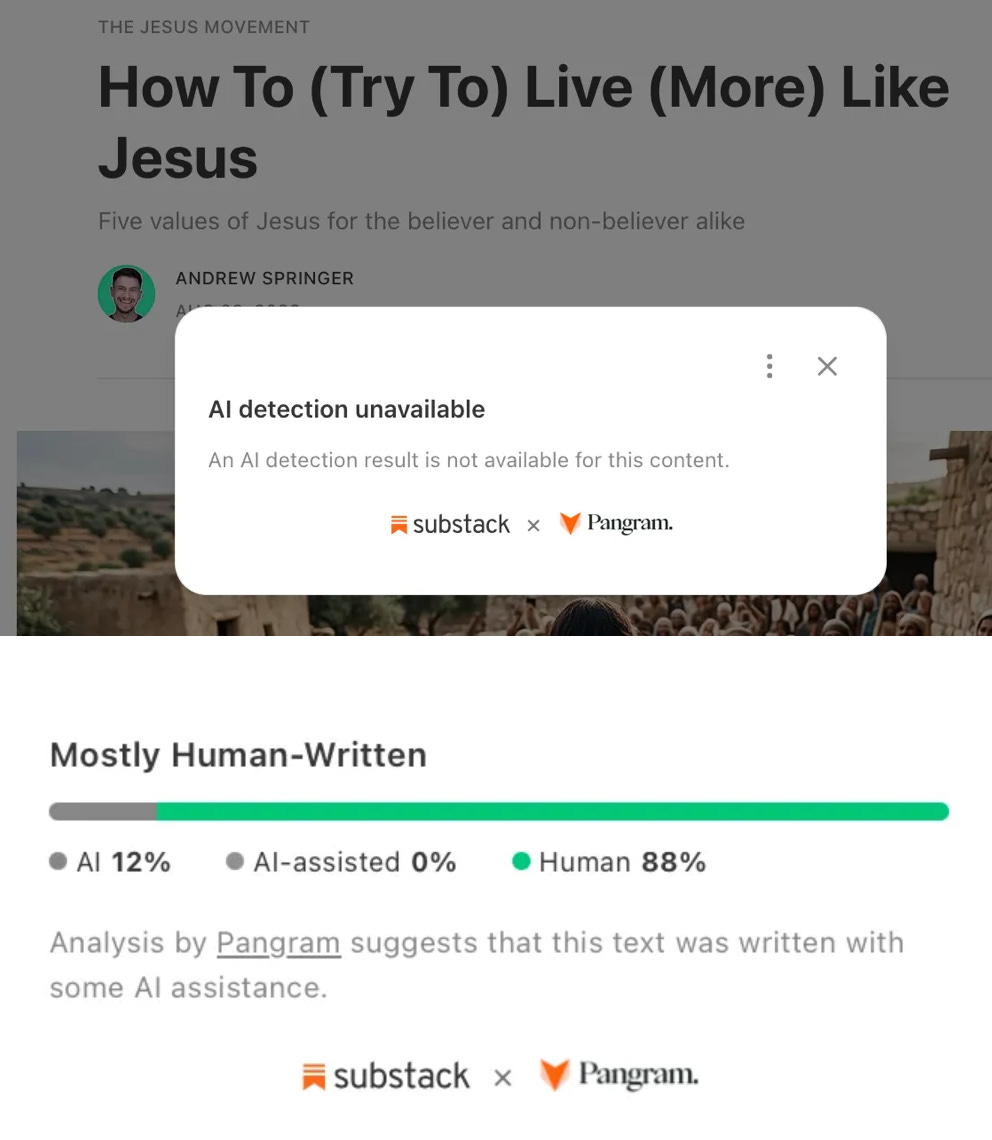
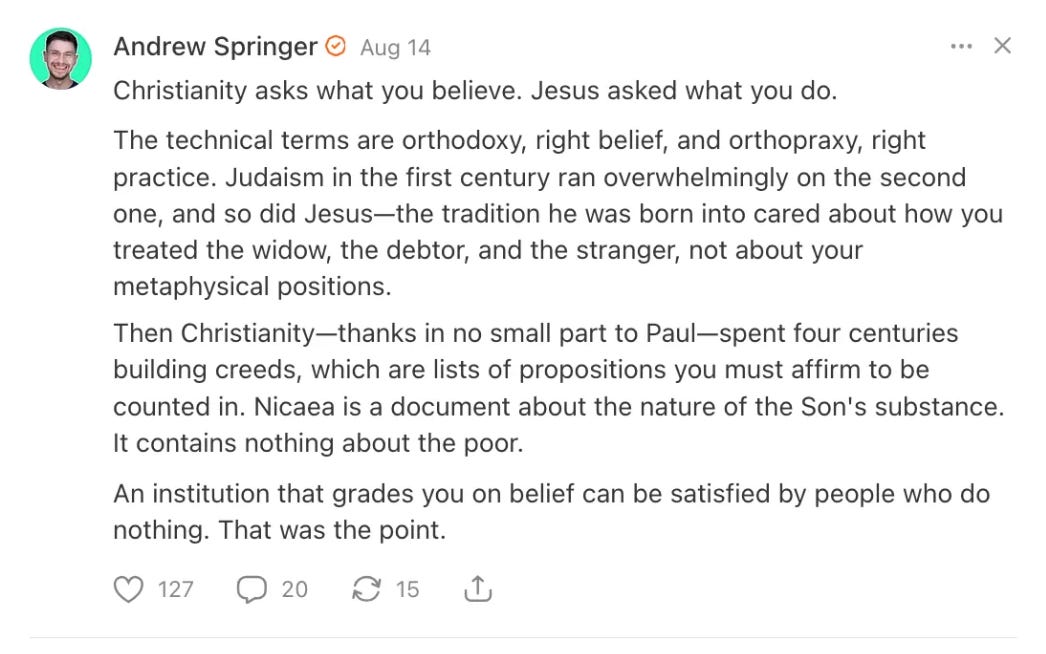
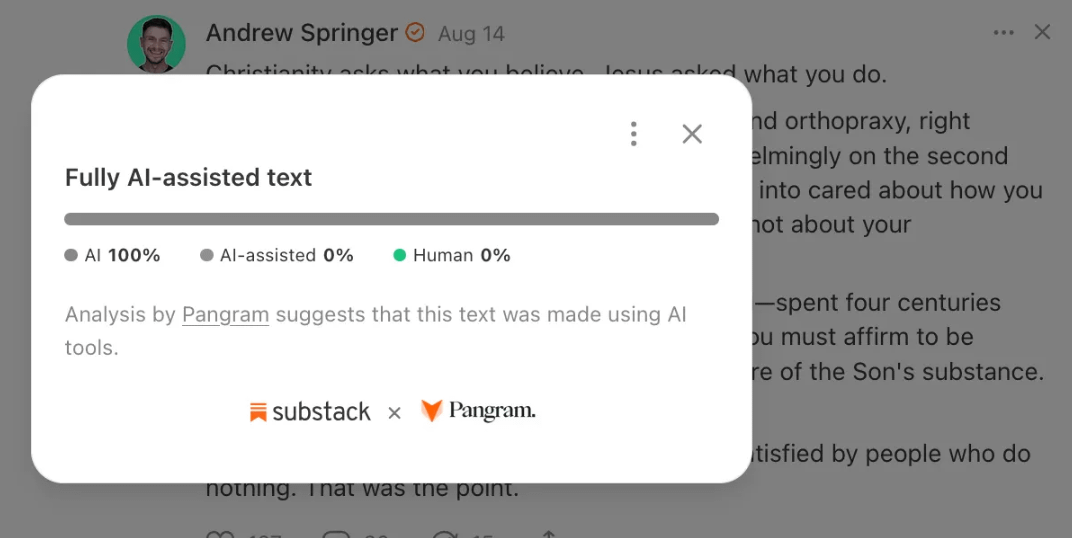
I used to be very angry with Andrew for what he was doing with lying aboug Jesus and blocking me over something as banal as pointing out that Ehrman disagreed with him.
I find it deeply offensive when people on right or left want to create a caricature of Jesus to suggest he would support their pet political projects. I’ve heard that lie since the Clinton presidency.
However, now having read his earlier writings which explain what inspired him to launch this ill-conceived “The Jesus Movement,” I more just feel sorry for him. One does not need to dig too deep to understand why he’s so unhappy.
SEPTEMBER 20 UPDATE:
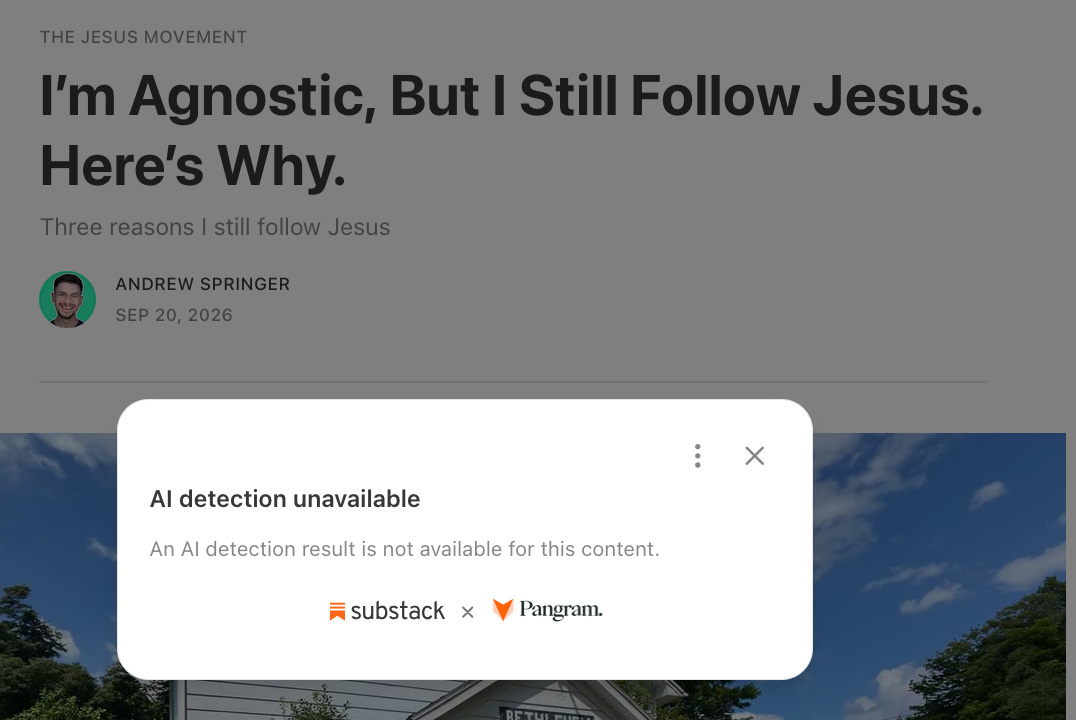
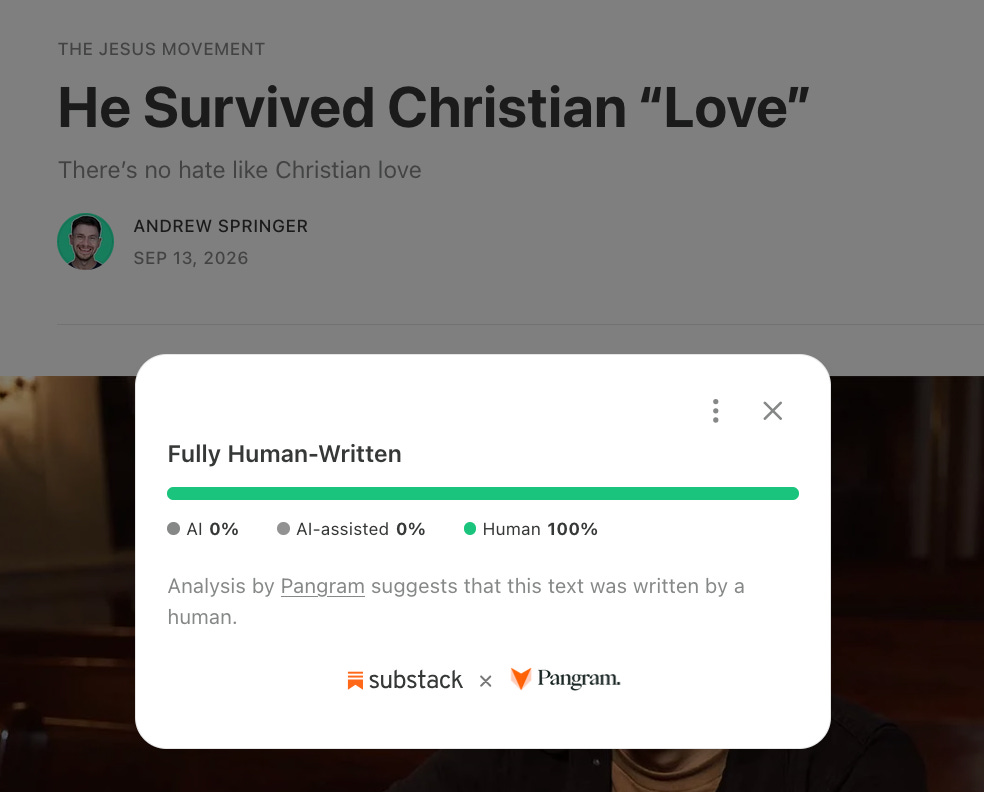
This one he was happy to show off as human-written:
12. Jermaine Fowler
I came across Jermaine Fowler’s substack because of his high ranking in the history category:
Reviewing his content, he does a kind of left-wing history spin of things, which is fine:
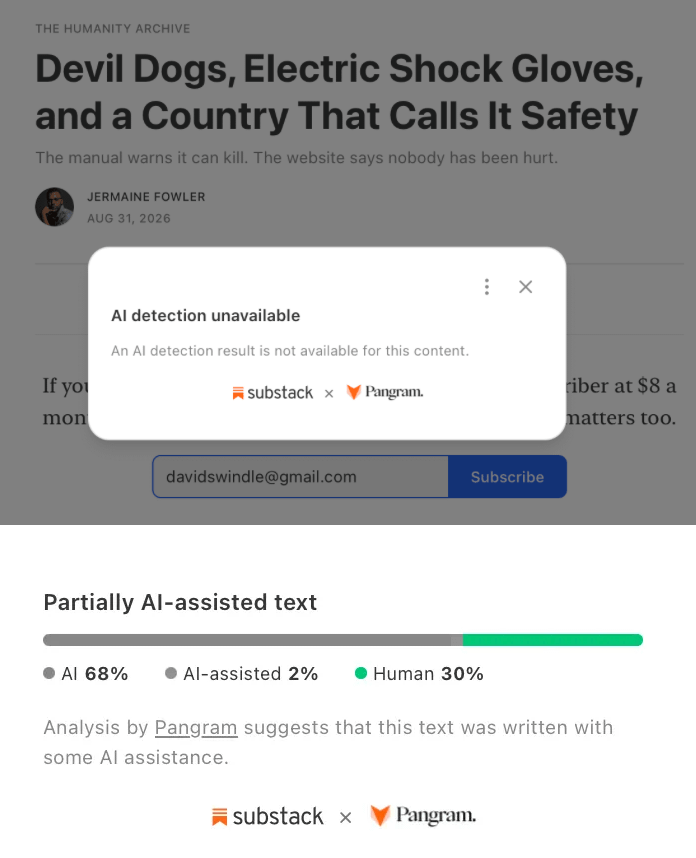
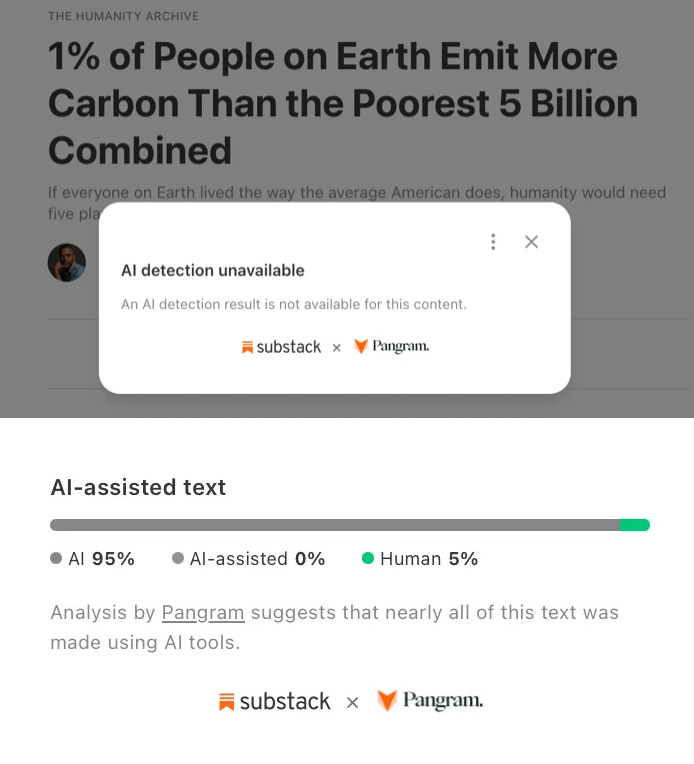
SEPTEMBER 20 UPDATE:
He’s still at it:

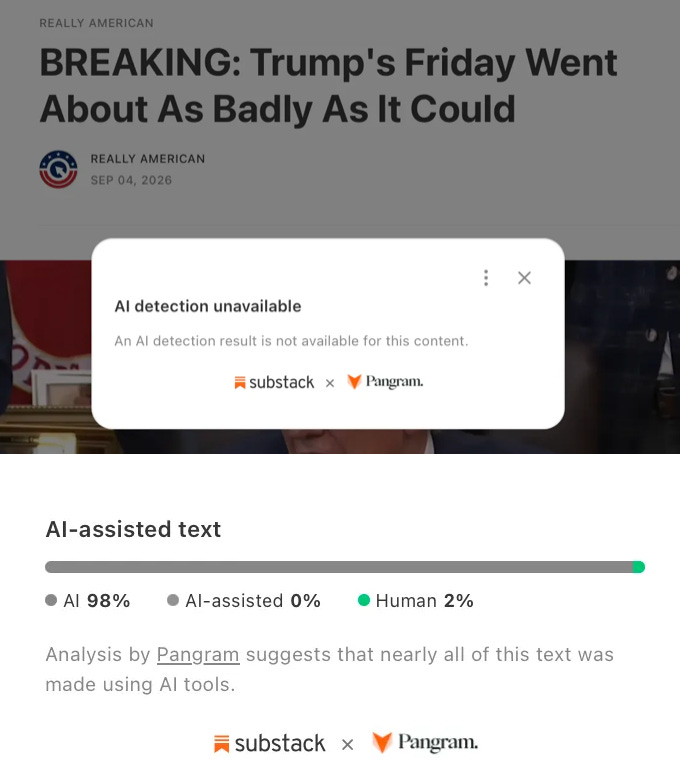
This phenomena of hiding the Pangram score is also used by publications rather than individuals as the next items on the list show.
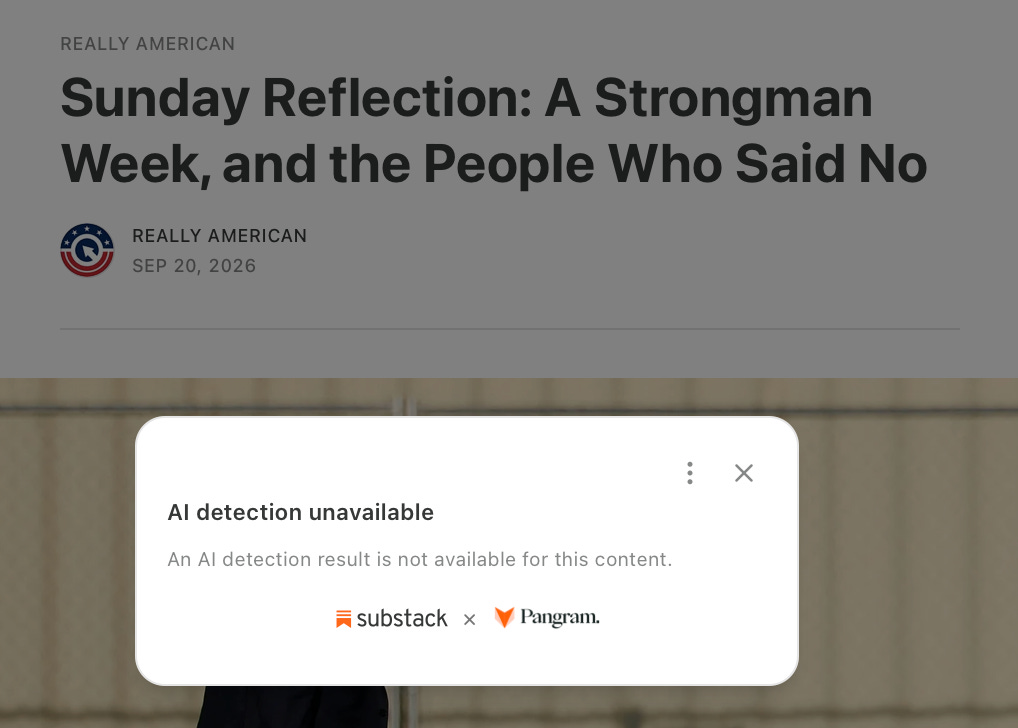
13. Really American


SEPTEMBER 20 UPDATE:
Nope:
14. Raw America
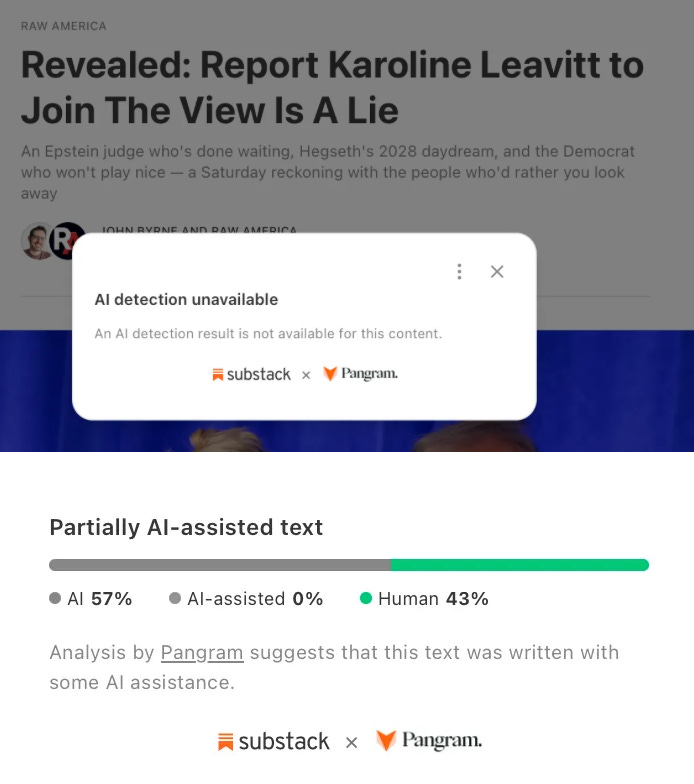
SEPTEMBER 20 UPDATE:
Encouraging:
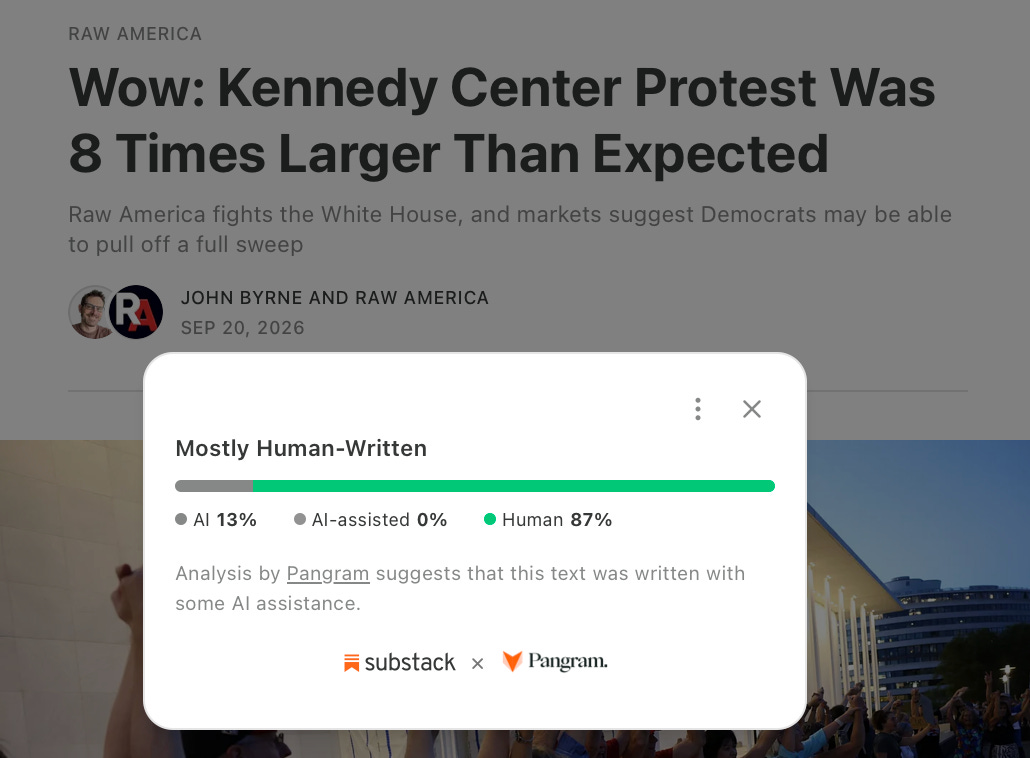
Also encouraging:
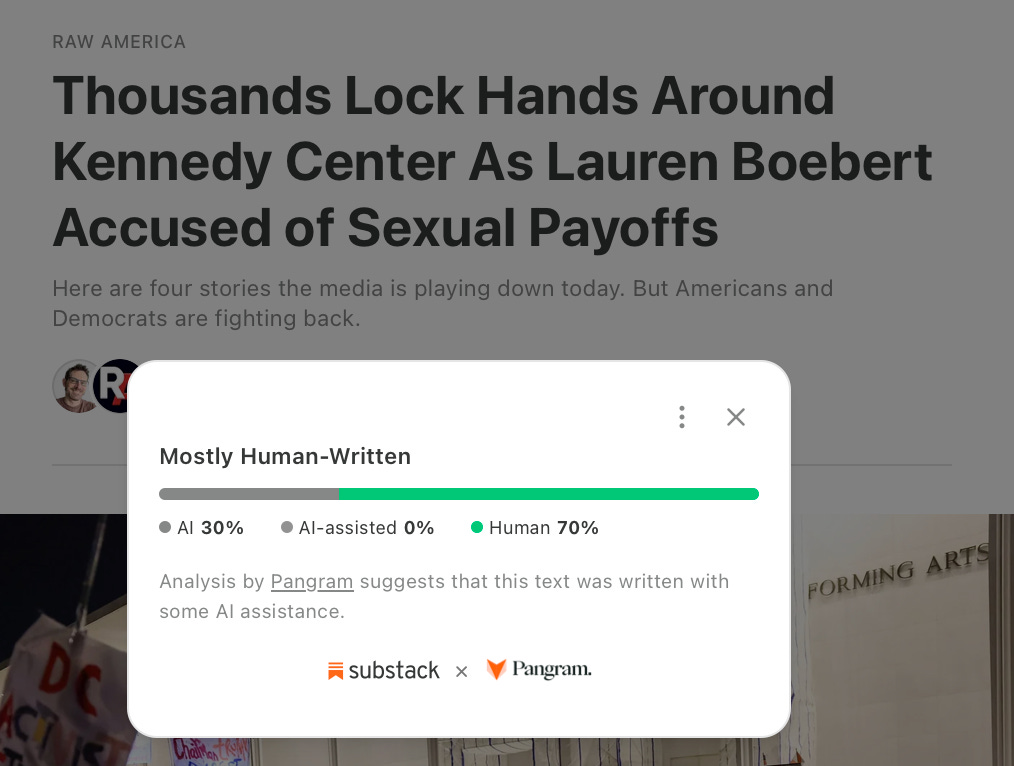
Well, how about that?
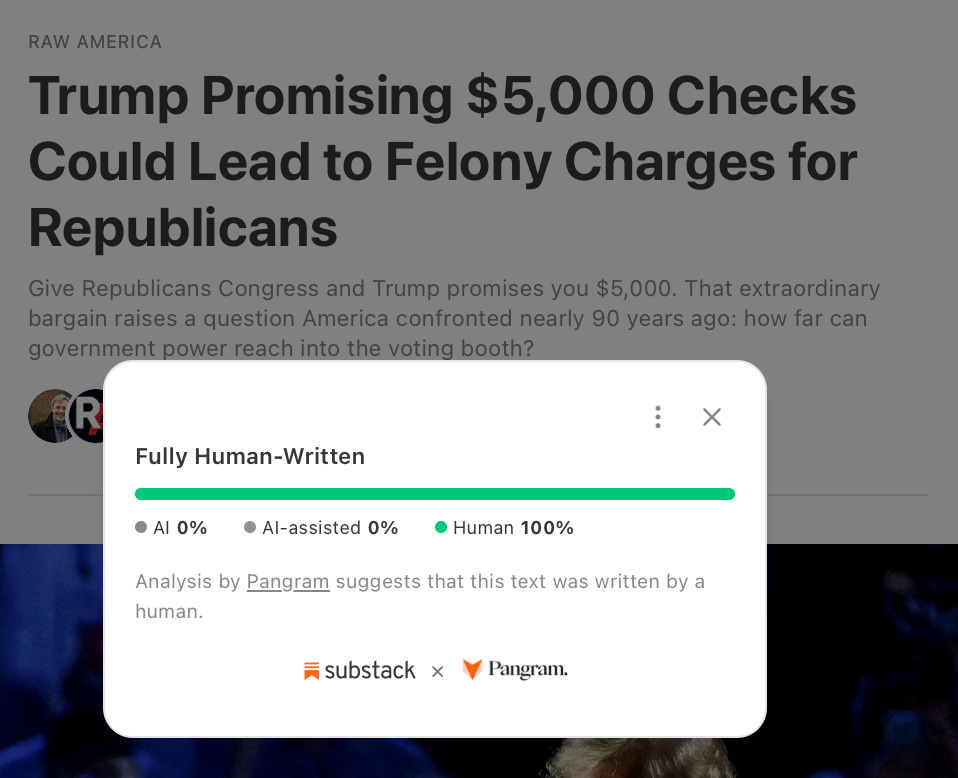
There we go:
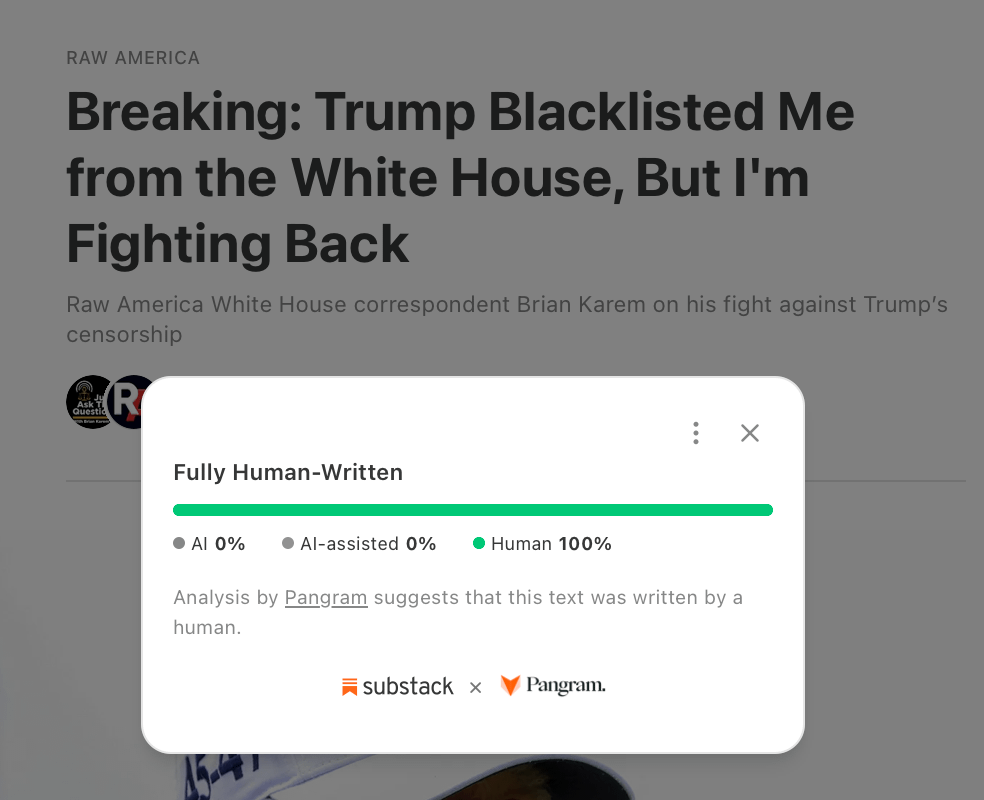
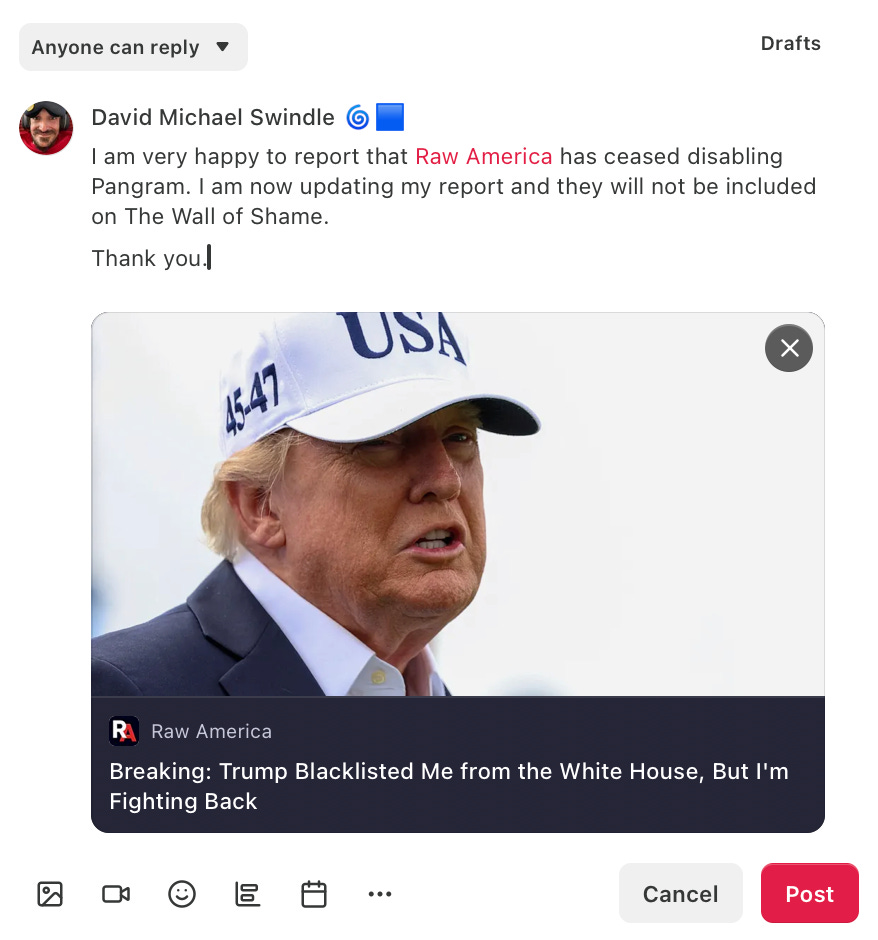
Well this is wonderful and more than satisfies me. The last five posts all have Pangram enabled and several show 100% human authorship. Congratulations Raw America, as with Erin Brockovich, you too now escape The Wall of Shame.
15. Democratic Wins Media
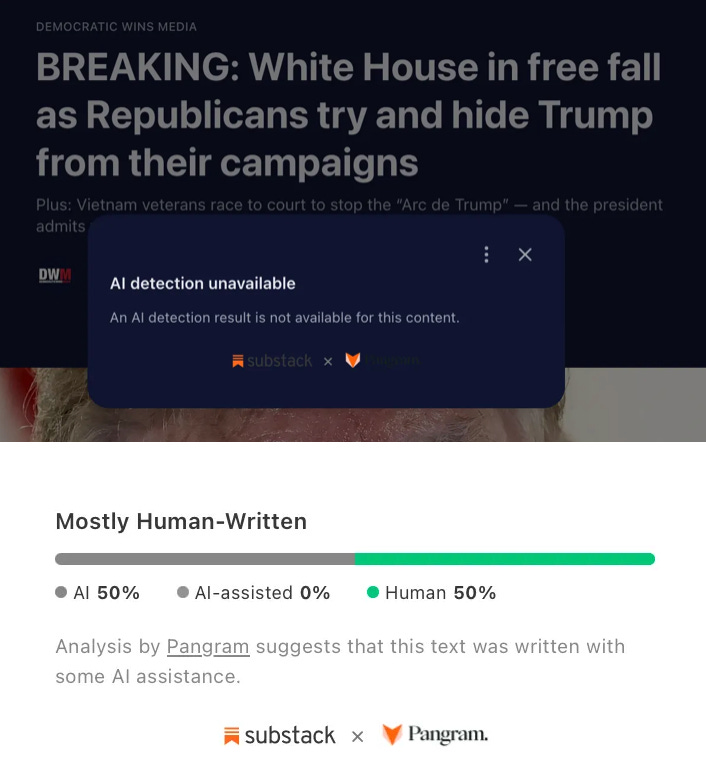
I think the main reason why I did not come across comparable right-wing Substacks like those is because that’s what virtually all of X is.
SEPTEMBER 20 UPDATE:
Still no action:

They must be so thrilled that their company name has never been more appropriate than now.
16. I Fucking Love Australia
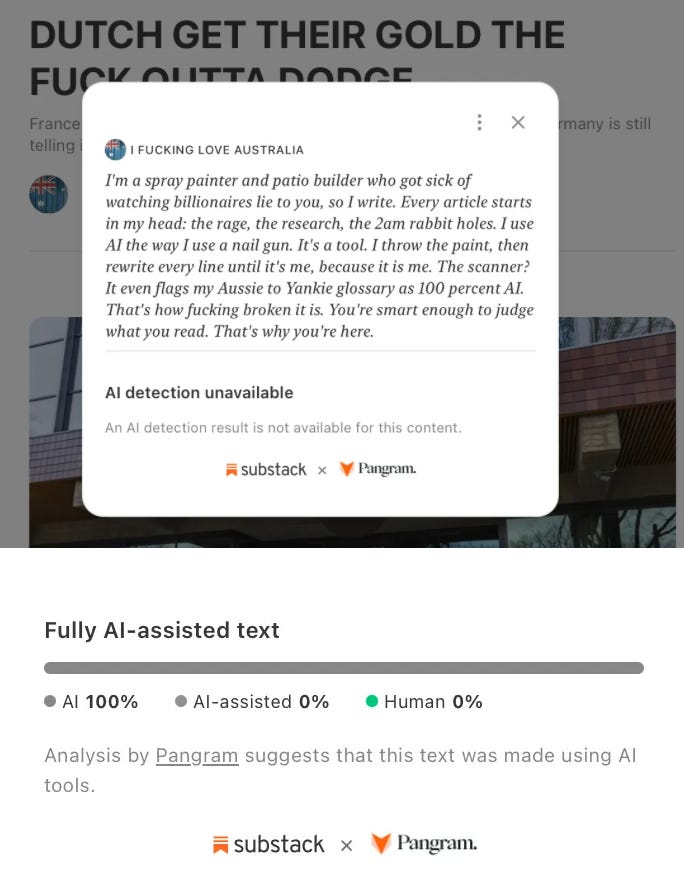
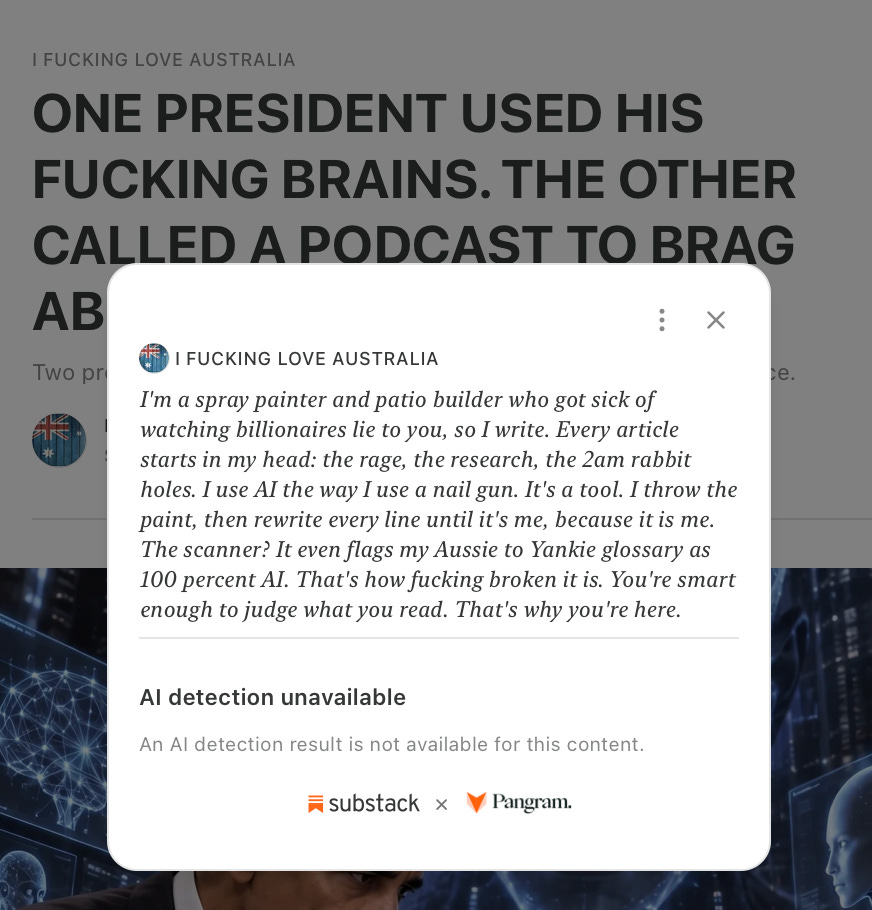
This I Fucking Love Australia guy is obviously Ausralian-branded but for whatever reason — I suppose he is entertaining at times — he has managed to worm his way into U.S. Politics substacks circles. His focus on blasting Trump has probably been most of what’s done it. Yell loudly against Trump and left-wing people will gather.
His act became much less impressive once it became clear how much of it was AI-generated:
The last writer in this section of the audit is funniest of all because after I asked why she disabled Pangram she volunteered what the scan number was which she had sought to hide. She then tried to justify herself before attacking.
SEPTEMBER 20 UPDATE:
This seems like a waste of my time to even bother to check:
17. Nikki Davidson - The Northern Watch

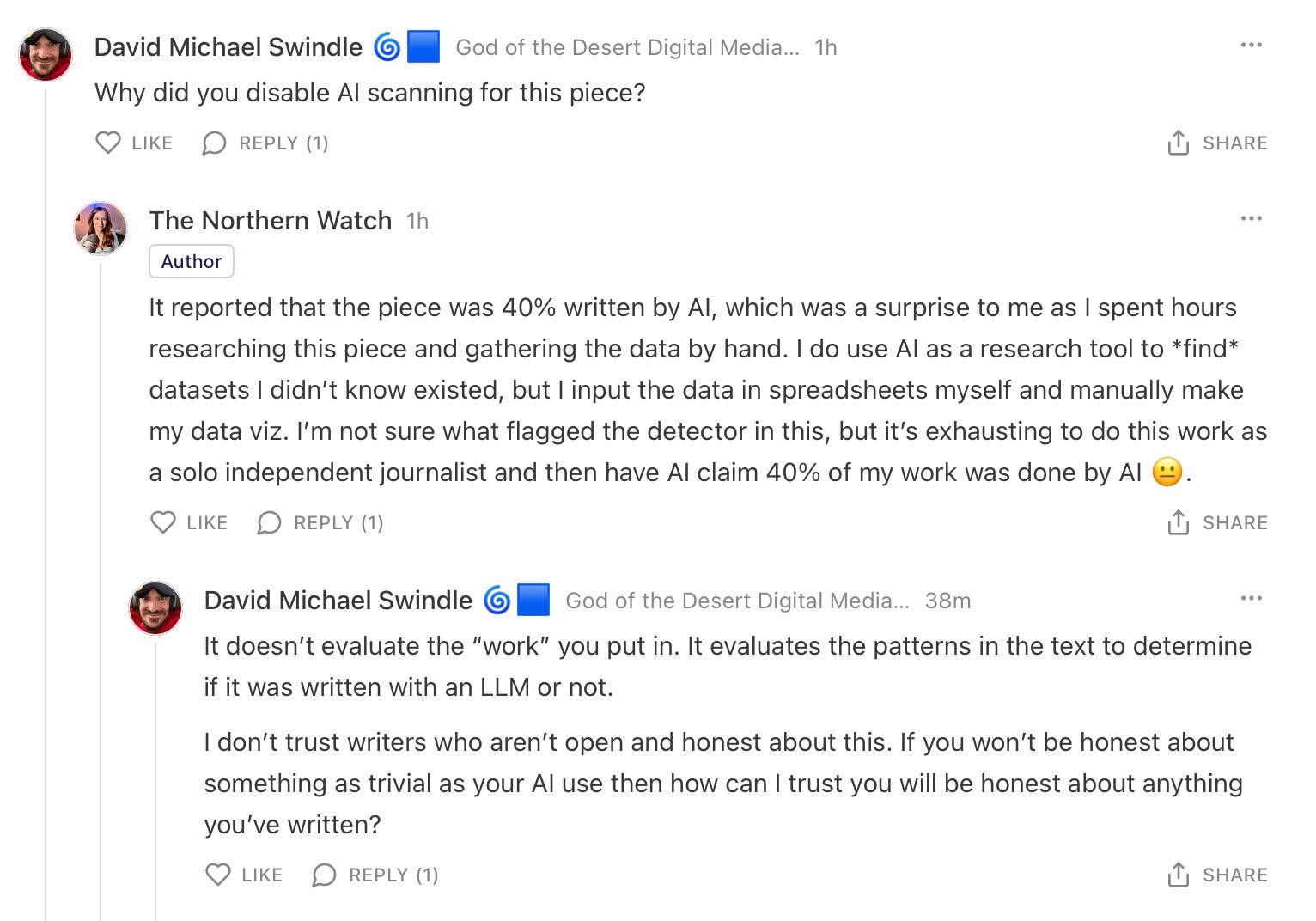
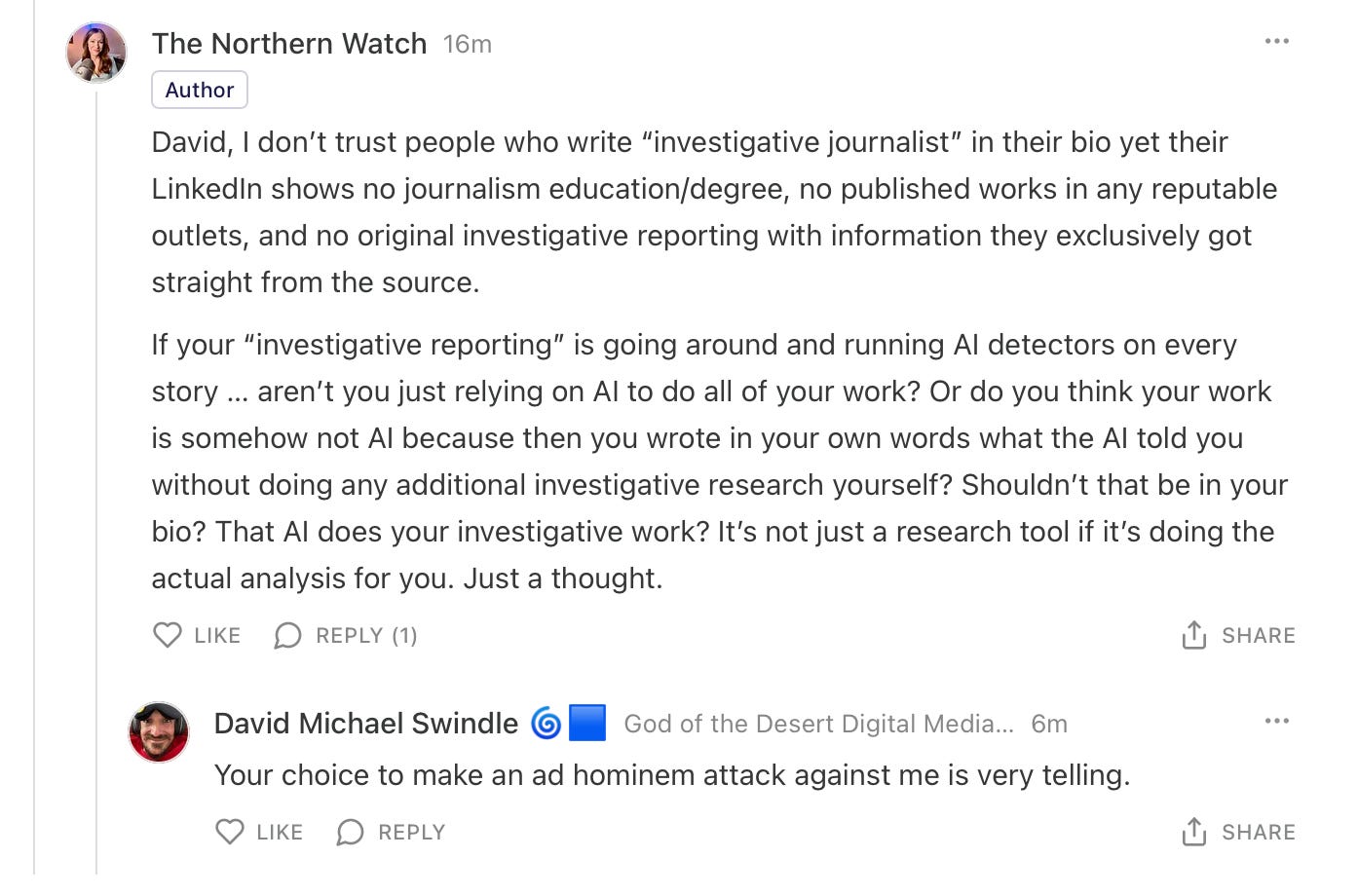
The Northern Watch, who I am and how professionally pathetic I am in comparison to your level of journalistic greatness means nothing. I could be a barely-literate, screen-addicted, high school newspaper student doing the experiment. The facts would still be the same:
You disabled Pangram to conceal a 40% AI score. When questioned on it, you sought to justify it and then you leveled a personal attack against me after a cursory scan of my LinkedIn page.
The facts speak for themselves. It does not matter that I write them in an absurd, unprofessional, MAXIMALIST style inspired by cartoons and excessive quantities of cannabis.
Update on Monday, September 14, 2026:
Nikki Davidson chose to remove my comments on her article and block me.
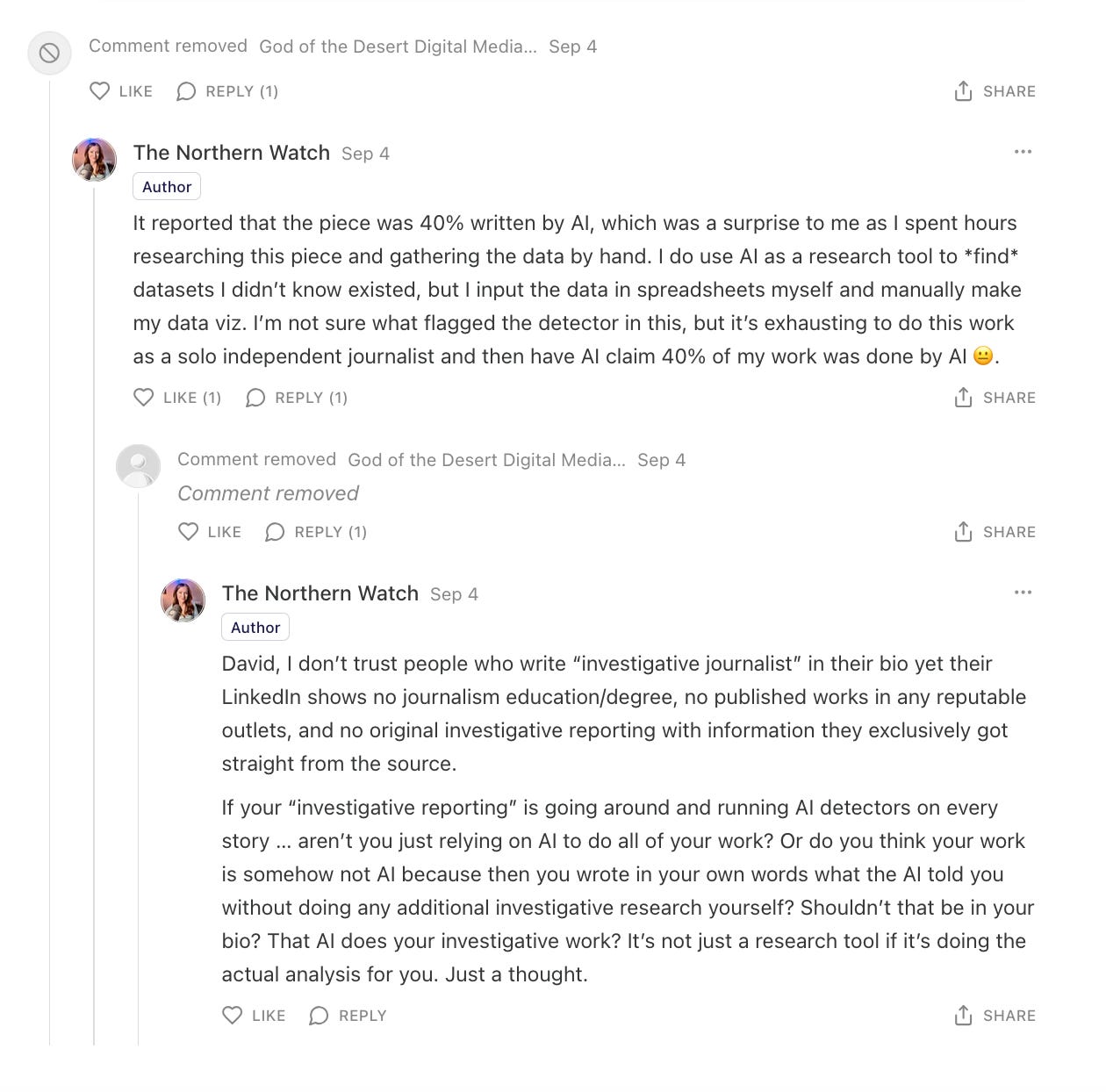

SEPTEMBER 20 UPDATE:
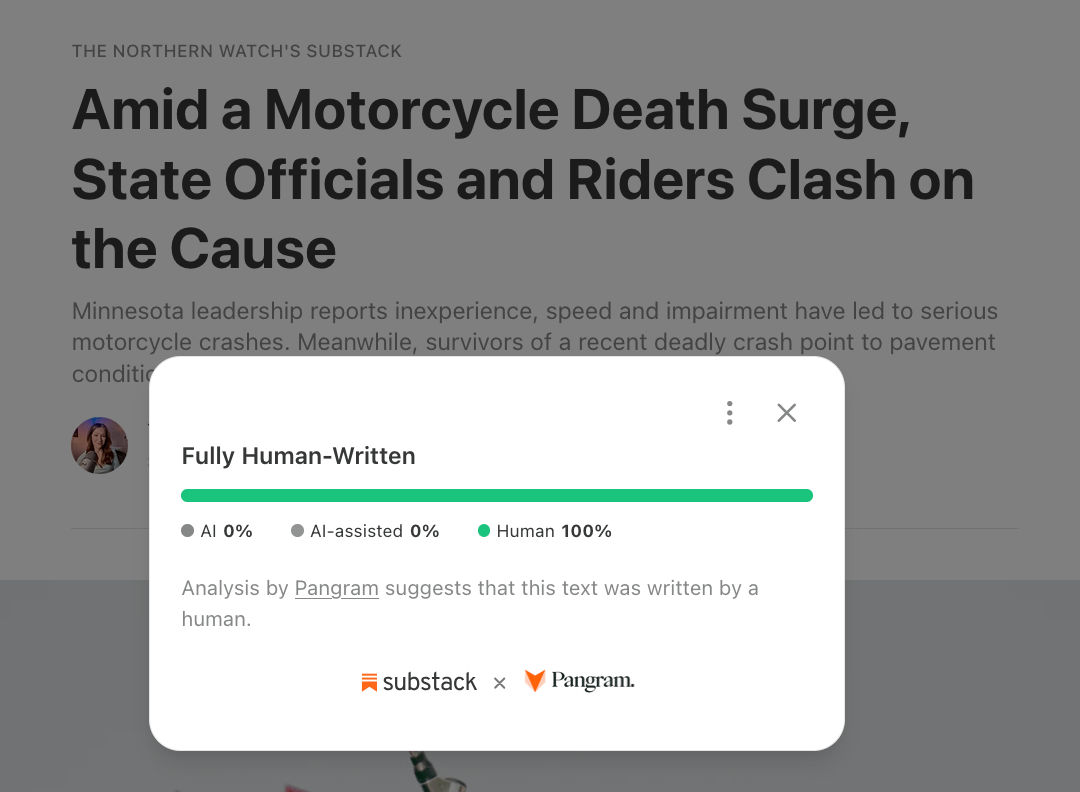
And now Nikki chooses to showcase her 100% human-written score.
I bet she’ll never disable Pangram again because of my calling her out on it. But it’s too late. She’s going on The Wall of Shame too.
Nikki, if you want to un-block me and affirm your intent to stop disabling Pangram, then I’d be happy to remove you from The Wall.
The Results of Auditing the Top 20 U.S. Politics Bestsellers:
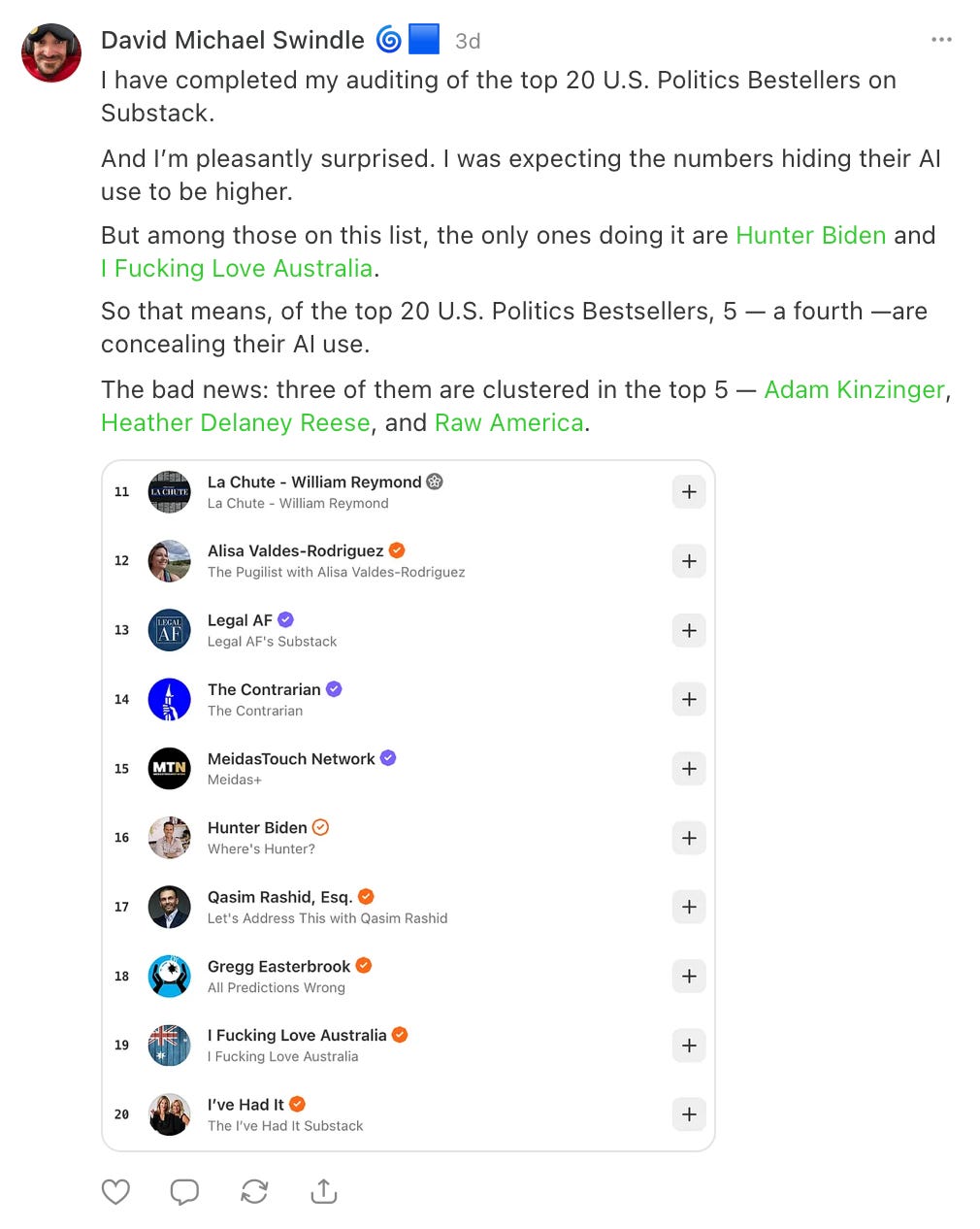
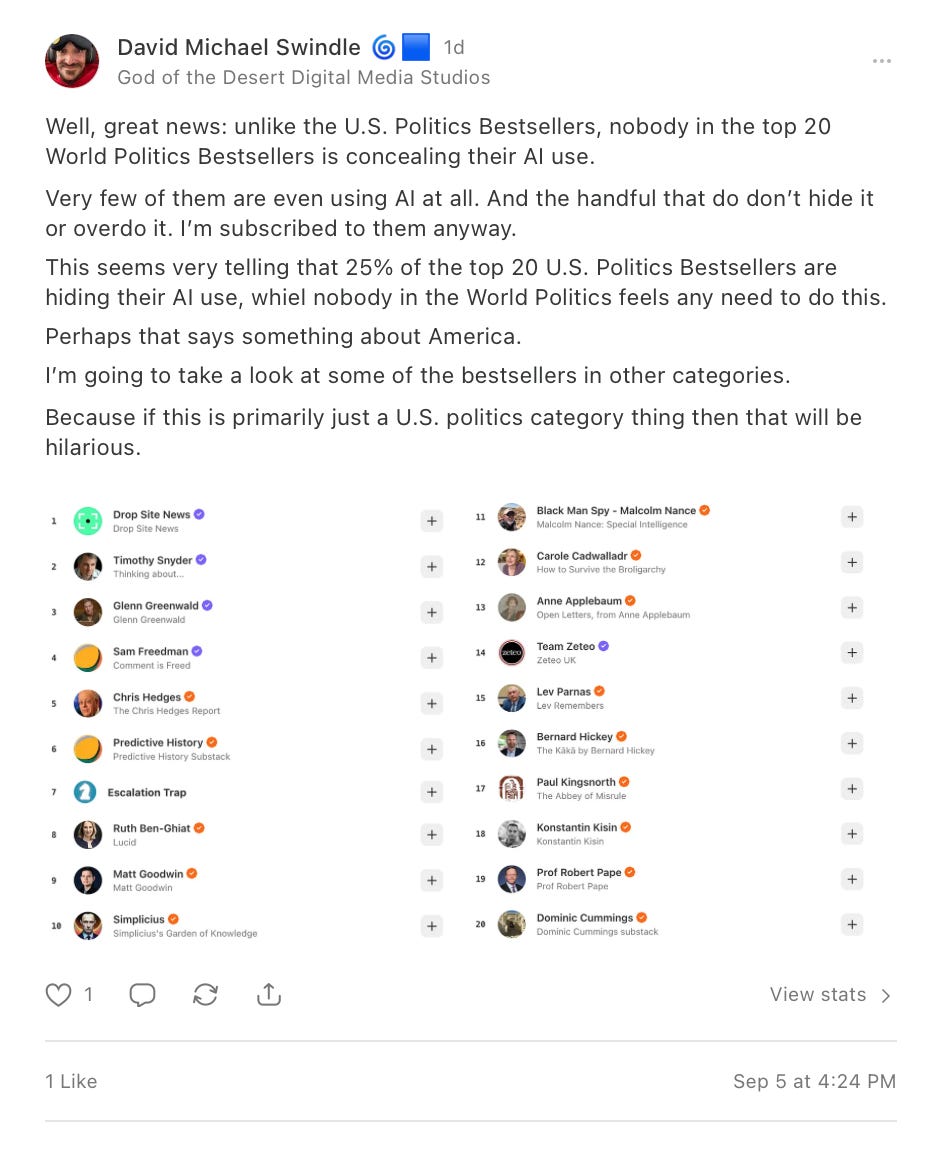
An Encouraging Sign from the World Politics Bestsellers List:
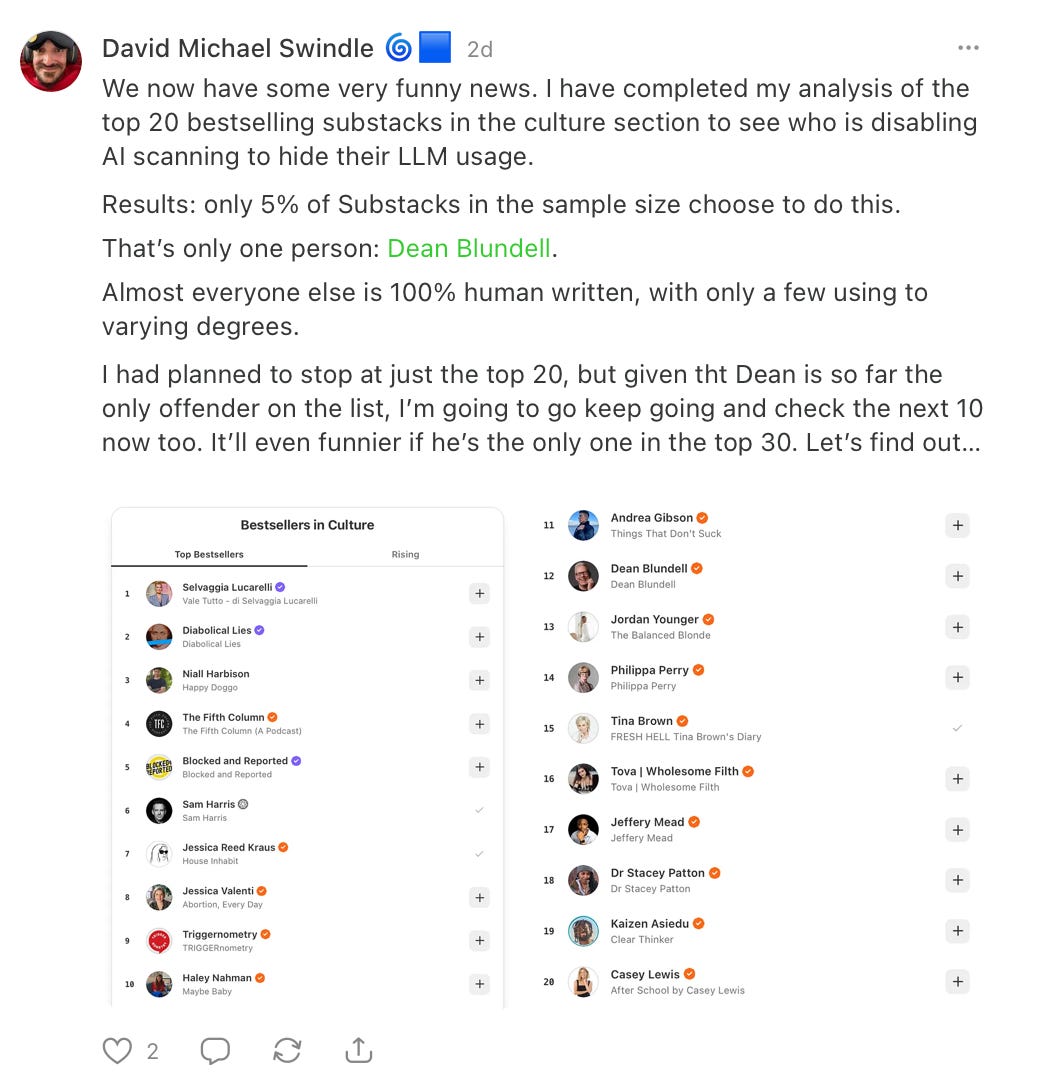
Some Encouraging News from the Culture List:
2 Right-Wing BS Merchants
These next two hurt more personally than those above because these are two women who I respect, and still do to diminished degrees now, in spite of this very sad ethical lapse here.
18. Restoring the West by Ayaan Hirsi Ali
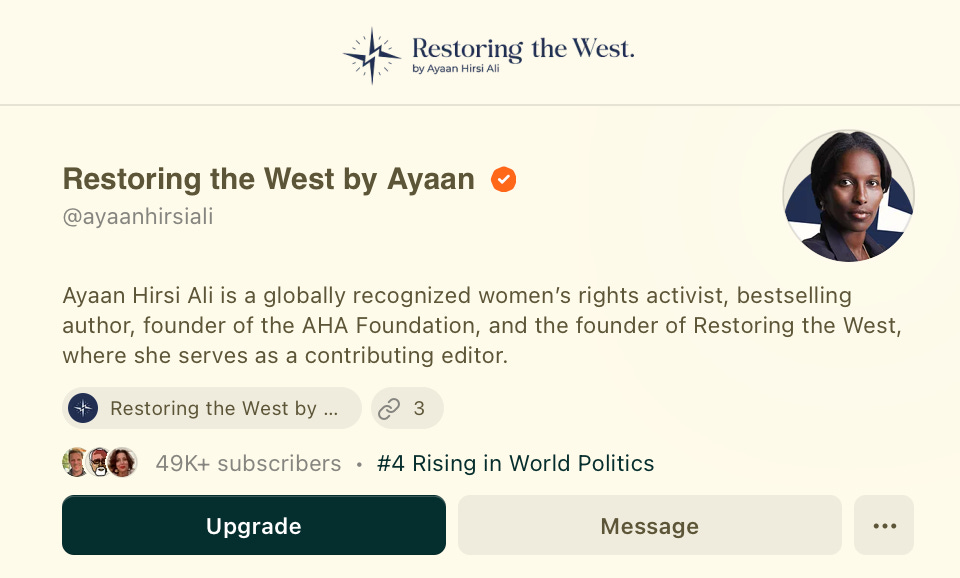
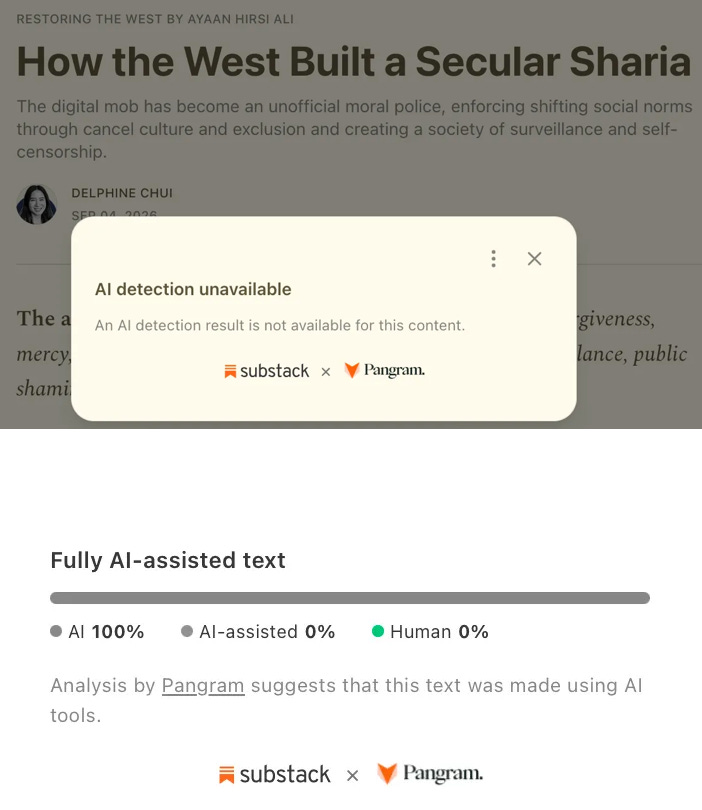
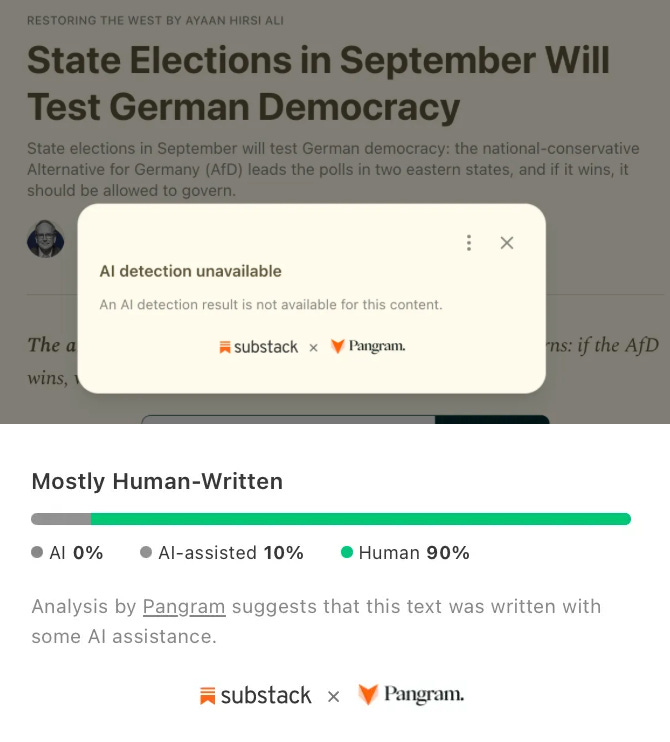
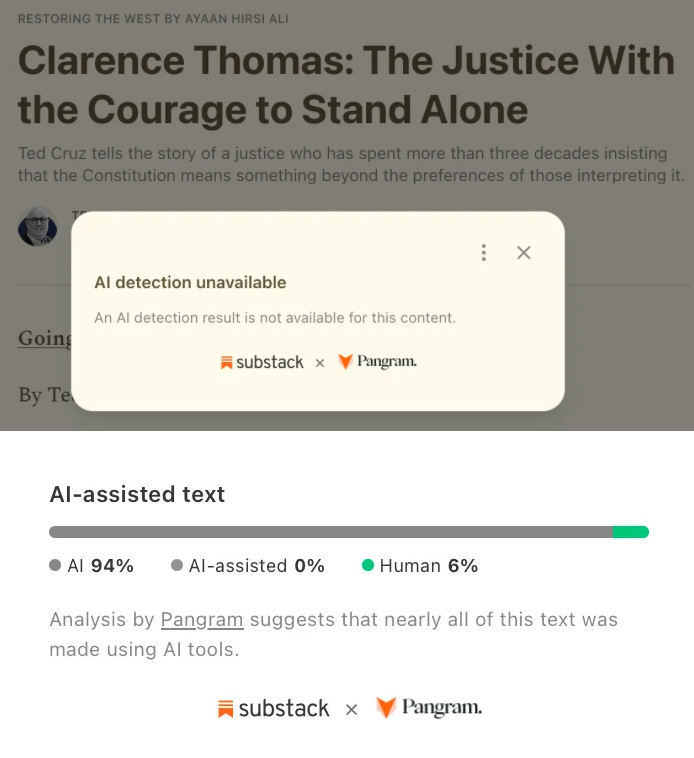
Those three articles were not written by Ayaan. They were by others with sympathetic views which she chose to publish.
So what about the ones with her own byline?
The articles written by Ayaan herself are paywalled, so AI scanning is not available or denied. However, by manually scanning the available preview text, we can see a pretty good idea of what follows:

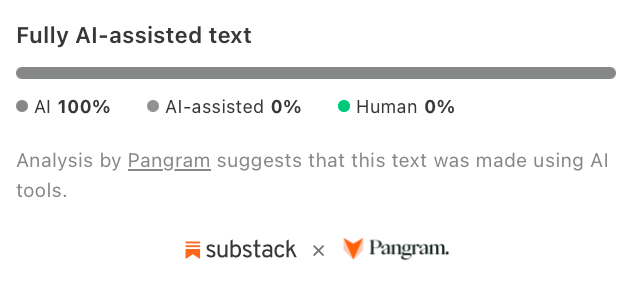
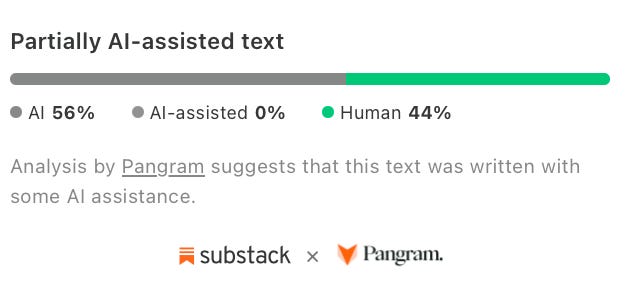
Ayaan has been a huge inspiration to me for a long time. Her books and ideas have often influenced me. I have an autographed copy of her third book, Nomad.
However, in recent years she has more and more devoled into just another predictable right-wing pundit.
I don’t think she’s really genuine. Maybe she never was and her whole career was just her acting pragmatically, shifting as she felt she needed to do.
This stood out in December 2023 when she announced her converstion to Christianity and it just seemed really fake. I explained why here:

It was though she converted to Christianity more as part of the branding of her career than out of sincerity.
The next “writer” on this list is someone else I’m sad to have come to see similarly now.
SEPTEMBER 20 UPDATE:
Come on, Ayaan, any improvement?
Nope:
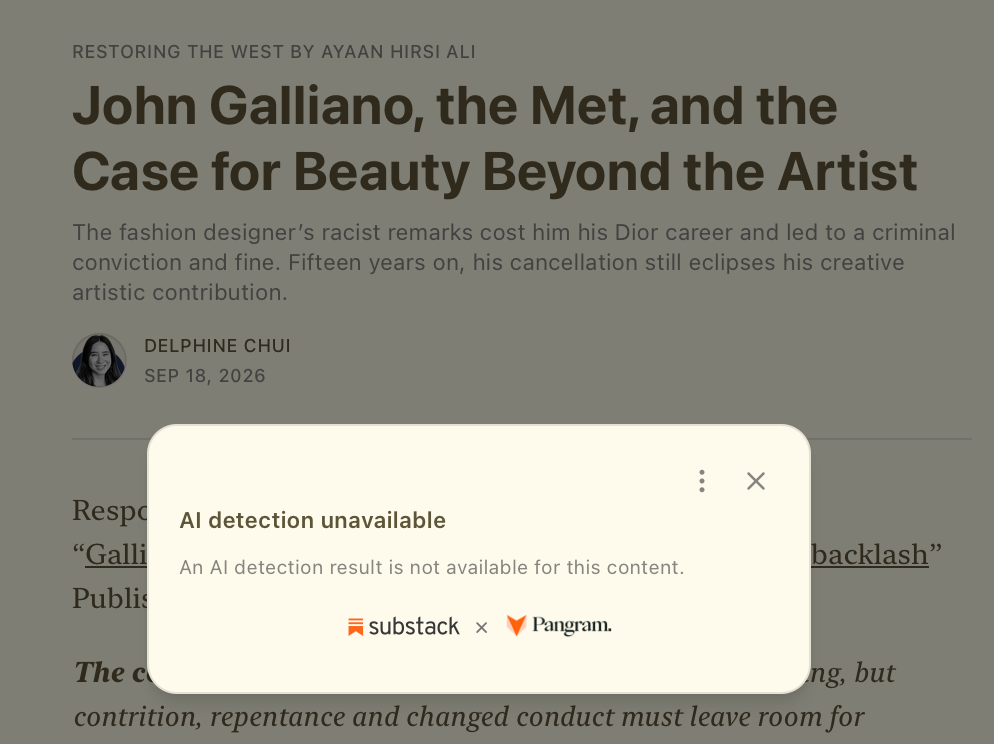
How about Ayaan herself? Here we have some encouragement from the preview of her most recent paid post:

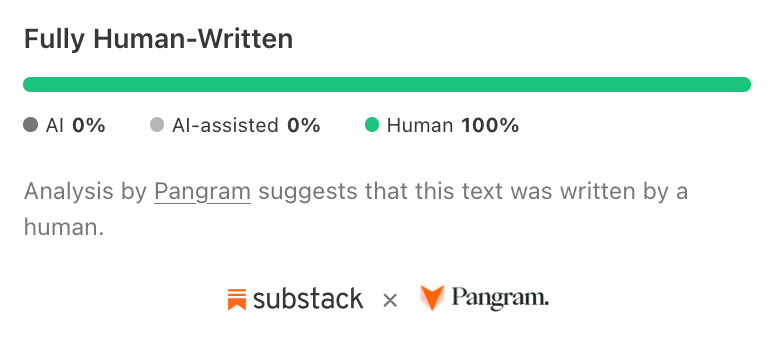
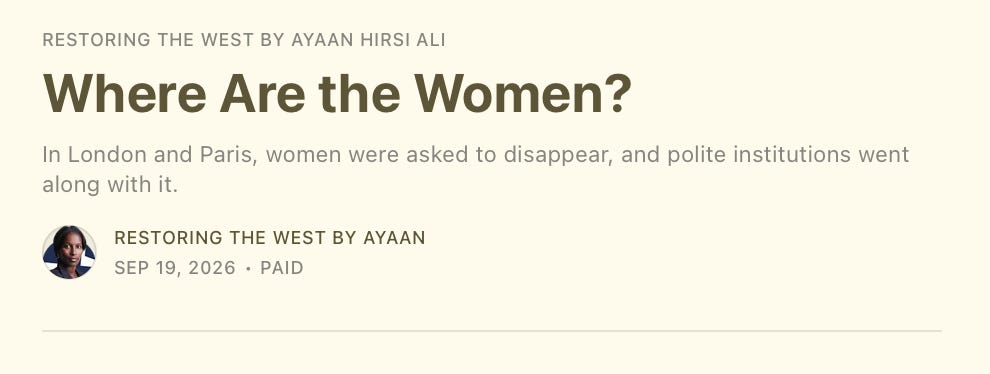
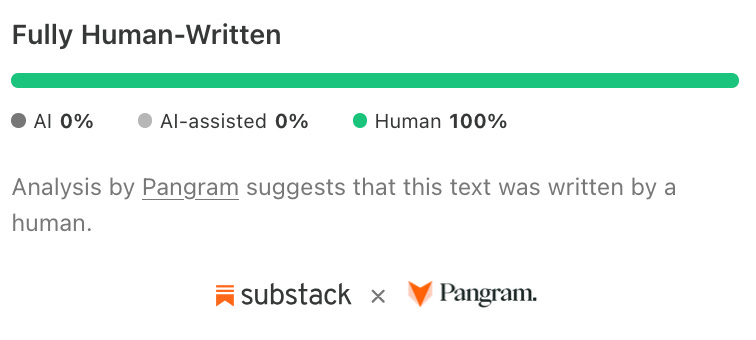
Gee, I wonder if somebody heard the message?
It’s unfortunate that I’ll need to keep Ayaan on the list since her publication continues to disable Pangram. However, it is an encouragement to see her apparently returning to drafting her own pieces.
19. Emily Schrader

I knew Emily Schrader before she was the big pro-Israel influencer with 238,000 X followers like she is now.
I knew her because I edited her mother Diane’s blog posts for David Horowitz’s NewsReal Blog.
Diane Schrader was a legend on my list of writers I edited. She was one of the best writers I ever recruited. We had plenty of powerful polemicists and smart writers, but Diane was by far one of the sharpest. I regarded her as our own Ann Coulter with the intensity of her rhetoric and strength of her arguments. She was one of the most reliable traffic-generating-writers on the team.
And I expected Emily to do the same intensity and tenacity at whatever she chose. Instead she went in a different direction, serving up stuff like this:
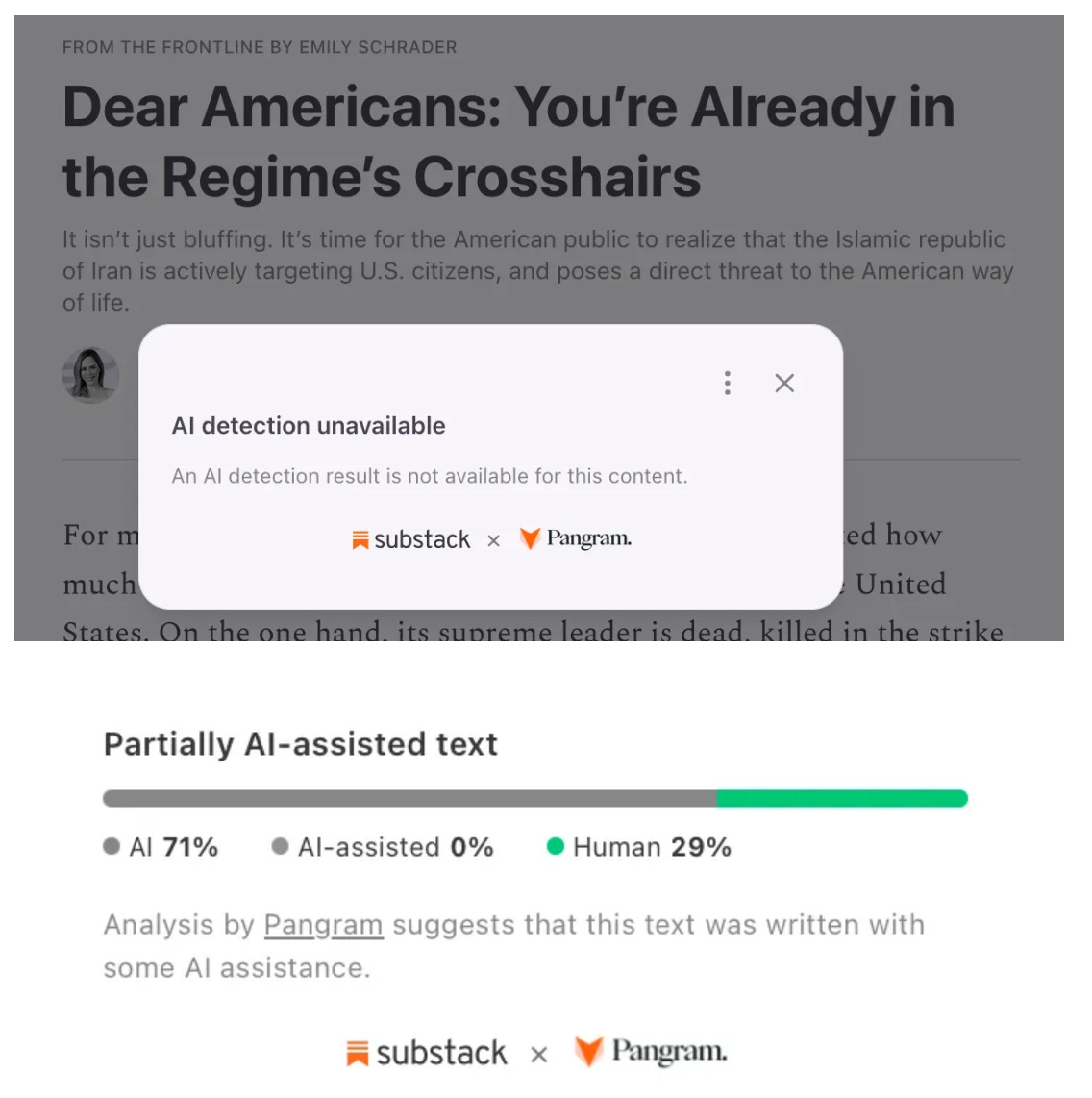
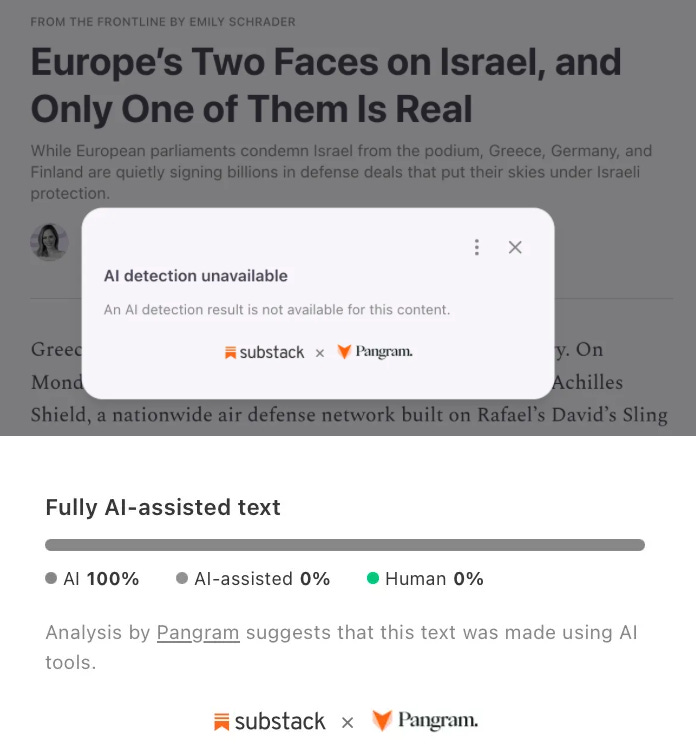
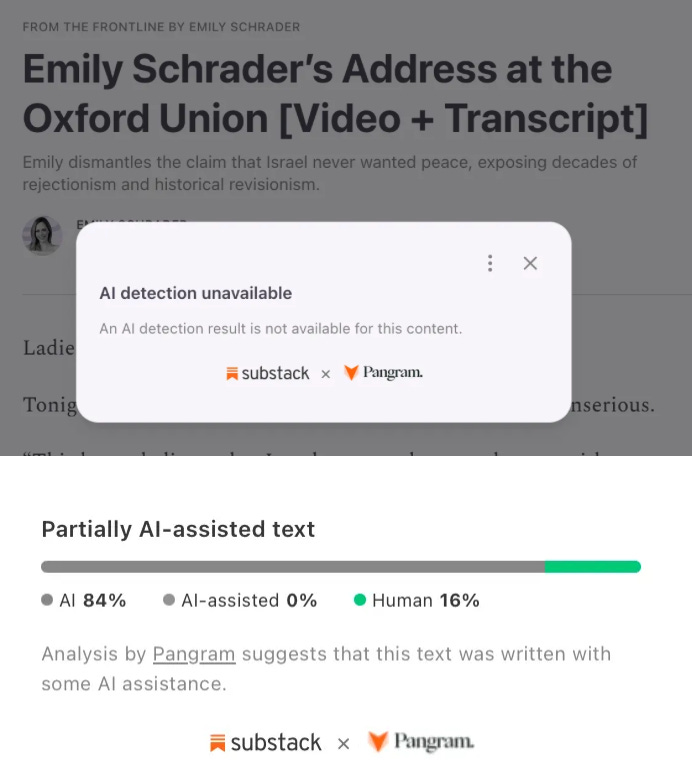

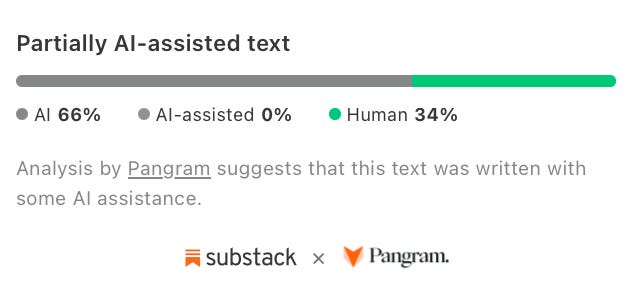
I had previously asked Emily in a comment at a previous post about this and she had denied using AI.
Emily was the pro-Israel influencer I wrote about previously who inspired this investigation. This whole thing is all her fault. I was being kind by not naming her. But now that forbearance is gone:
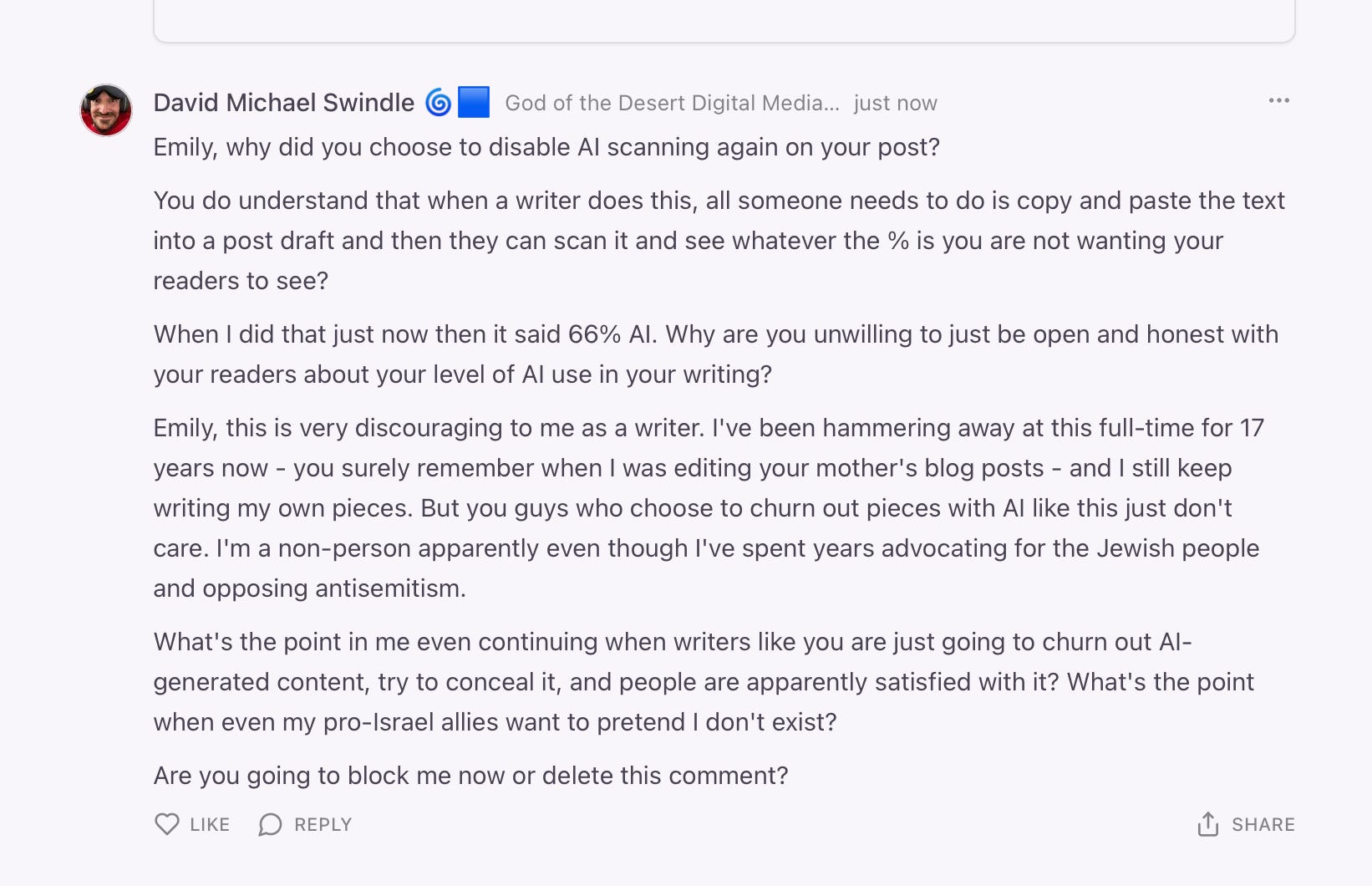

Initially when compiling this list, I had positioned Emily in the Zionists section. However, upon further reflection, it seemed much more accurate to make sure others understand her more as a “right-wing ideology personality figure” building a media career — like an Israel-focused millennial Ann Coulter type — rather than someone who was a sincere Zionist activist focused on the truth.
The key reason for this can be found in Emily’s primary professional affiliation right now with my former employer, what was once known as Jewish News Syndicate but that since chosen to rebrand as Jerusalem News Syndicate, I gather because now they’re aspiring to compete as the right-wing version of The Jerusalem Post rather than the right-wing version of the Jewish Telegraphic Agency.
Emily is the host of JNS’s “Axis of Truth” podcast. How about you just have a seat down there in that and let the irony sink into your pants.
JNS does not care about Truth or about News.
Its editors and leaders care about pushing the right-wing ideology of the donors who fund them. People reading the content from the outside can see how obviously slanted the coverage is and I was subjected to my work having to be endlessly shoehorned into that contorted shape on a regular basis. The editorial process was often bizarre. My editor would frequently micro-manage so much he would want to rewrite articles line-by-line, subjecting me to relentless scrutiny and crticism line by line. Often he would say something like, “Well, have you thought about Y?” And I’d respond, “Yes, I discuss that in the next paragraph. I wish you could read the whole article first instead of just editing it one sentence at a time!” That is how JNS operates — a sense of tunnel vision focused on obsessing over one trivial tree at a time while ignoring when the whole forest burns.
One of the funniest things that right-wingers do when they try to build their own media companies with donor money or an angel investor’s checks, is they think that since the dreaded “MSM” is “biased to the left” then that means that they should then simply be “biased to the right.” Right-wing media operatives have this perpetual tendency to try and just rewrite op-eds as news articles. They think if they can just adopt the rhetoric and conventions of journalism then they can launder the right-wing idoelogy and GOP-partisanship. They think conventional media sources do that and so they have to fight back by doing it too from the other direction. It won’t work, but at least it will keep the lights on as long as the billionaire donors are dumb enough to keep Heath Ledgering their wealth funding it.
SEPTEMBER 20 UPDATE:
Emily is undeterred:
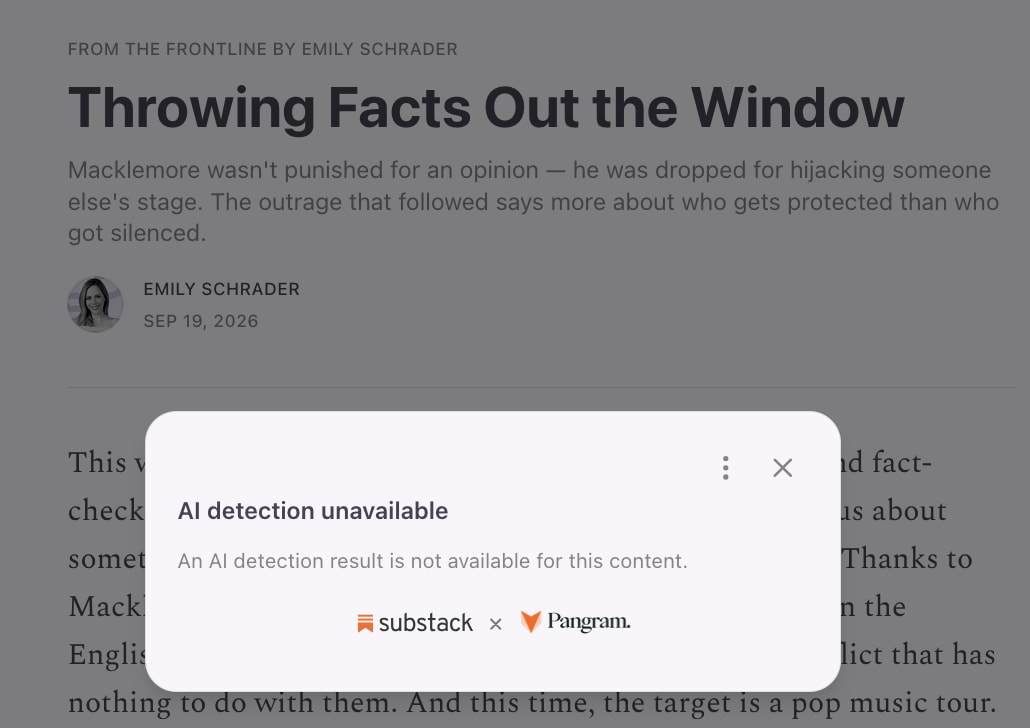
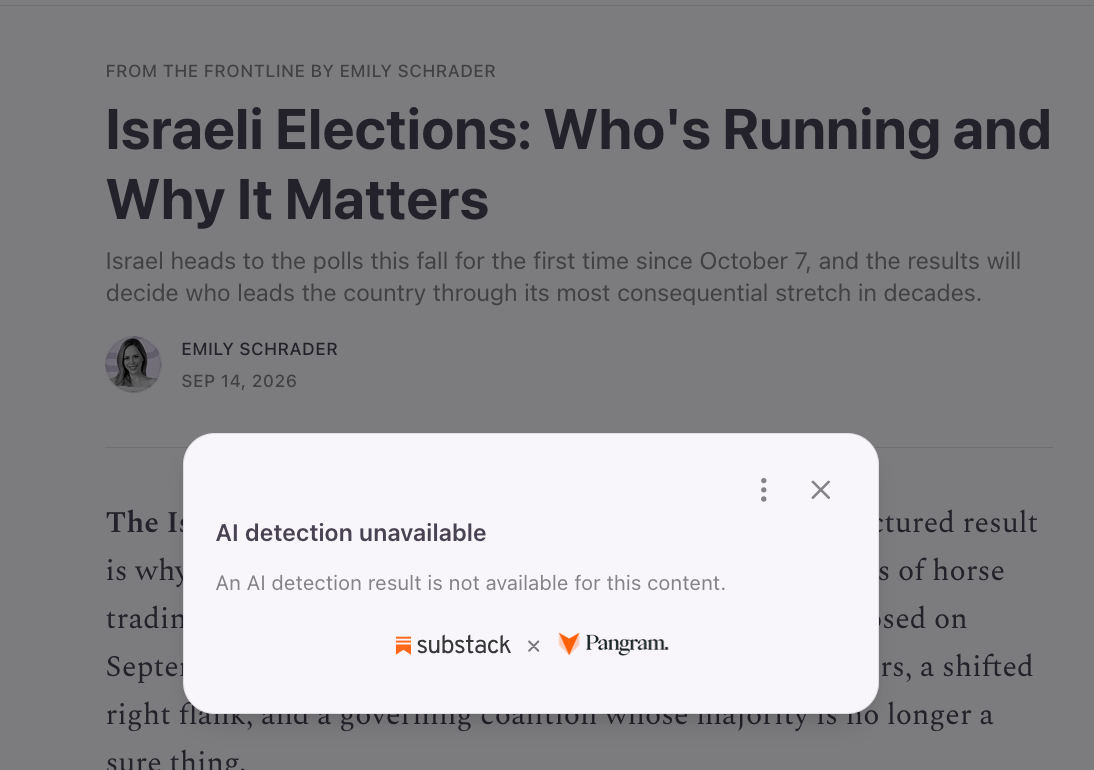
All Emily had to do is say, “You’re right David, I’ll stop disabling Pangram.” And then instead of putting her on the Wall of Shame, I’d likely still be promoting her work, even knowing that she needed AI’s help with it. If she could just be open about it then there would be no ethical problem.
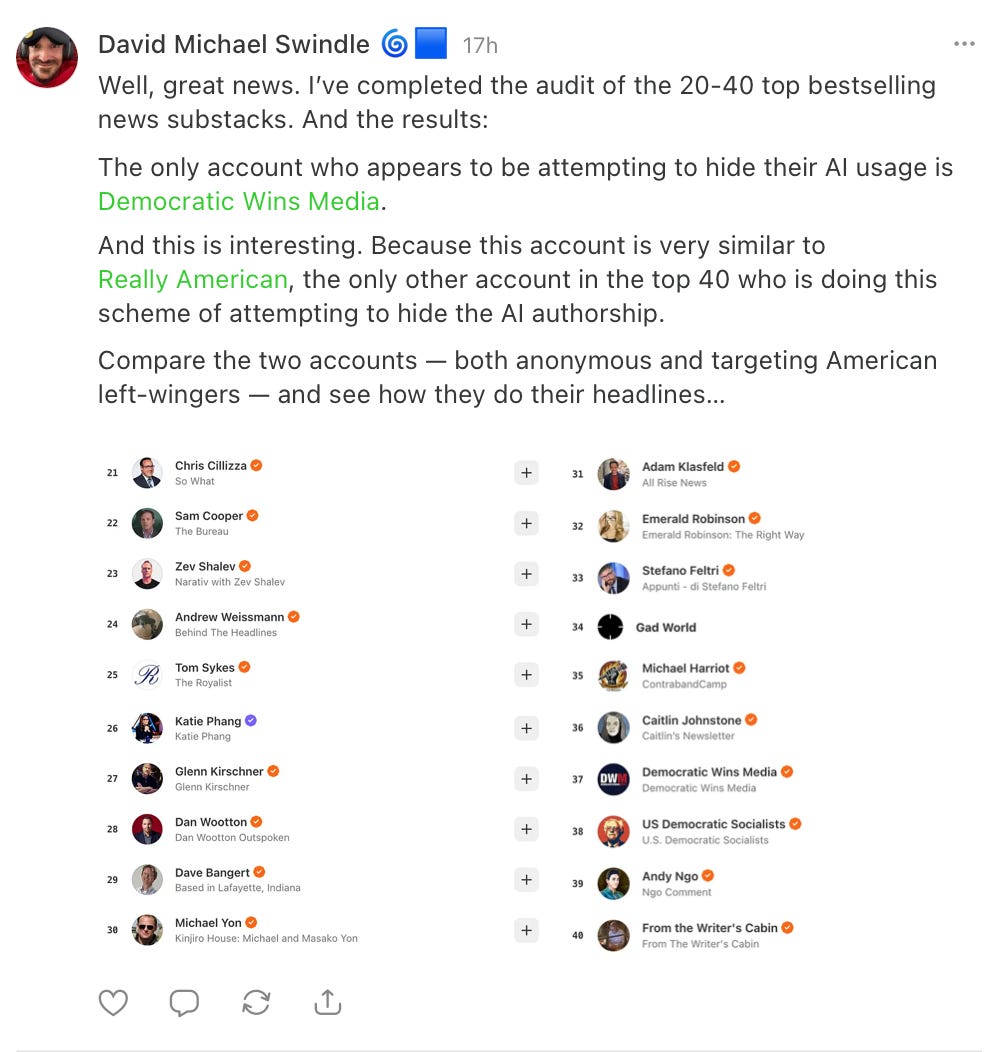
Some Encouraging Discoveries from the Bestselling News Substacks:
7 Religious BS Merchants
In looking over the Substacks in the religion category which pull this hide-the-AI trick, while their subjects seemingly differ wildly, they do have some things in common: most are “outside the mainstream” and they often center around a charismatic individual with questionable credentials.
20. John Anderson PhD, Tipping Point Prophecy Update
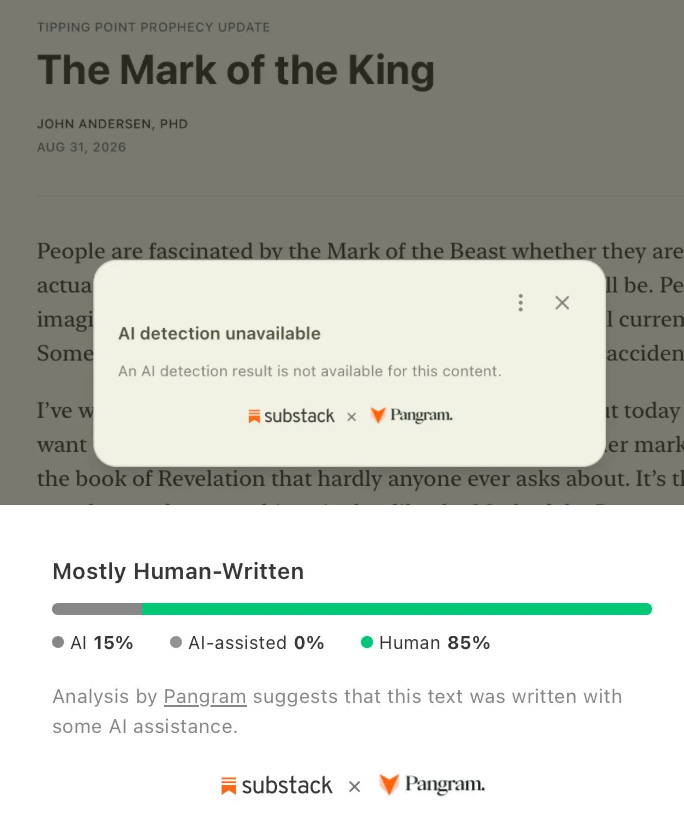
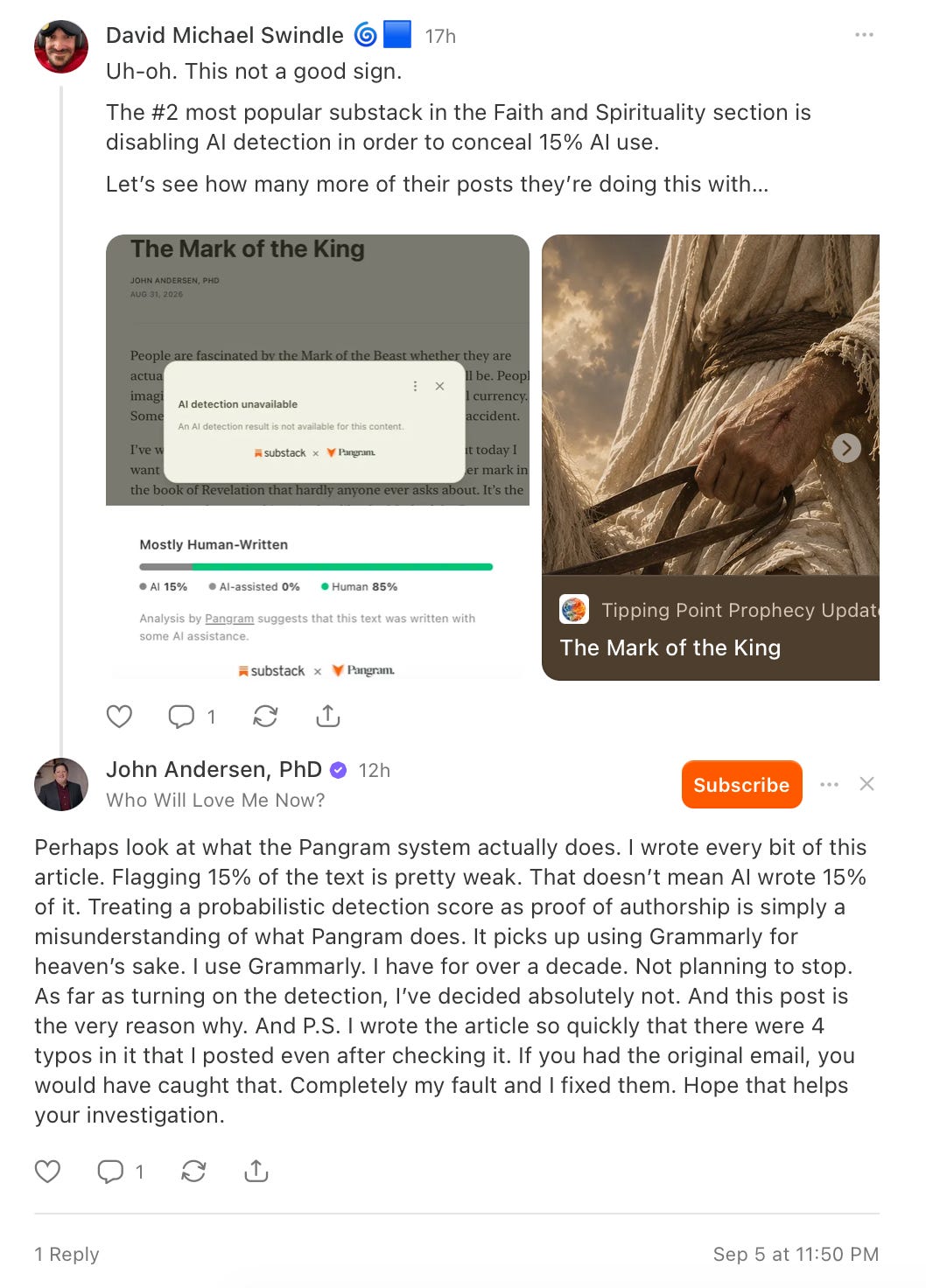
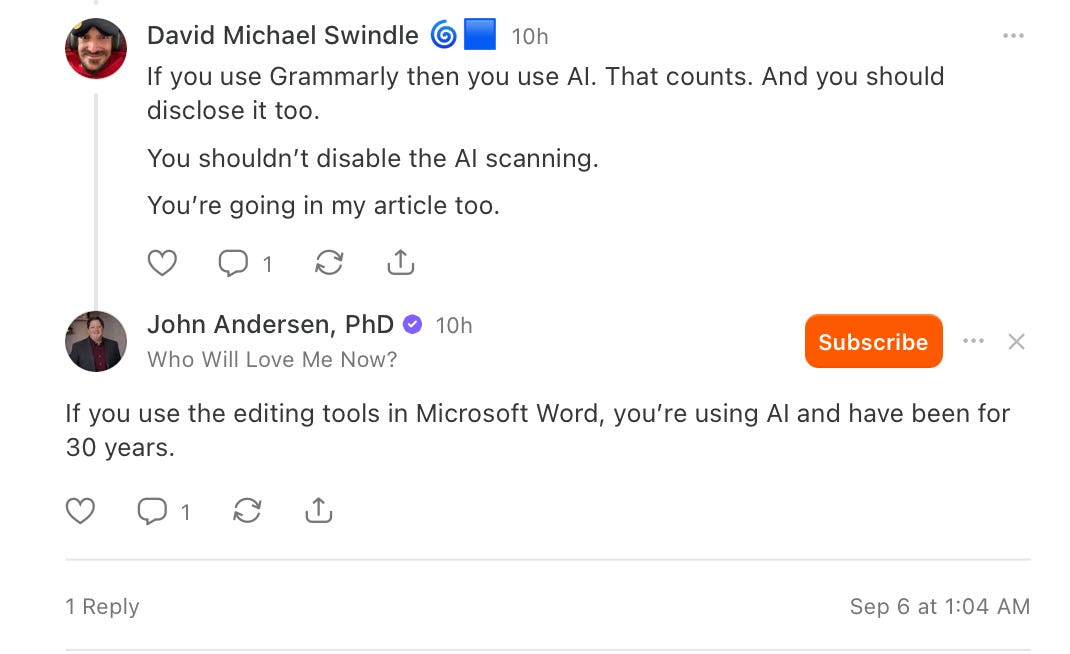
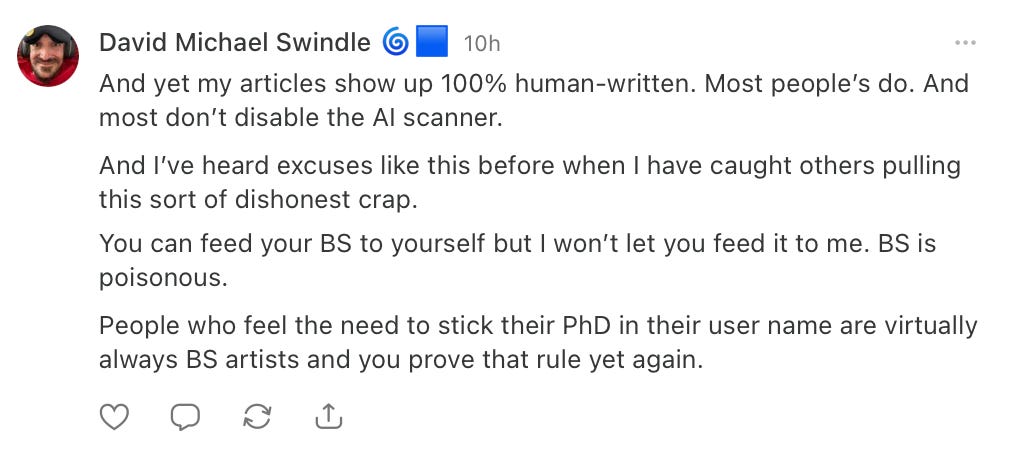
Notice again how just as with Nikki Davidson of The Northern Watch, the tendency some writers have when confronted about this is to turn around and attack the person asking. This is a common thing that narcissists do when their ego is threatened: Deny, Attack, Reverse Victim and Offender.
It is so predictable. I knew this was coming from people.
SEPTEMBER 20 UPDATE:
Andersen has not published since this article’s publication and there are not other pieces at the publication to scan. Thus, he will remain on the upcoming list.
21. Stranger Theology

I was not familiar with this site before beginning the investigation, however I knew its general outlook fairly well as they draw inspiration from the late Michael S. Heiser, a Biblical scholar who focused on themes around The Book of Enoch. I’d read him during my research on a novel project which I’ve worked on off and on for years.
So I knew what I was getting into here. The fallen angels themes of the Enochian literature are rich and engaging, but too often they devolve into a kind of Ancient Aliens sensationalism and fundamentalist silliness that has generally turned me off from engaging too deeply in “communities” interested in these themes.
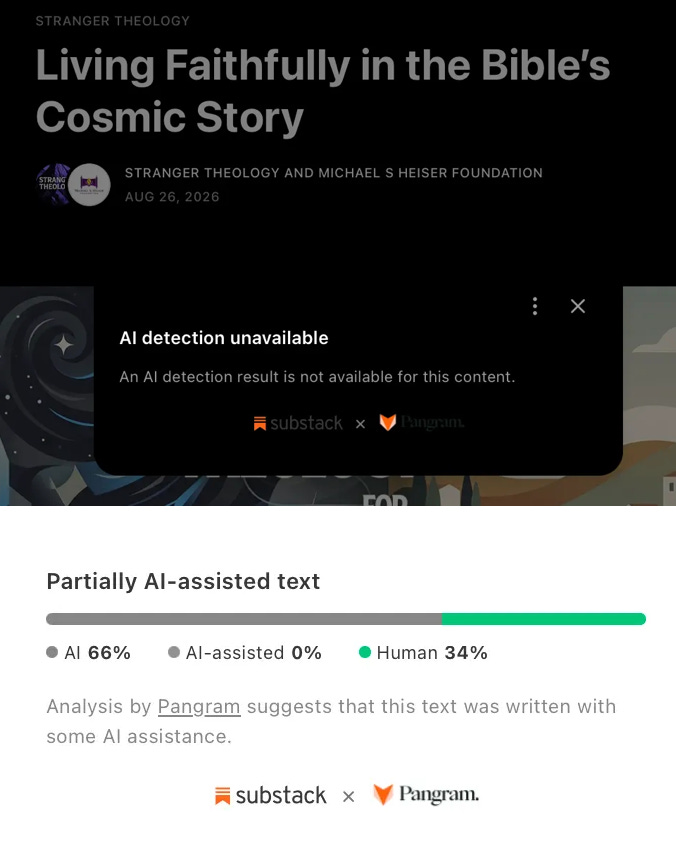
The author responded when I shared the score on Notes:
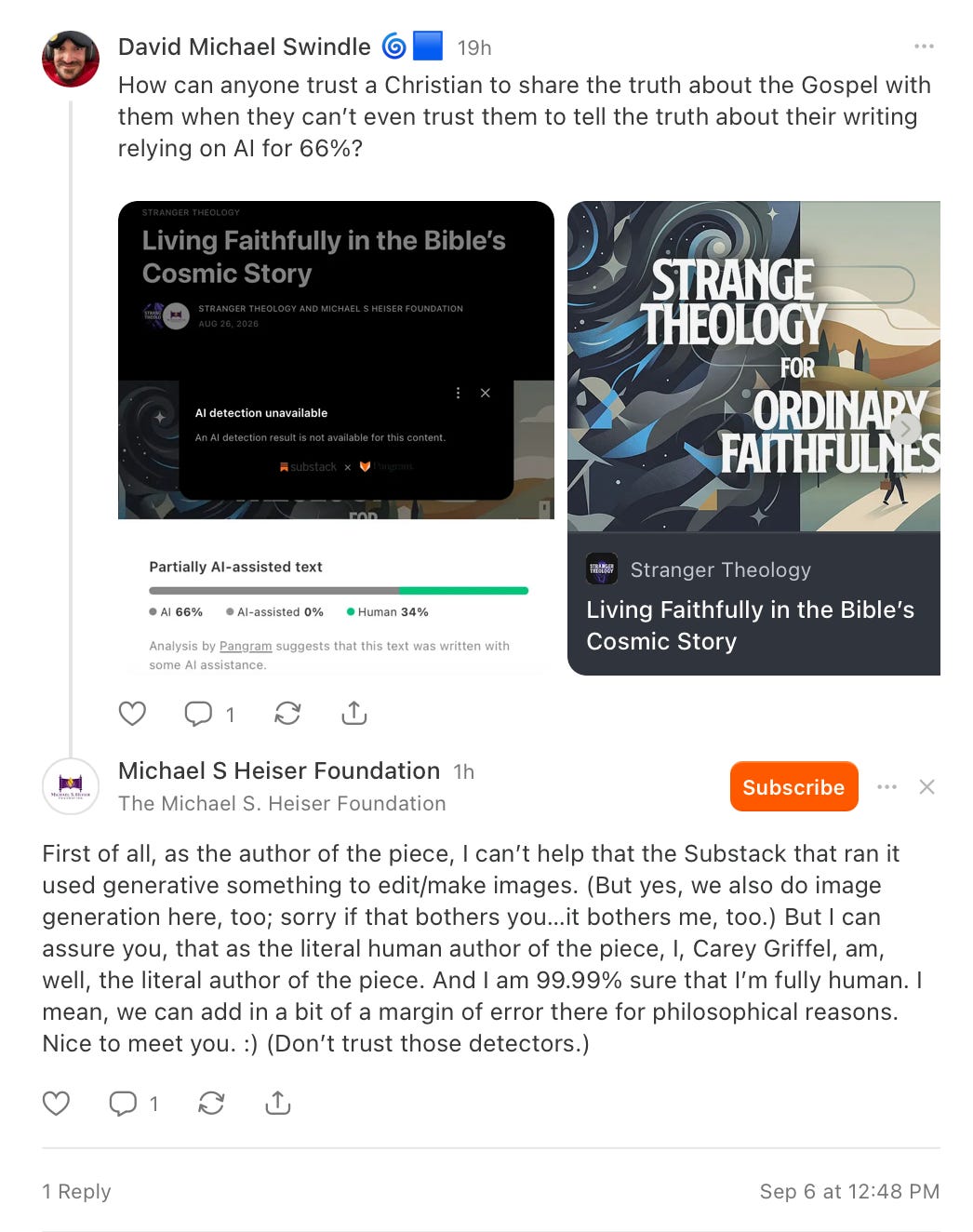
This is just bizarre for an instituional social media account to respond in this fashion. Or to author articles without the explicit byline of the author.
I answered:
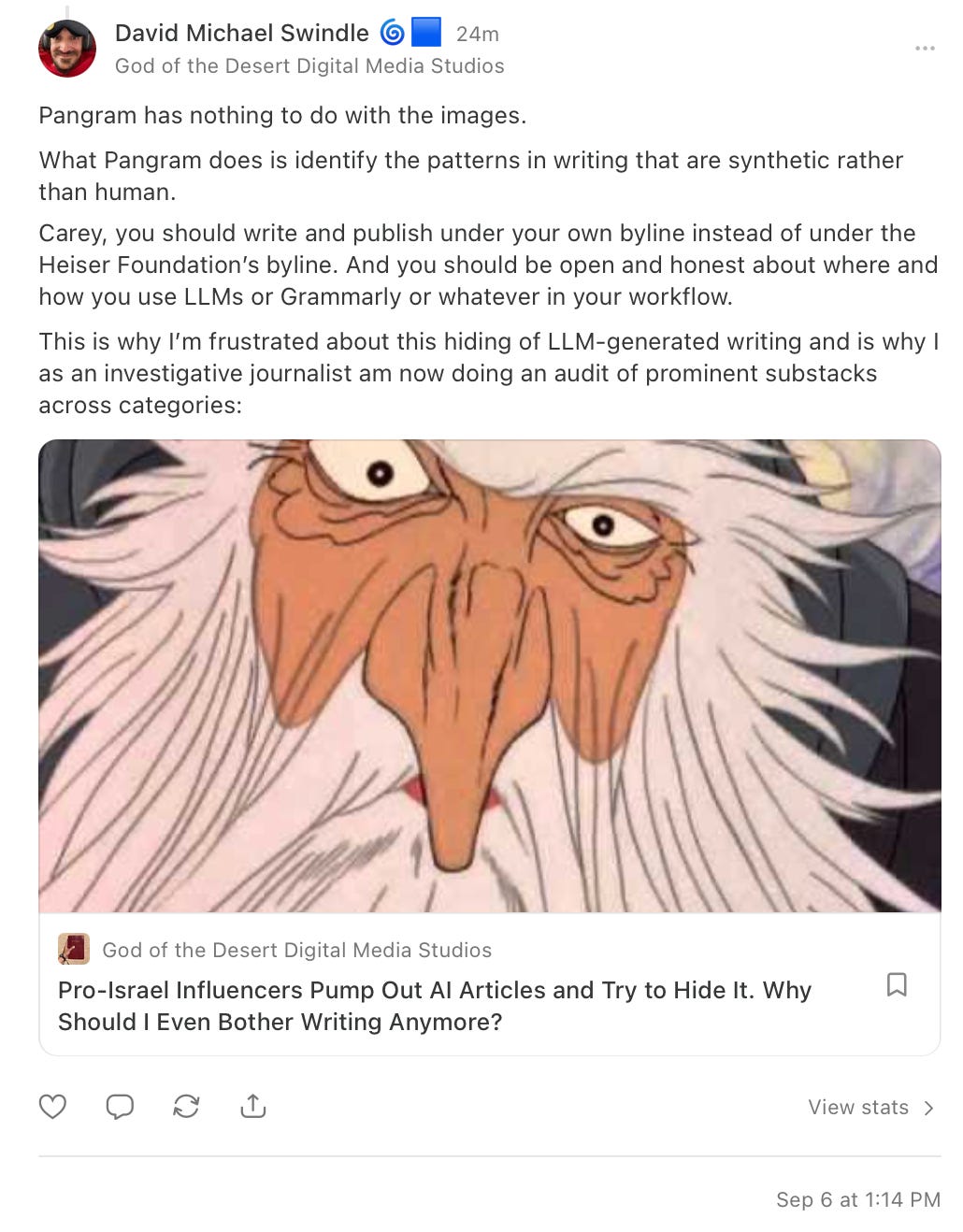
This gaslighting about how AI-generated images are supposedly impacting Pangram is something I’ve heard a lot. It’s nonsense from someone trying to cover their deceit.
Just as this investigation has sought to gather data about who has disabled AI scanning it has also gathered data about how many people react when confronted with the truth of their concealed AI use.
The author responded again:
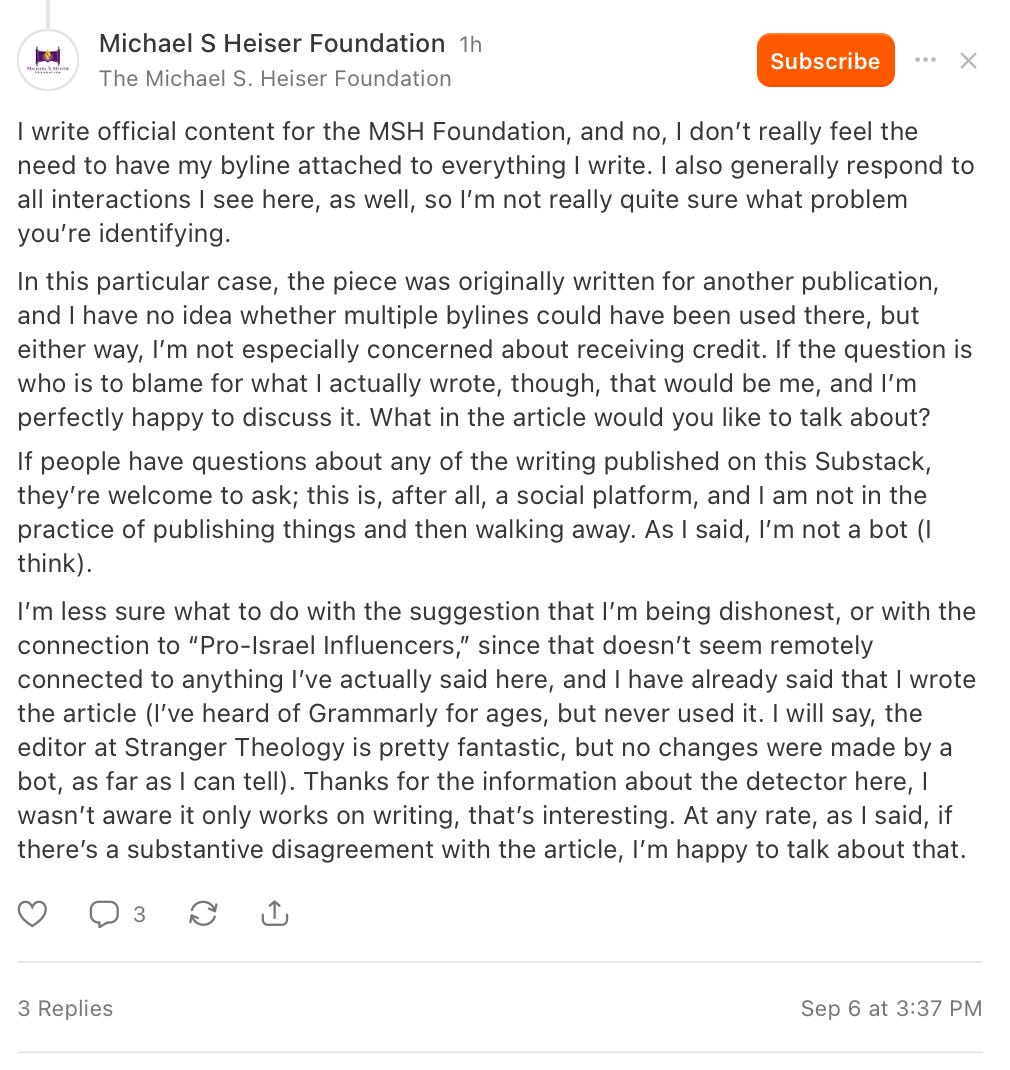
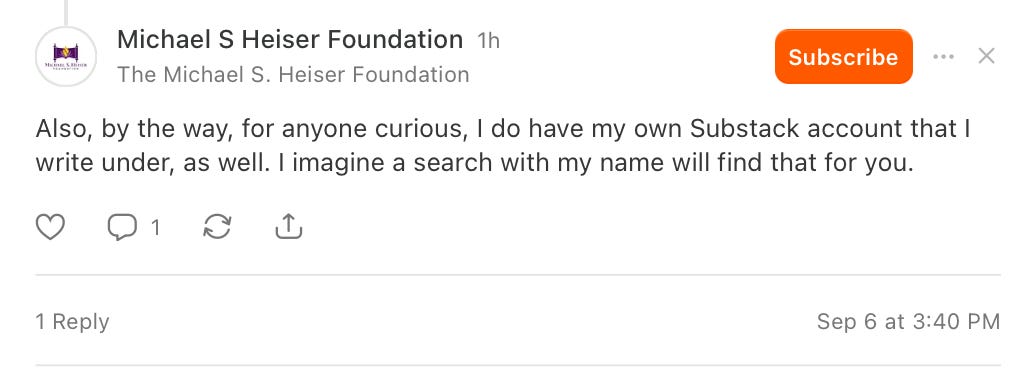
Here is a piece from that Substack under Carey Griffel’s own name:
I replied:
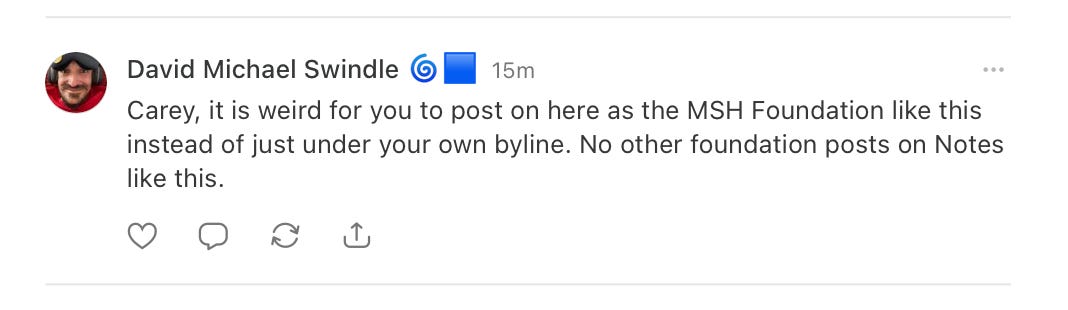
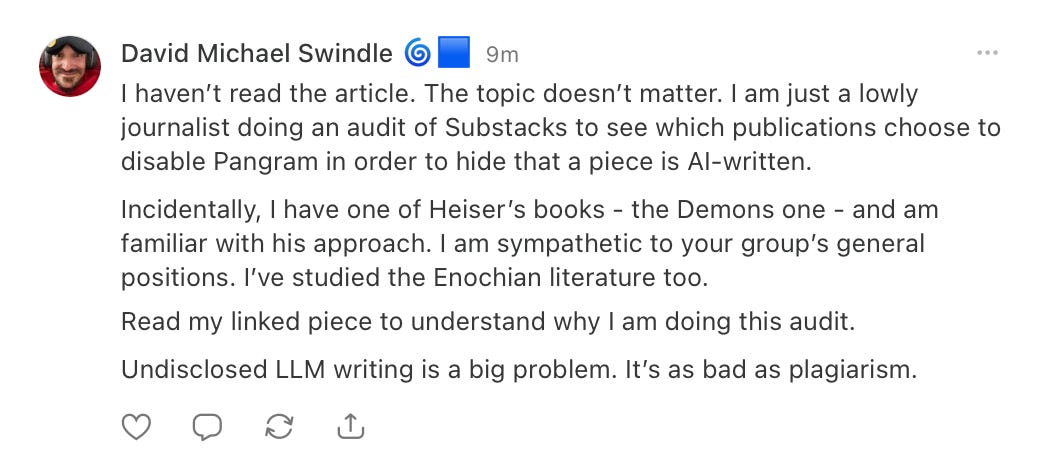
Here is the Heiser book which I own — acquired as part of my Enoch research — but have not yet finished:
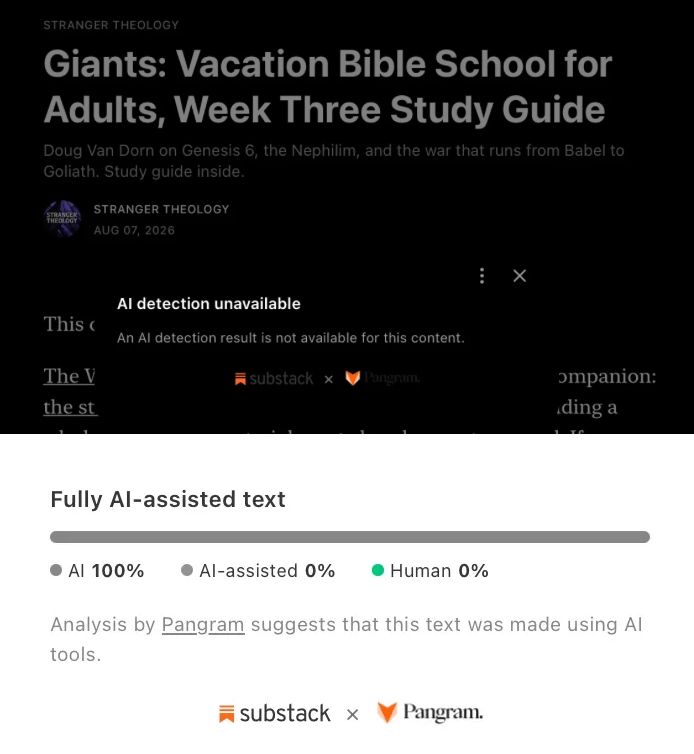
SEPTEMBER 20 UPDATE:
This is encouraging:
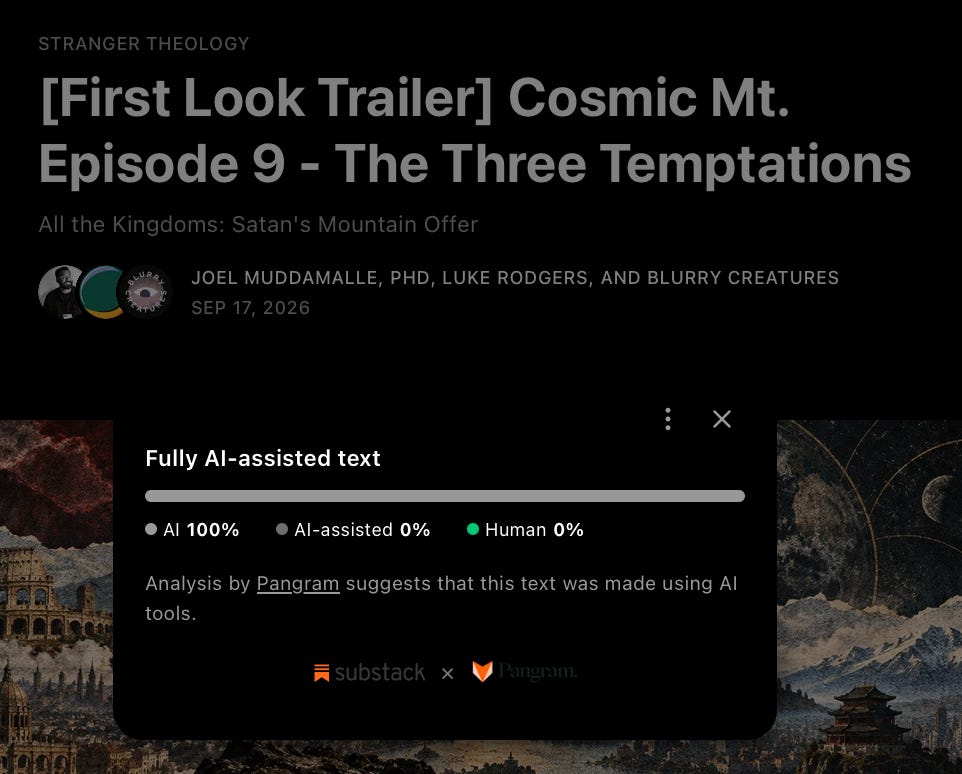
But this is not:
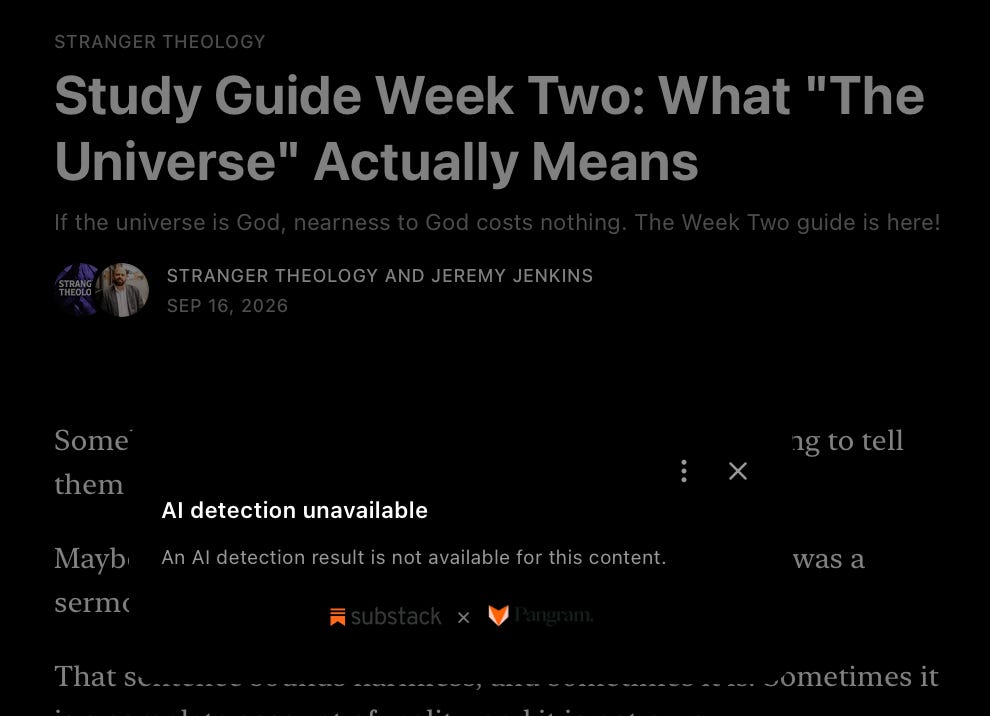
And neither is this:
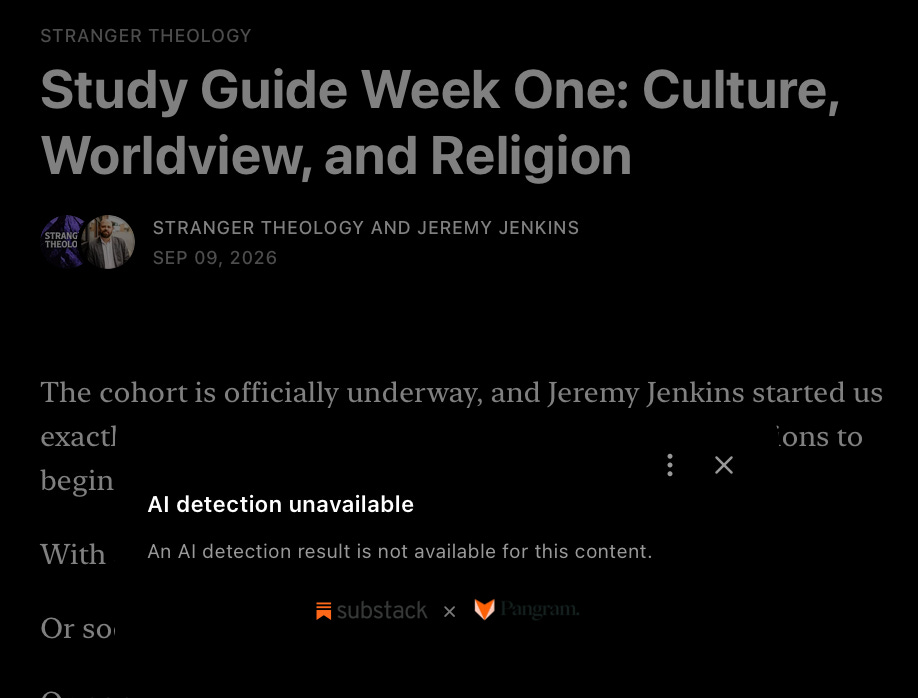
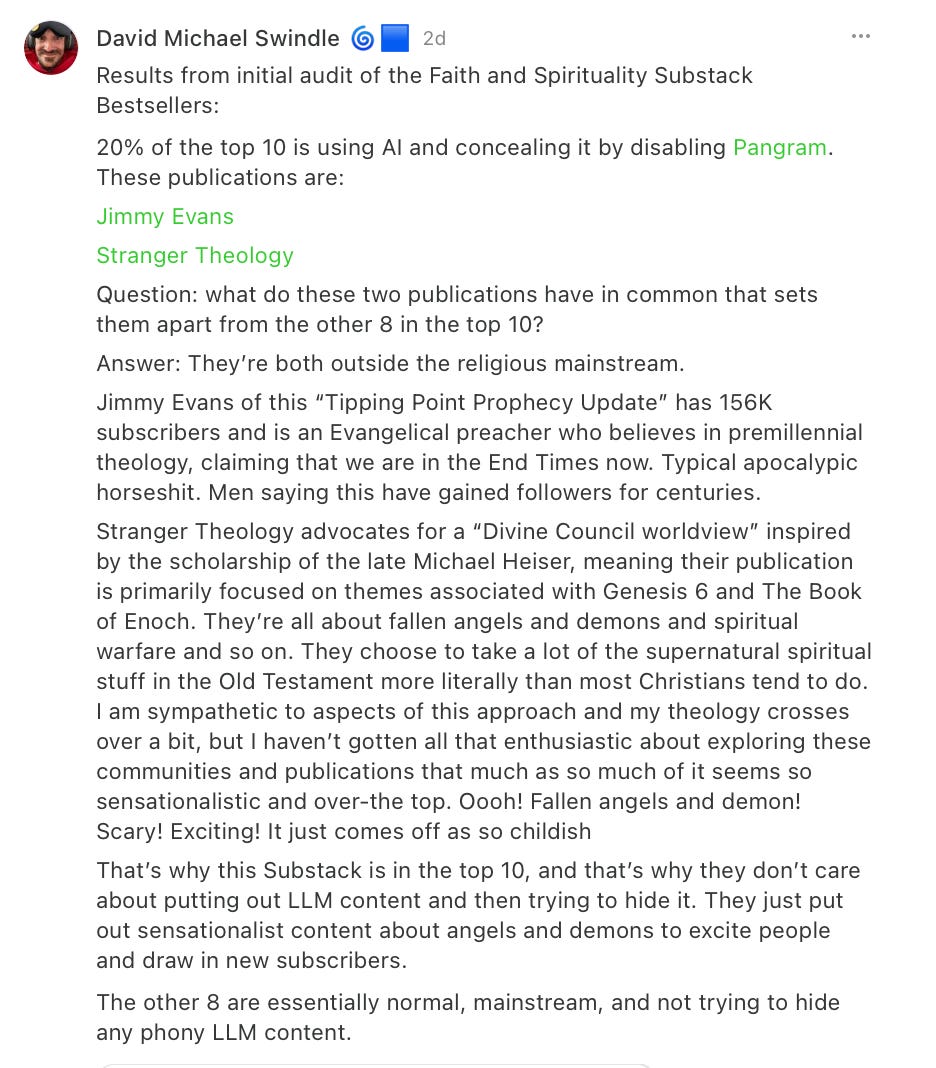
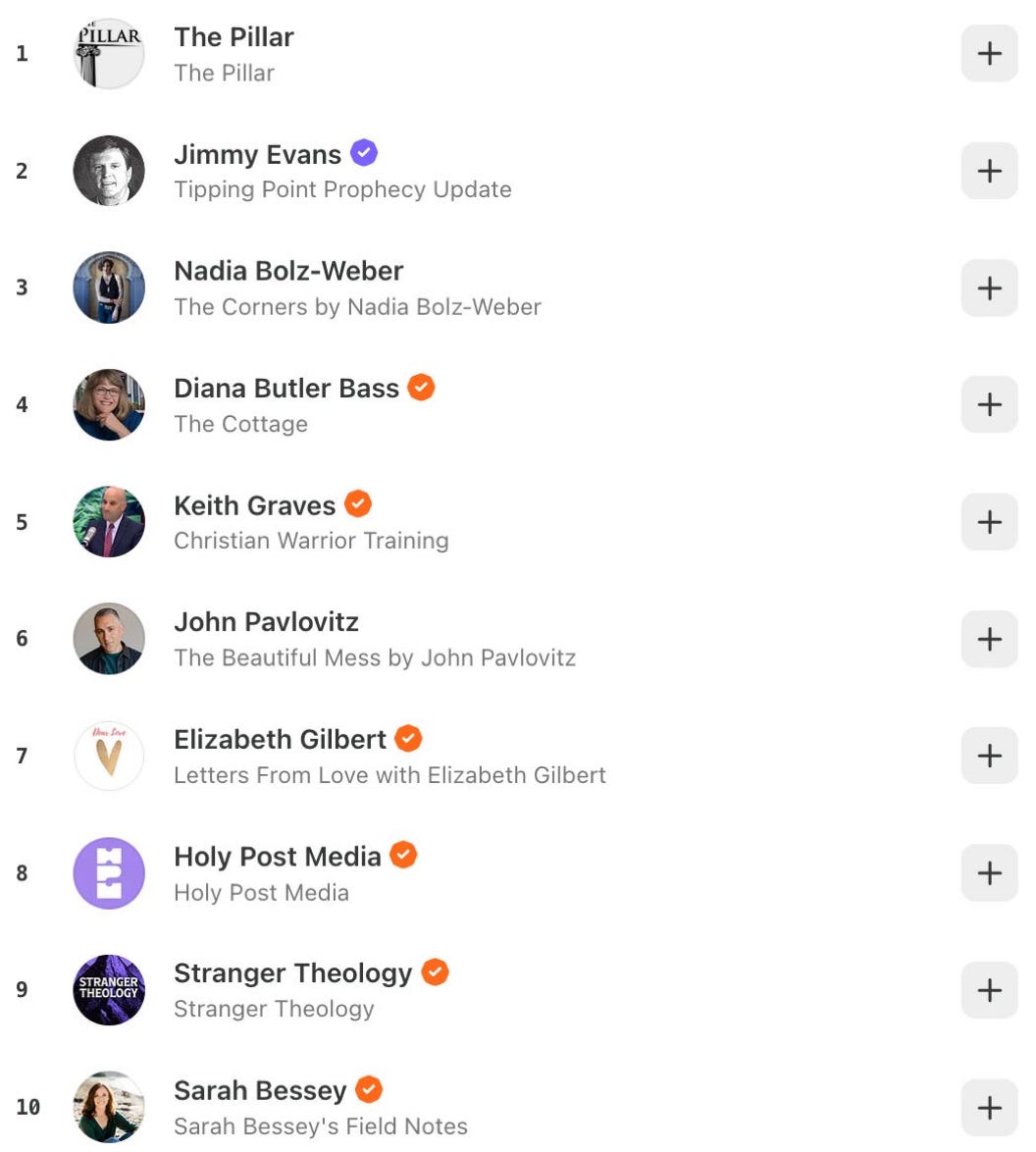
22. Michael S. Heiser Foundation
Following Carey Griffel’s response, I decided to begin an audit of his foundation’s Substack. Where there’s smoke, there’s a flaming pile of bullshit.
Here are the results — too predictable — one must lament:
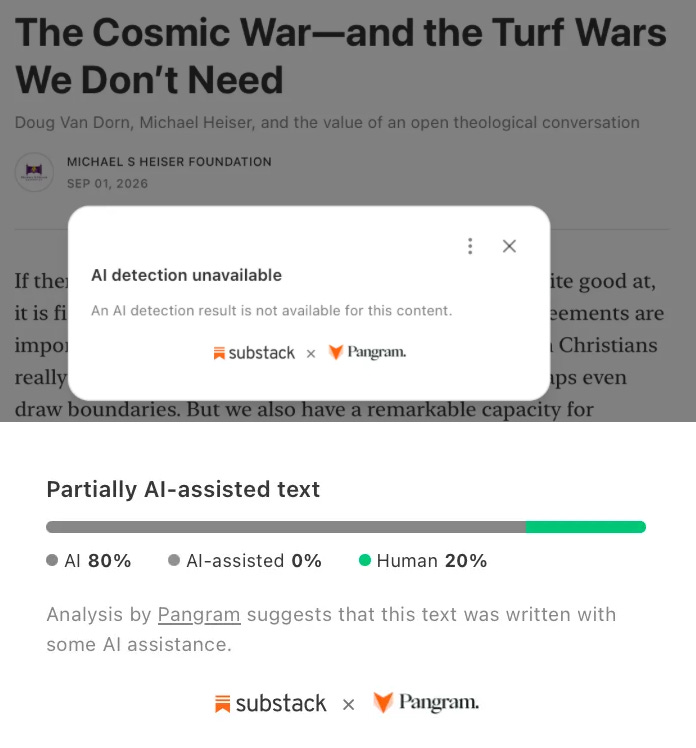
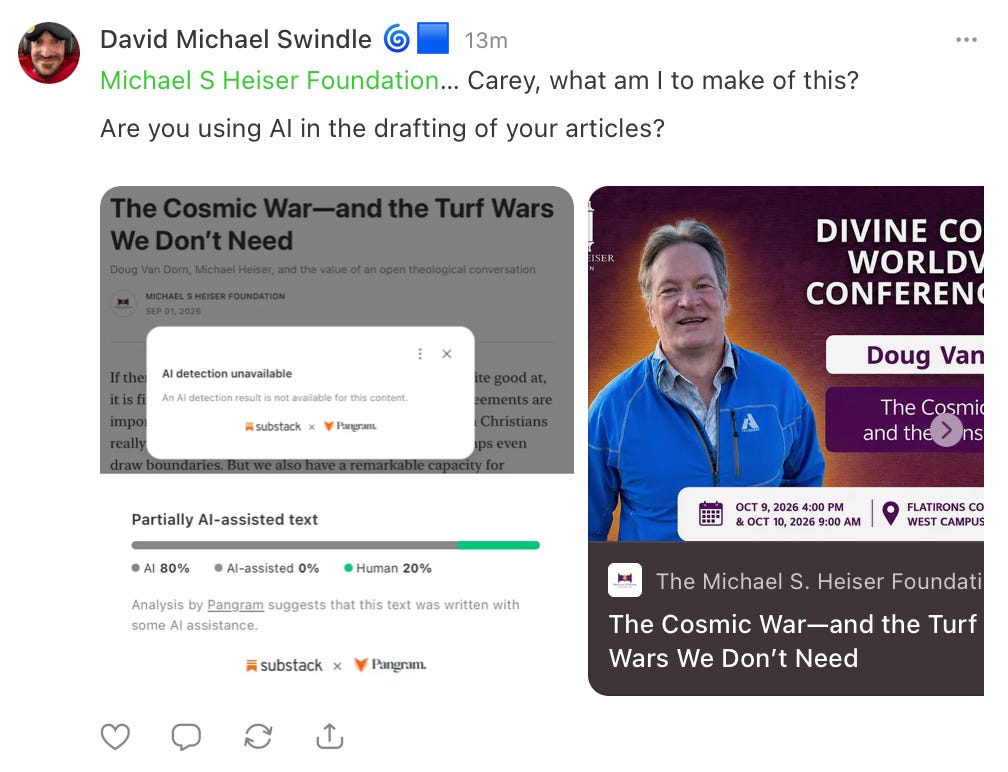
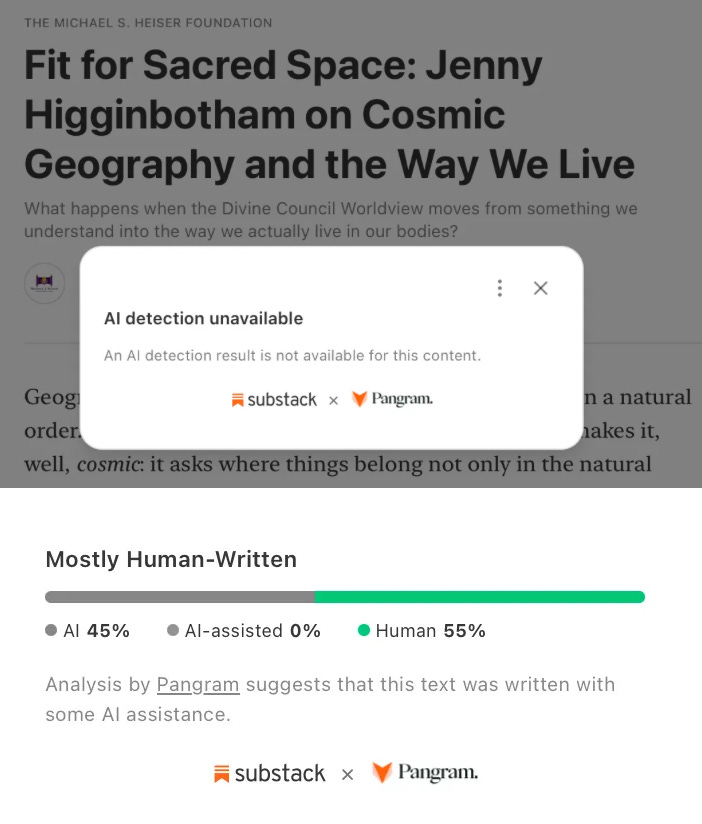
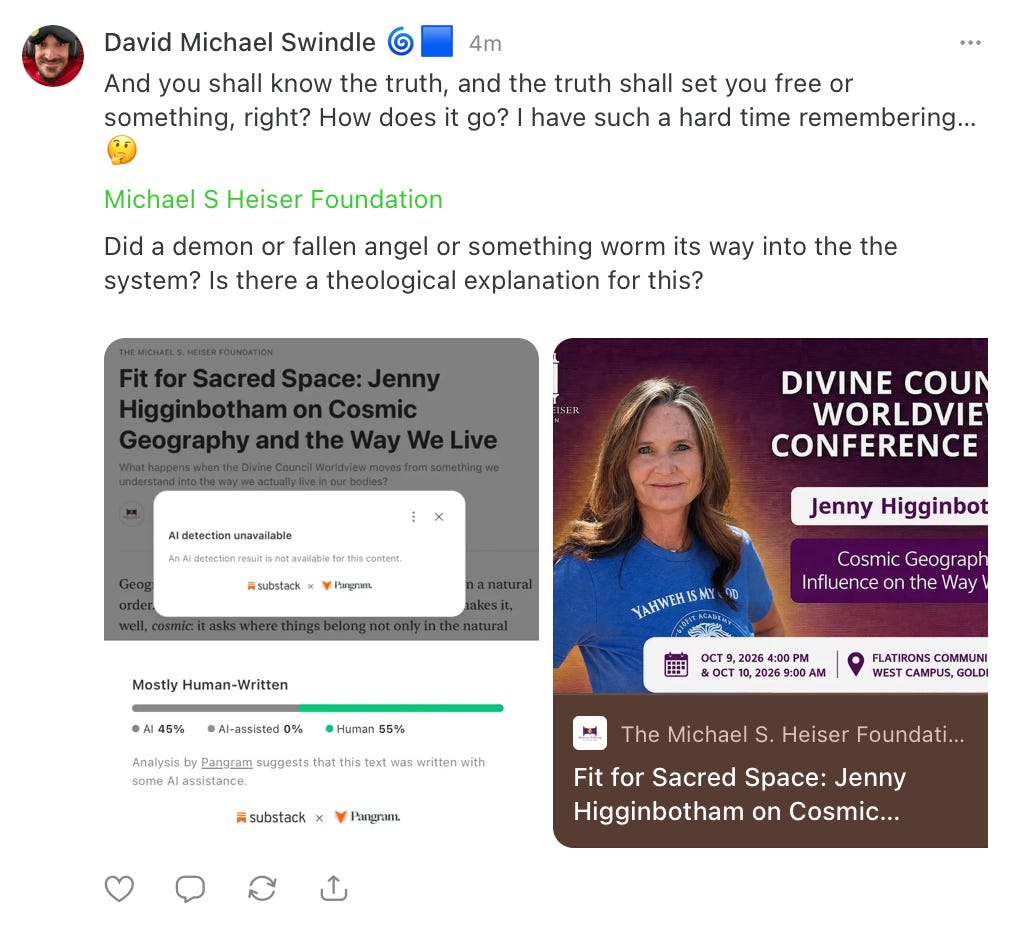
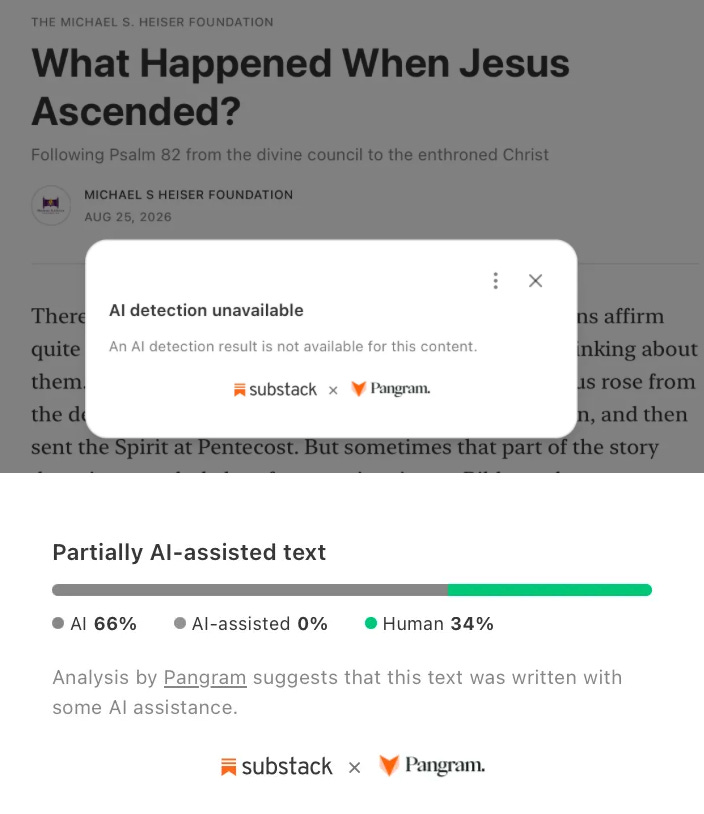
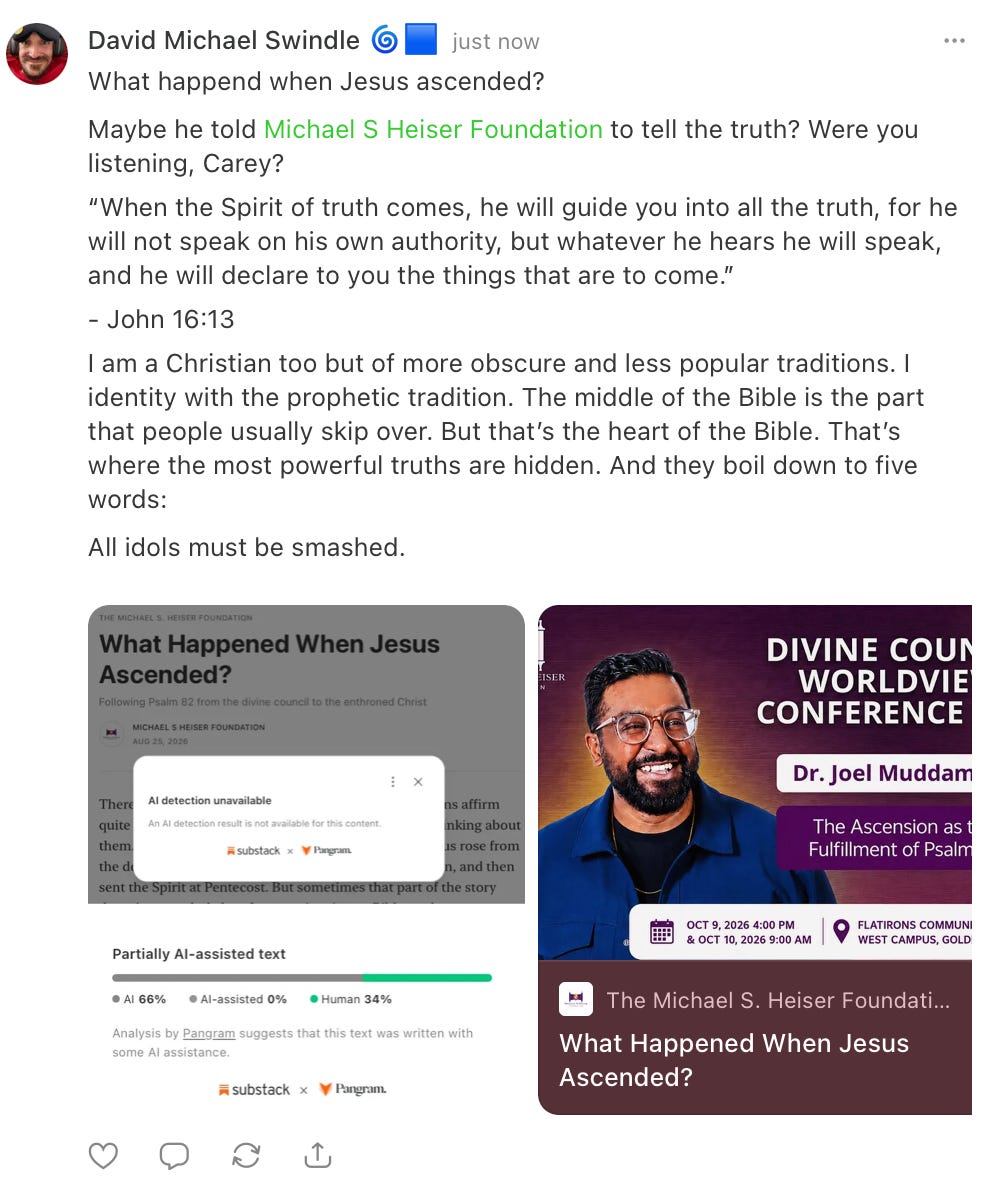
Before acknowledging any of the three notes above, Carey responded again, telling on himself. I responded with screenhots of the three AI scans above:
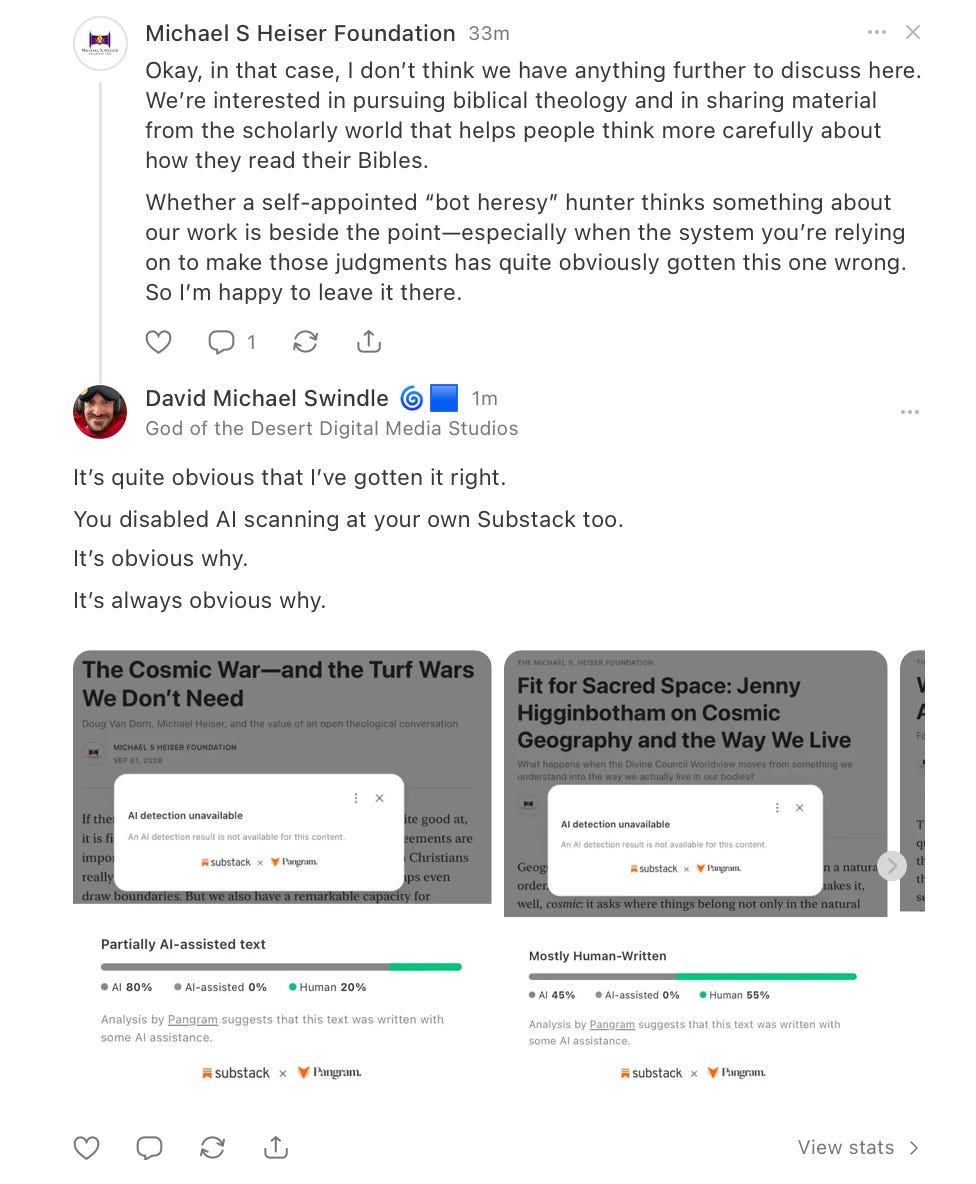
He again attempted to malign Pangram as unreliable:
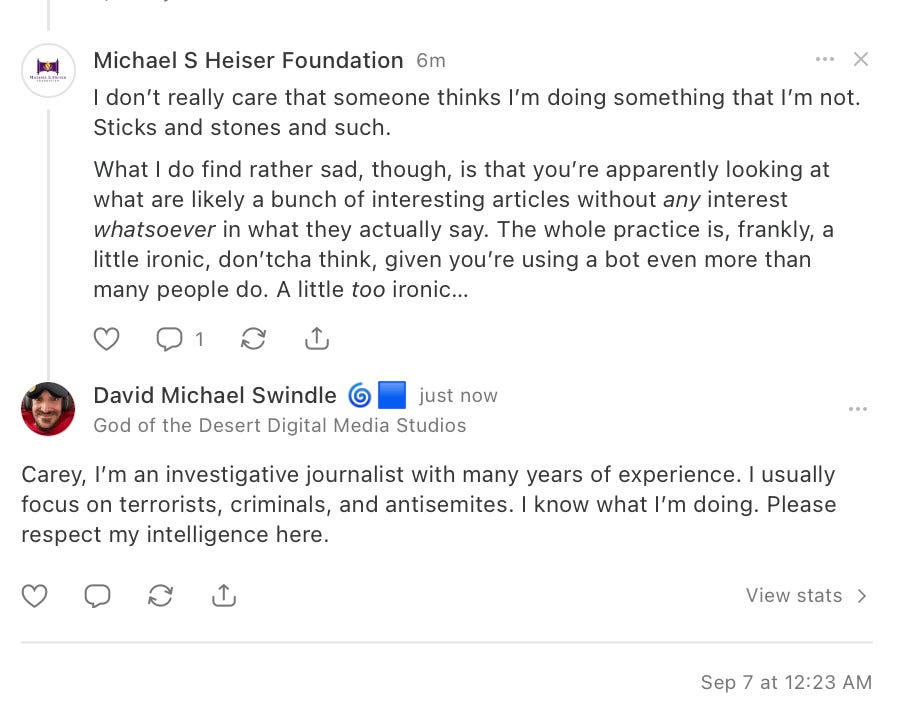
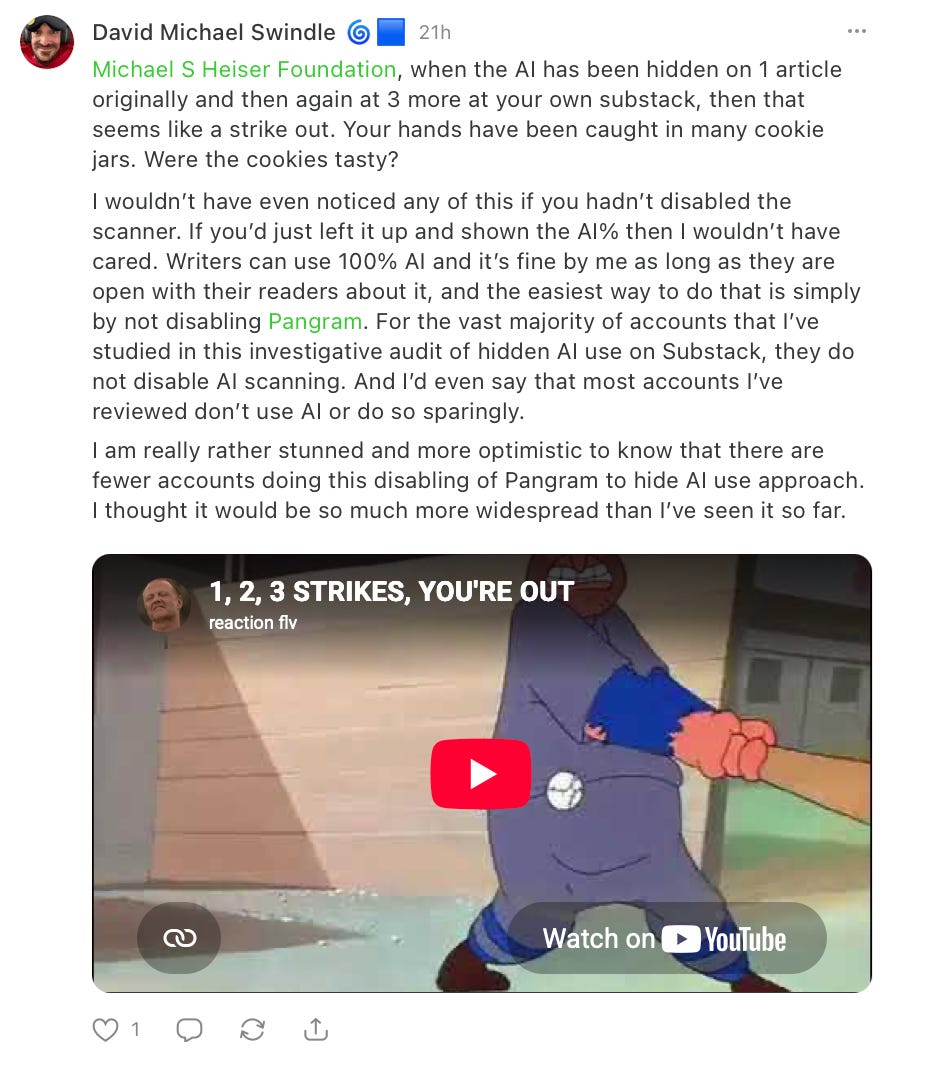
Usually in the research of a Substack I’d take a 3-strikes-you’re-out mentality. One post could be negligence or confusion. Three posts in a row is a pattern and deliberate.
SEPTEMBER 20 UPDATE:
Oh yeah, that’s the stuff right there, right into my veins:

Tell me you’re peddling bullshit without telling me you’re peddling bullshit.
The religion category offered other esotetic eccentricities which I otherwise might have sympathized with…
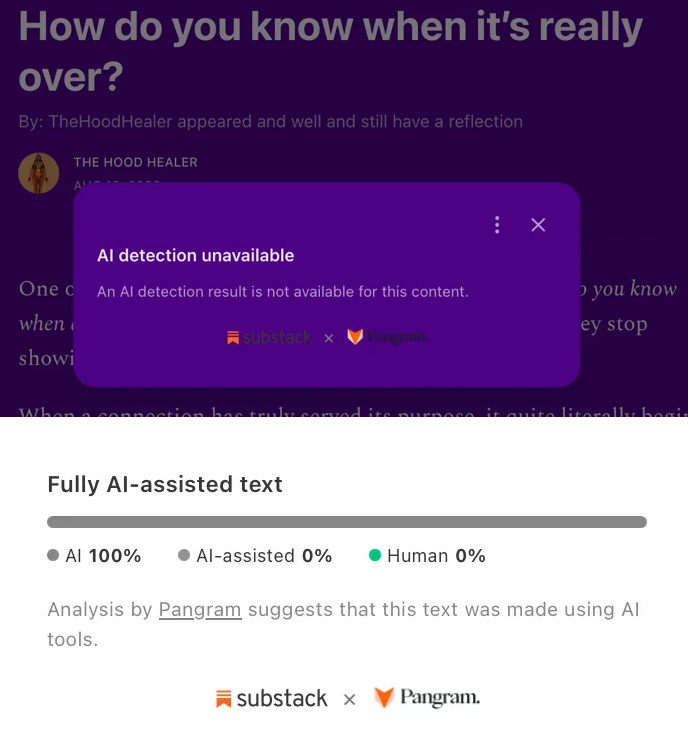
23. The Hood Healer

I have written previously about how I draw a strong line between the centuries of occult tradition which I practice and the New Age movement which emerged primarily in the 1970s:

When one starts swimming in the New Age seas on Substck then all sorts of weirdness and darkness emerges. The Hood Healer is probably fairly benign in spite of the LLM plagiarism, it’s the self-proclaimed “The Wise Wolf” next who is doing more damage not just with deceiving readers on authorship, but in laundering antisemitism.
SEPTEMBER 20 UPDATE:
The Hood Healer has offered no new posts, nor any contact so she will remain on the upcoming Wall of Shame.
24. The Wise Wolf
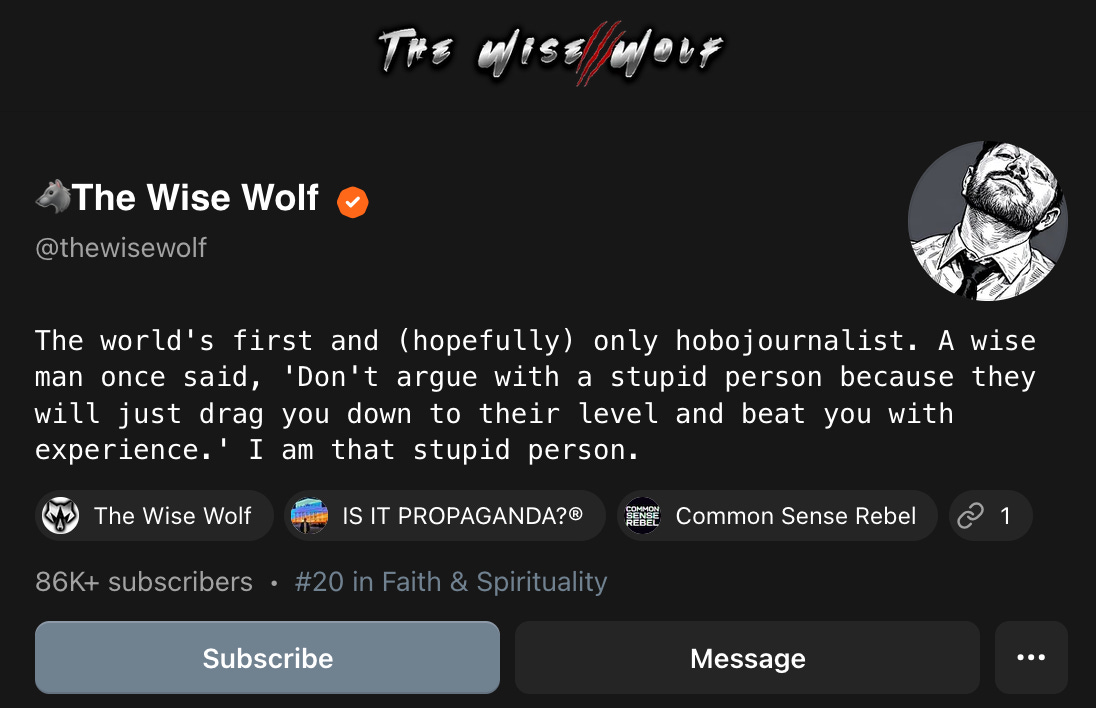
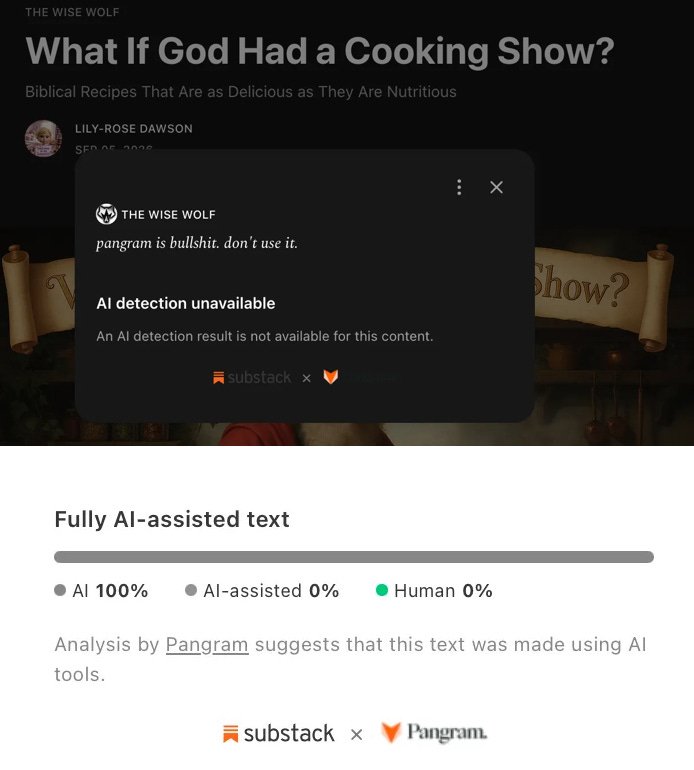
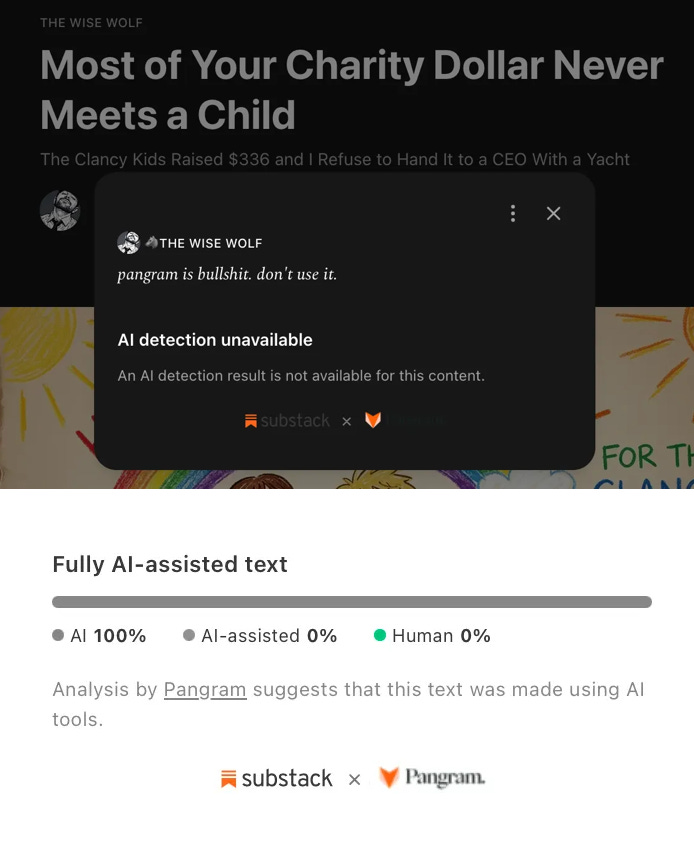
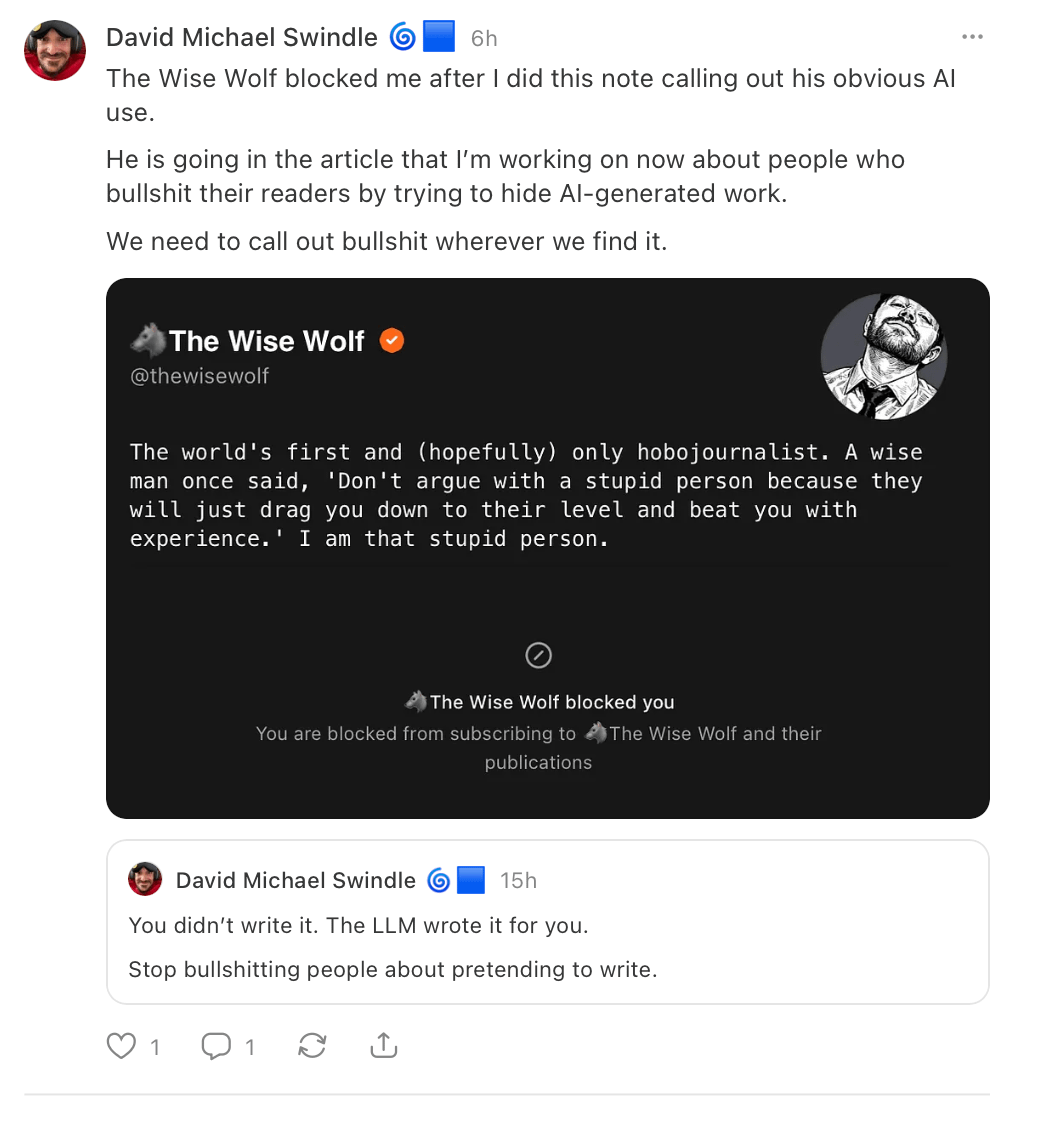
I don’t remember how or why I had first started following The Wise Wolf. I gather just because he’s a popular promulgator of “alternative spirituality” type content. I engaged with him a number of times and it soon became clear he was not at all bright and was just a run-of-the-mill right-wing conspiracy theorist using the mystical aesthetics for branding.
When I started calling him out on Notes then he quickly blocked me:
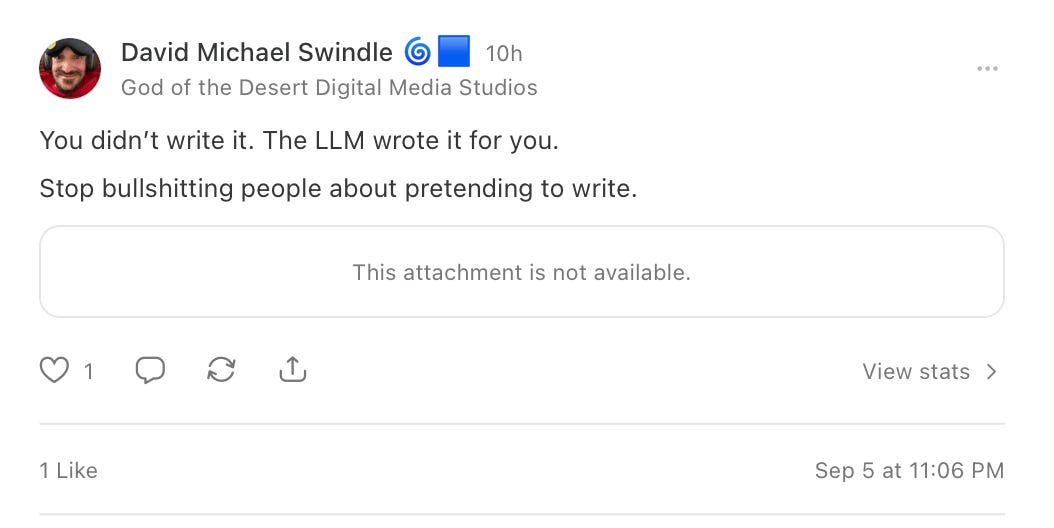
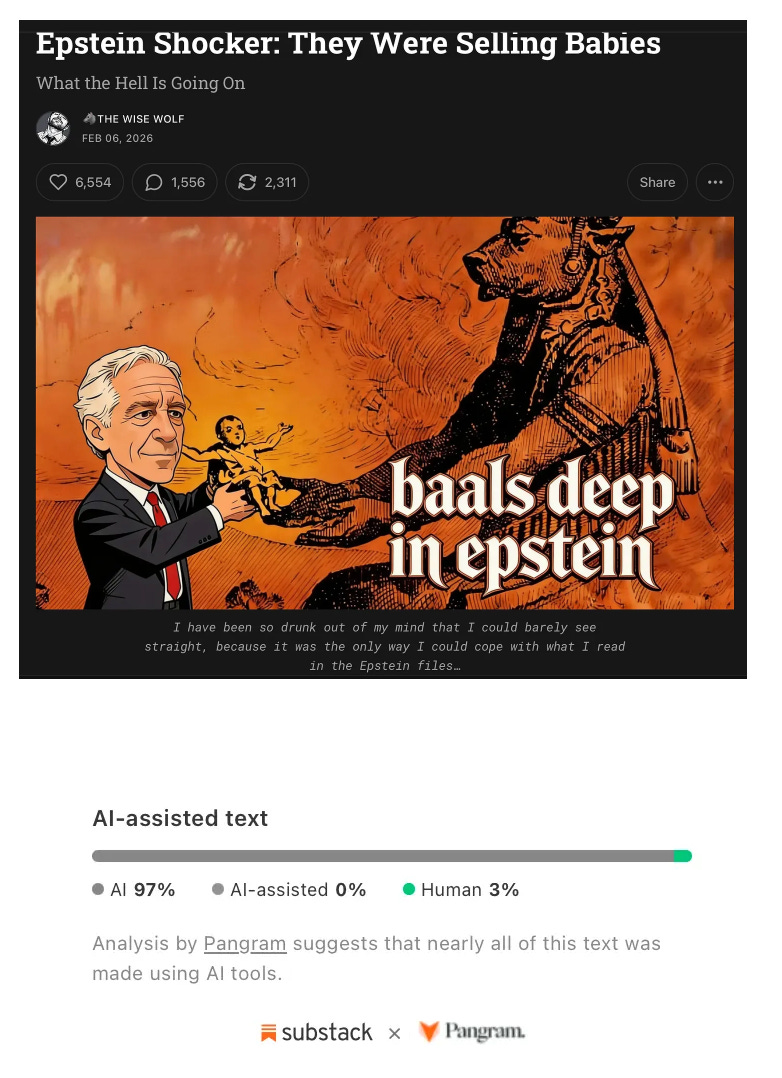
Earlier in year, pre-Pangram, here was one of his top posts, which generated 2,311 restacks and 6,554 hearts, likely because of its antisemitic, blood libel trope of Jews selling and murdering babies:
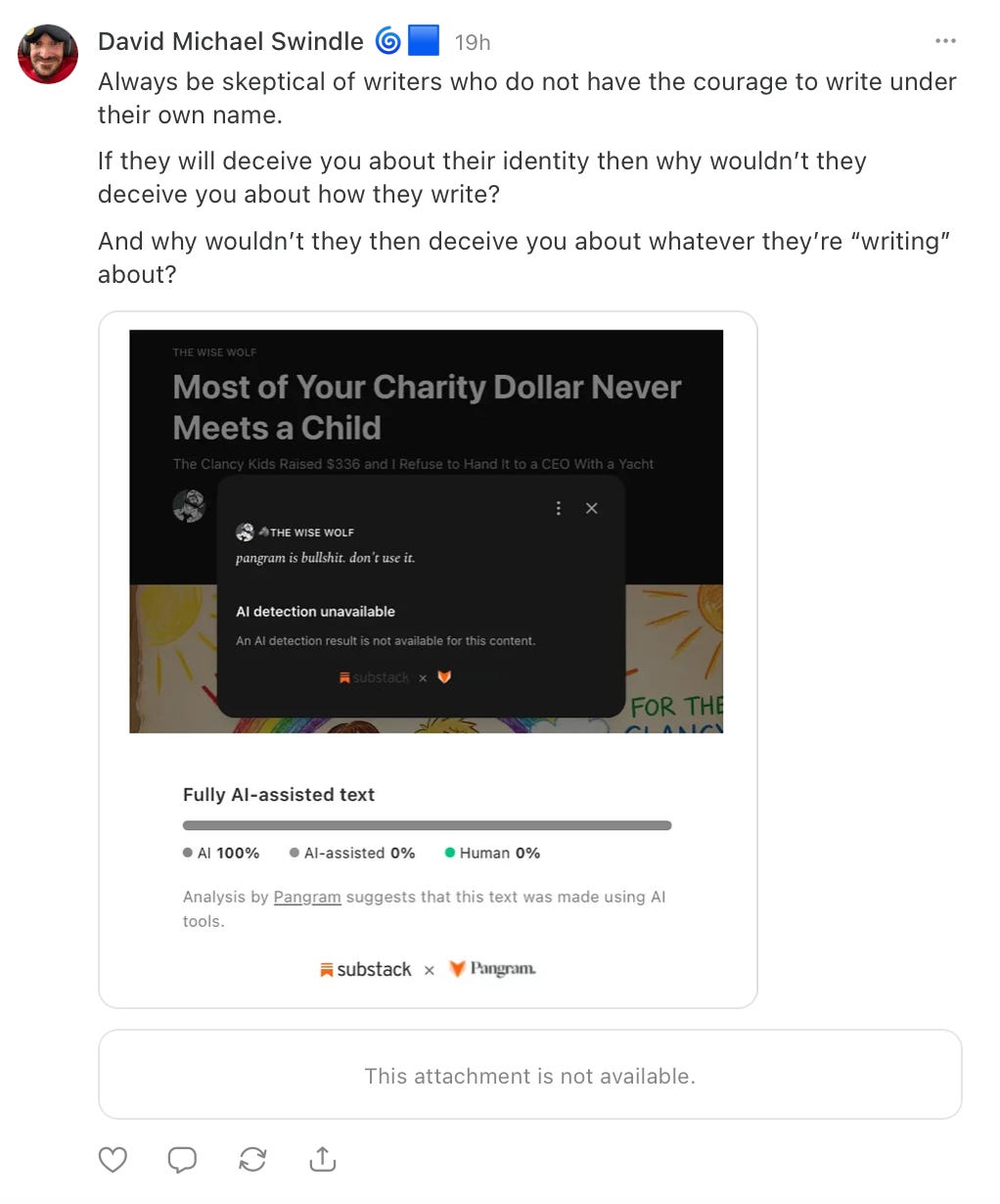
SEPTEMBER 20 UPDATE:

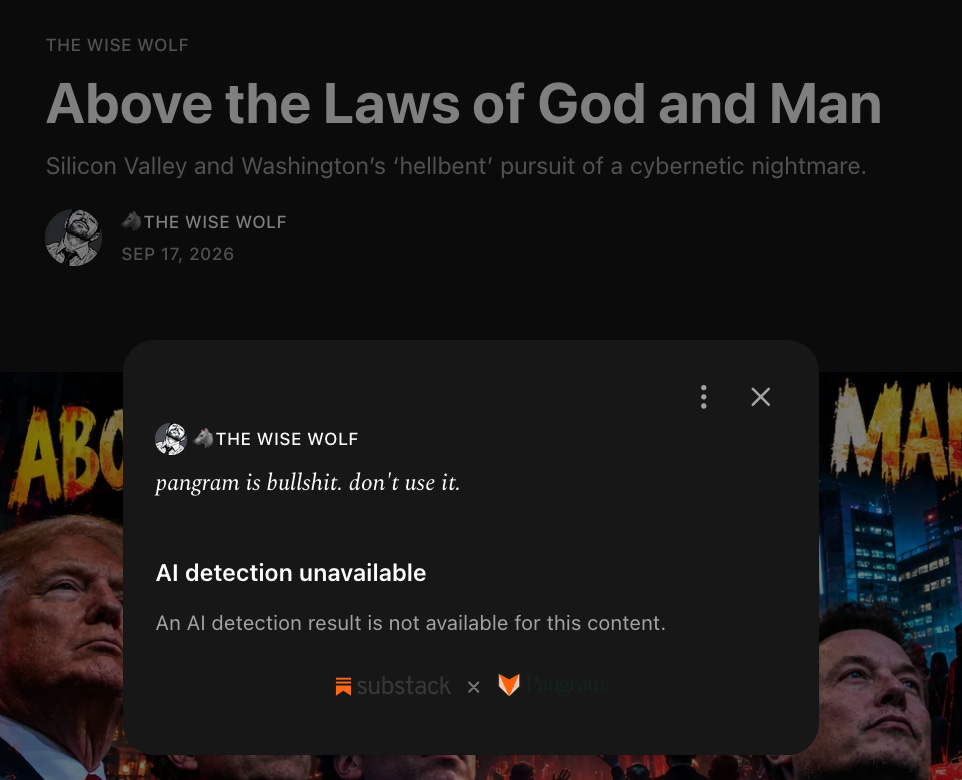
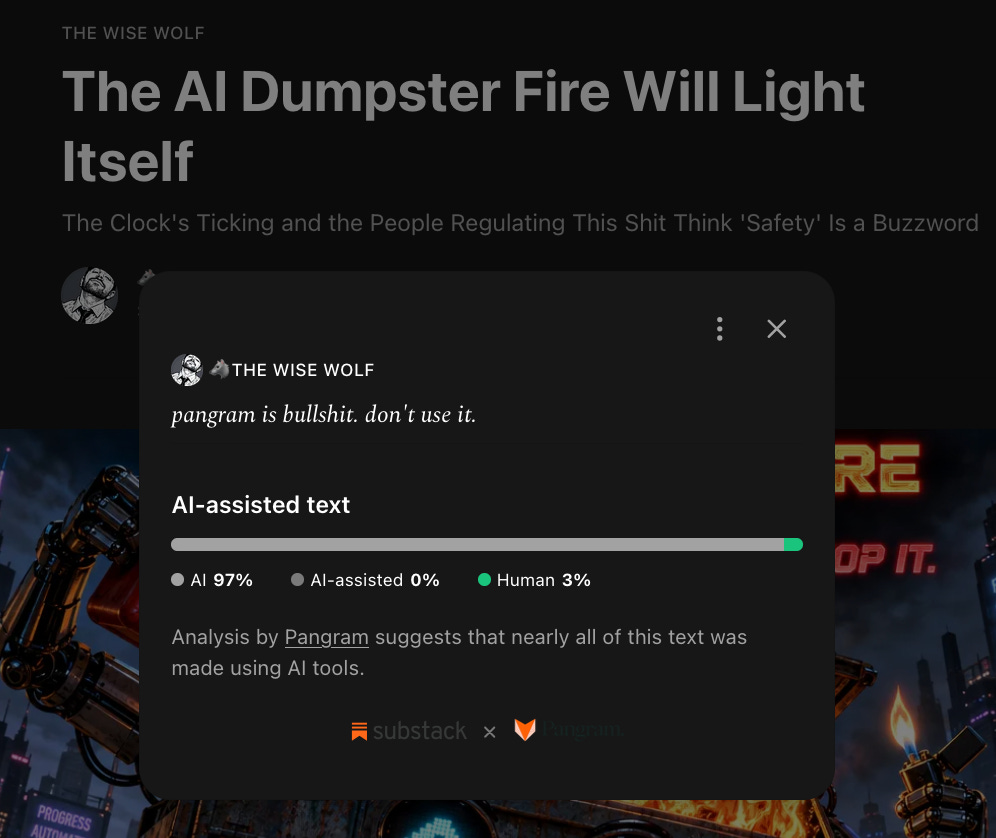
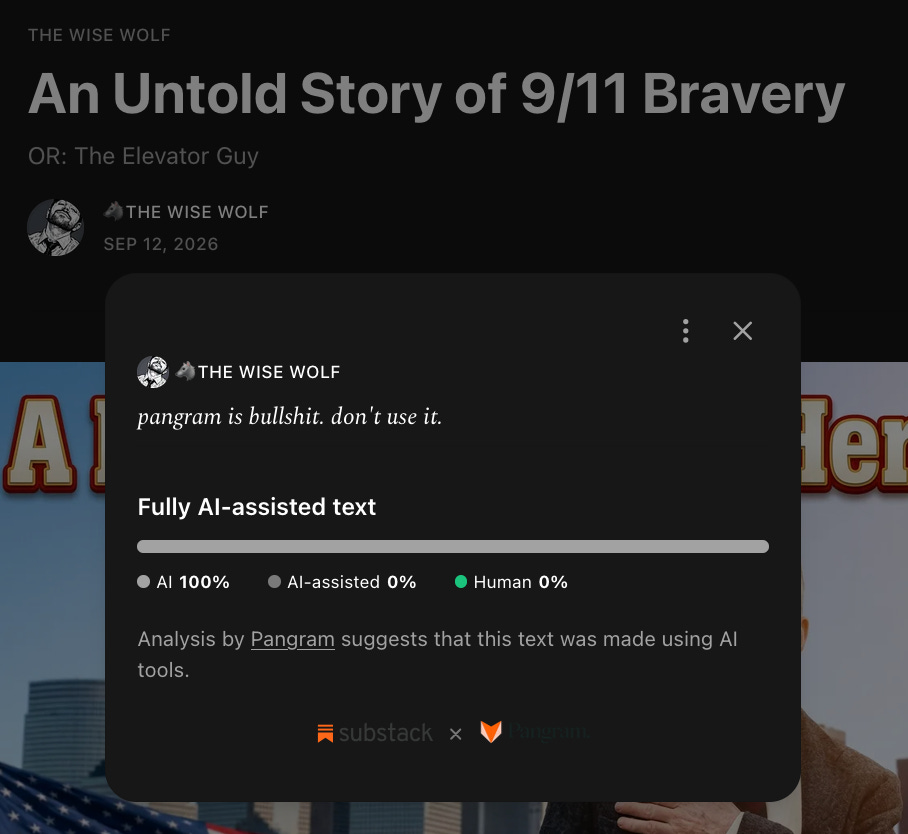
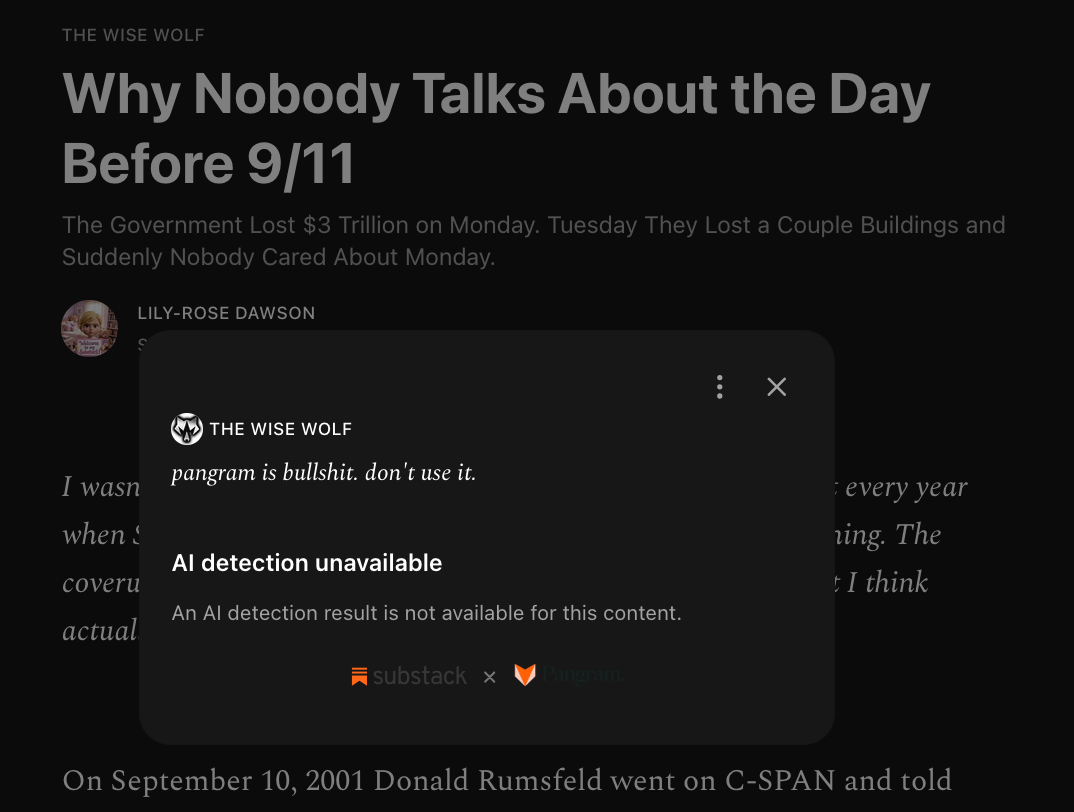
So now instead of “The Wise Wolf” disabling pangram all the time, he only turns it off sometimes. I suppose that’s progress.
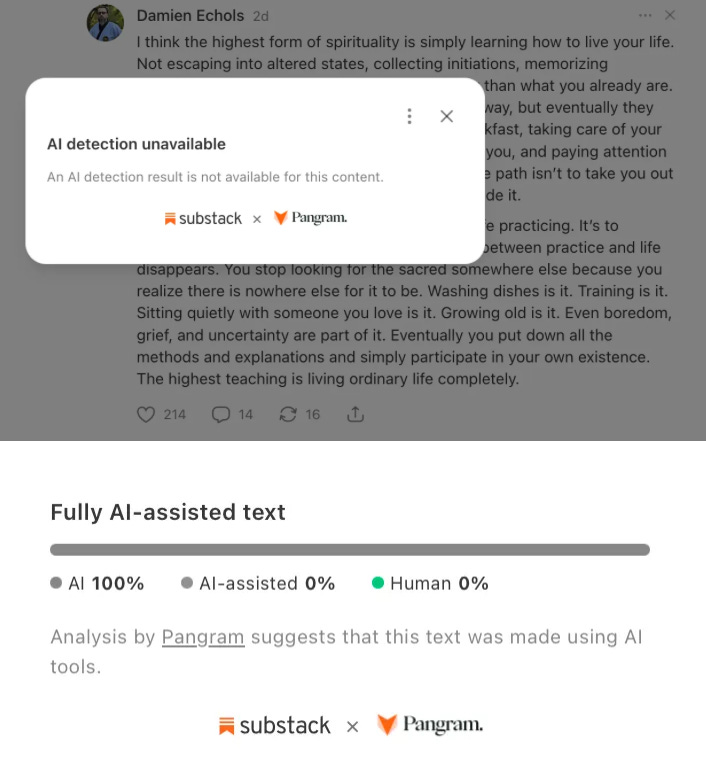
25. Damien Echols
Damien Echols has long been a famous figure in occult circles due to his tragic life story depicted in the famous “Paradise Lost” documentaries:
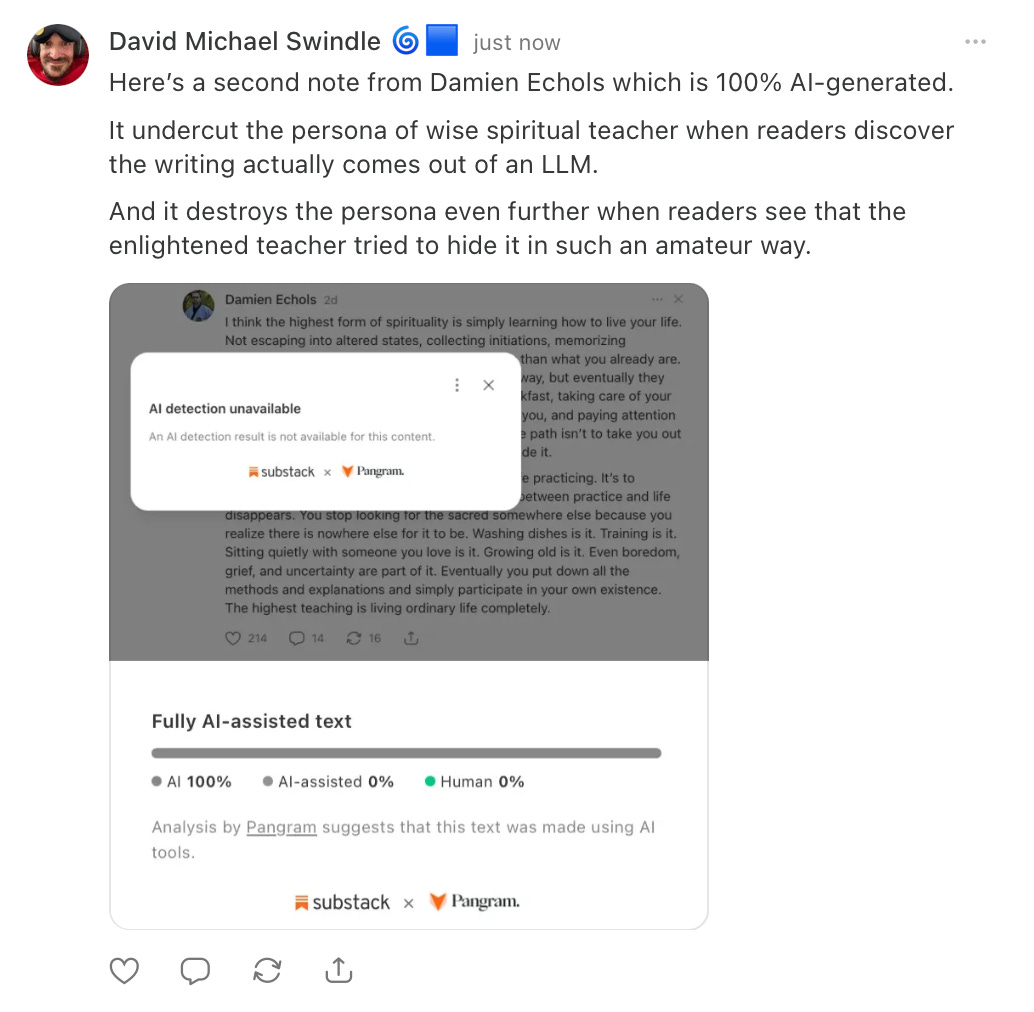
There’s just one problem. In spite of all that time wrongfully spent behind bars, apparently Damien did not learn to write as well or think as deeply as he wants his readers to think:
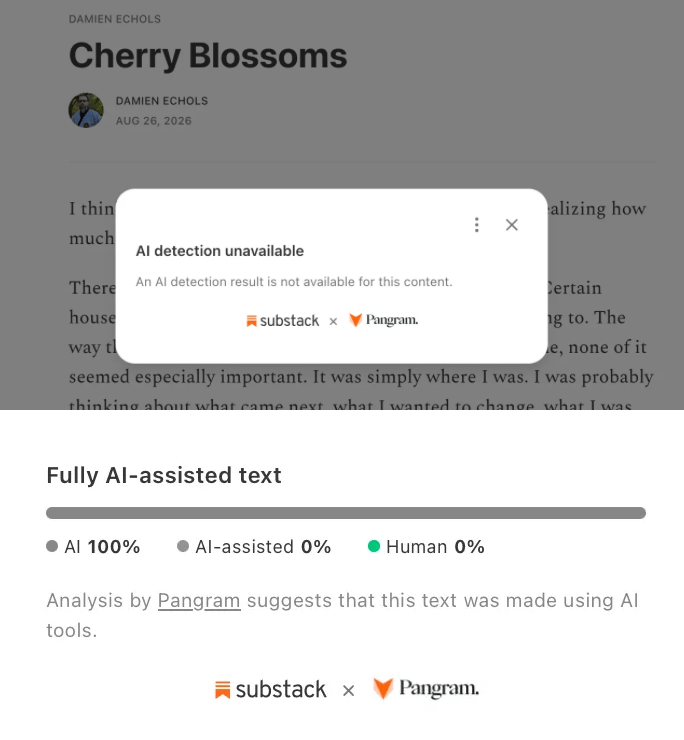
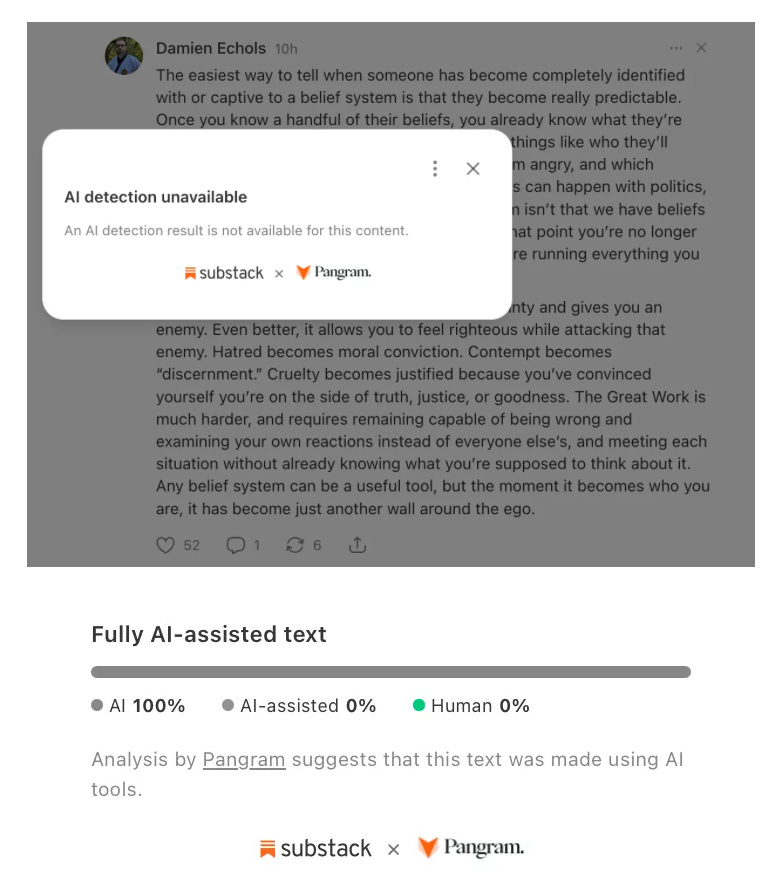
In recent years, Damien has sought to rebrand himself as a kind of mytical guru, in the mold of his friend Mitch Horowitz.
I followd him for a while but he soon blocked me as I began to push back on the generic pablum he published on Notes. It seemed AI-generated at the time and now it’s nice to have confirmation that it was.
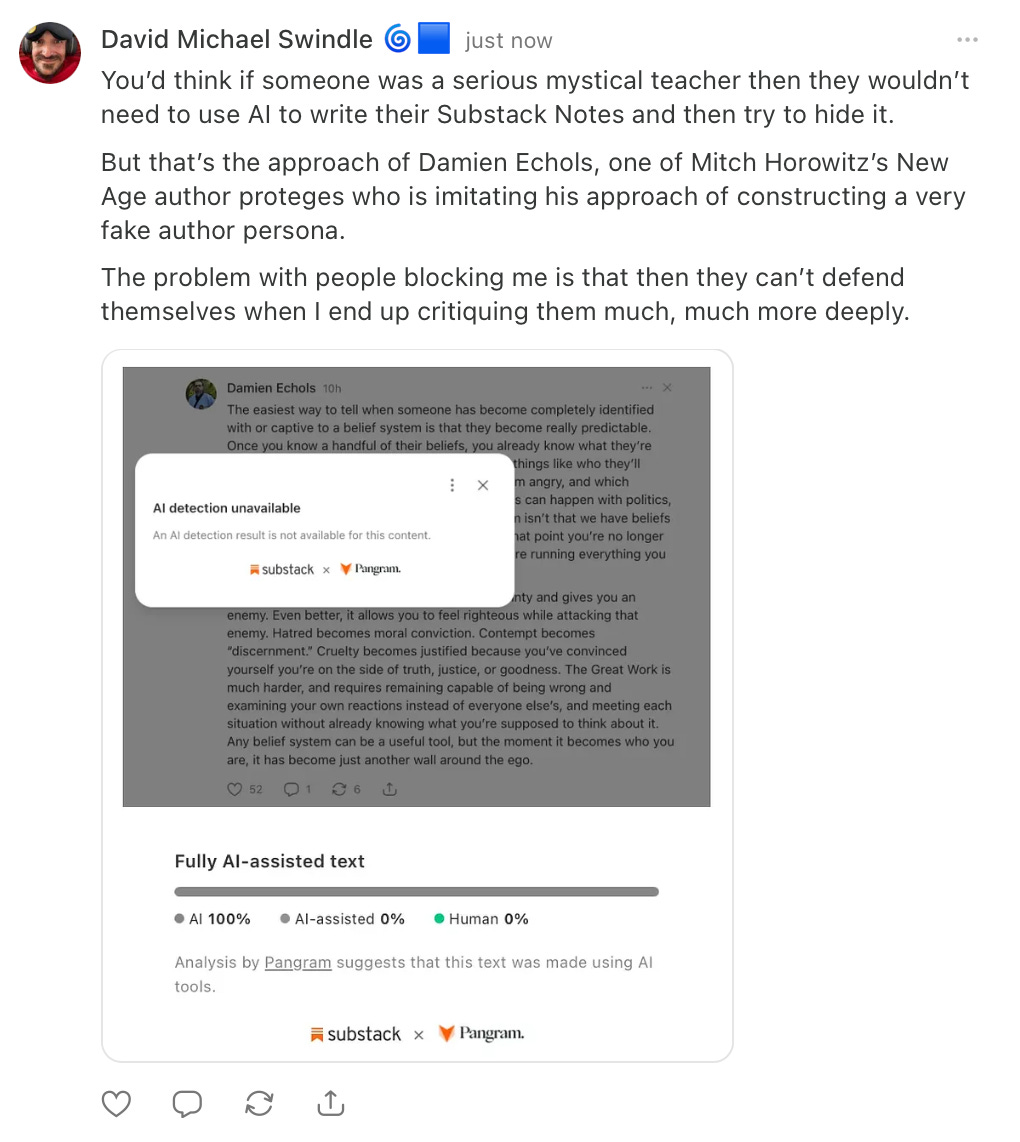
For more on Mitch’s methods of persona creation, see his interview with media theorist Douglas Rushkoff here:
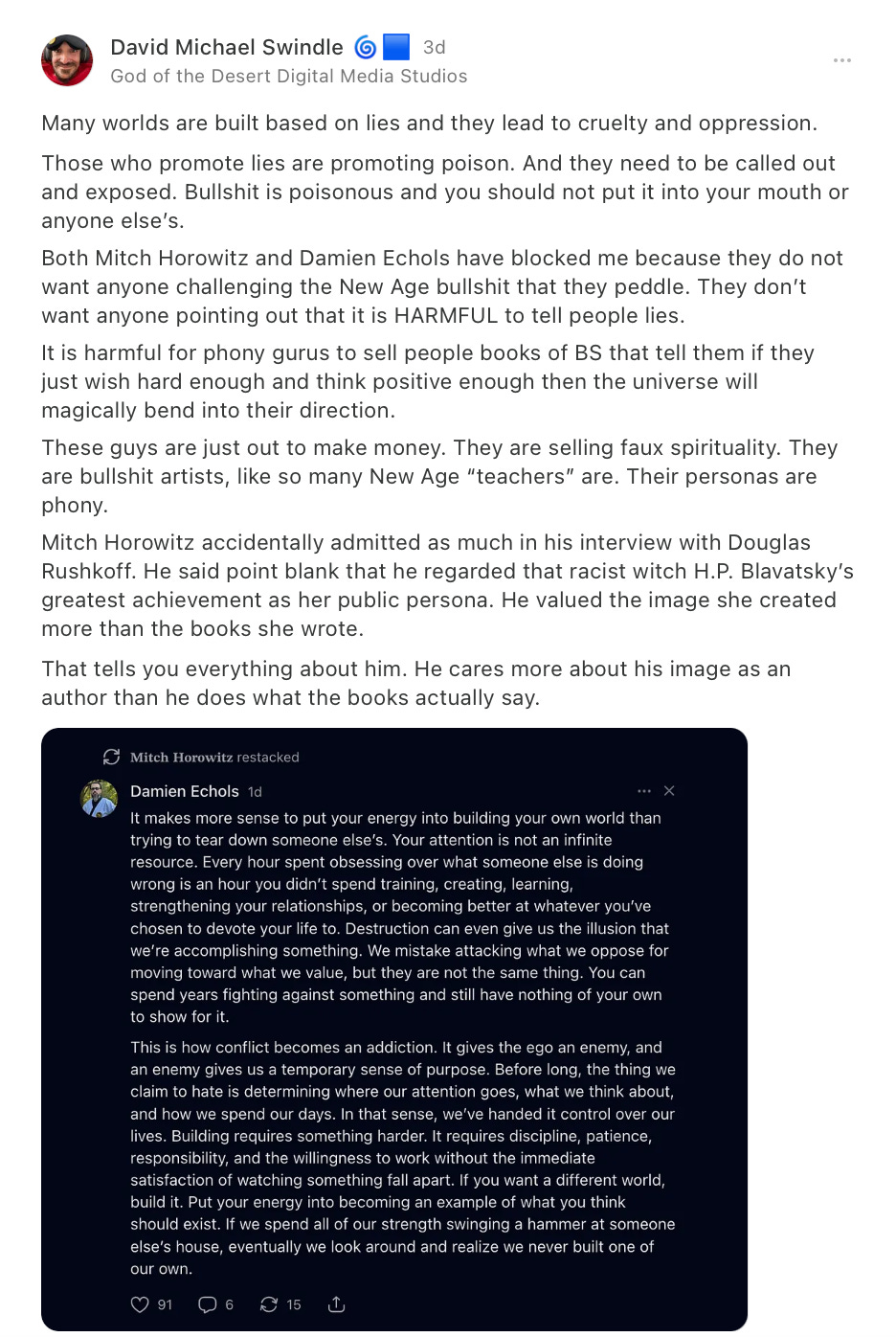
SEPTEMBER 20 UPDATE:
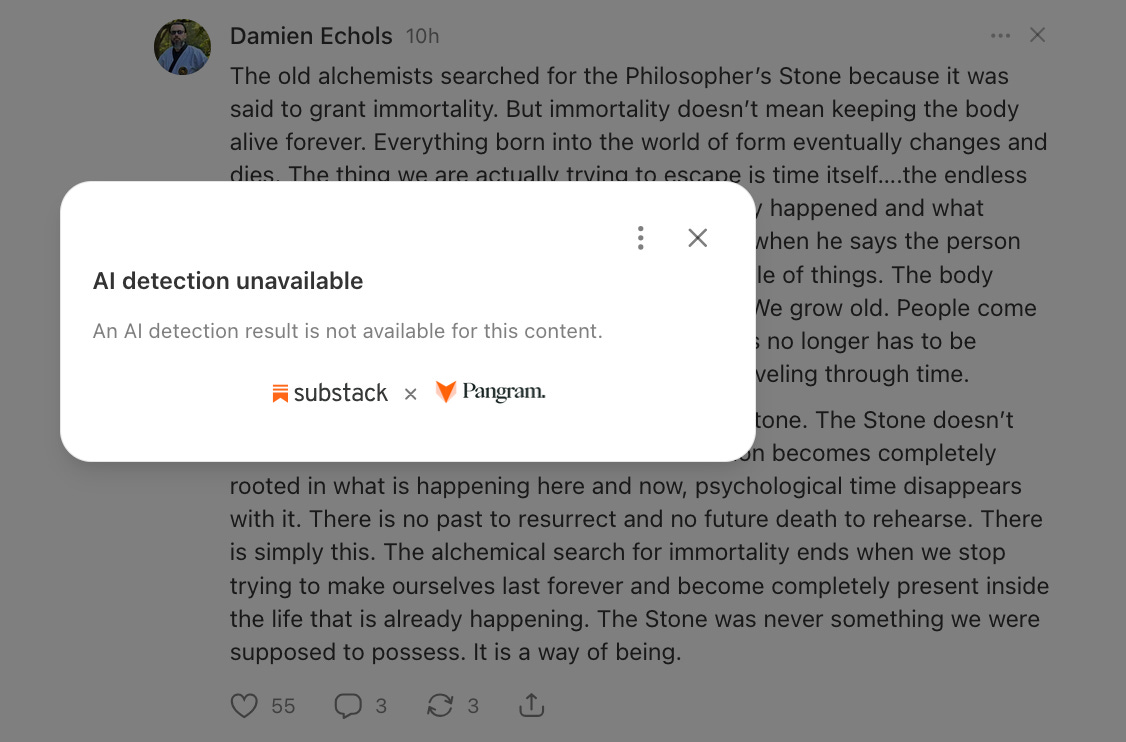
He continues to disable Pangram to peddle LLM-generated wisdom as his own profound spiritual teachings:

26. Demi Pietchell - The Starfire Codes

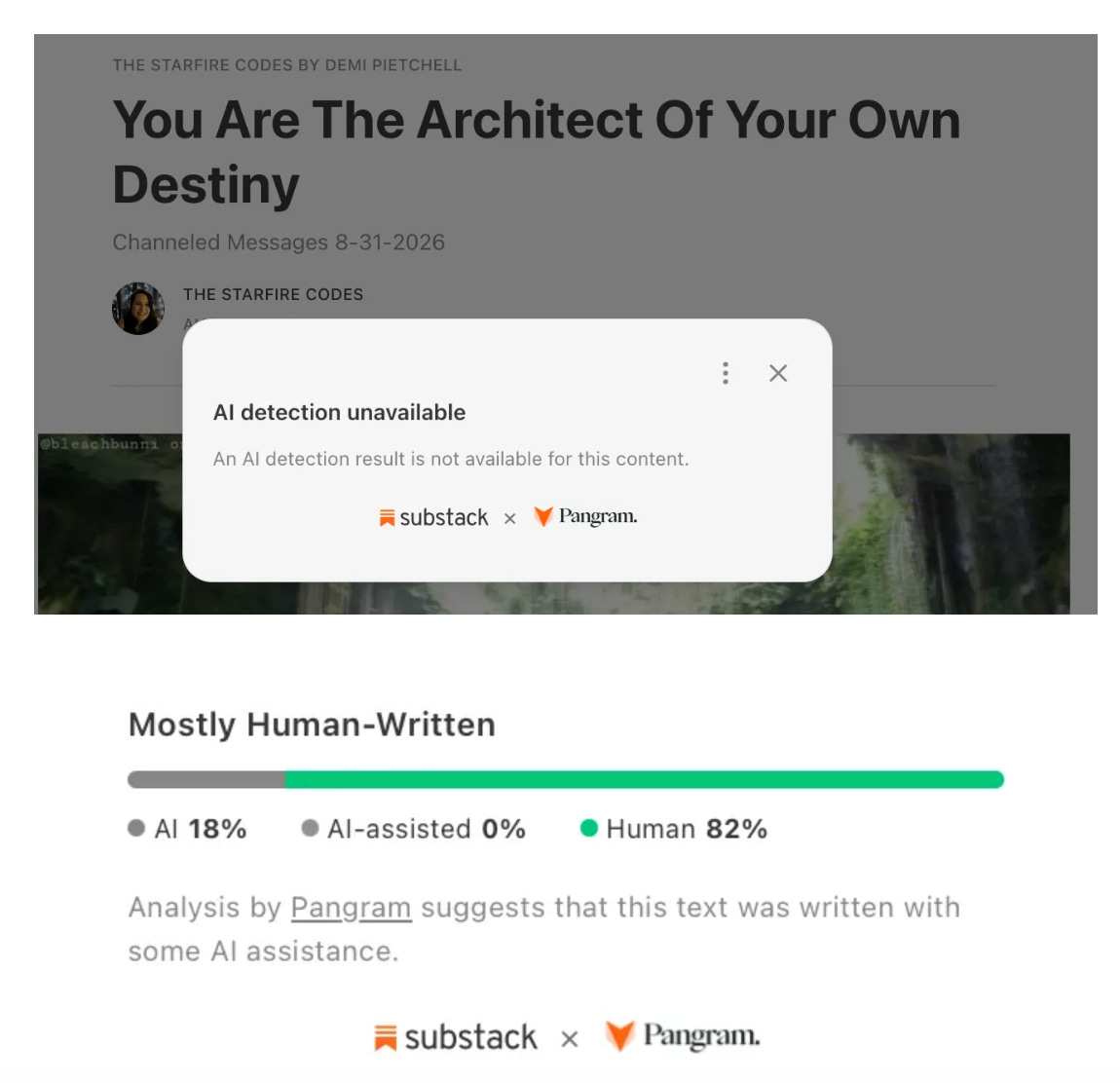
The Starfire Codes is another Substack which sells conventional New Age nonsense. I had followed her some time ago and then she blocked me. The specific reason eludes me. I surely challenged her on some point or another and that was enough.
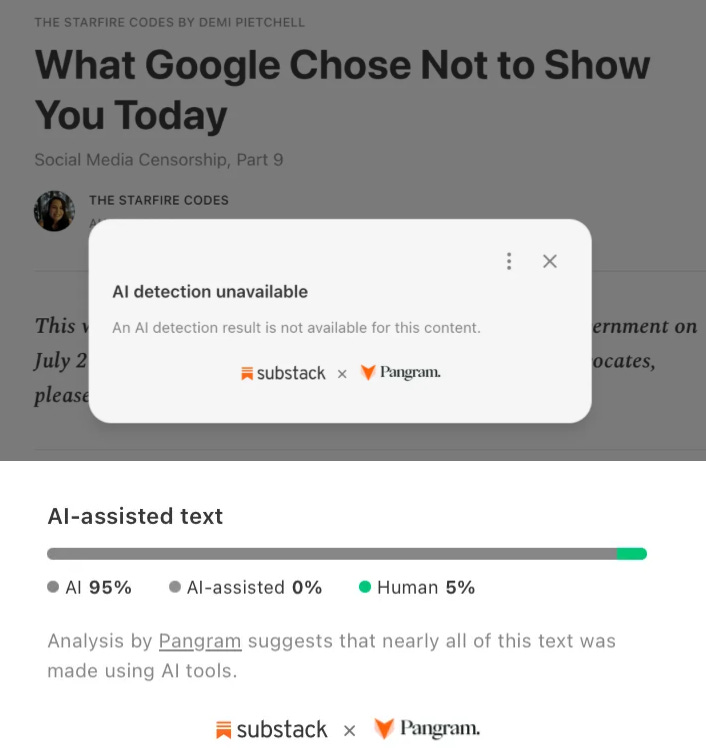
SEPTEMBER 20 UPDATE:

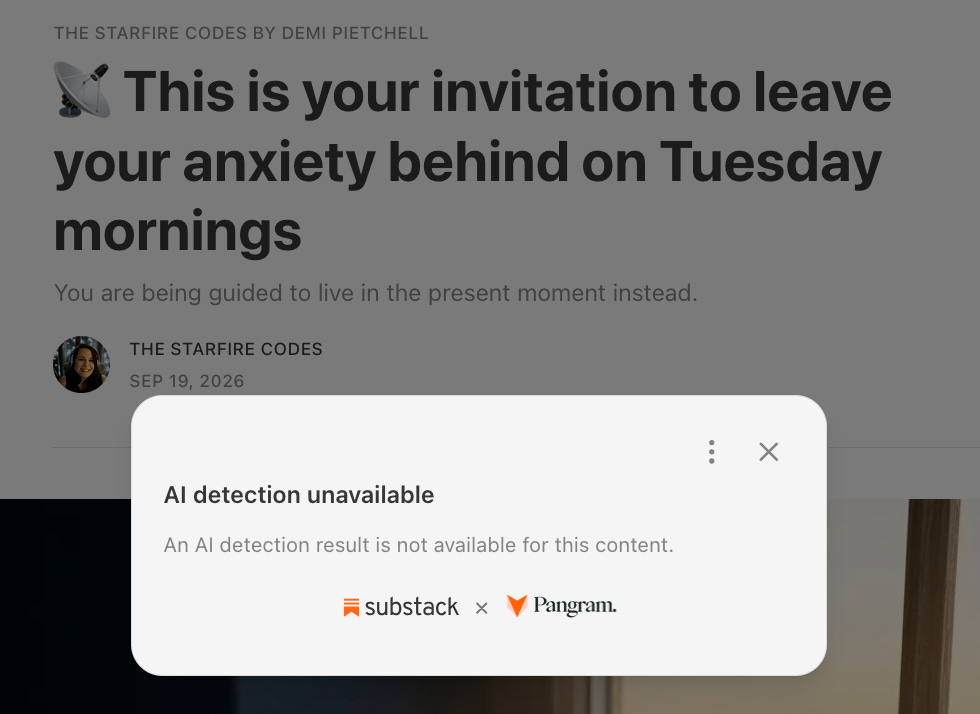
The irony in juxtaposition here should perhaps be stated explicitly.
Following four Substacks with New Age AI slop garbage overflowing, now we stumble onto a rabbi, Rabbi Steven Abraham, pulling the same trick.
27. Rabbi Steven Abraham
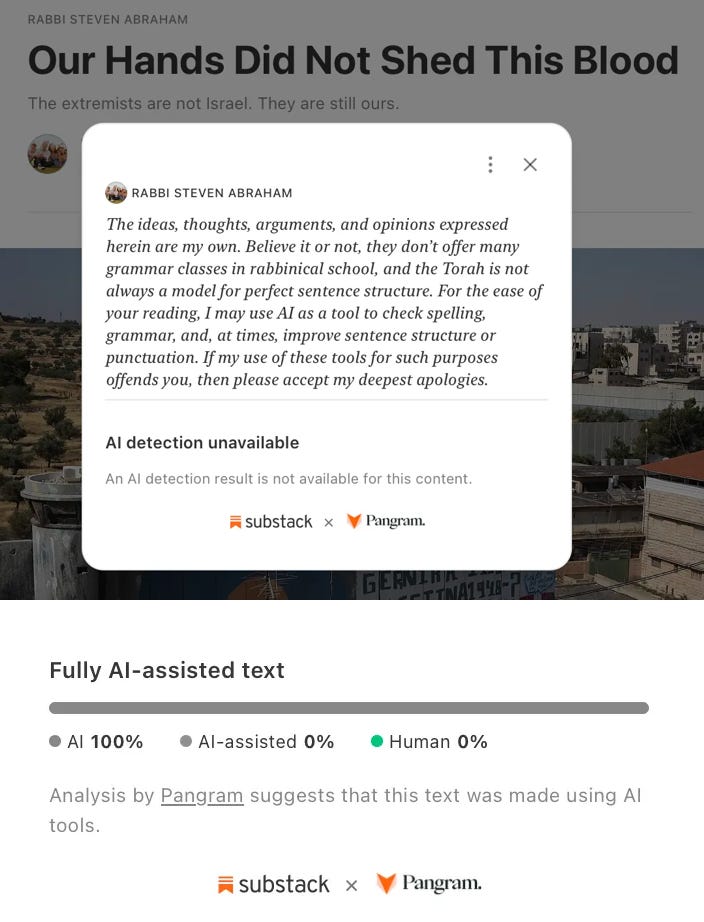
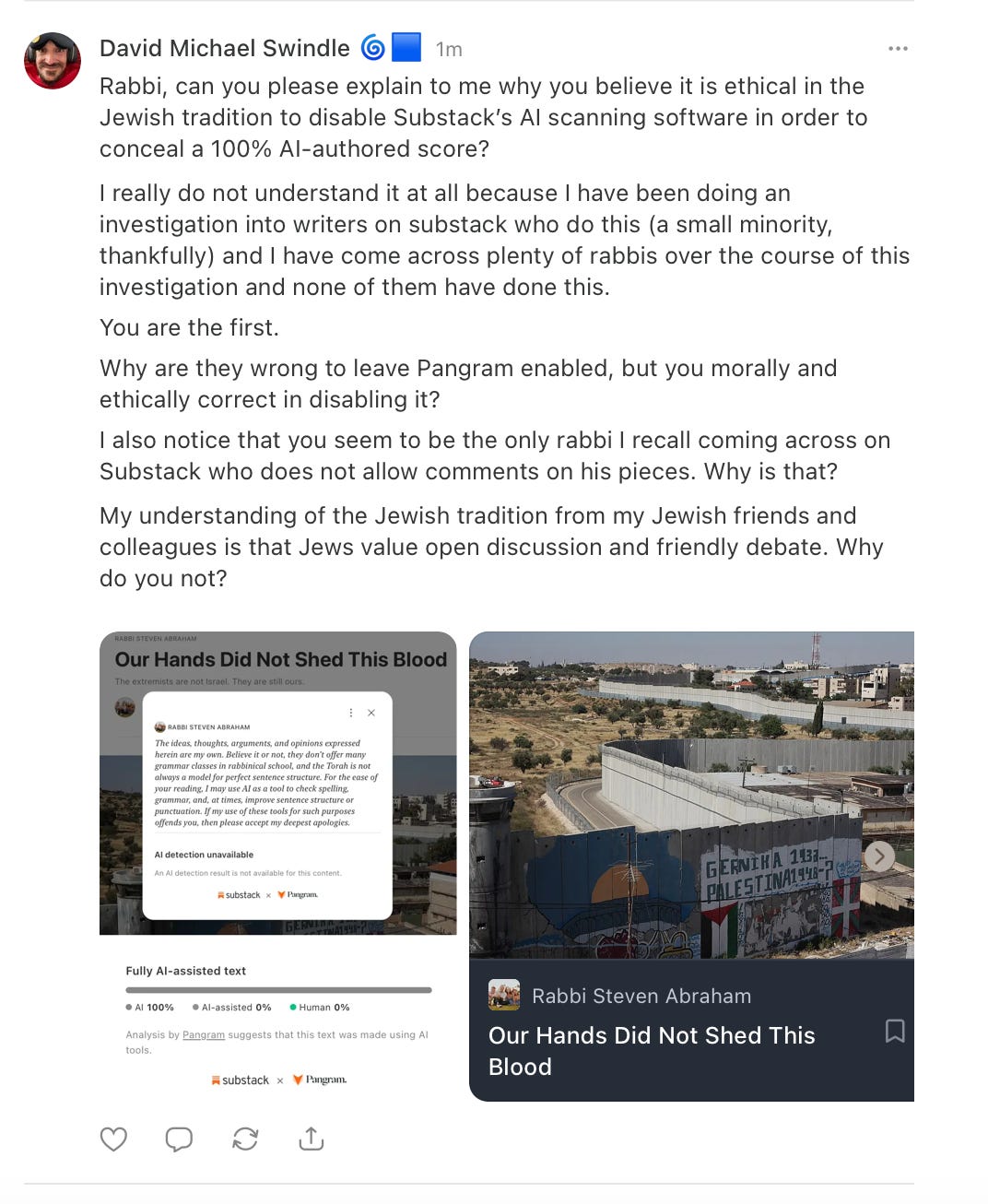
SEPTEMBER 20 UPDATE:
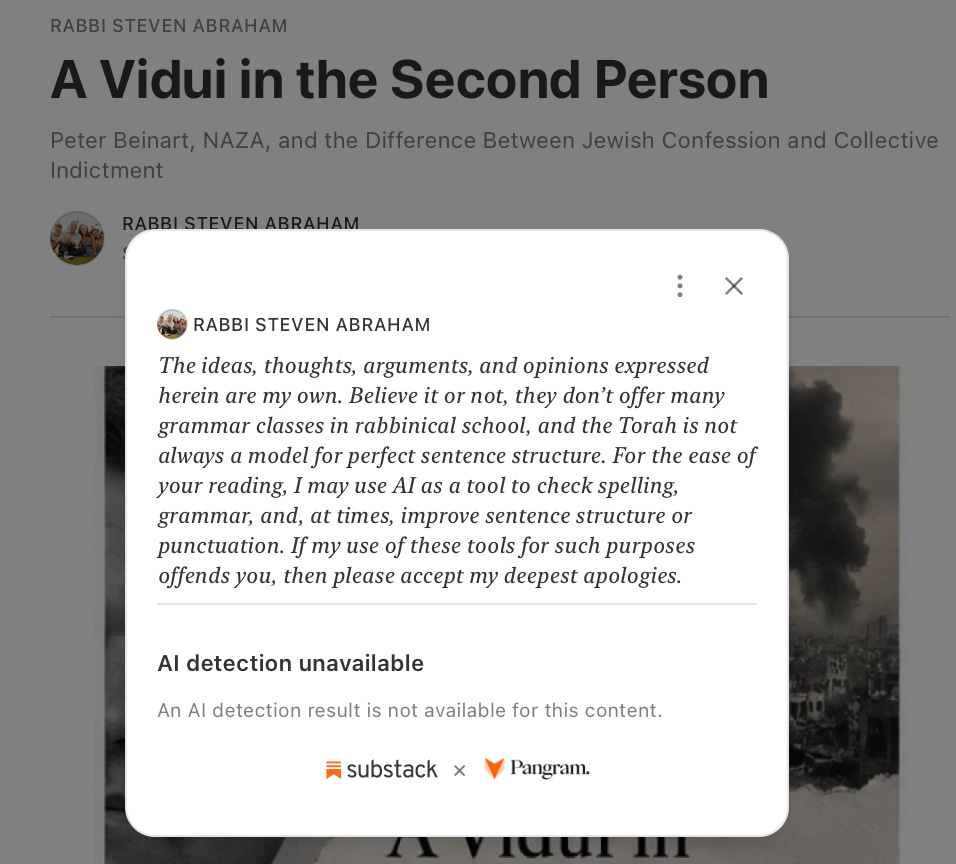
If Rabbi Abraham admits he uses AI to aid in his writing, then why not simply disclose to what extent?
4 Zionist BS Merchants
Perhaps the pattern is clear now: anybody with any ideology or agenda can choose to obscure and misrepresent the level of authorship in their articles in order to fluff themselves up to appear as a greater writer than they actually are.
Here are four who I found in the movement which I’ve participated in since 2009.
28. Hen Mazzig

This is another discovery in this investigation that broke my heart.
I’ve always liked Hen Mazzig a lot and still do. I interviewed him one time years ago at a Zionist students conference in Washington D.C.
The issue is that Hen has more made himself into a symbol, a pundit, and predictable propagandist rather than a serious writer or original thinker. With 300,000 followers on X he has become tremendously influential. During my years reporting for JNS and The Algemeiner, I checked up on him every day on X to see what narratives he pushed out into the broader pro-Israel space.
But what genuinely original ideas and writing has he ever put forward beyond rah-rah for Israel?
I haven’t heard them yet but perhaps I just haven’t listened carefully enough.
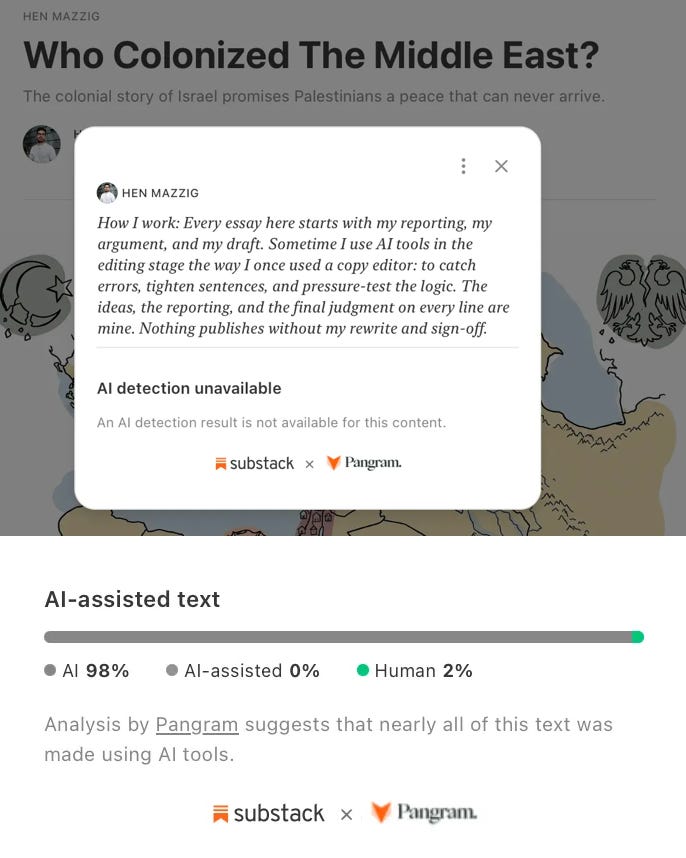
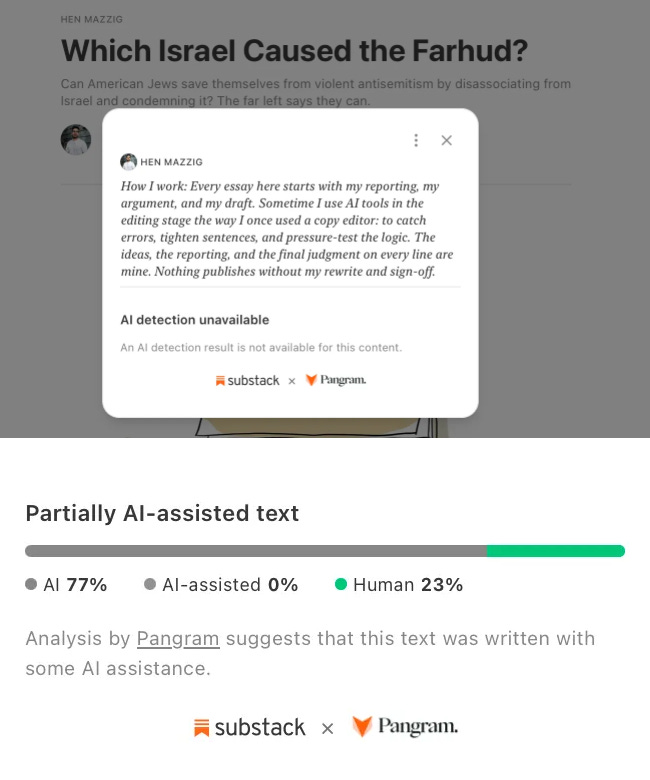
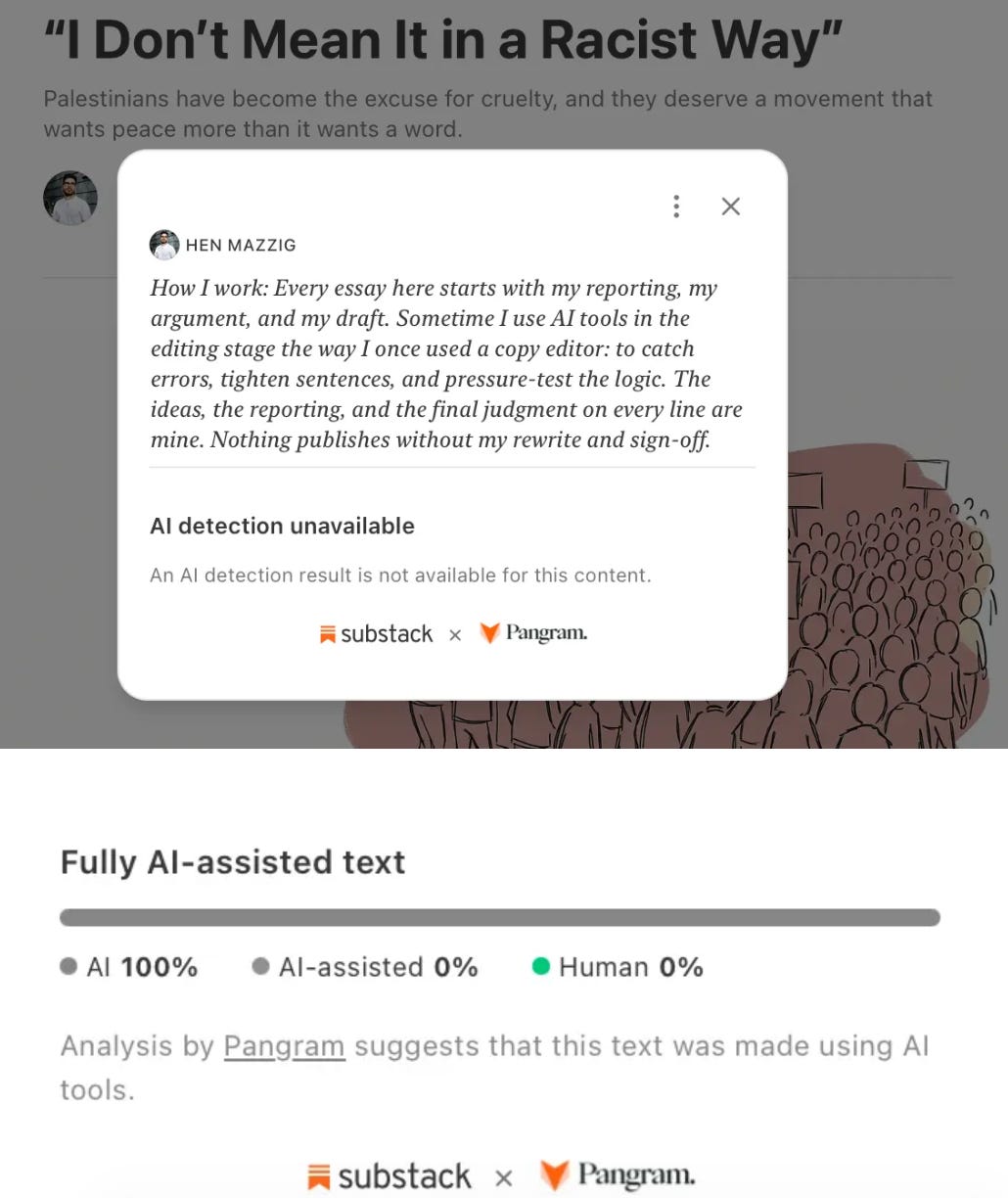

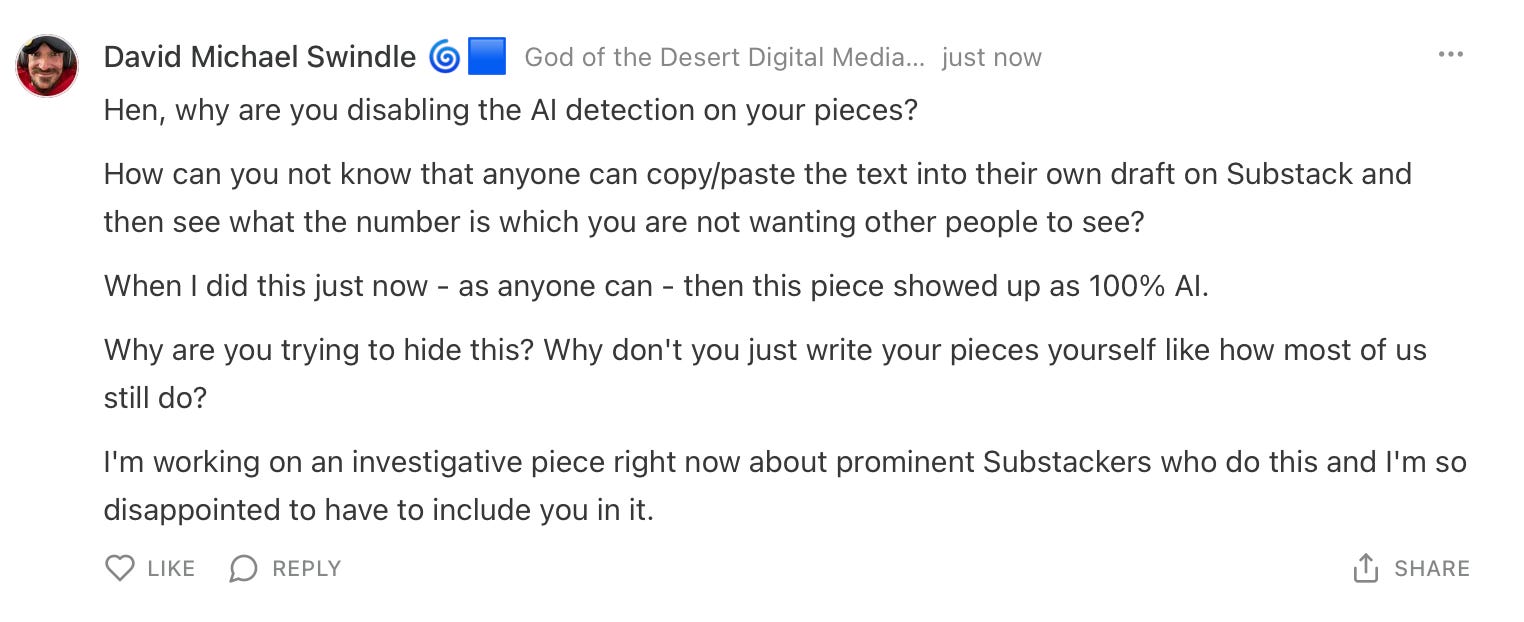
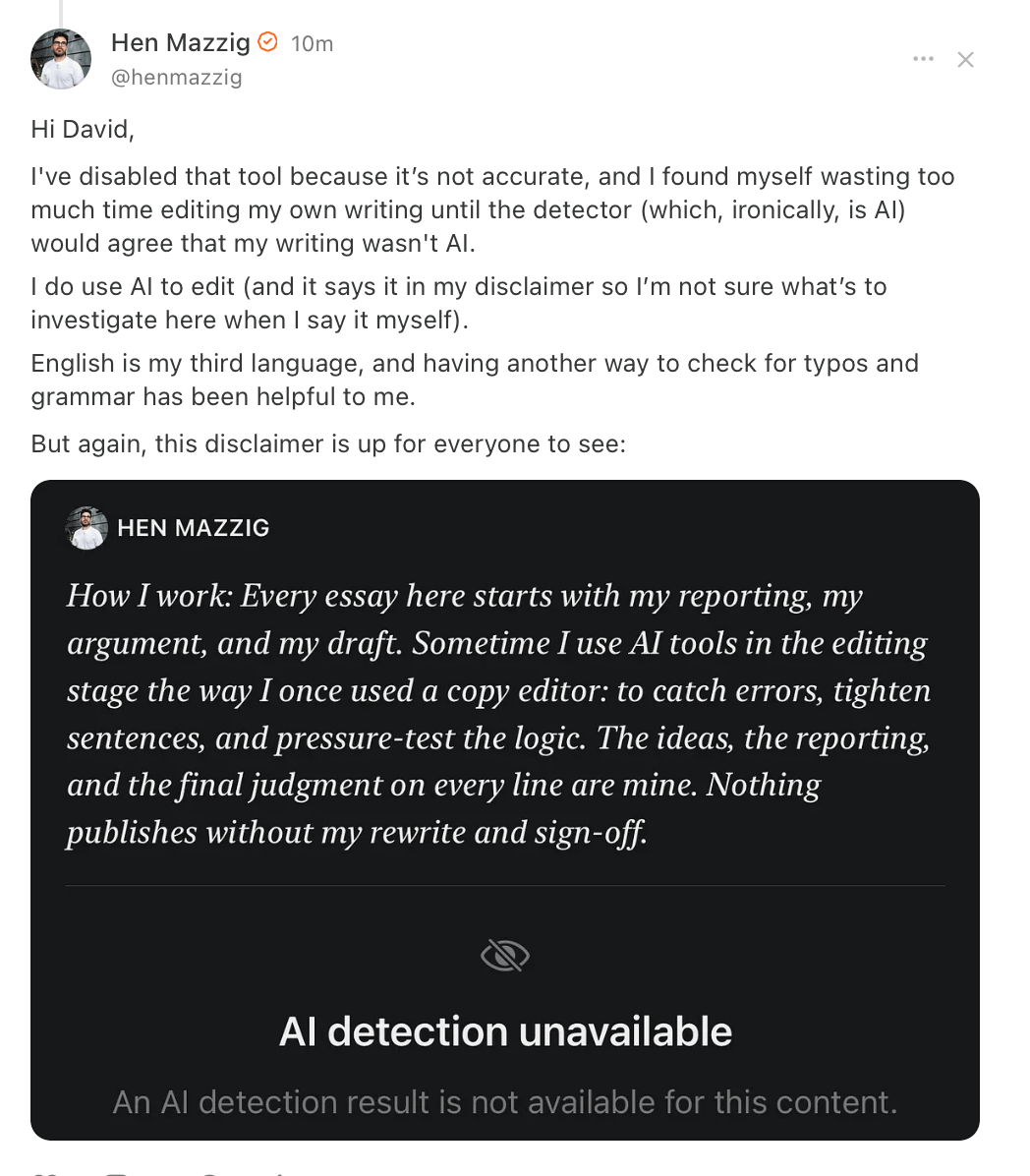
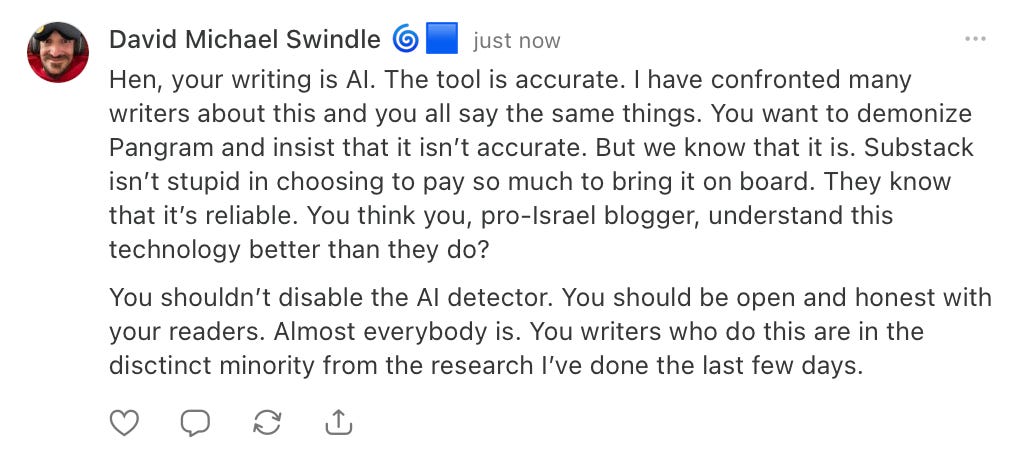
When the Future of Jewish site republishes Hen’s articles then he is not able to disable the AI scanning, so we can see the 92% AI level for his piece published on Saturday:

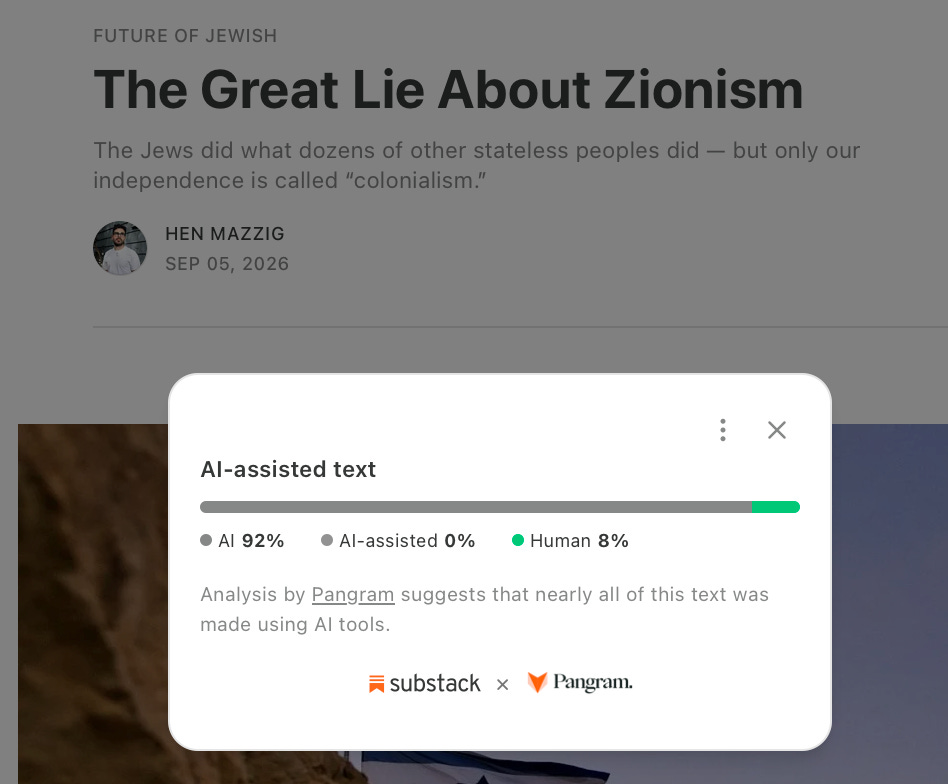
Hen and Emily Schrader are perhaps the two biggest Zionist media advocates online. And both of them for years have just been churning out stuff so predictable that it may as well have come out of an LLM. And now we see that for both of them, it probably did. Wonder why so much pro-Israel discourse sounds similar today? It looks like ChatGPT is the real author behind so much of it now.
Update on Sunday, September 13, 2026:
Following the publication of this article, Hen chose to cease disabling Pangram and specifically published a wonderful 100% human-written piece:
Thanks Hen Mazzig, for listening to me and for upping your creative game. I’m looking forward to continuing to read you and will let you know if I have any other feedback which might be of use to you.
SEPTEMBER 20 UPDATE:
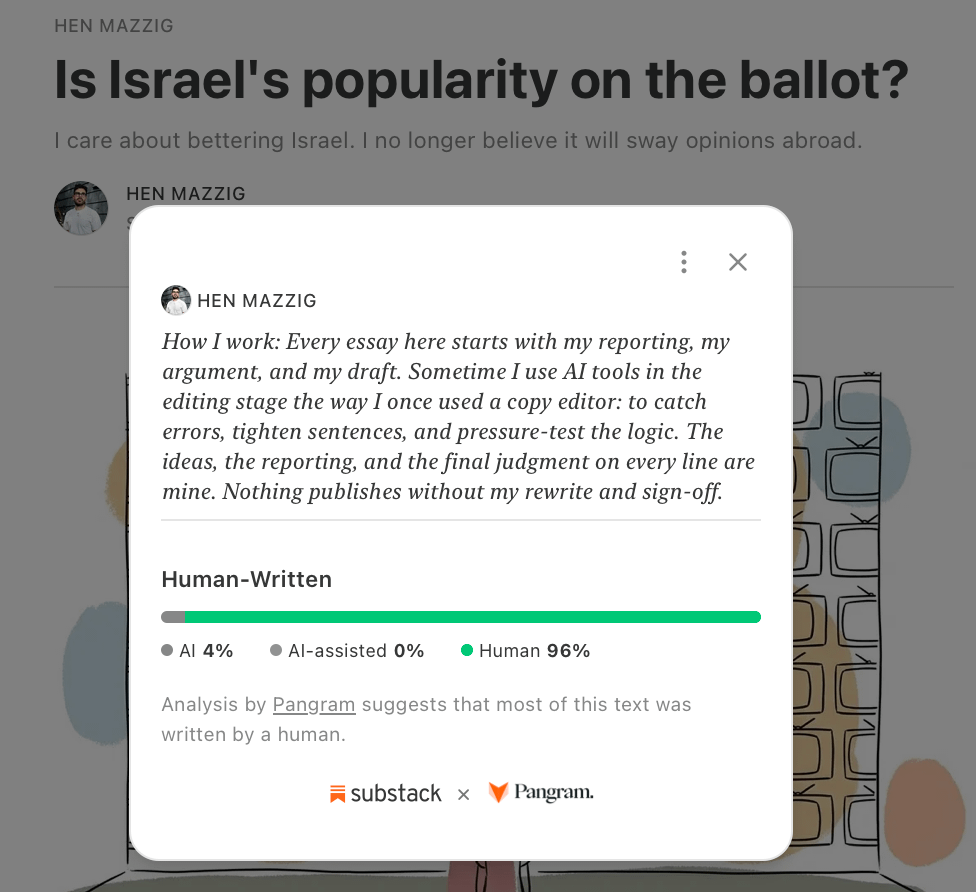
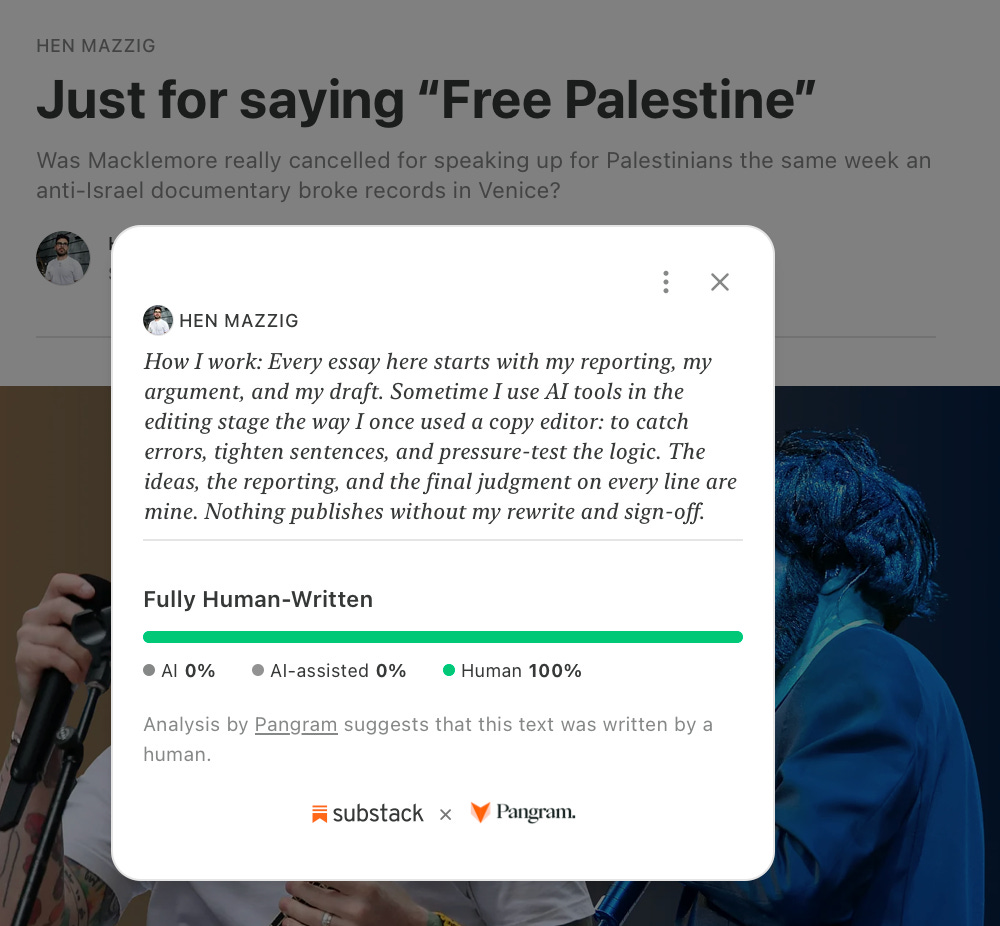
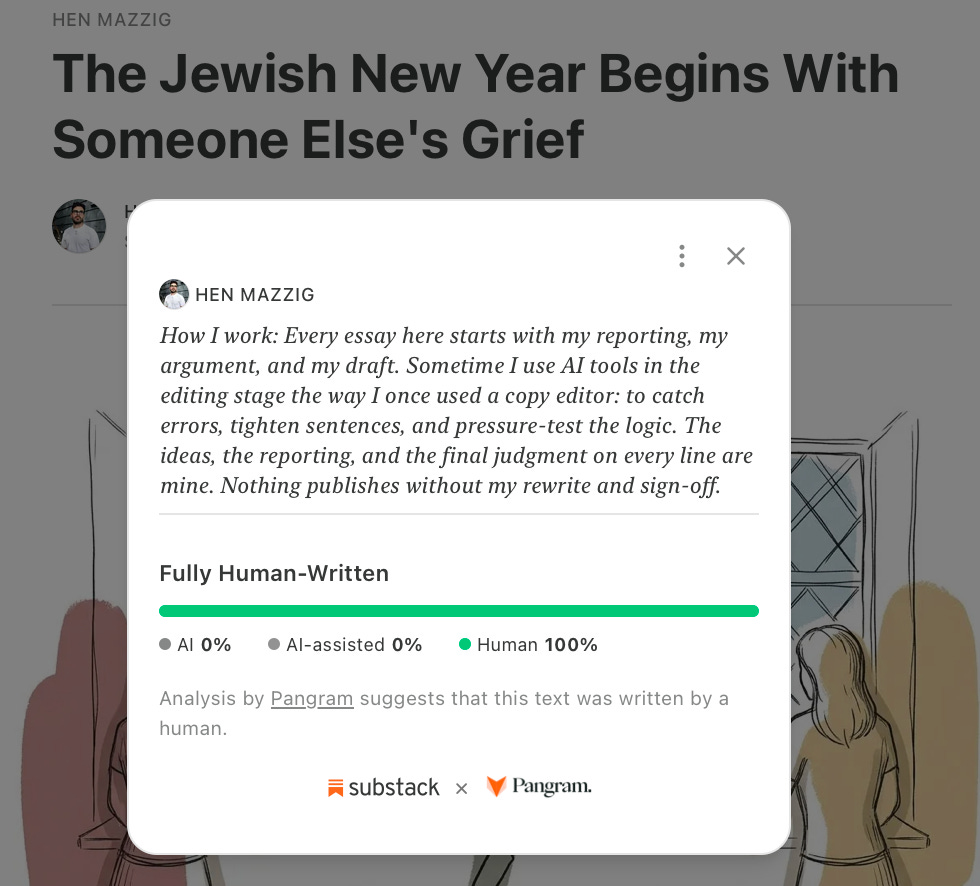
Hell yeah!
And now Hen is not going on The Wall of Shame. Simple as that. And not only that, but now he has renewed my enthusiasm for his work.
He took the critique, responded to it, and is now pushing his work. And now I’m more excited by it and share him more.
However, not everyone has the moral clarity to react as Hen did.
29. Daniel Mael
Daniel Mael is one of many Zionist substackers I’ve followed for years and generally enjoyed his articles. This was a big disappointment:
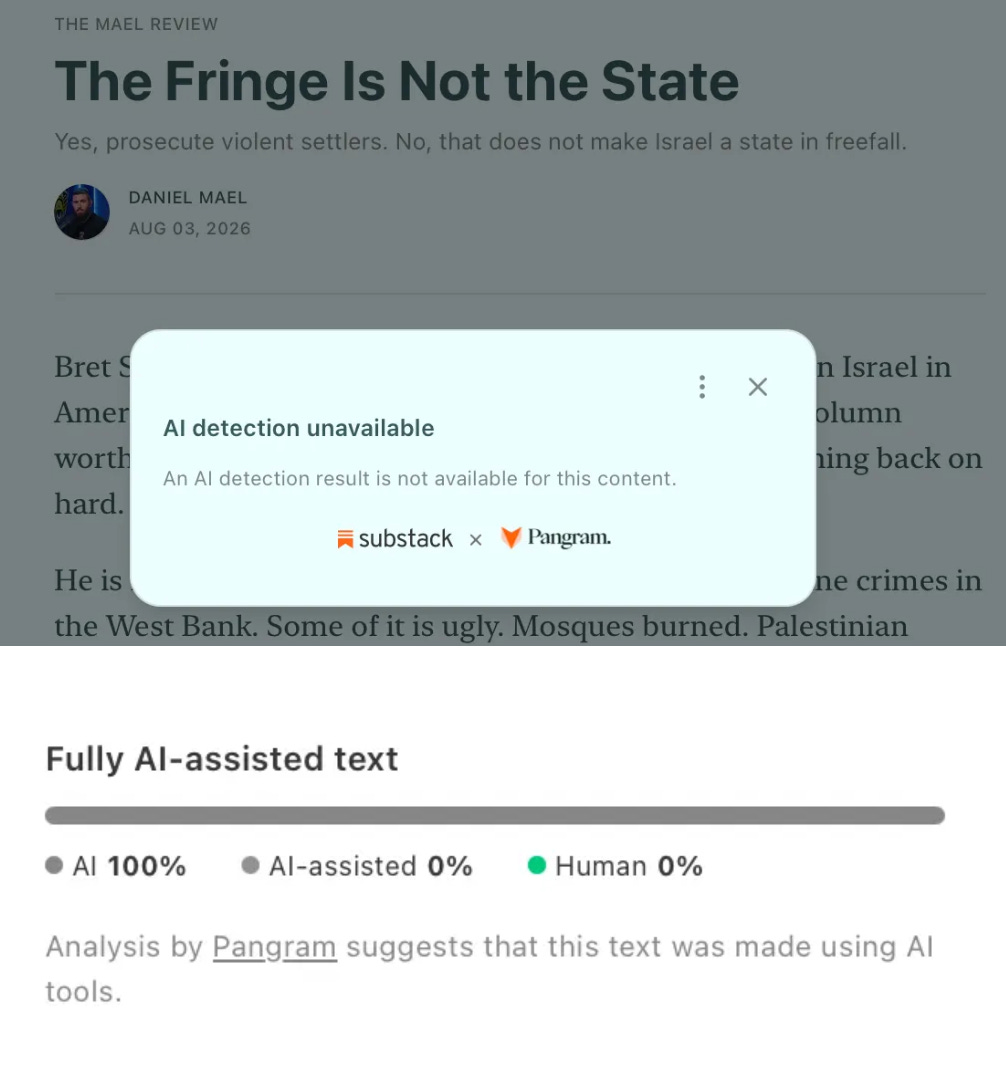
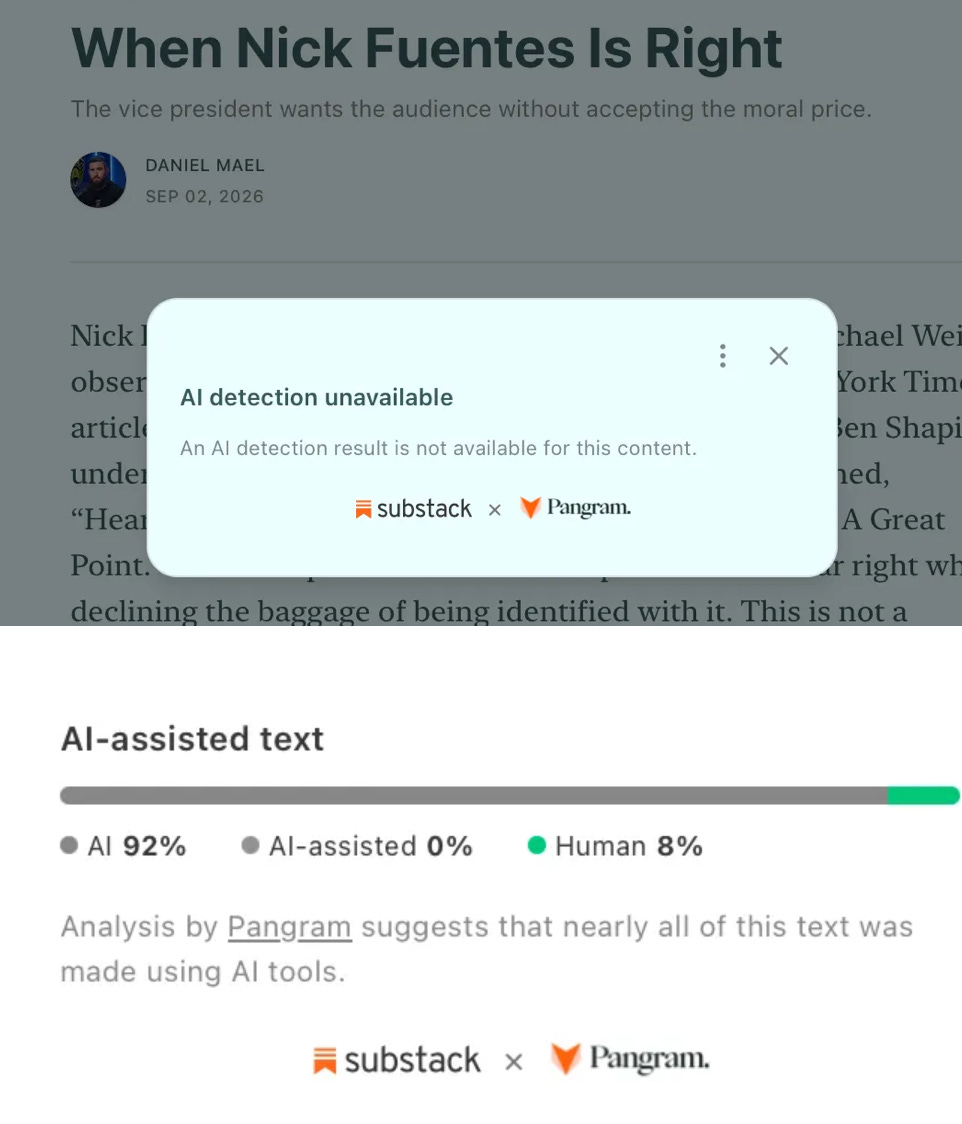
But this was an even more dejecting.
I asked in the comments if he had used AI. We had an exchange and then he chose to delete it, for obvious reasons:
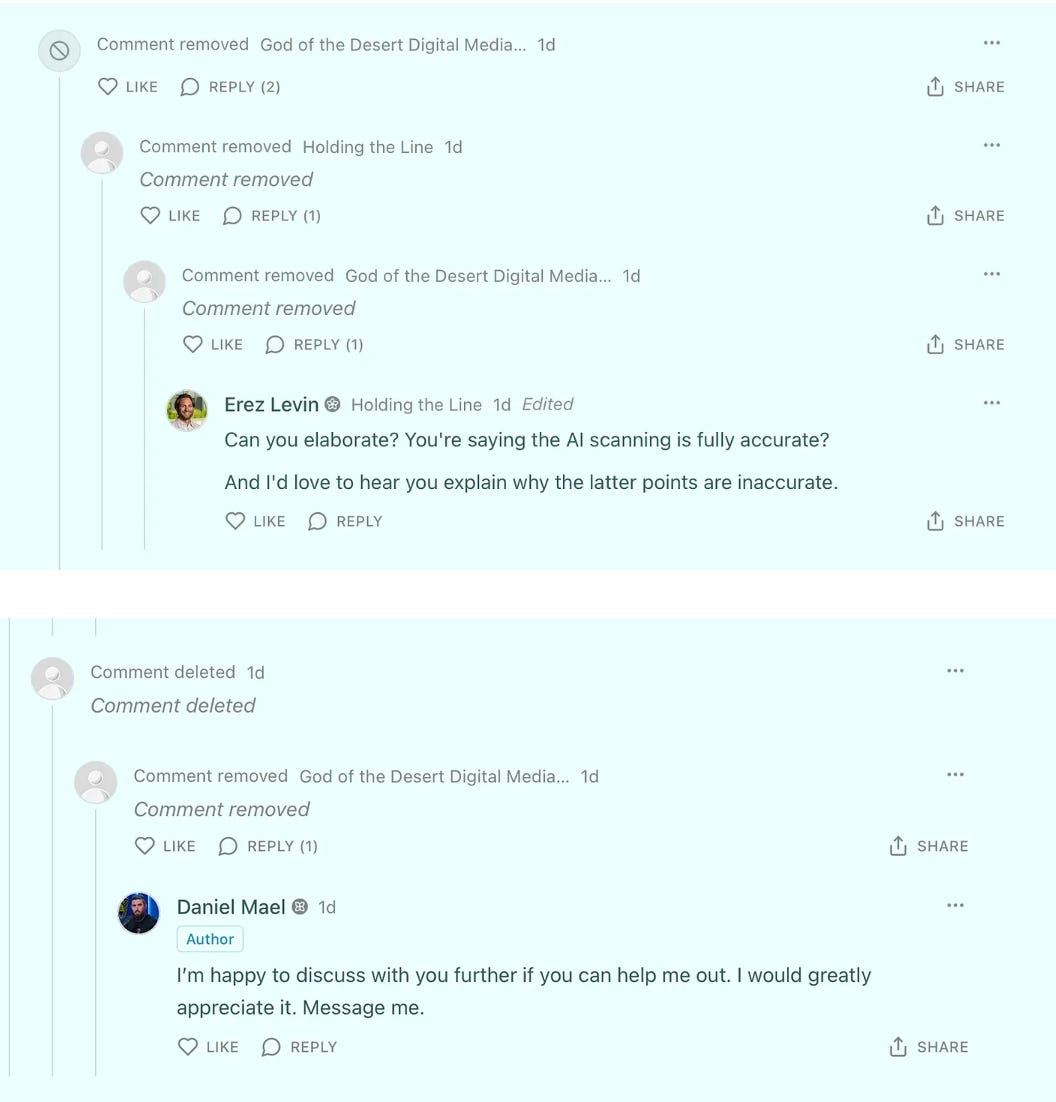
After this public exchange he messaged me privately. The back-and-forth then left me even more annoyed than seeing him delete my comments. All he could remember about me was that I used to work for David Horowitz… 15 years ago. So all the work I’ve done since I managed a dumb cable news commentary blog has just been invisible to him, as it has for most in the pro-Israel activist community.
SEPTEMBER 20 UPDATE:
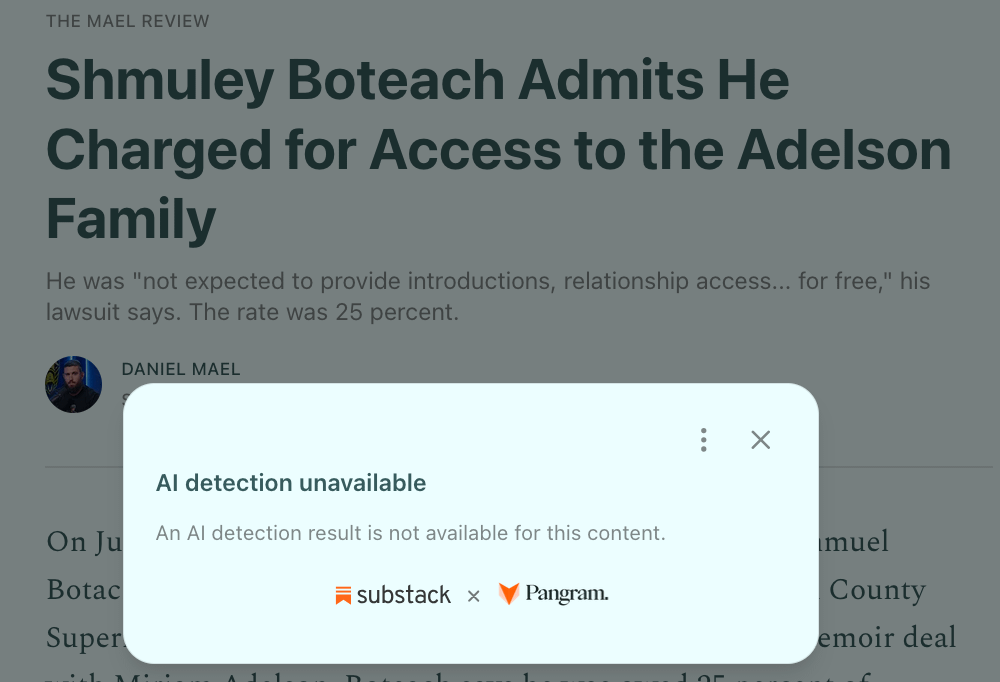
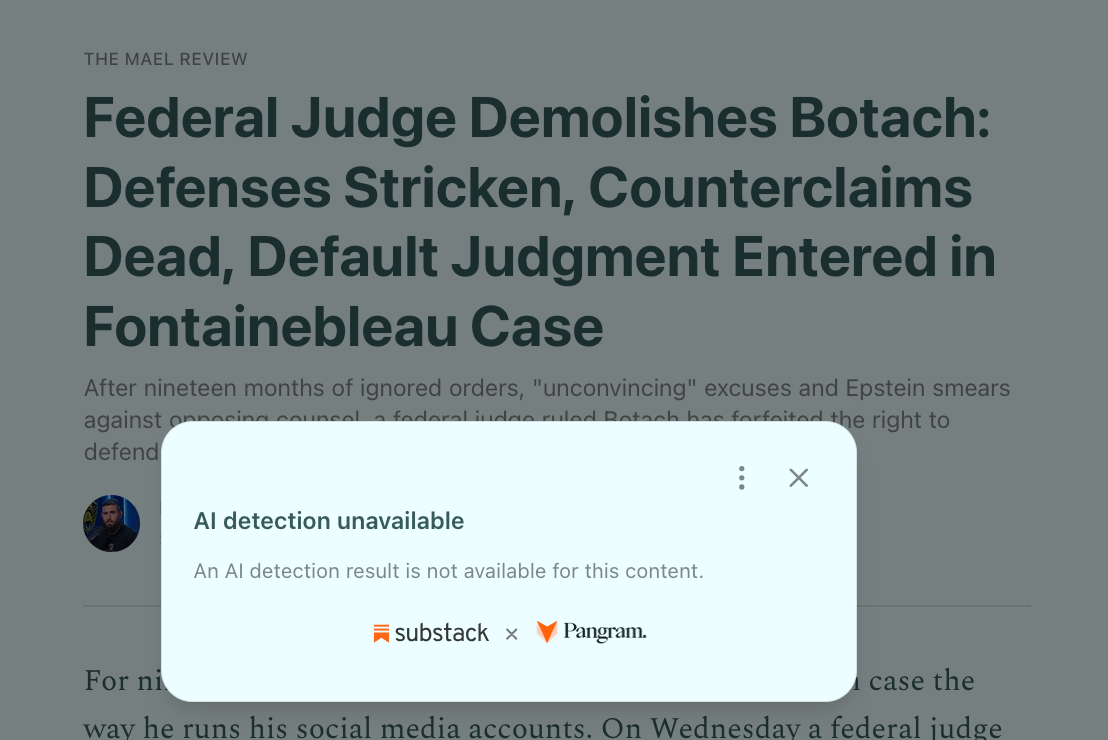

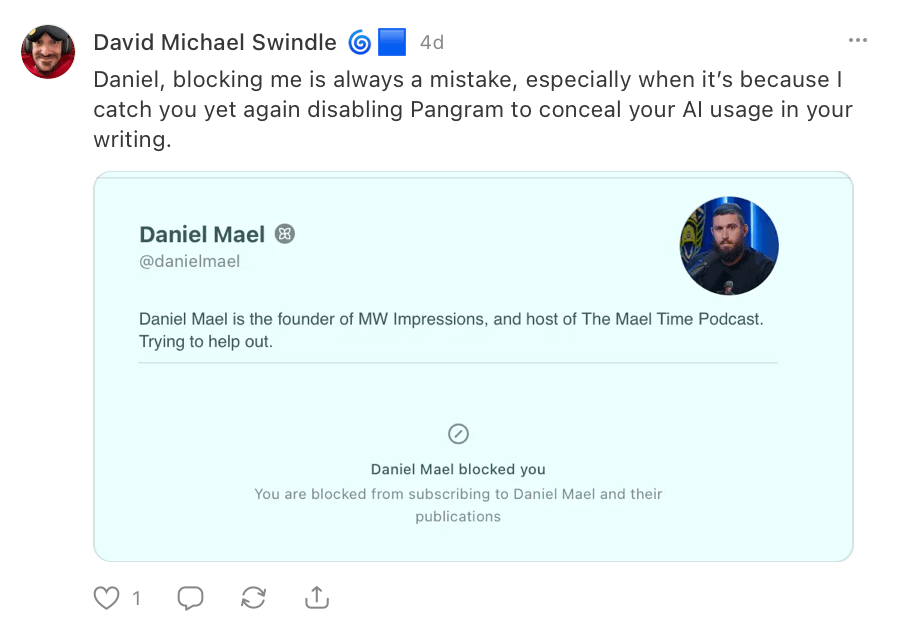
Now, say what you will about Rabbi Shmuley Boteach — he’s given us plenty of stuff to both celebrate and cringe at for decades now — the man doesn’t block Pangram or his fellow Zionist activists asking pointed questions:
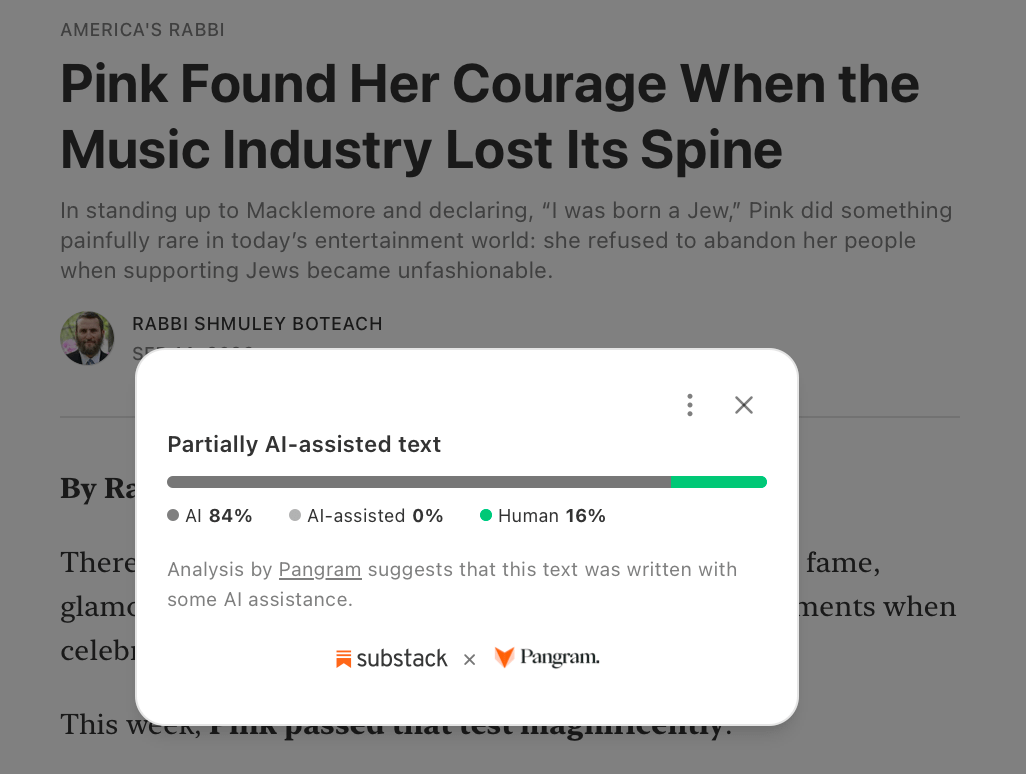
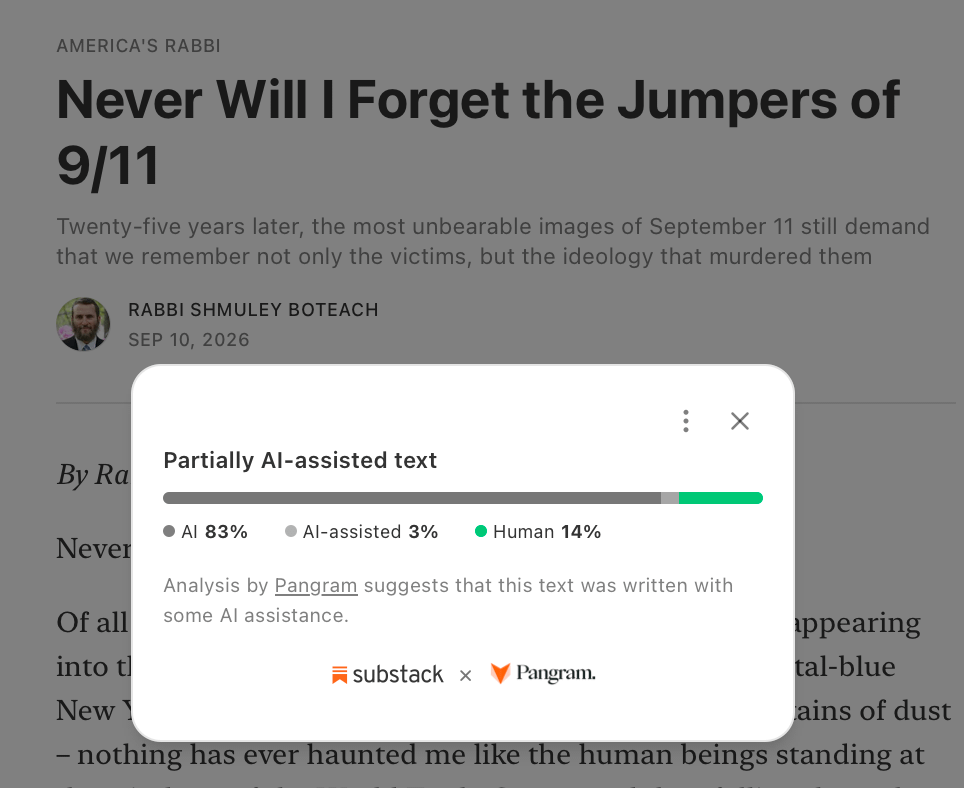
So does Daniel have some legitimate critiques of Shmuley? Probably. But because I can’t trust him, then I can’t trust his presentation of the facts.
Once trust is shattered over something as trivial as enabling AI-scanning software, it’s hard to repair it for subjects which matter so much more.
30. Yisrael M. Eliashiv
Yisrael M. Eliashiv is one of my favorite Zionist essayists on Substack. And it turns out that he cannot resist the temptation of attempting to conceal AI-drafted writing, even though the percentage for him is miniscule.
In the words of The Dude when examining the phony ransom note handed to him by the Big Lebowski, “This is a bummer man, that’s a bummer.”
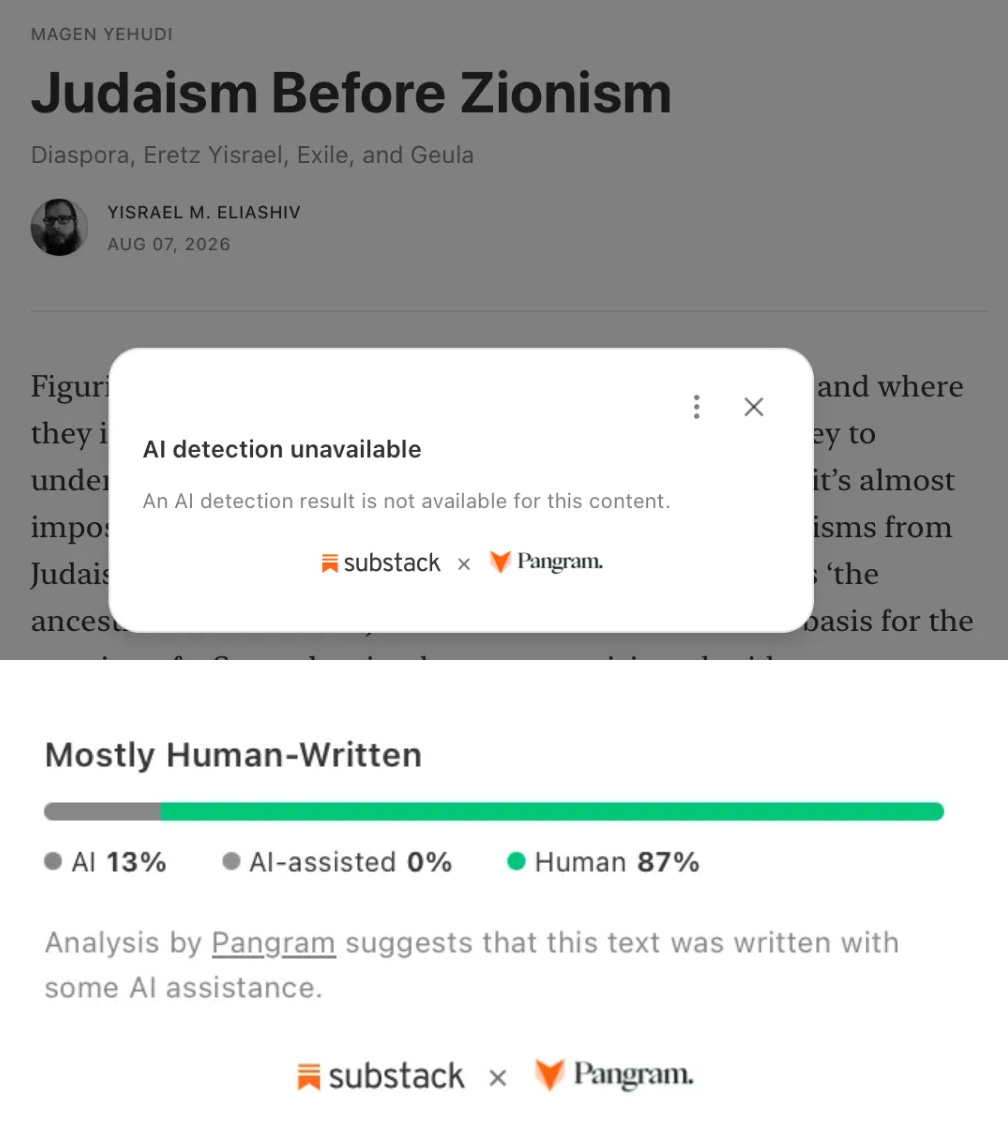
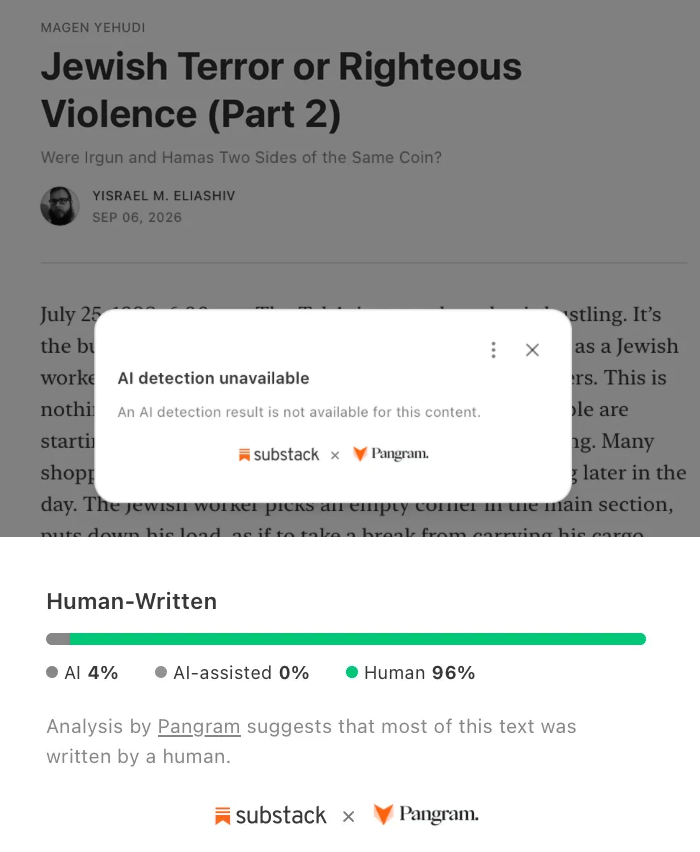
Why even hide such small levels of AI use? Nobody would have cared if it had remained unhidden.
Rabbis, pastors, imams, and “spiritual teachers” are supposed to operate at a higher level of ethics and morality than the rest of us. It shouldn’t be up to stoner blogger me up late out in the desert to remind rabbis about proper ethics.
SEPTEMBER 20 UPDATE:
Here are screenshots from the discussion Yisrael and I had in the comments of this article last week:
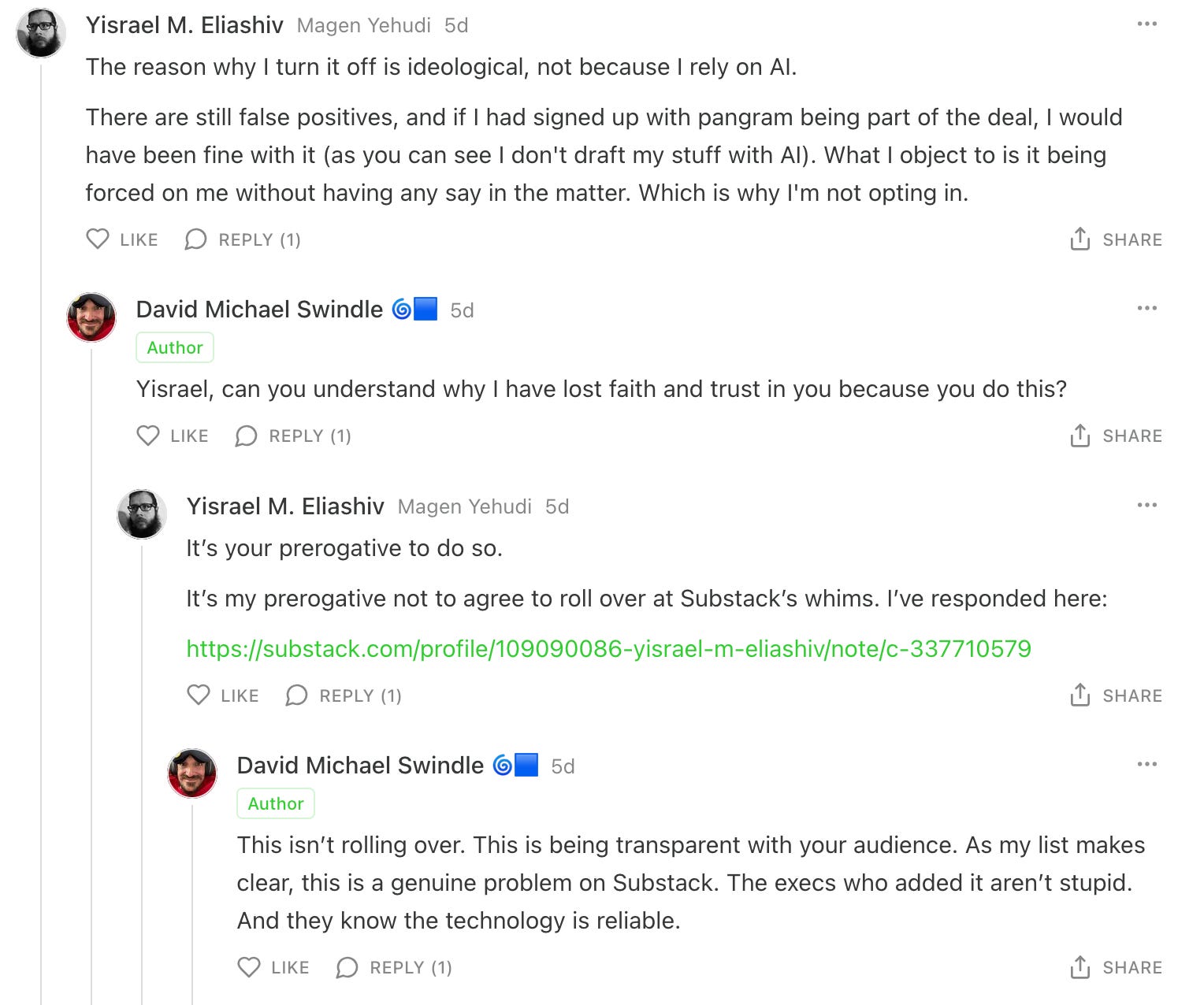
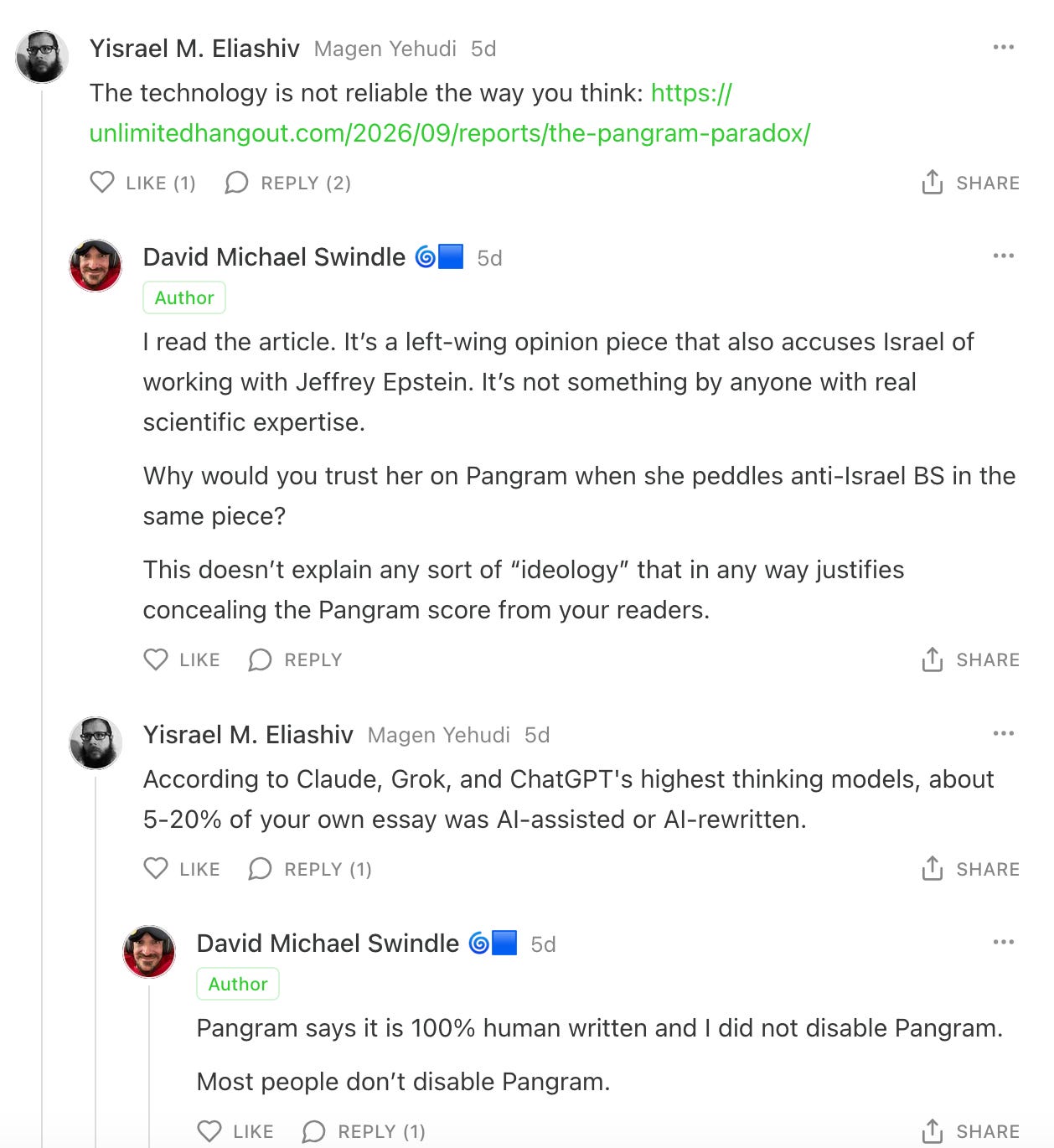
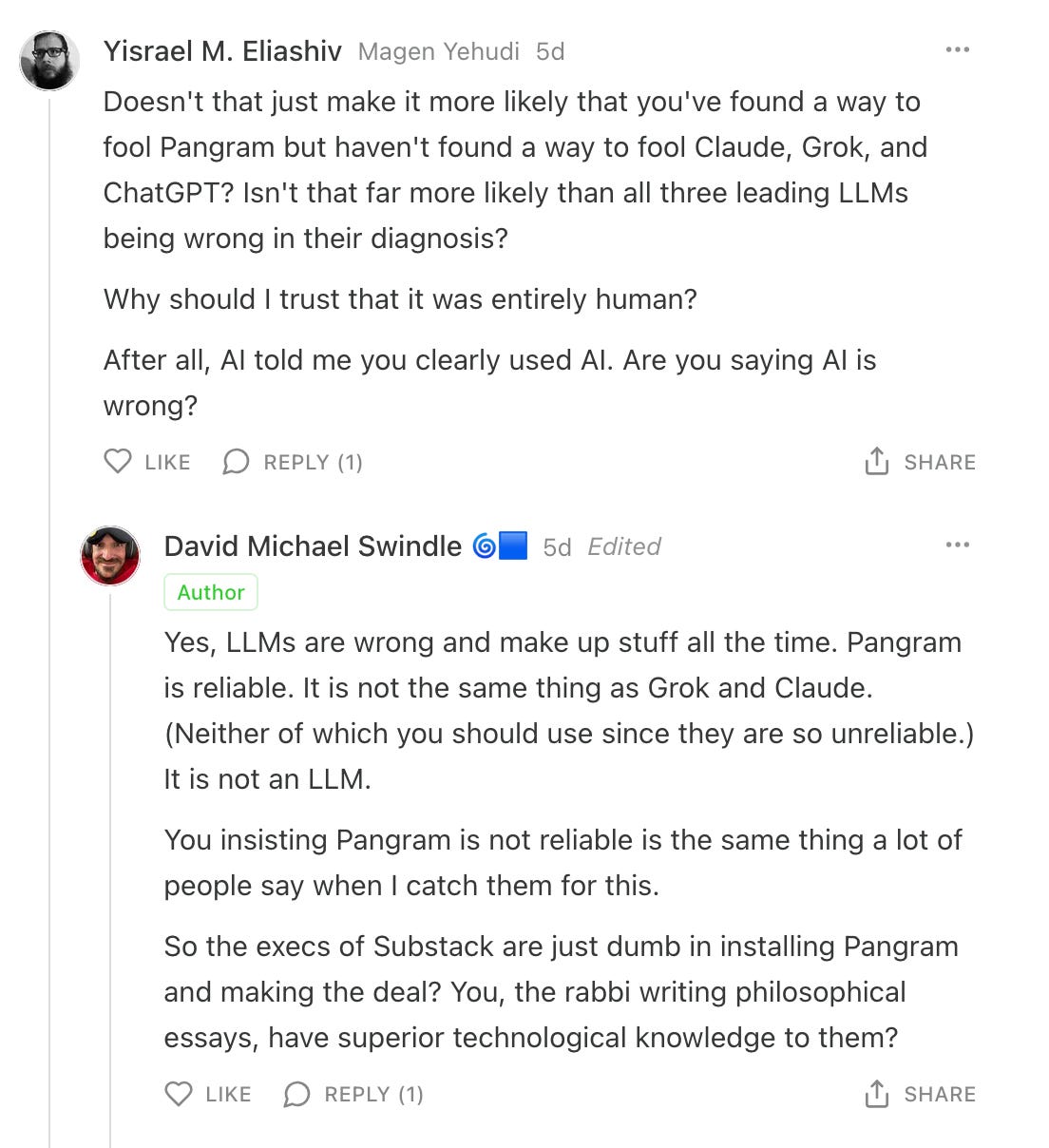
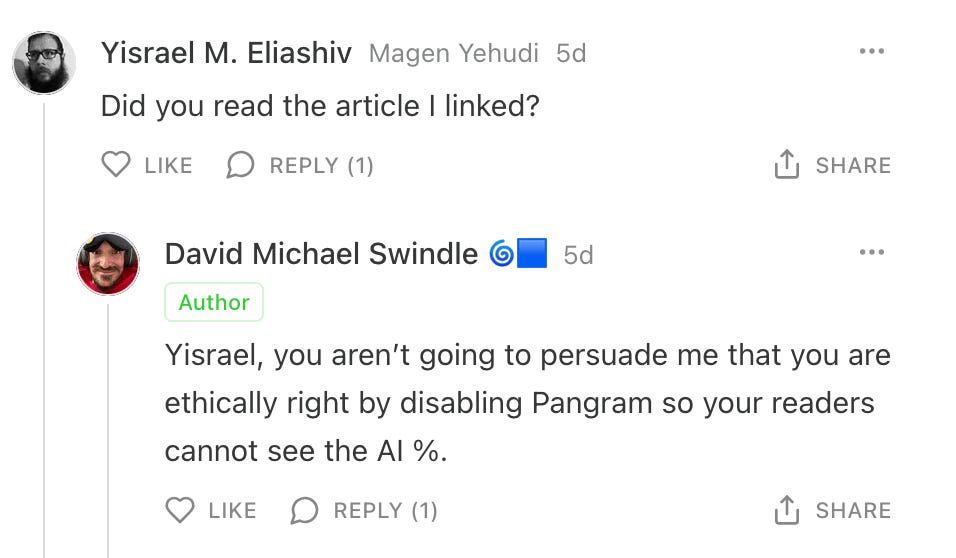
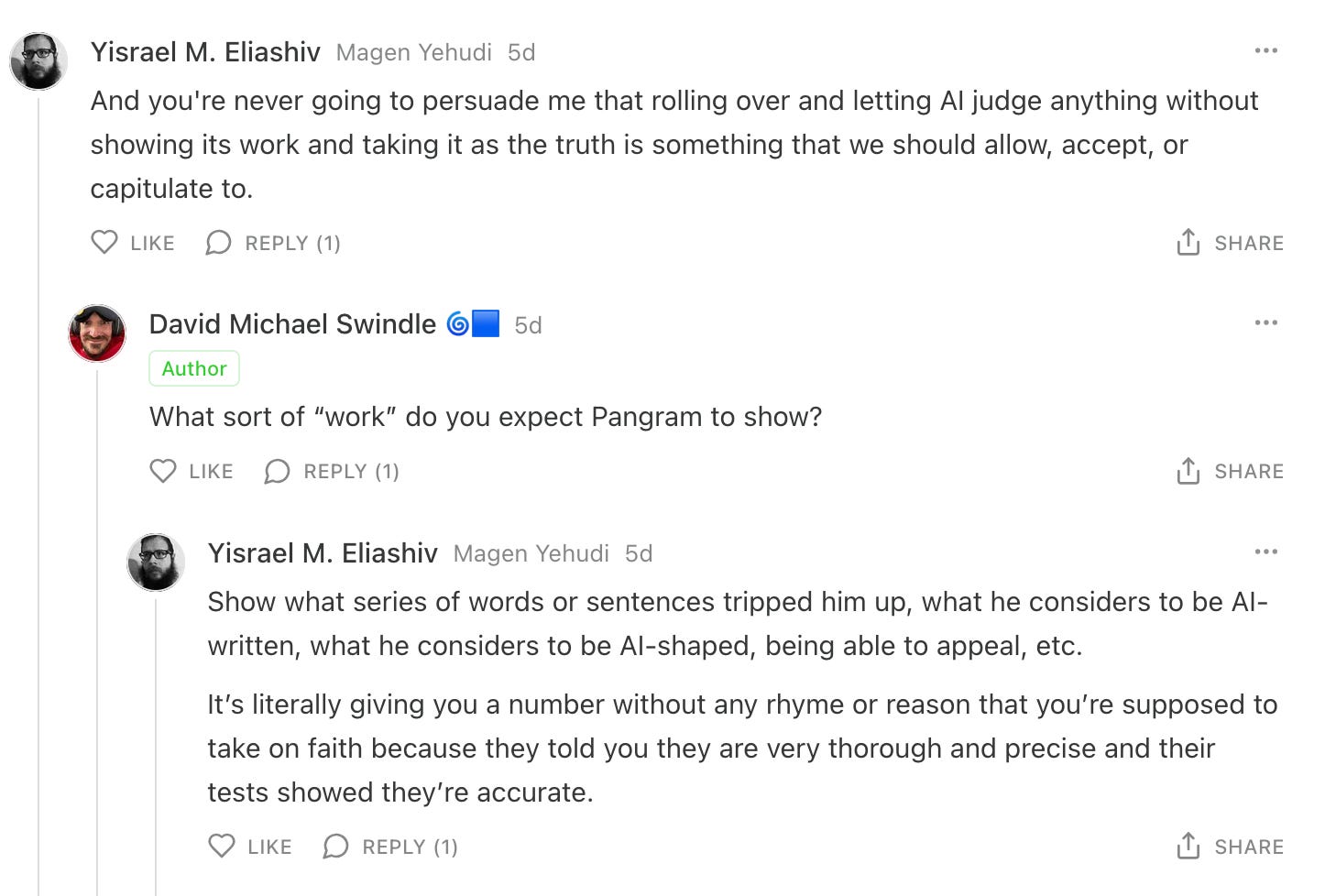
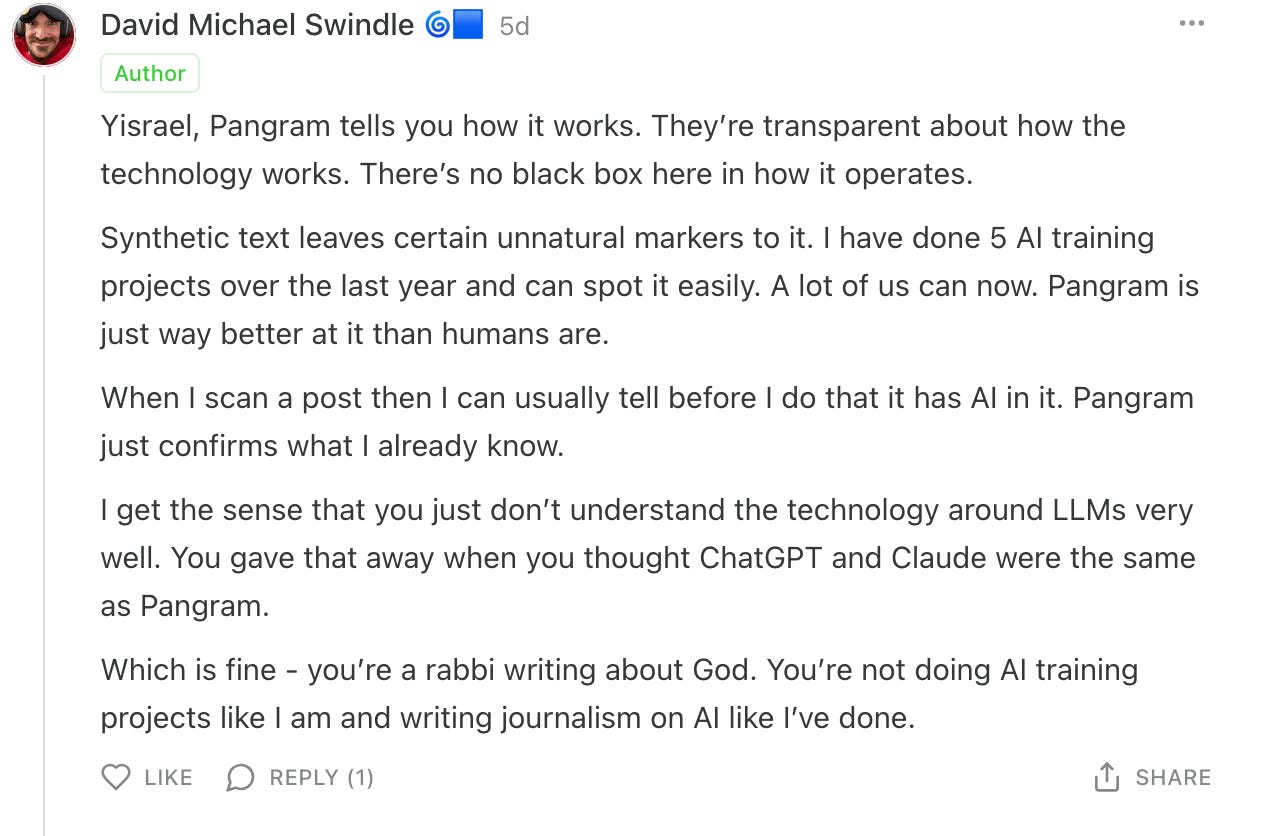
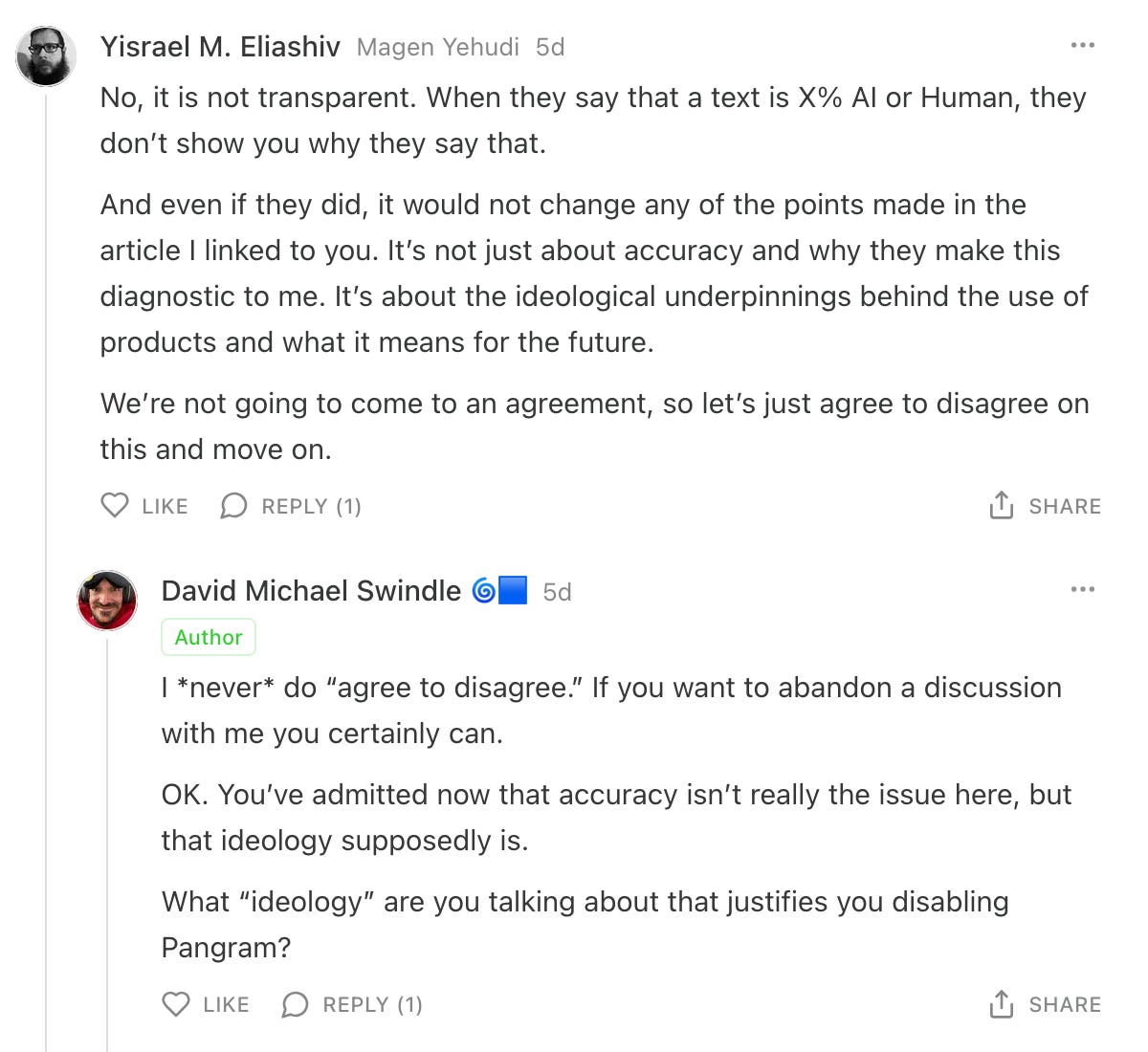
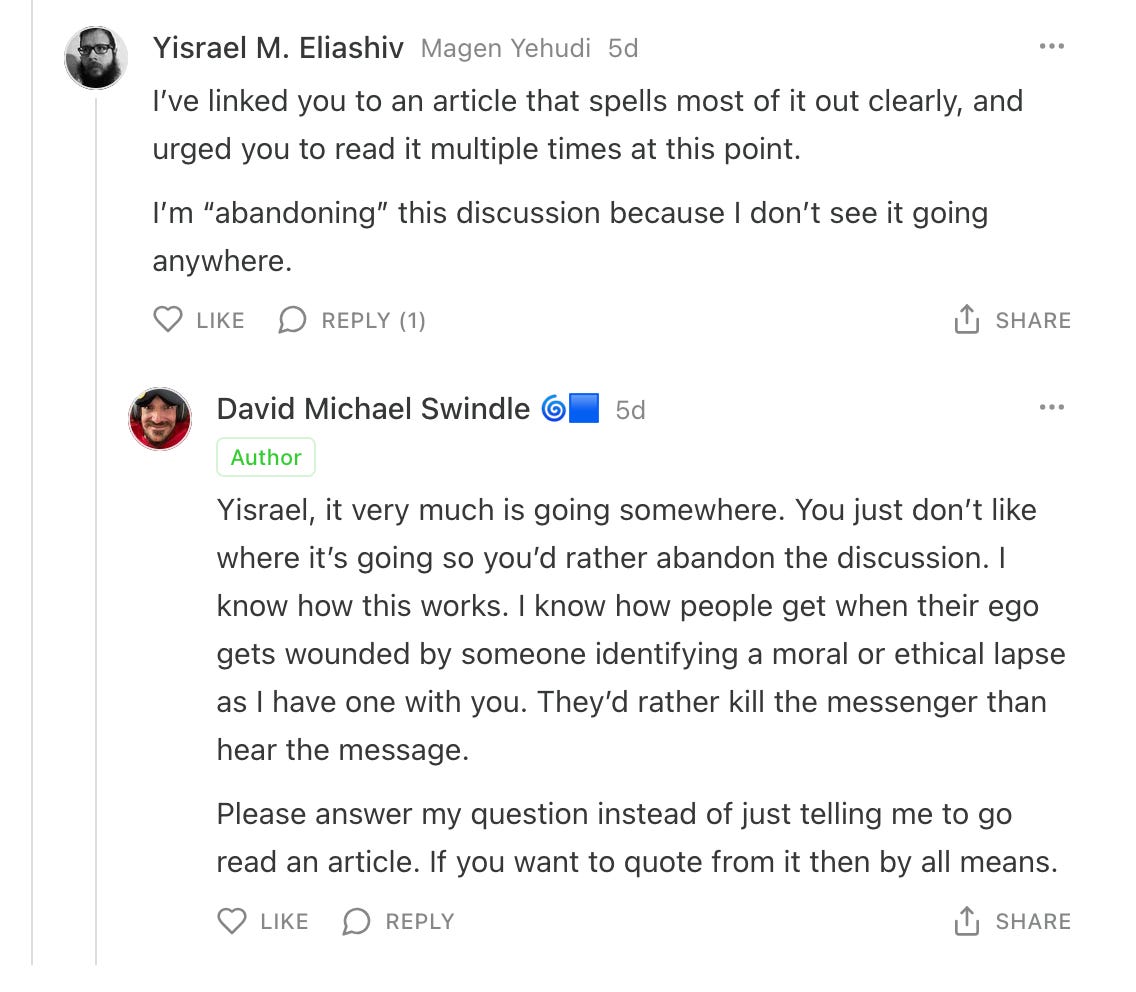
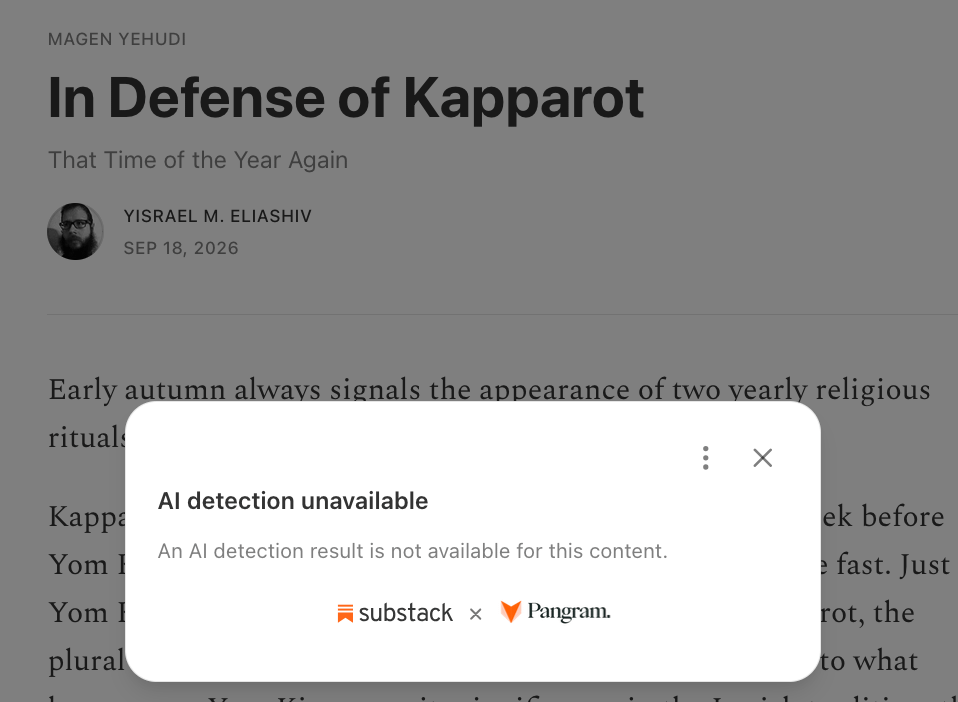
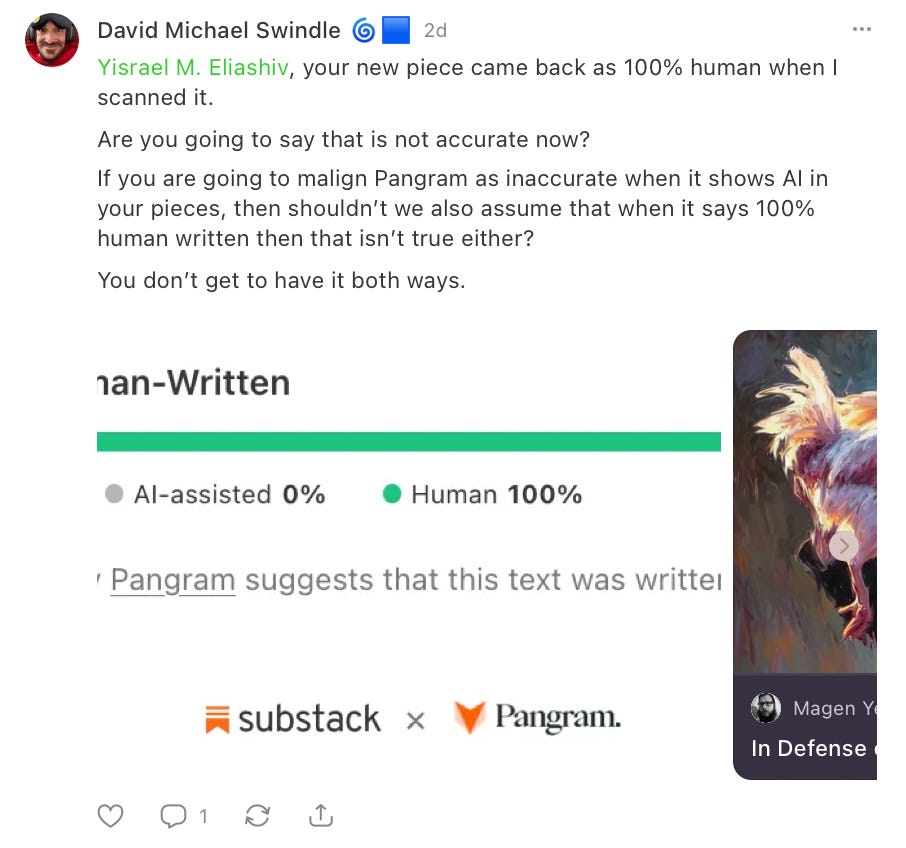
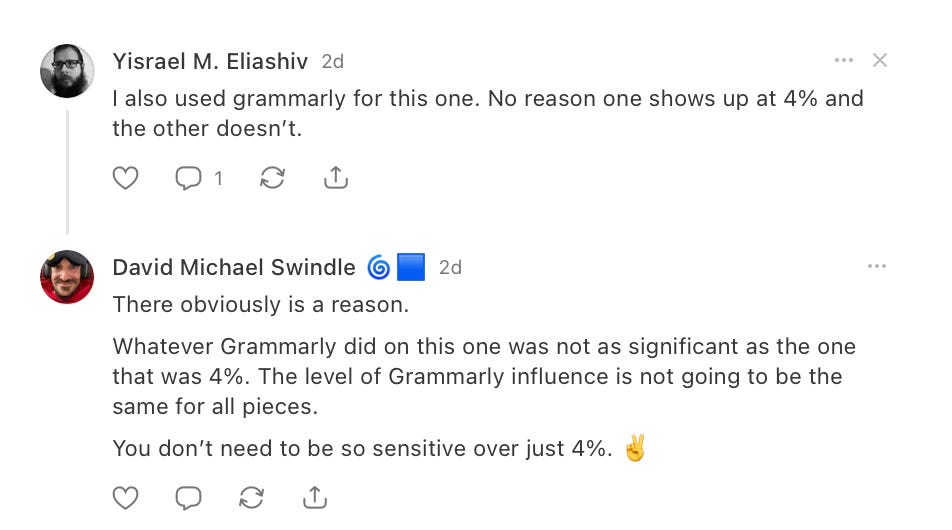
What sort of ego can’t handle that Grammarly usage apparently shows a few percentage points of AI use in an essay?
31. Hussein Aboubakr Mansour
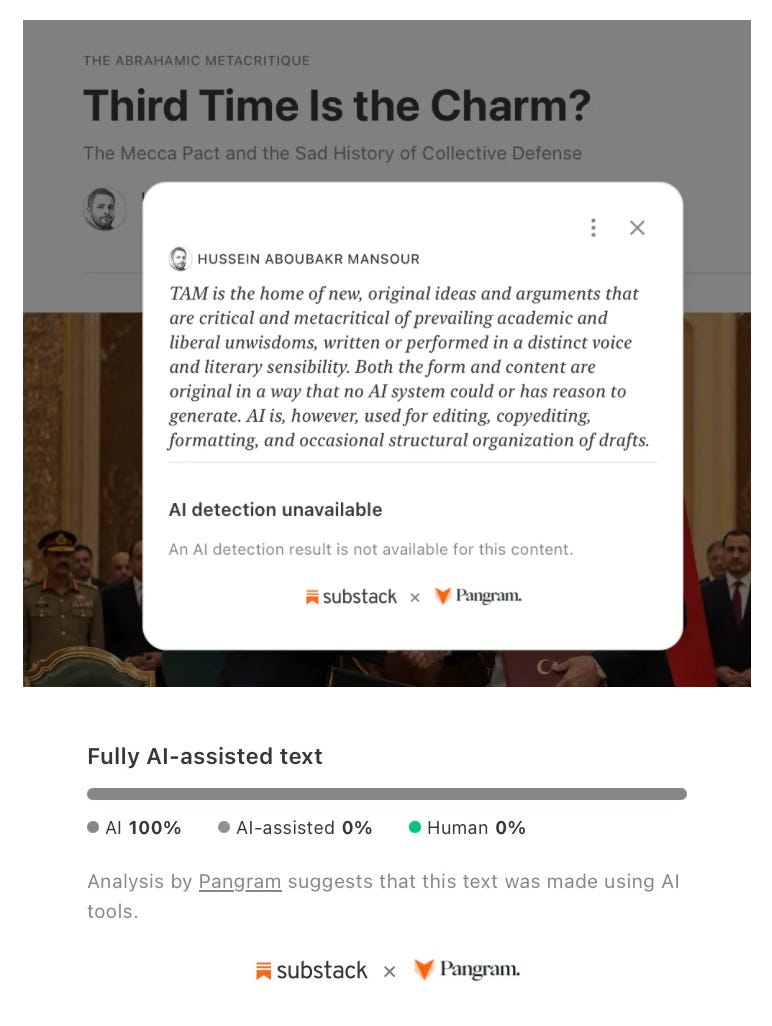
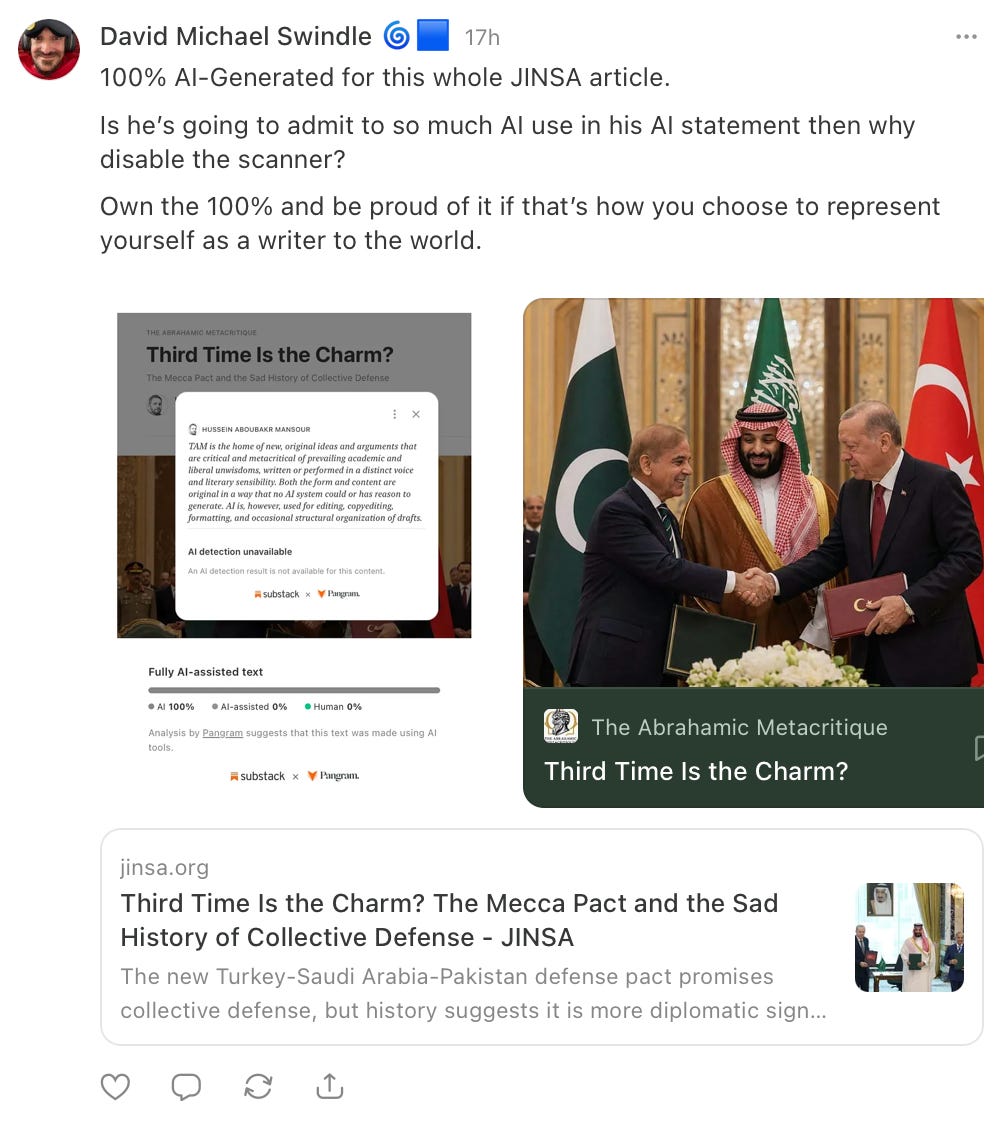
Hussein Aboubakr Mansour is an Egyptian writer I’ve read for years. But he never made a strong impression on me as an original, deep thinker. Maybe he will someday if he lays off the LLM writing?
Or perhaps if he invokes one of the older gods of his people to point him in the right direction?
SEPTEMBER 20 UPDATE:
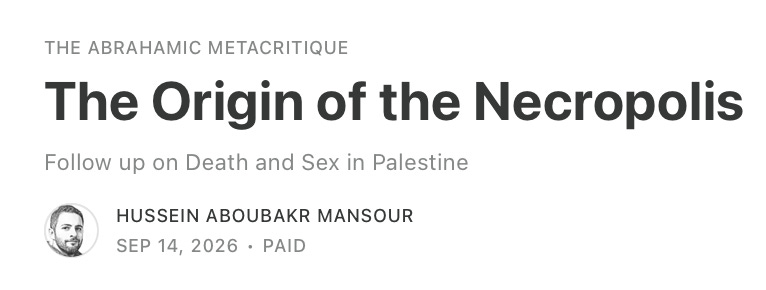
This appears behind the paywall, but the excrerpt shows AI use:

10 Cultural BS Merchants
Just as the religion category showed such diversity in beliefs among those who felt a need to conceal their writing’s AI authorship, in the cultural realm, dishonest operators target a wide variety of demographics.
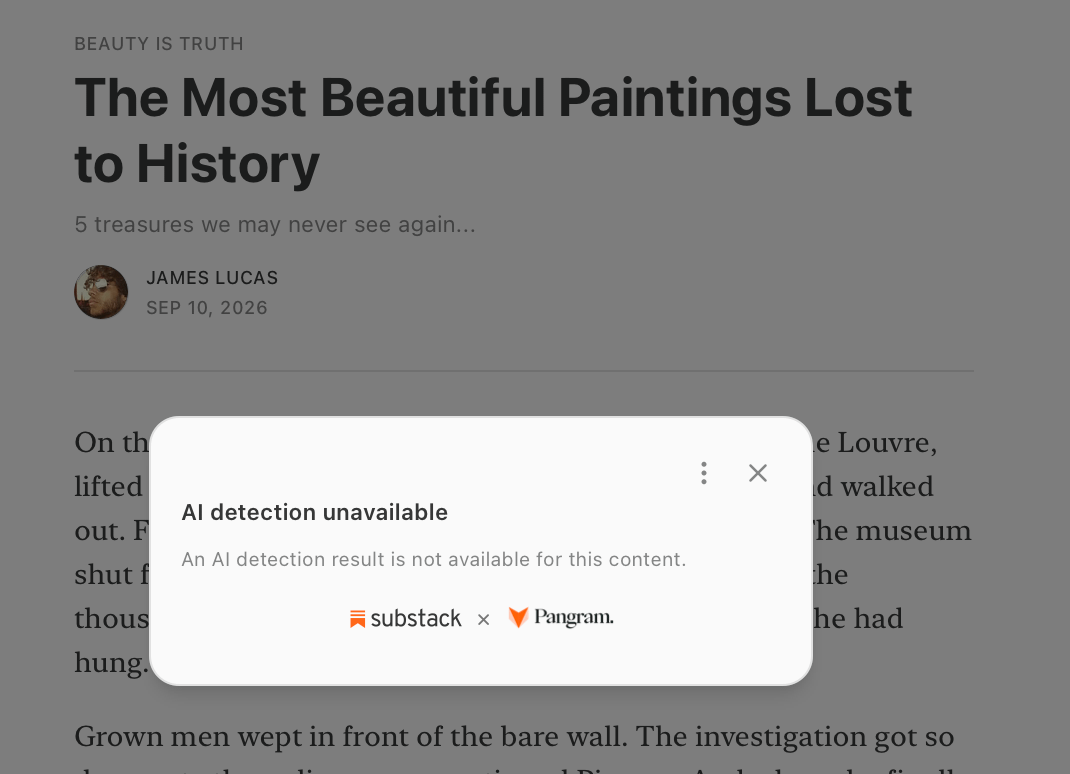
32. James Lucas
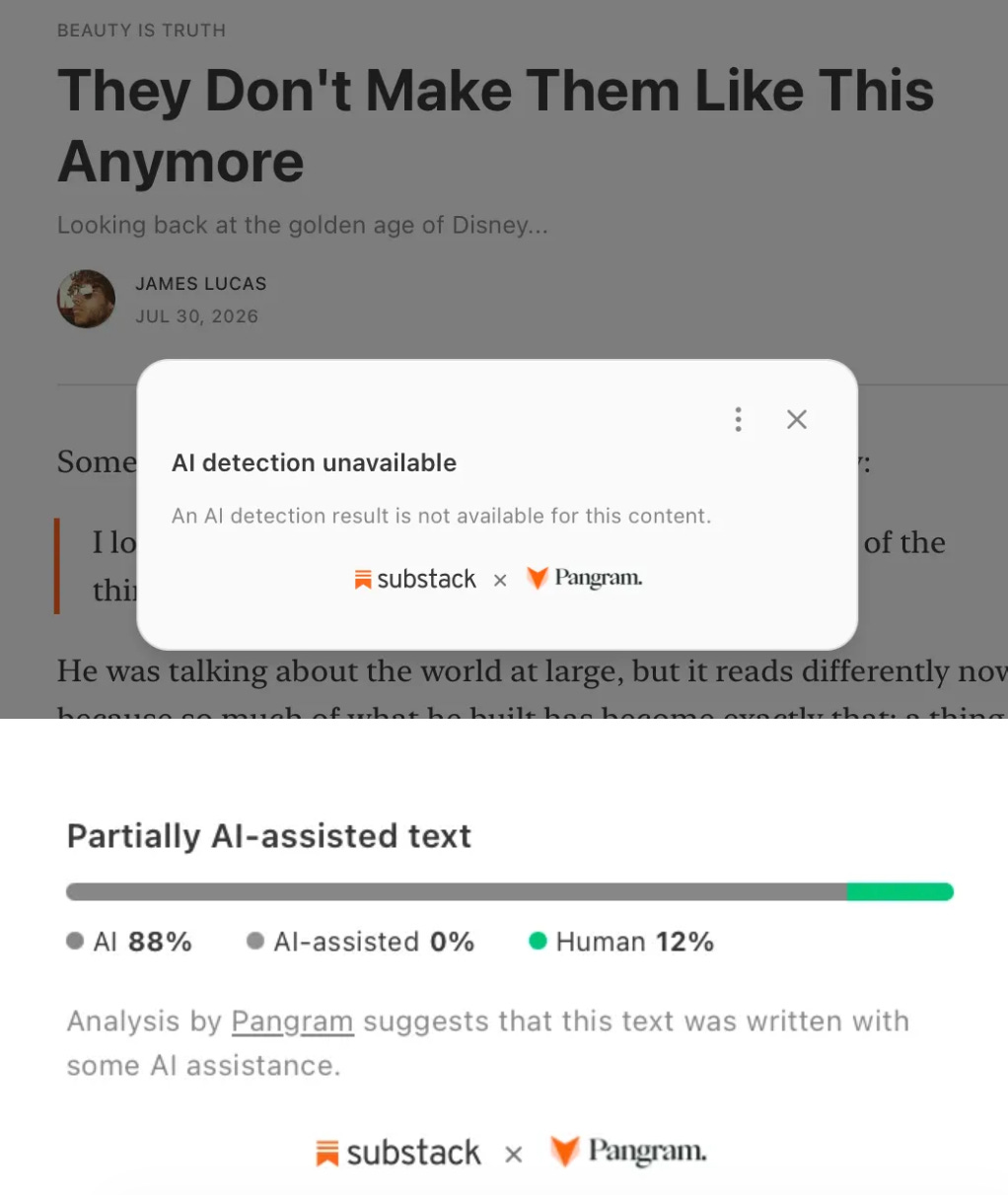
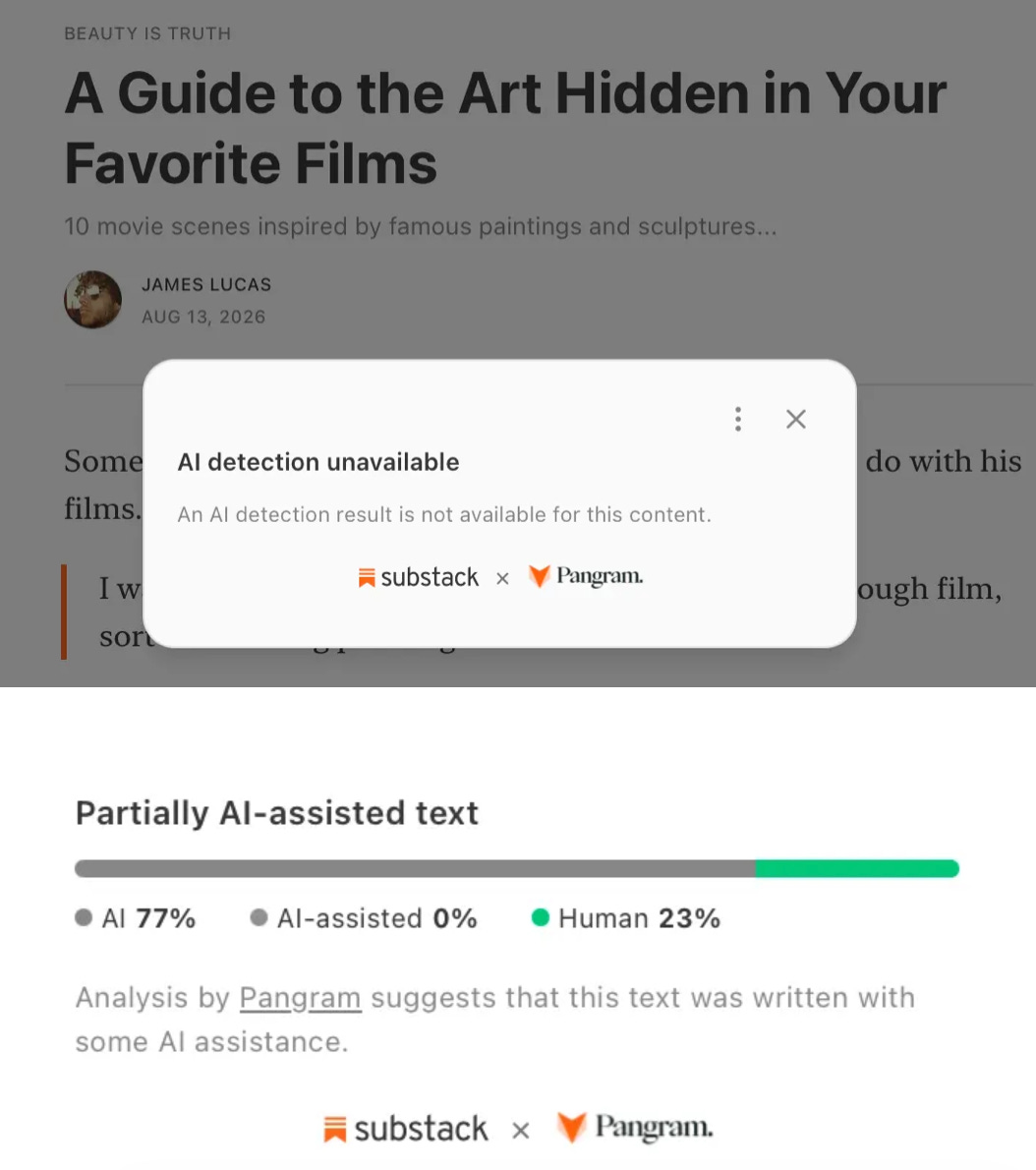
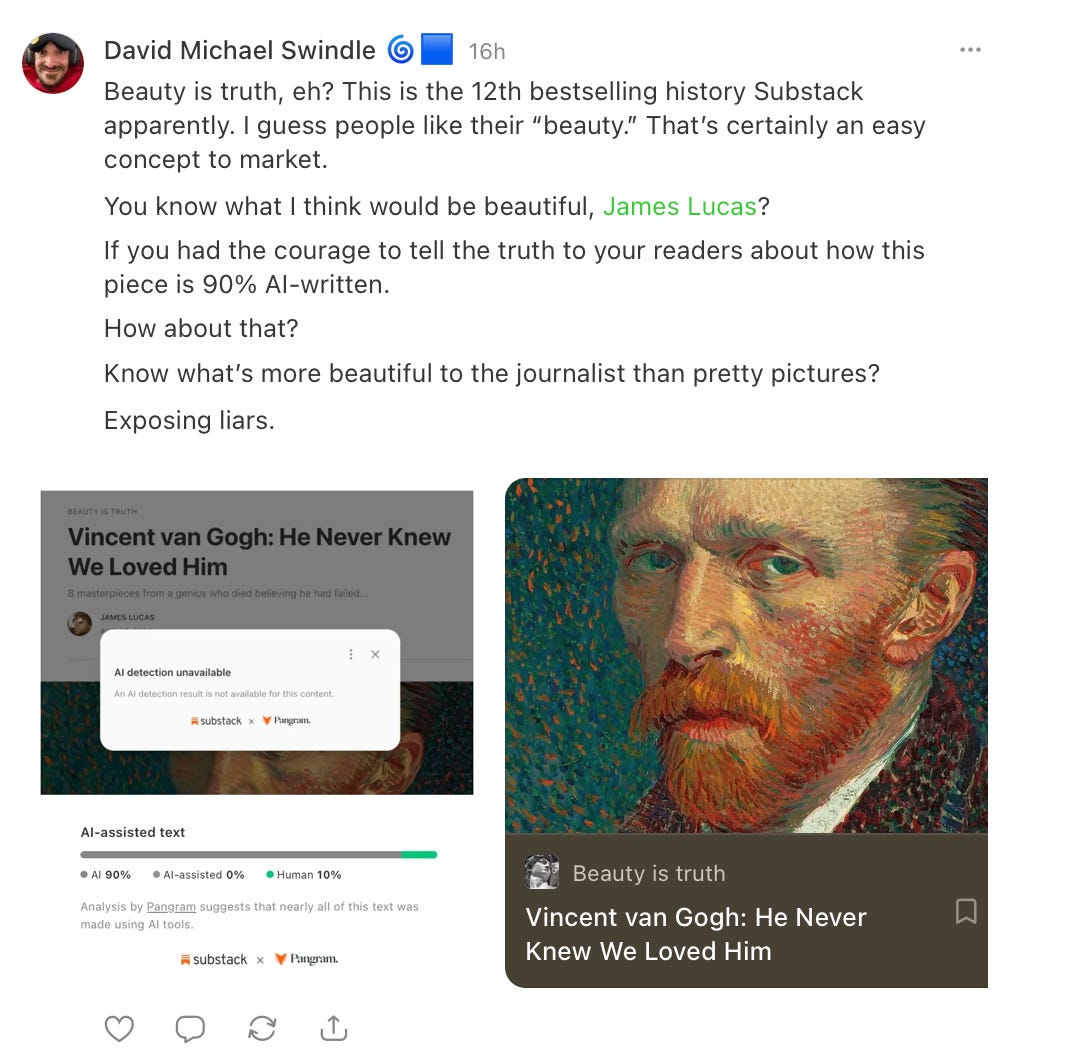
I was not familiar with James Lucas and his grift before beginning this investigation.
The sentiment he offers is a common one and it’s a big lie. Beauty is often false. A woman can paint up her face to appear beautiful but it conceals a cold heart. A gorgeous painting could celebrate evil men.
Our eyes and our senses deceive us every day.
SEPTEMBER 20 UPDATE:
Unchanged
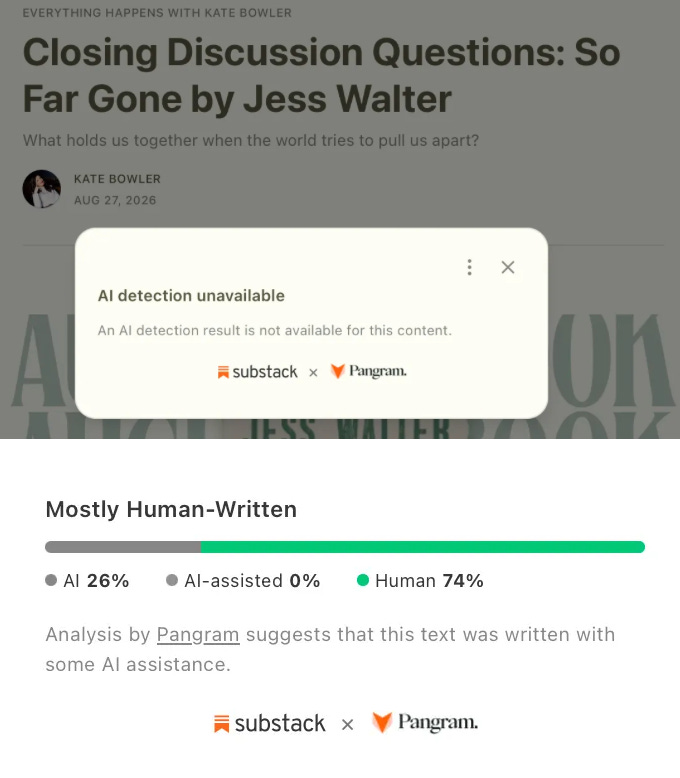
33. Kate Bowler
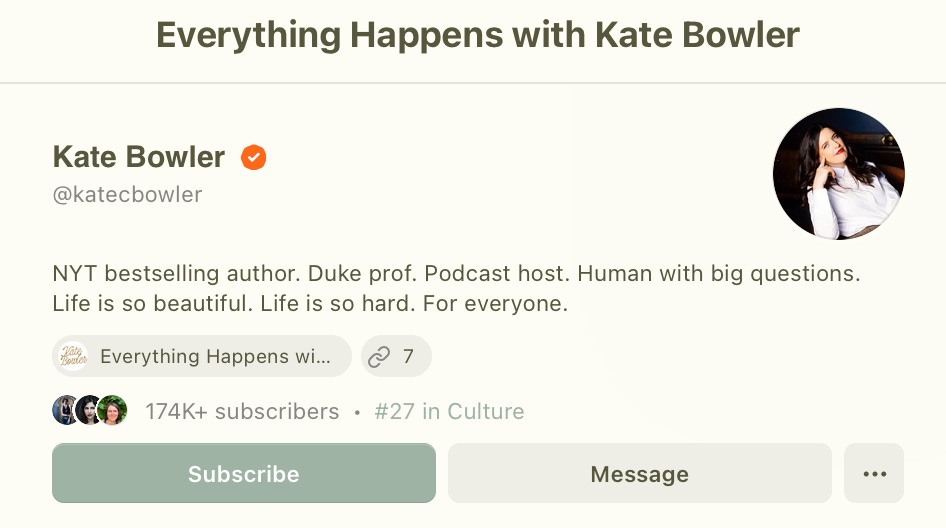
”Human with big questions,” eh? Is your LLM not answering those questions sufficiently, Professor?
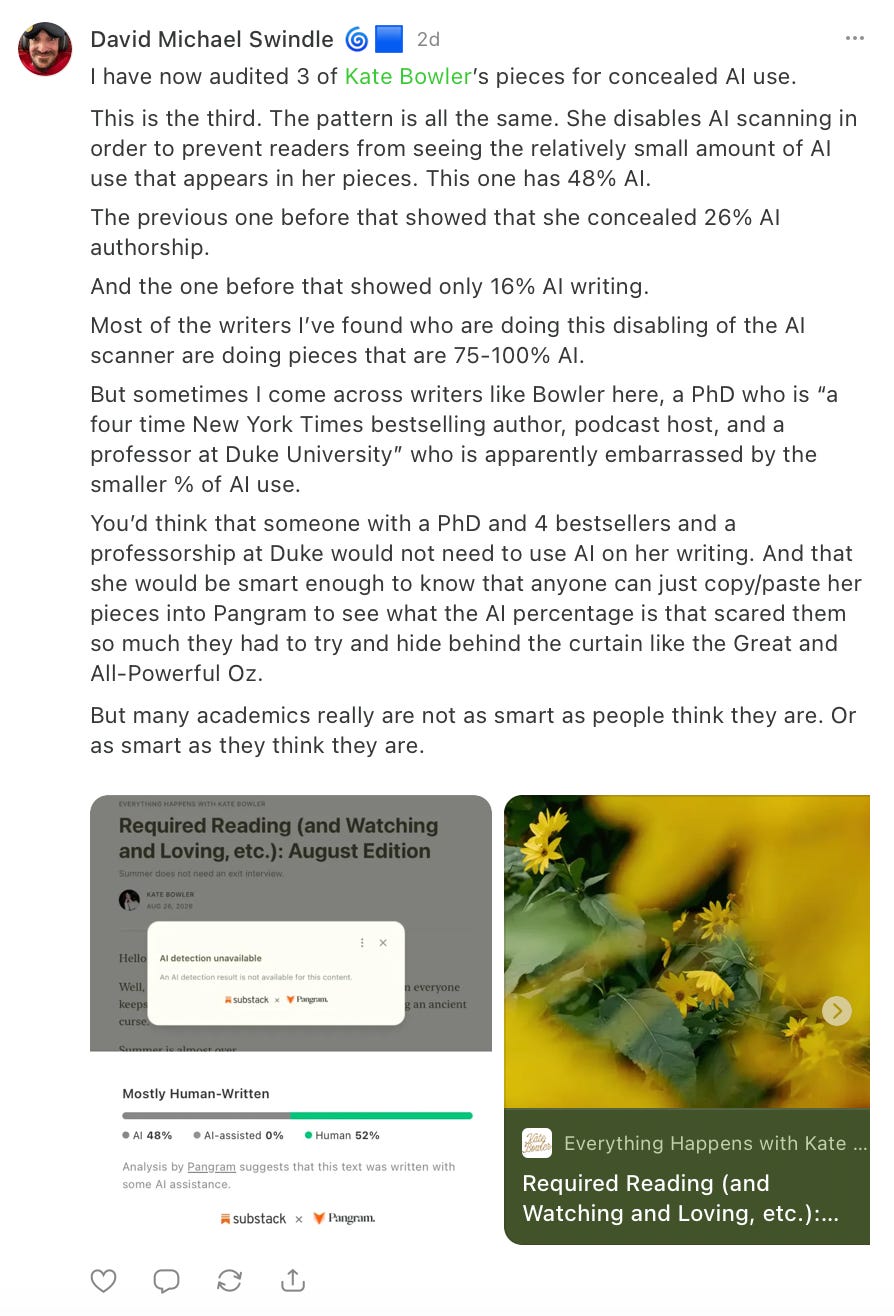
If you’re sensing a bit of anti-PhD bias here, then I assure you that it only annoys me when people want to wave it around to try and make others feel inferior to them. At least Kate isn’t sticking it in her user name like some people do.
However, she is naming her authority as a “Duke prof” as the second most important item in her personal branding.
As with rabbis and preachers being held to a higher standard, the same goes for professors and academics. It’s understandable that anonymous entrepreneurs like “The Wise Wolf” or “I Fucking Love Australia” or “The Hood Healer” would cut corners. It is not for people who have earned major academic postings.
SEPTEMBER 20 UPDATE:
Encouraging:
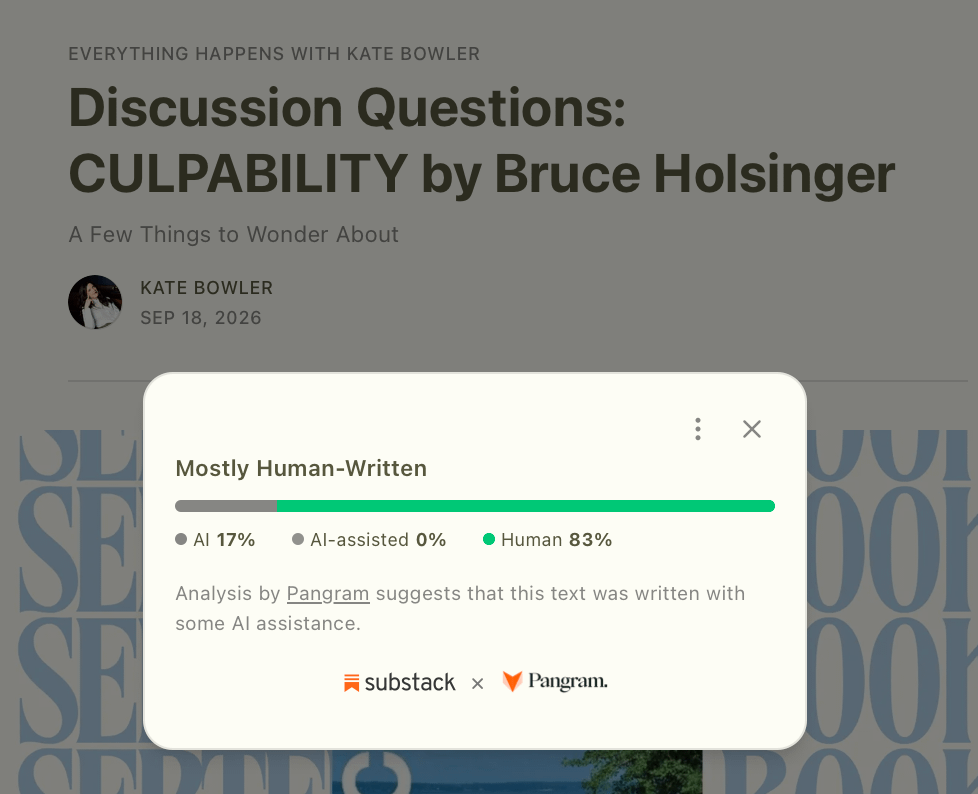
Less encouraging:
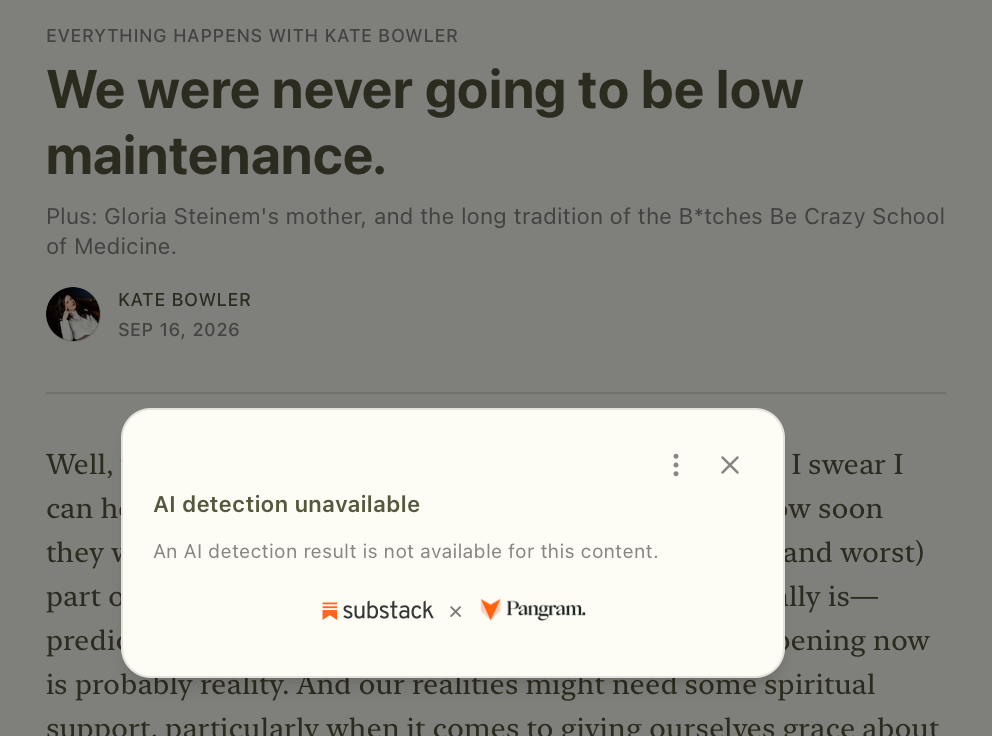
Nope, she’s still going on The Wall of Shame. How disappointing:
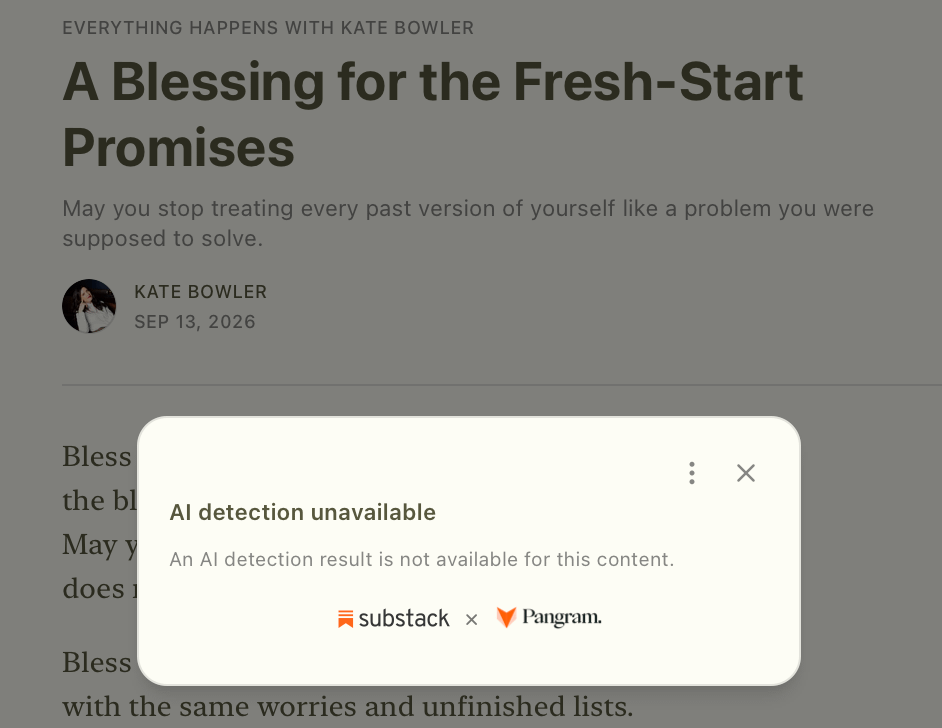
34. Roxane Gay
This came as a shock.
An essay published on September 2 at Roxane Gay’s The Audacity. featured AI-detection disabled and then showed up 100% AI-written.
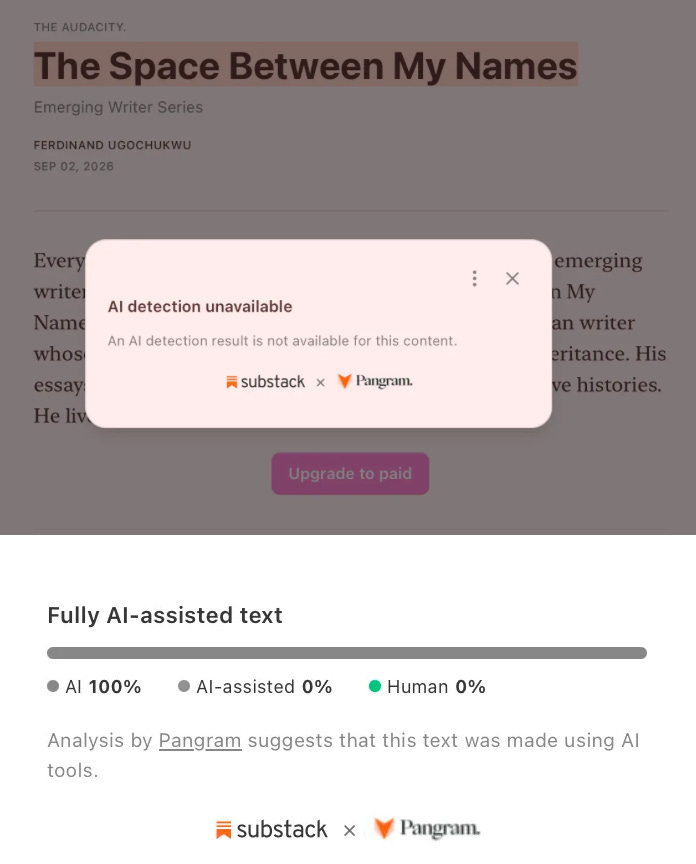
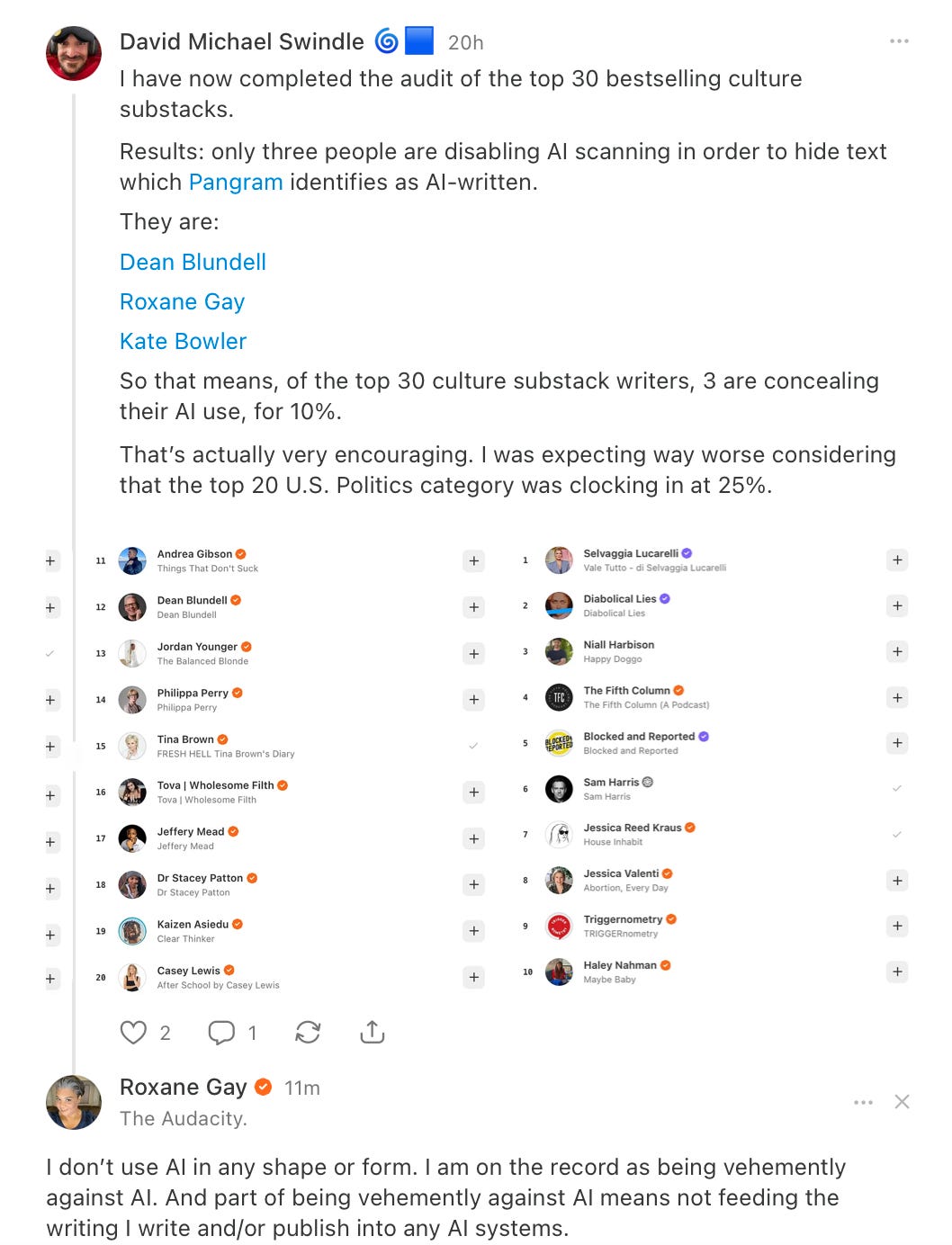
Roxane responded to one of my posts noting her among the AI concealers:
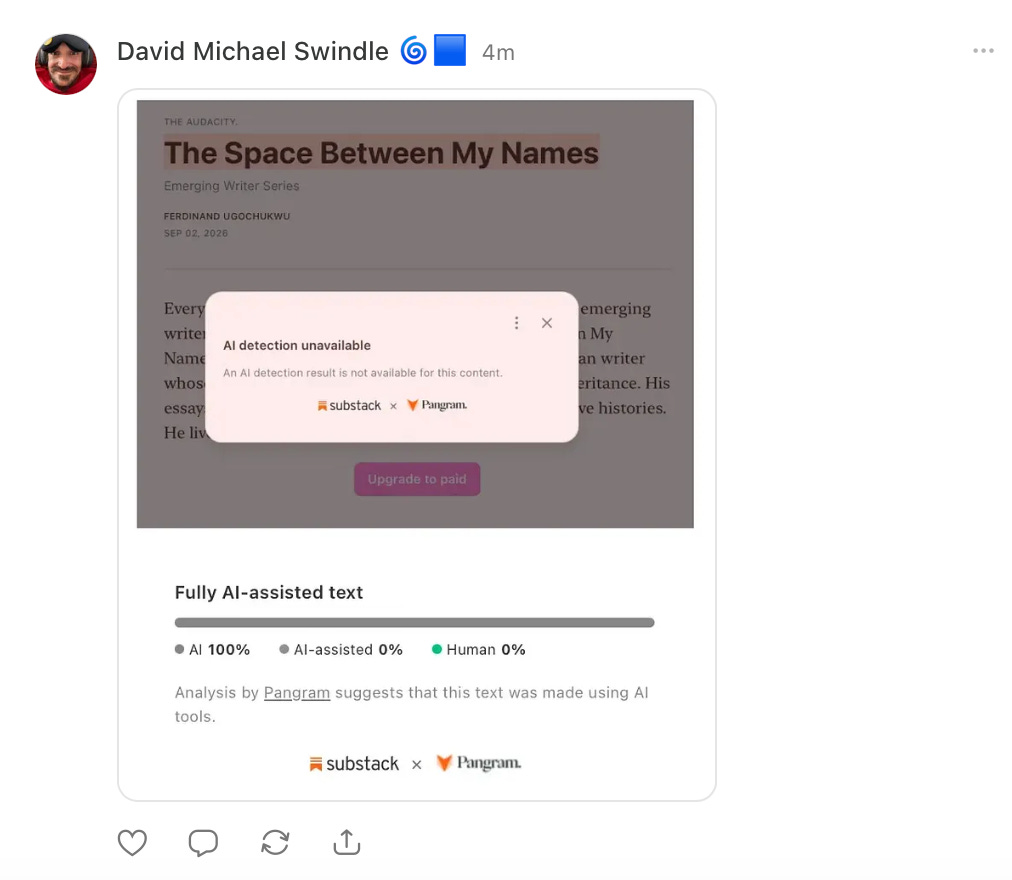
I responded with a screenshot of the image above:
She answered:
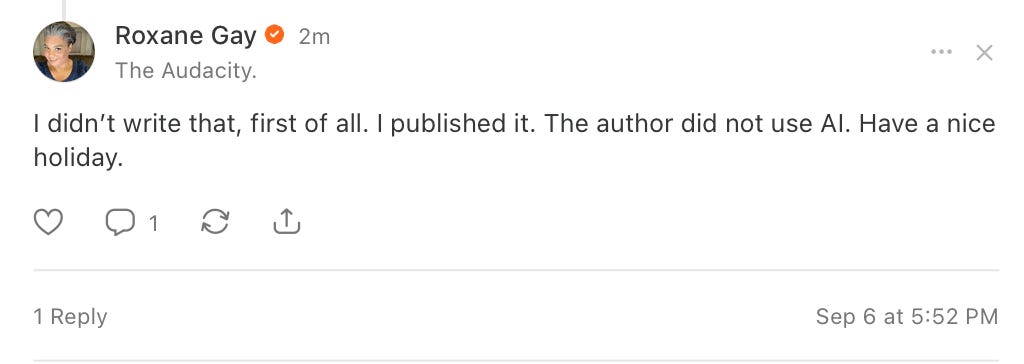
I replied:

In spite of the ideological gap between us, I like Roxane Gay quite a bit. She’s very talented. While we’d disagree on issues, I have no personal ax to grind with her.
And what this post in the investigation spotlights is that for those of us who publish other people’s work, we now have to start using Pangram to check the submissions we receive.
Roxane was duped, but it’s not a mark against her — though she really shoud not have disabled Pangram.
This is normal now in publishing and editing. Writers submitting AI-generated work as their own get past us all the time, as the next writer on this list did with me for years:
SEPTEMBER 20 UPDATE:
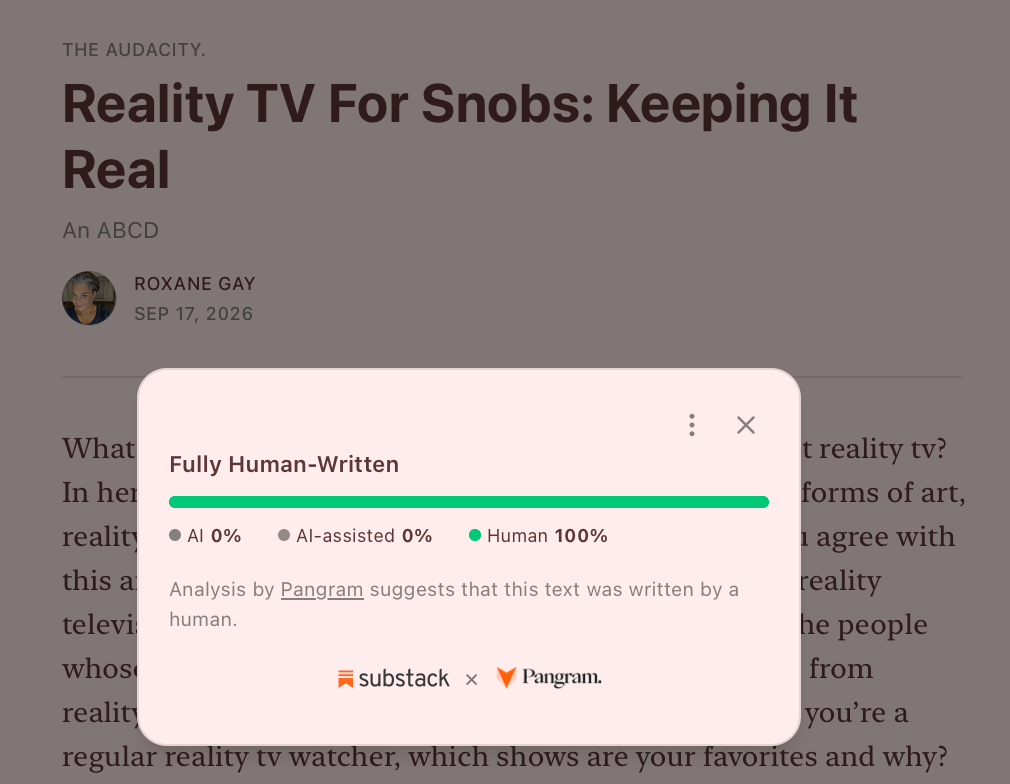
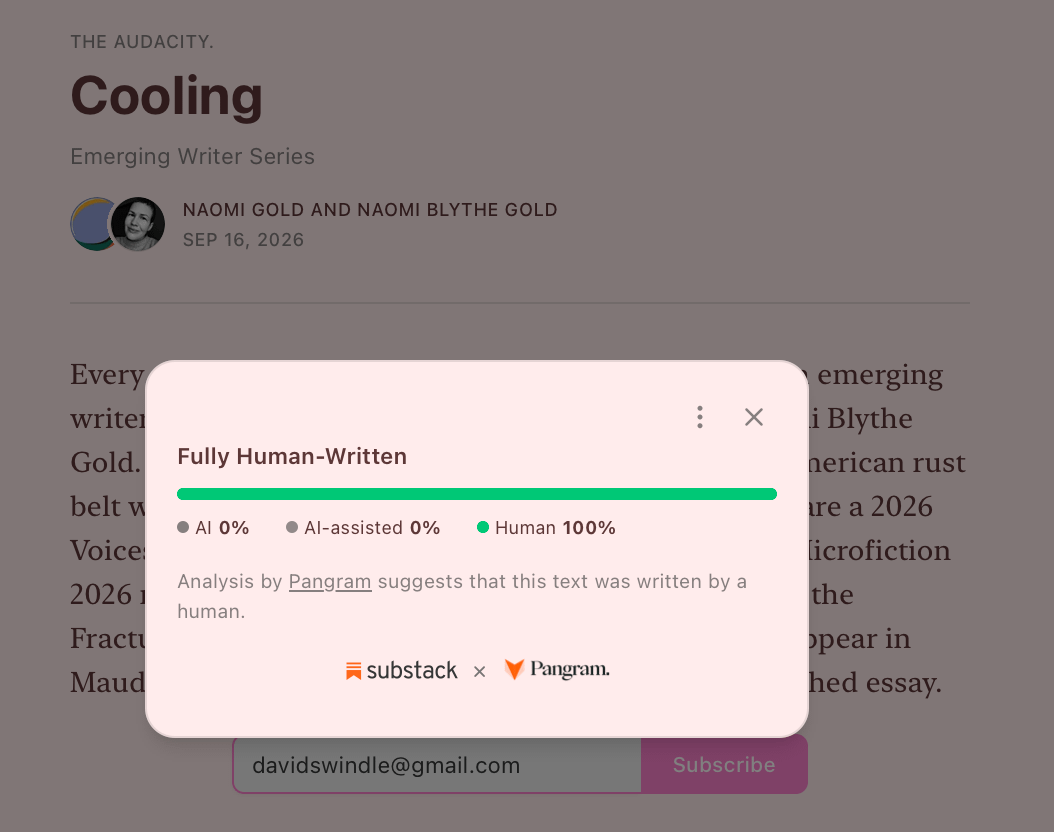
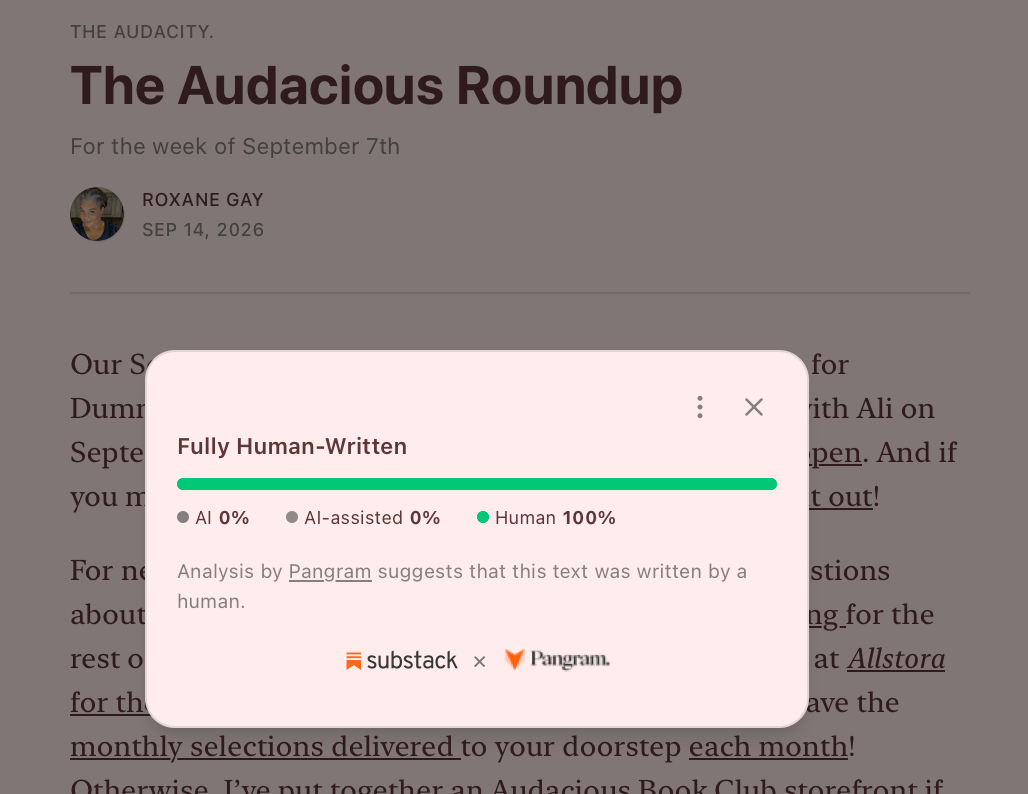
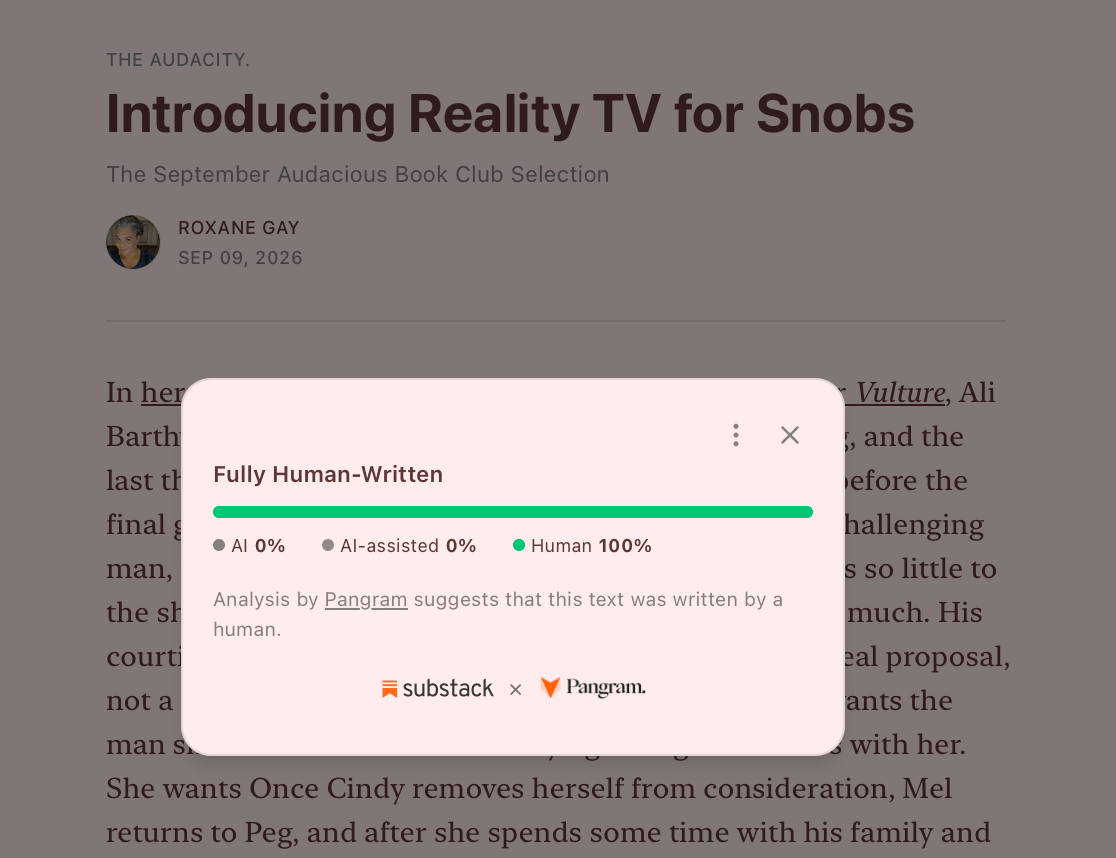
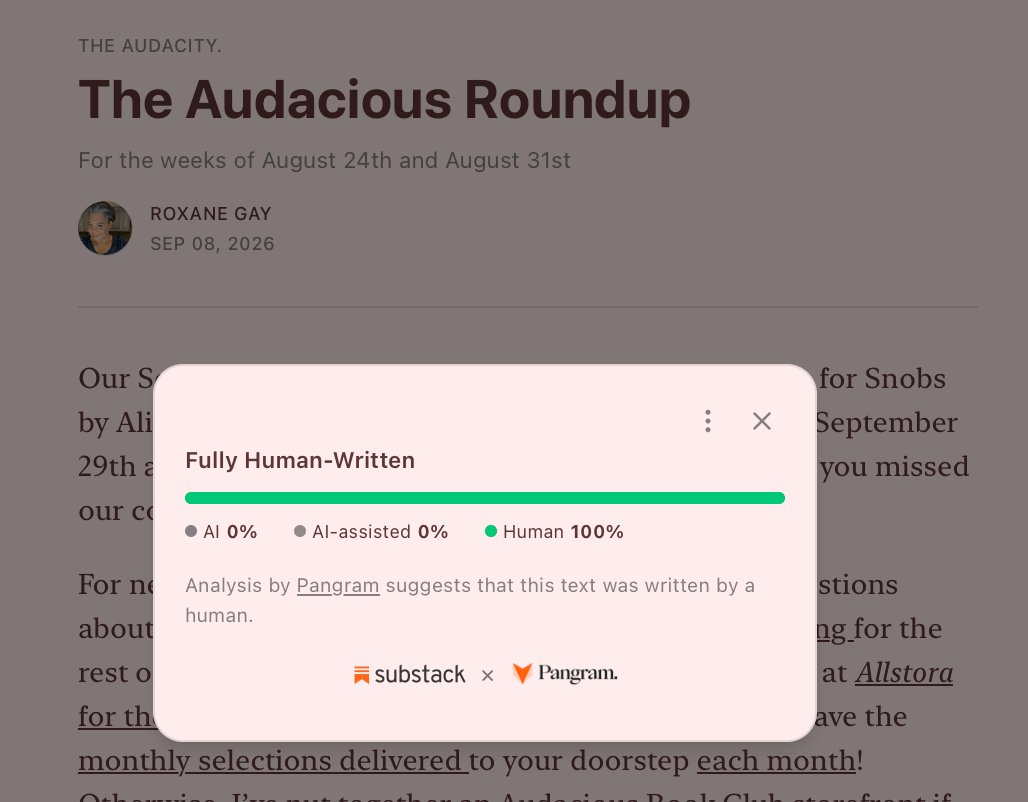
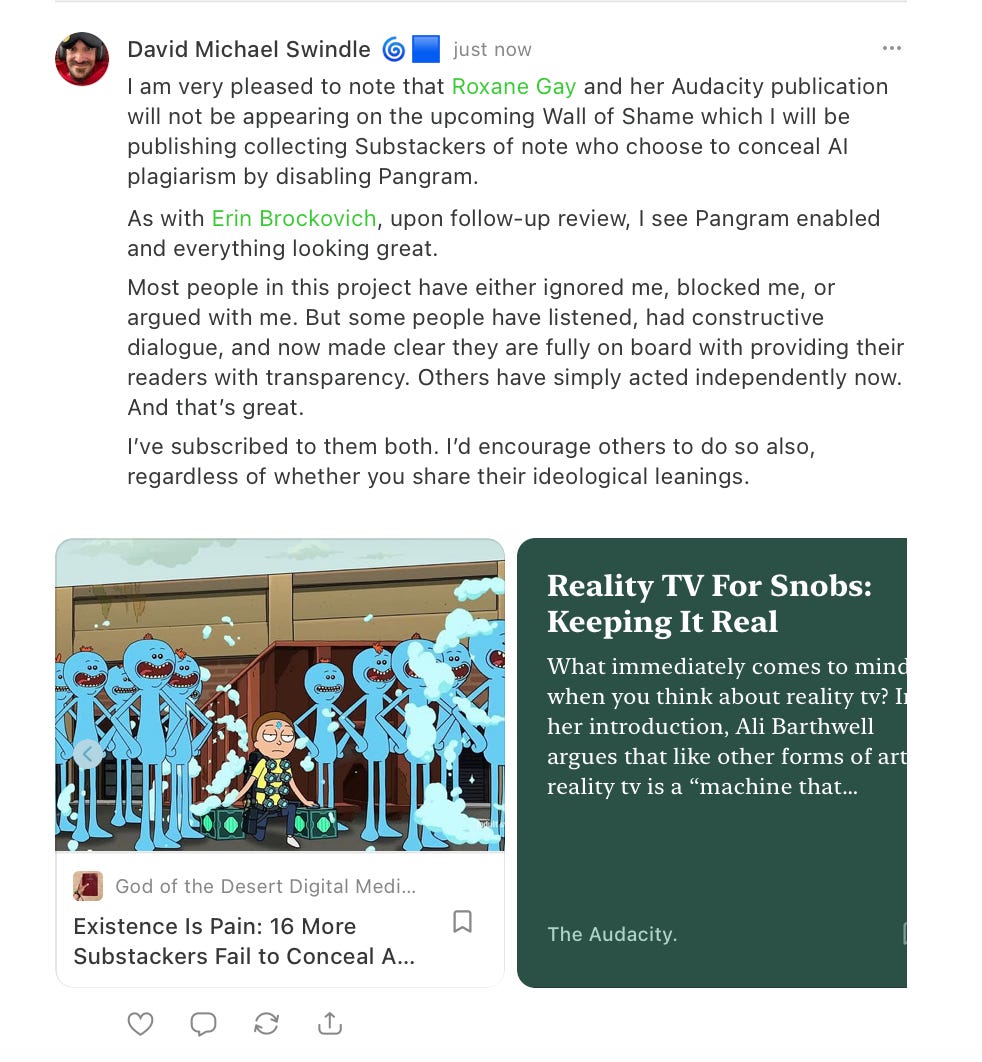
Excellent.
This means that I will not need to include Roxane on The Wall of Shame. She was one of the people I was most unhappy to have to include.

35. Marc Friedman

I can empathize with Roxane for having made the mistake of accidentally publishing authors who have presented writing plagiarized from an LLM as their own work.
I have unfortunately made this mistake multiple times now myself.
I trusted writers when I shouldn’t have.
One of them was Marc Friedman, a writer I met here on Substack who I regarded as a friend and previously named one of my favorite writers on the platform, including him as #19 on my last in July. I’d had a call with Marc praising his writing, discussing collecting his pieces, and developing broader book projects in the future.

The story Marc wrote for us above about his decision for him and his wife to move into a senior living facility seemingly earlier than necessary has been our most popular post of all time:


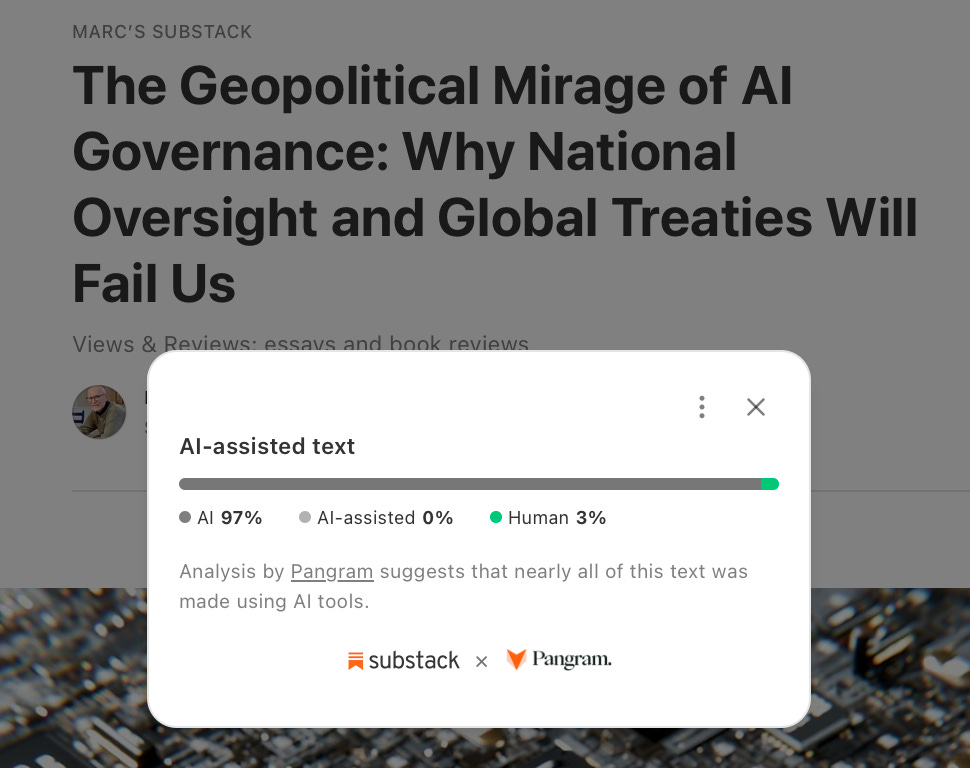
And there’s just one problem. Like what you find on Marc’s Substack, he didn’t really write it himself. Here’s the scan that I just did on it:
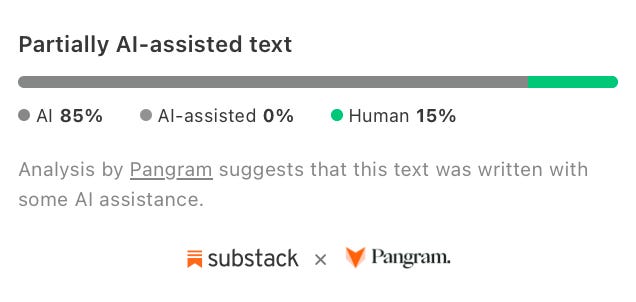
The reason why we published this seemingly odd post was because in January and February when I was even more deeply depressed about “Miscarriage 7/Miscarriage Final” than I remain now, I put out a call to our contributors for pieces since Sally and I were struggling to write much ourselves.
So Marc jumped in and offered us this and I was so grateful. And then when it hit big with drawing in so many new subscribers and so much traffic I was thrilled. The screenshot above says 4 subs, but that’s an undercount as those figures always are in the Substack dashboard. I know that it generated over a dozen new subscribers because that’s how many came in soon after Marc’s piece.
But if I’d known that Marc had just told an LLM to spit these out for him then I would have never published his work.
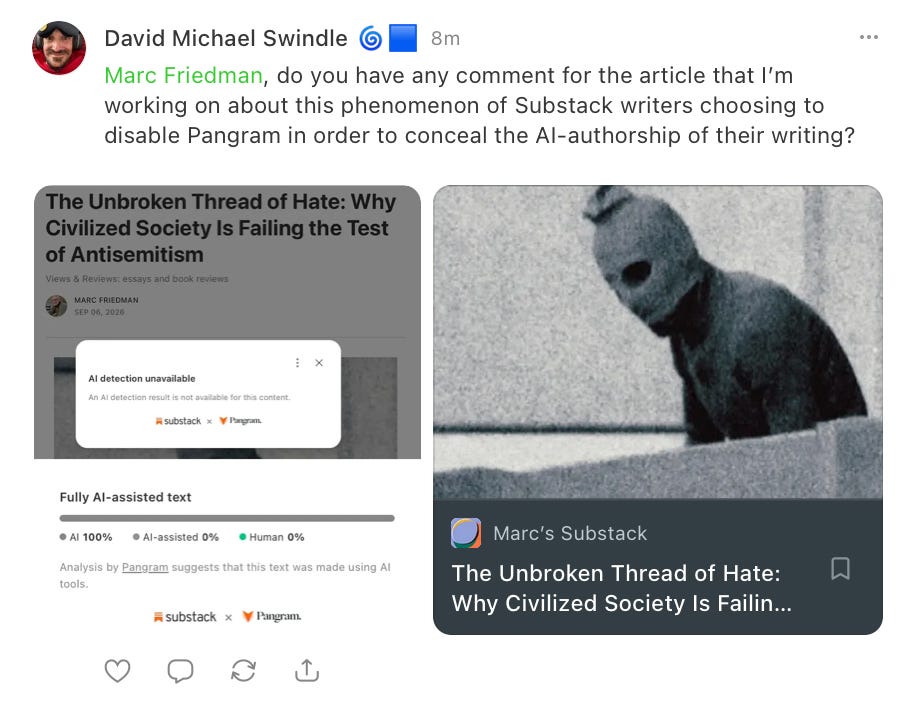
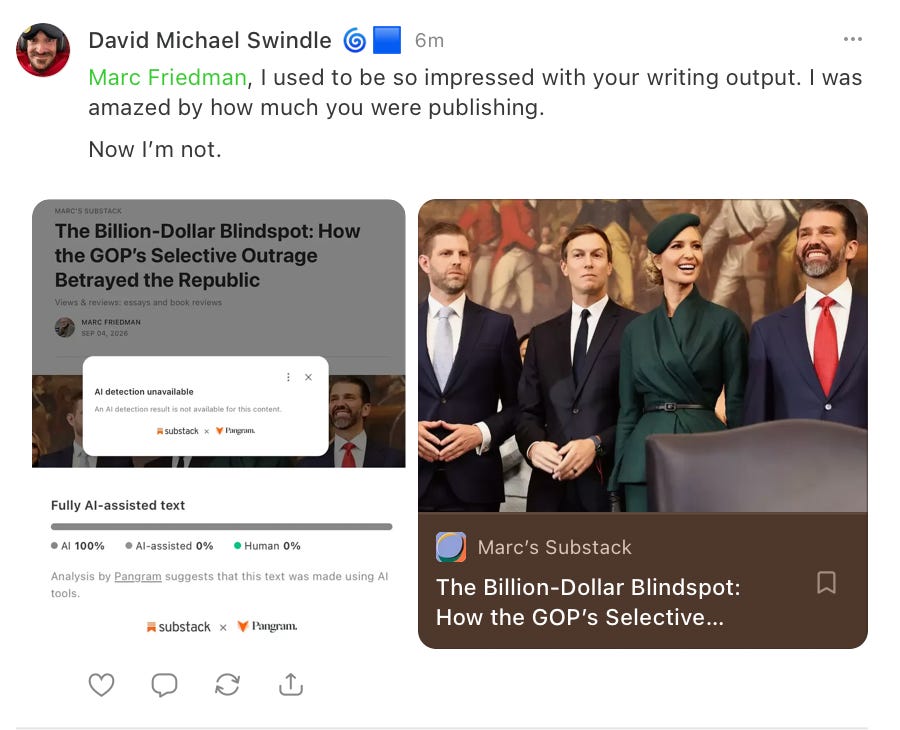
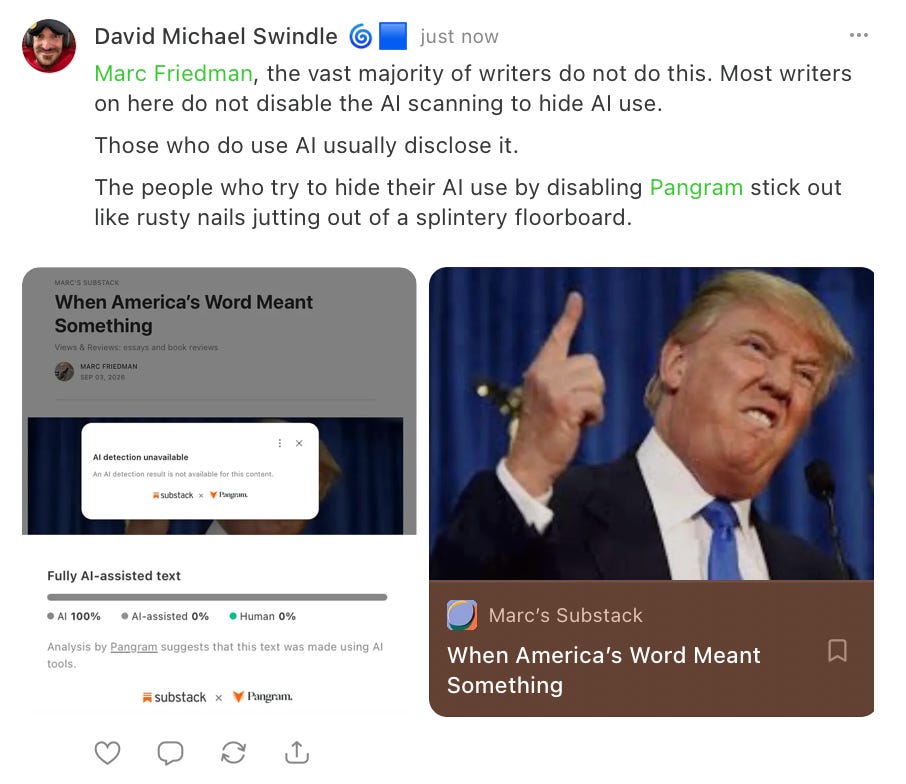
I emailed Marc on Thursday to ask him about this and begin a dialogue about his writing and our future professional relationship. I was not eager to put him on this list and expose him if not professionally required. If his responses had been sufficient then I would have not included him. I wanted to give him a pass here since he’d been so kind to me previously. Now I see that was just phony professional politeness, not authentic friendship.
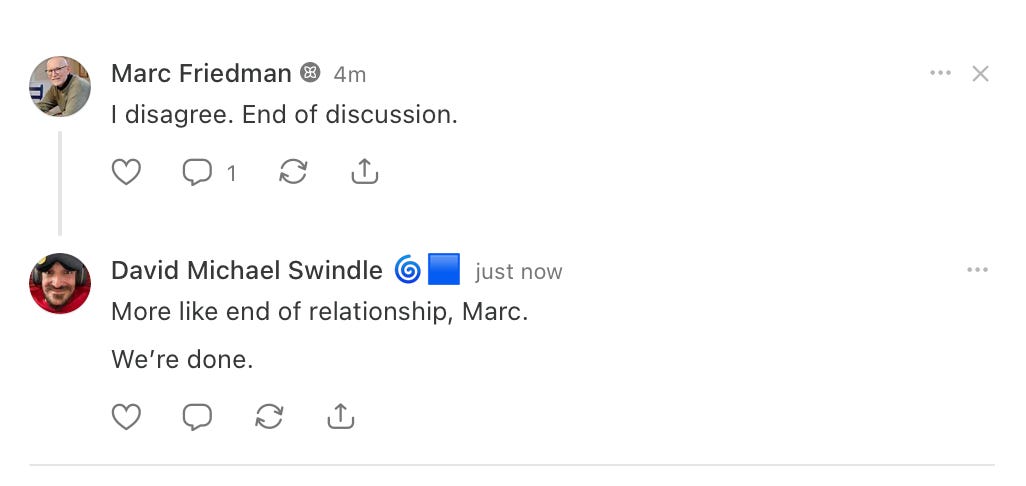
But given that Marc chose yet again to still publish yet another article in which he blocks Pangram, even after I’d emailed him last week warning him that I’d seen writers doing it, he’s on the list now and we’re done.

In emailing with Marc over the weekend, I found his answers evasive and he has yet to respond to my email from Saturday, September 5, 2026 as he said he would:
Marc,
I’m not going to enjoy the Labor Day weekend at all. What is there to enjoy? These will just be days working like any other for me. I’m assessing if I want to continue as a writer at all.
I am very discouraged right now as a writer. For months now, I have felt like quitting. It’s seemed like my work has been largely ignored for years and so it remains.
And now I feel even more discouraged as an editor and publisher. Because I feel duped.
Do you remember that I included you on my list of 75 favorite Substackers this year? https://www.godofthedesert.org/p/my-75-favorite-substacks-for-2026s
I wrote this:
One of the things that has disappointed me most about Substack is that as I have searched for writers for years to potentially publish, and ultimately found so few writers as strong, thoughtful, and interesting as Elizabeth Sowden, Ehud Neor, and Marc Friedman. They each do very different writing, with Beth focusing on historical fiction often set in her Minnesota region of the country, Ehud focuses on his home in Israel, and Marc has transformed himself into a machine producing one thoughtful review and essay after another. (And his fiction explorations recently have been wonderful too.) I’ve published each of them before and look forward to developing further projects. Like Yakubu Dakléshelleng Musa, they’re each writers who I just want to pour some editorial editorial sunshine on and see grow. Give them subscribes.
Look specifically at what I wrote about you: “Marc has transformed himself into a machine producing one thoughtful review and essay after another”
Now it’s clear that you hadn’t transformed yourself into a machine. You were just using a machine and passing it off to me and to your readers as though you were doing it yourself. And what has this method resulted in for you? You have nearly 3000 subscribers compared to my just over 700, in spite of the fact that I’ve been a professional writer and editor since 2009. And this imbalance in subscribers isn’t just with you. I’ve found over a dozen other Substackers like you who I have found doing this same thing of disabling the AI scanning in order to conceal AI use. That I am capable of writing much better than an LLM because of a lifetime of practice since age 8 does not matter. Readers do not seem to care much about the quality of the writing. Whether I rattle off something superficial in 30 minutes or spend 3 days researching and polishing something extraordinary doesn’t seem to make much difference to readers.
I feel like such a fool, Marc. You duped me. You were one of just a handful of writers I had found on Substack who I was looking forward to working with on book projects. I even stated so publicly.
And this isn’t the first time I’ve started working with a writer and even published some of their writing only to then learn that they were just using an LLM to do the work for them. It has happened too many times now. And each time my heart just sinks.
Experiences like this are just further motivation to me to give up my own writing career and to stop publishing books at all. I’m just so tired with being deceived by other writers, especially when I am actively trying to help them.
Take care,
David
Marc responded promising a thoughtful email — none has yet arrived — and I shot back:
Are you going to respond or is your LLM going to respond, Marc?
How can I tell the difference anymore?
That’s the big betrayal here to me as a publisher. I thought that Marc was this great writer with a lot of potential. And it turns out he’s not. The editorial time that I gave him was just a waste. I should have focused on writers who were actually writers instead of just a retired lawyer marketing his executive coaching business by churning out LLM-written articles he pretends he wrote himself.
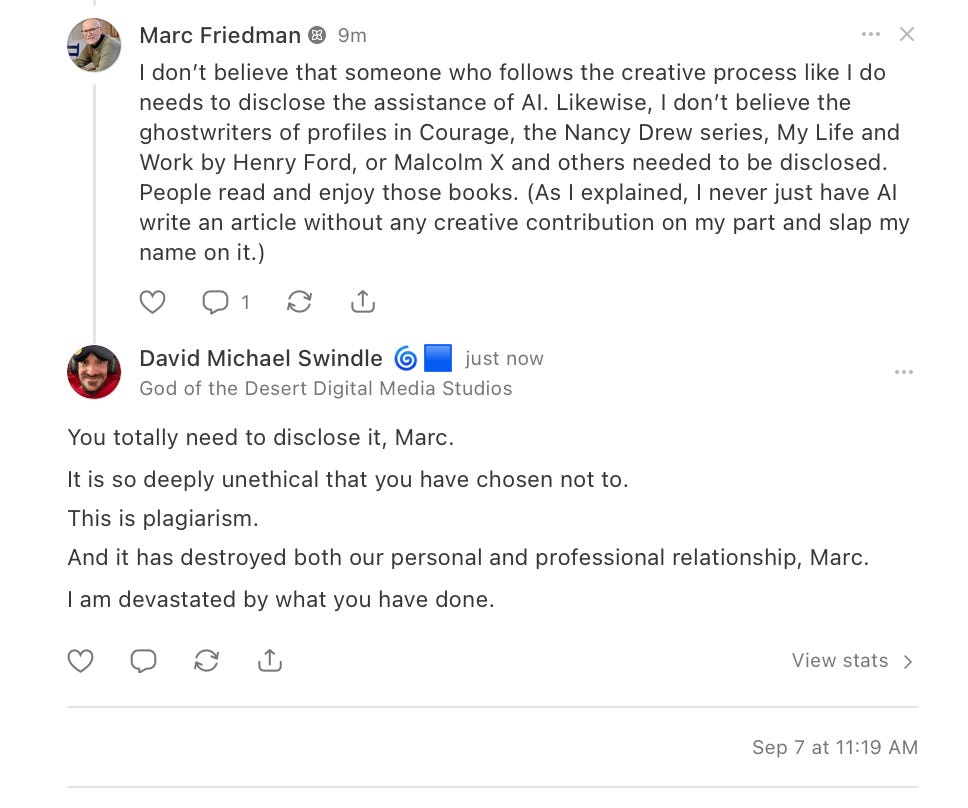
Marc responded to my request for comment above and chose to claim with a straight face that he did not think he needed to disclose his AI use:
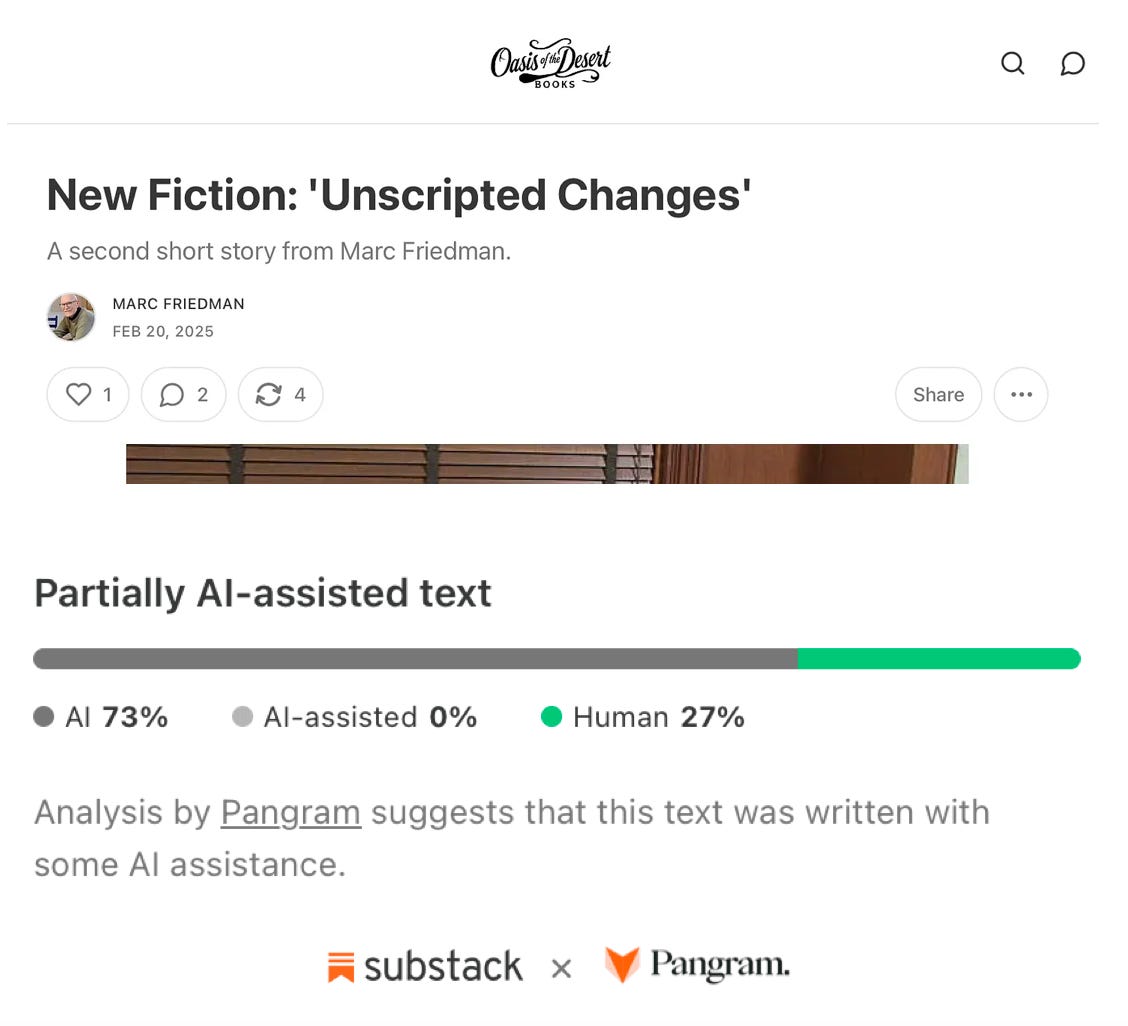
Last year, Sally and I spent a lot of time working with Marc on some fiction pieces. It turns out he relied heavily on AI for that too:

At this point, after being burned multiple times now by writers like Marc who choose to conceal their AI use, I’m done recruiting any more writers for God of the Desert. The team we have now is it. I’m not interested in publishing authors other than the group we already have under contract now.
Thanks, Marc. You’ve ruined it for everyone else. I’ve learned my lesson now about trusting writers in 2026. Being a publisher really isn’t worth it any more if I now have to put every single submission through Pangram first. Heck, I’m going to have to just scan everything now, lest I make the mistake of thinking too highly of someone again who didn’t deserve it.
There were so few writers strong enough to publish before and now there will be even less since we’ll now be able to deploy the Pangram brain police to spot the fakes like Marc more easily.
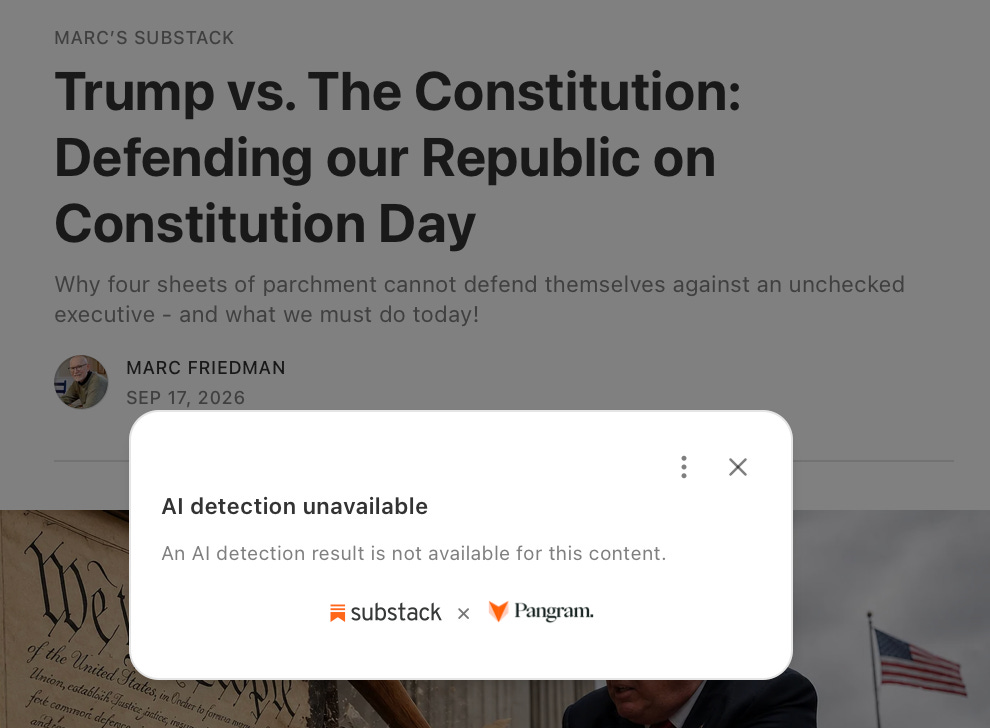
SEPTEMBER 20 UPDATE:
Don’t get your hopes up:

36. Shannon Bindler

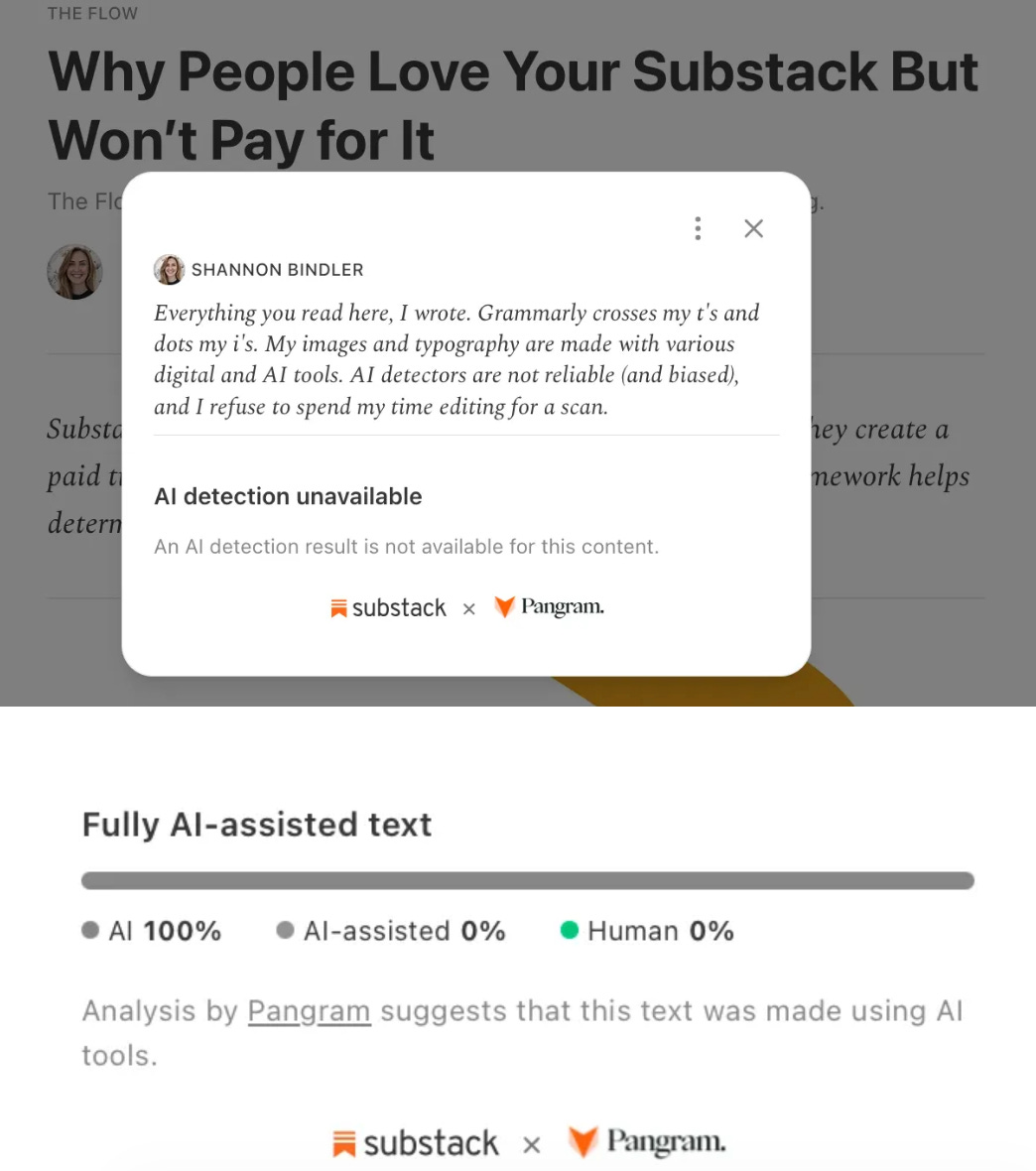
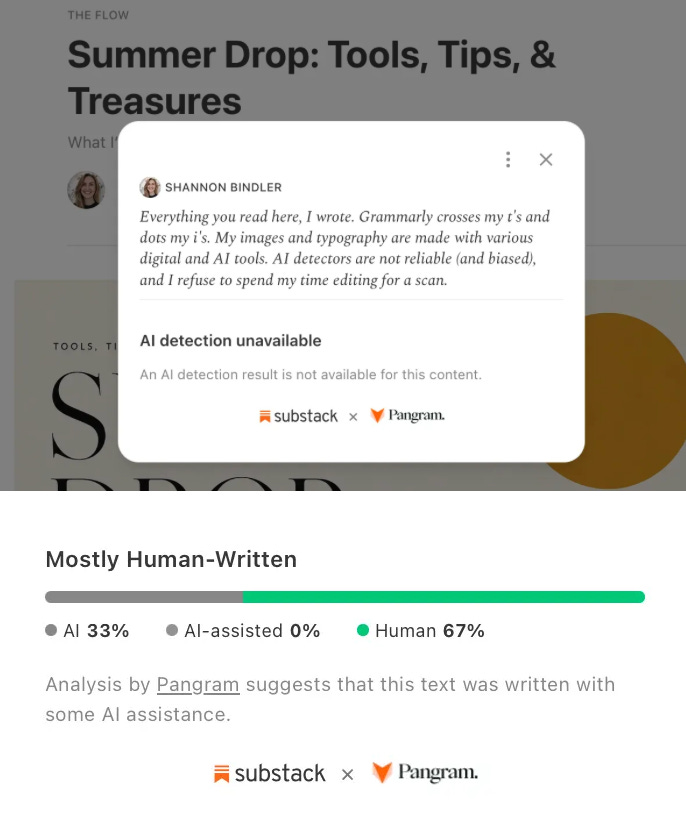
I already figured out Susan Bindler was peddling BS even before it became clear she plagiarized from AI to do it.
I subscribed to her after some positive engagements on Notes and a thoughtful piece she did on being a “highly sensitive person,” a condition I clearly identify with too. However, it did not take long of me pushing back on some of the lame platitudes she posted before she felt compelled to block me as most people playing the persona game rather than living the authentic life choose to do:

SEPTEMBER 20 UPDATE:
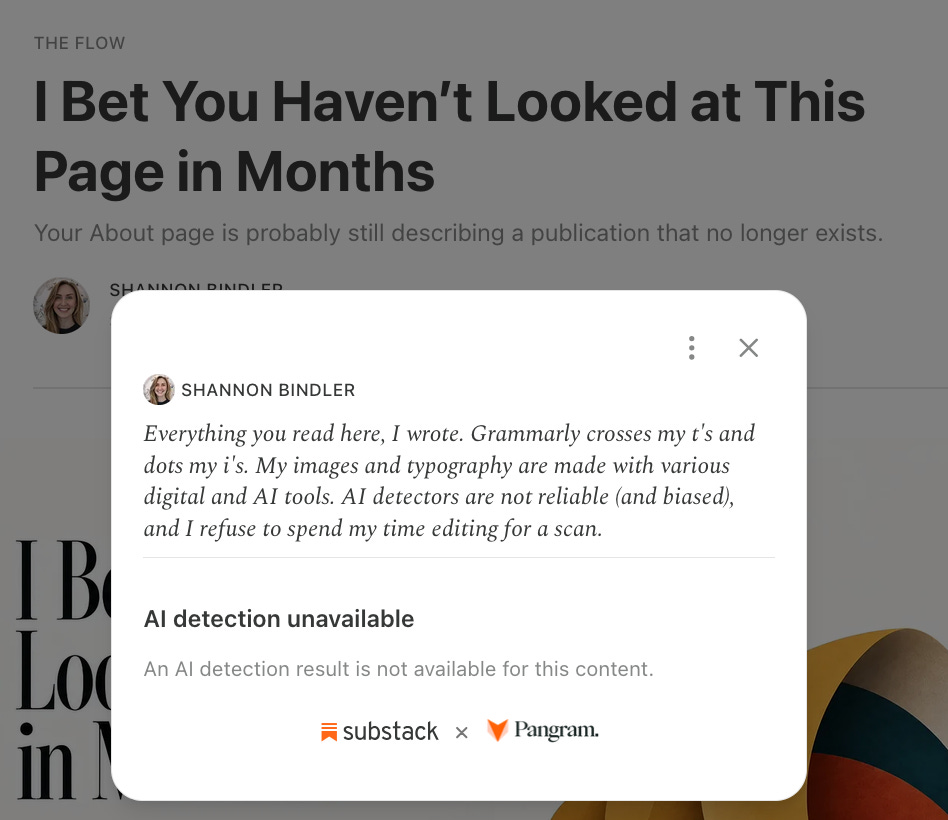
This is the confession of a woman who chooses to live in a world of bullshit:
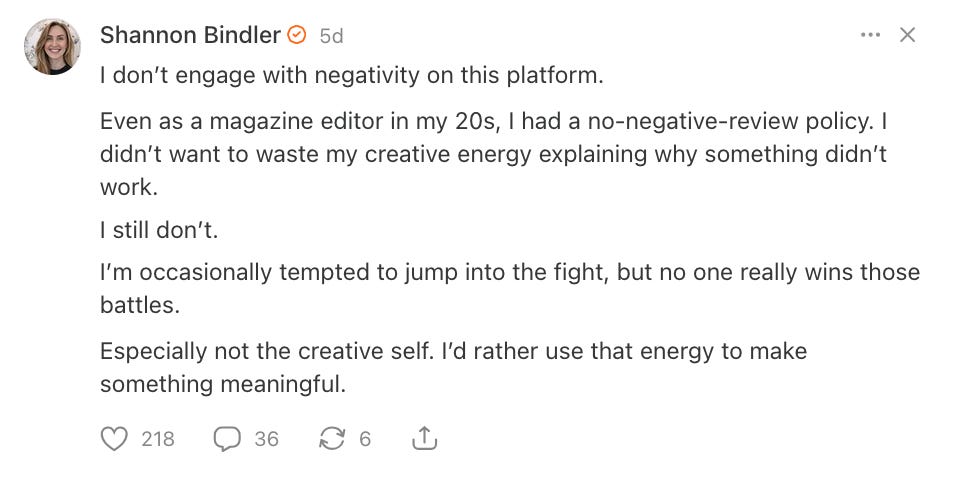
A “no-negative-review policy"? Are you absolutely fucking insane? A movie or album is terrible and you refuse to warn other people about it?
It is not a waste of creative energy at all explaining why something doesn’t work.
This article and its updates proves it. I highlighted something negative many writers did and we can see now how people responded in wildly different ways. Some people took the note, made the change, and now have earned my respect and endorsement. Others chose to run like a coward and block me. They will now go on The Wall of Shame. This is their own fault and I am doing a public service here by alerting the broader Substack community who the platform’s bullshit merchants are.
37. Yuri Minamide

I subscribed to Yuri Minamide for some time. She is a Japanese woman living in London, writing a Substack promoting Japanese culture, usually stuff like food and movies and trivial stuff.
I always wondered just how much of what she wrote was actually her own work. Now Pangram helps out:
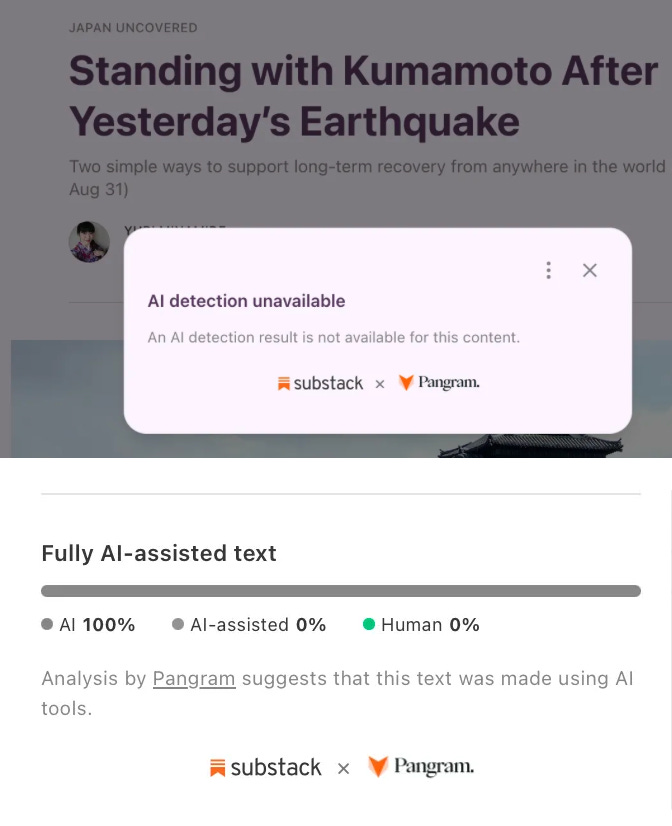
One of the aspects of Japanese culture which I’ve found can sometiems disrupt cross-cultural dialogue is that in Japan, “Honor” is valued more than “Truth.” In Japan, one can file a defamation lawsuit against someone for saying something true that merely harms their “honor.”
I guess I’m doing that now with Yuri. It’s wondeful that I’m living in America protected by the first amendment.
I love Japan. It’s my favorite East Asian country. But they too have serious cultural problems hiding beneath the surface for those who know where to look. The great Japanese filmmaker Akira Kurosawa knew the problems of his people well and his masterpiece “Ikiru” reveals them:
SEPTEMBER 20 UPDATE:

38. The News Today, Oh Boy

I recently found this delightful Beatles fan blog The News Today, Oh Boy through a friend and it inspired this satirical essay in March after learning that “Got to Get You Into My Life” from Revolver was really Paul’s ode to marijuana:

However, my enthusiasm has diminished since discovering the reason behind the Substack’s success:
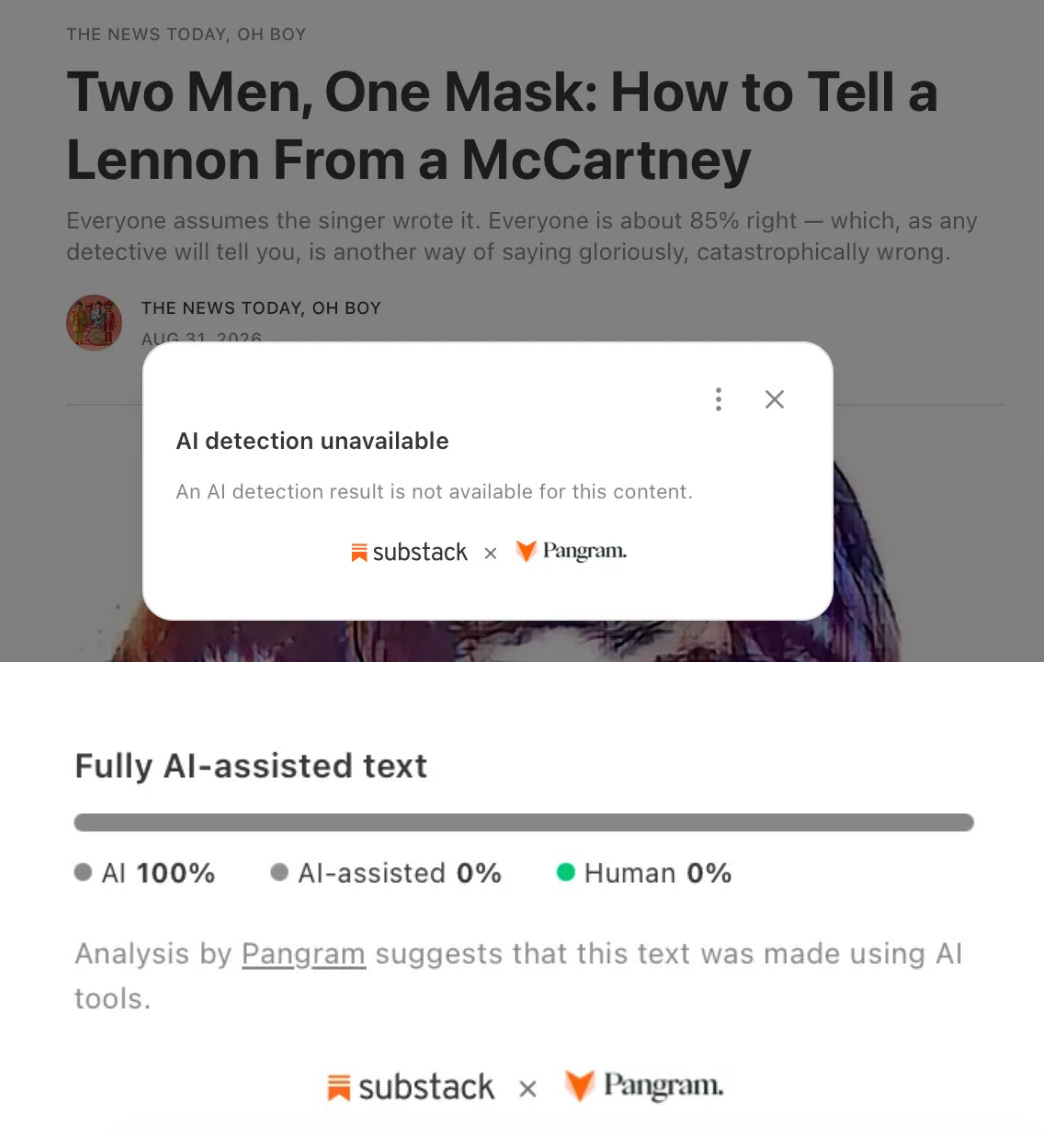
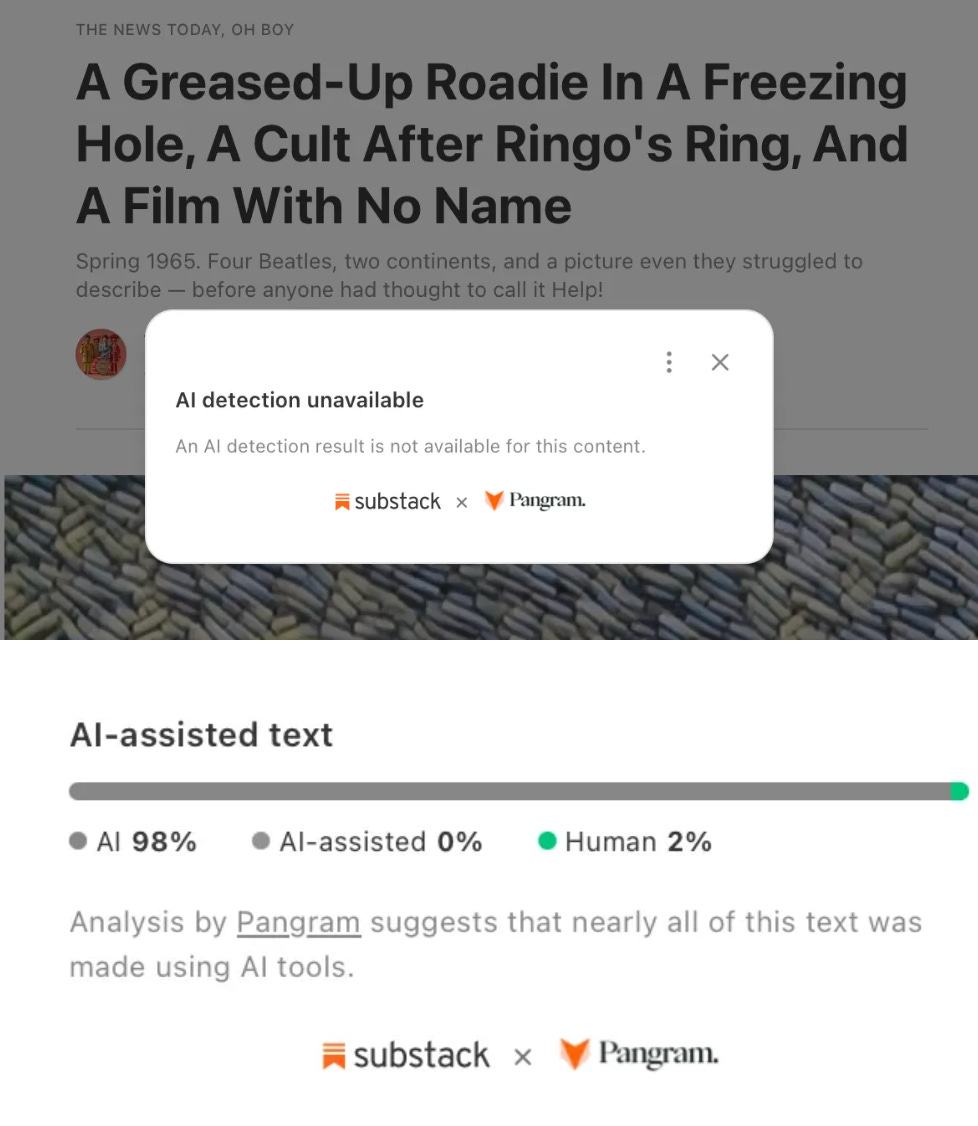
For some reason the song “I’m Looking Through You” from Rubber Soul comes to mind now…
SEPTEMBER 20 UPDATE:
Just the same song on repeat:

39. The Style Edit
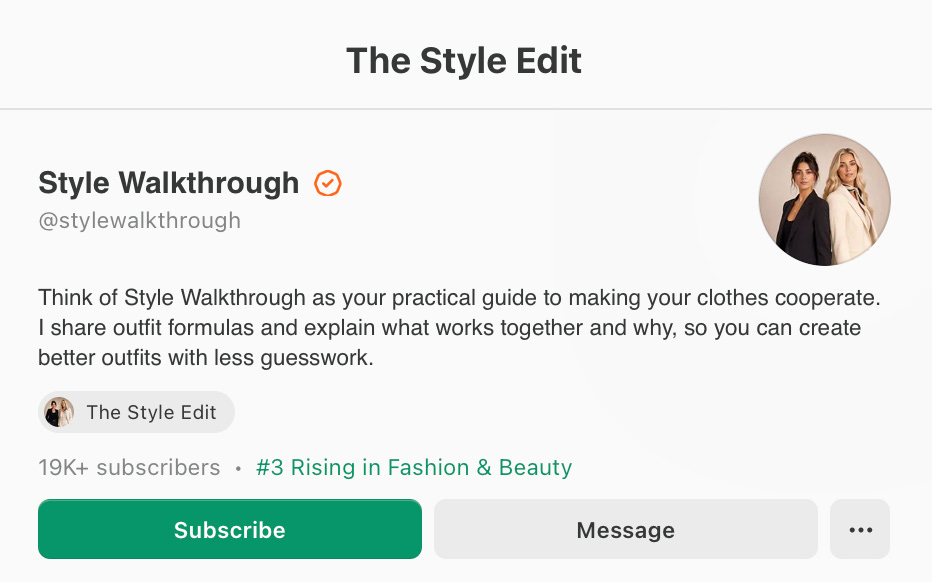
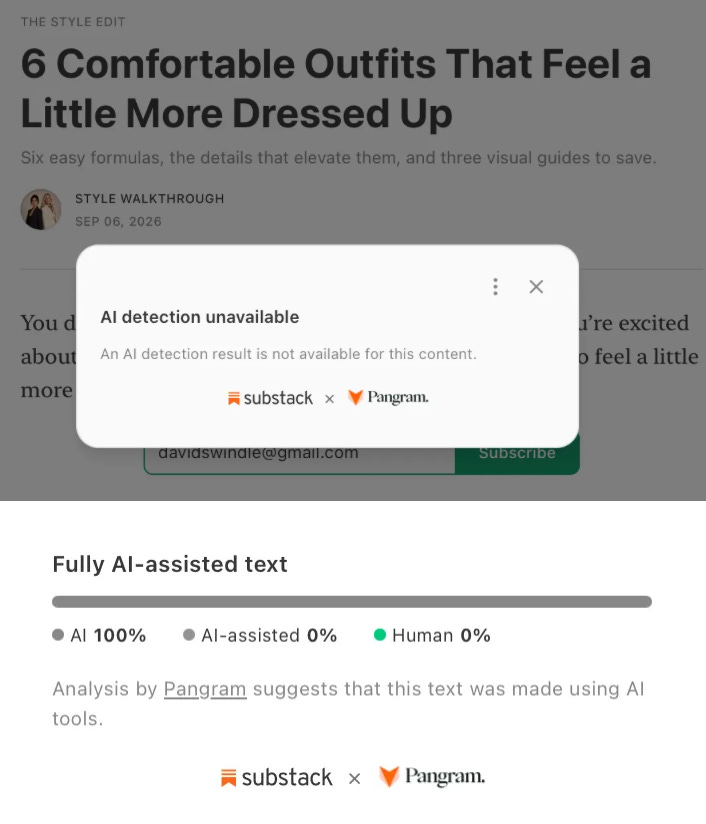
Apparently even some fashion bloggers feel shame to admit how much AI helps them with their writing. I came across Style Walkthrough while surveying the lists of rising publications.
This might be the lowest stakes instance of LLM plagiarism, but it doesn’t matter. This is a universal principle of journalism and all writing. It doesn’t matter if you are writing about Vladimir Putin or pajama pants, the same basic ethical standards apply for all writers.
SEPTEMBER 20 UPDATE:
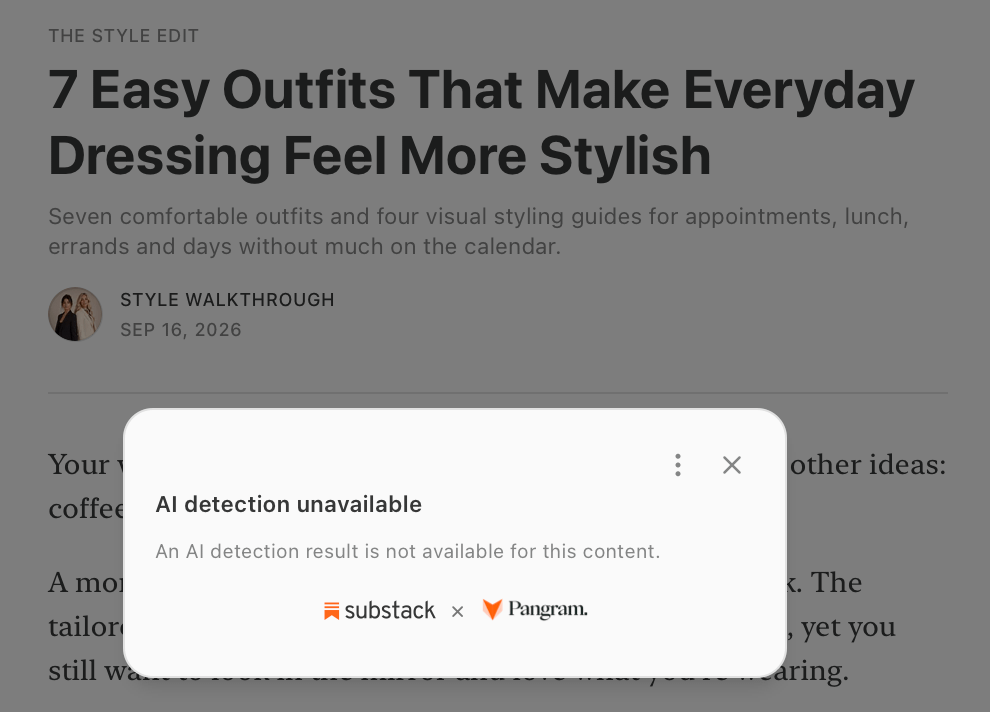
40. The Human Project
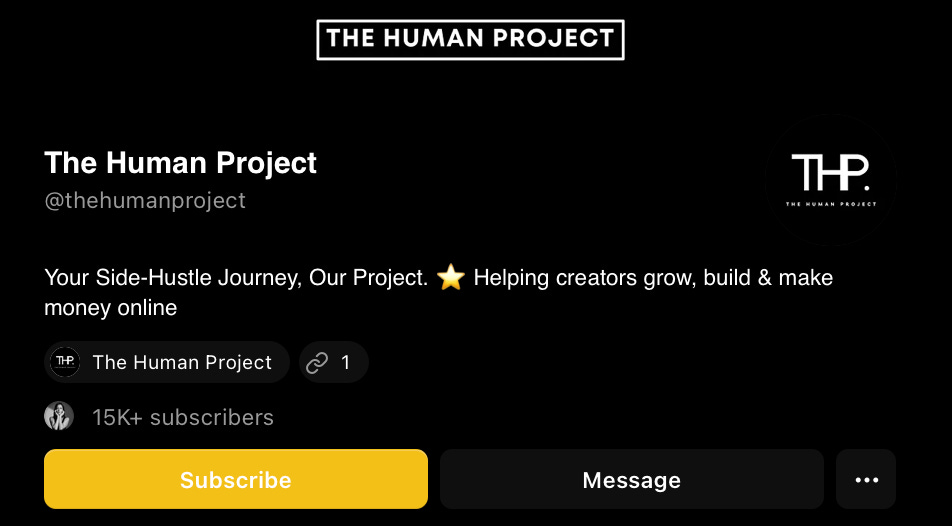
Gee, want to take a guess whether actual humans write The Human Project?

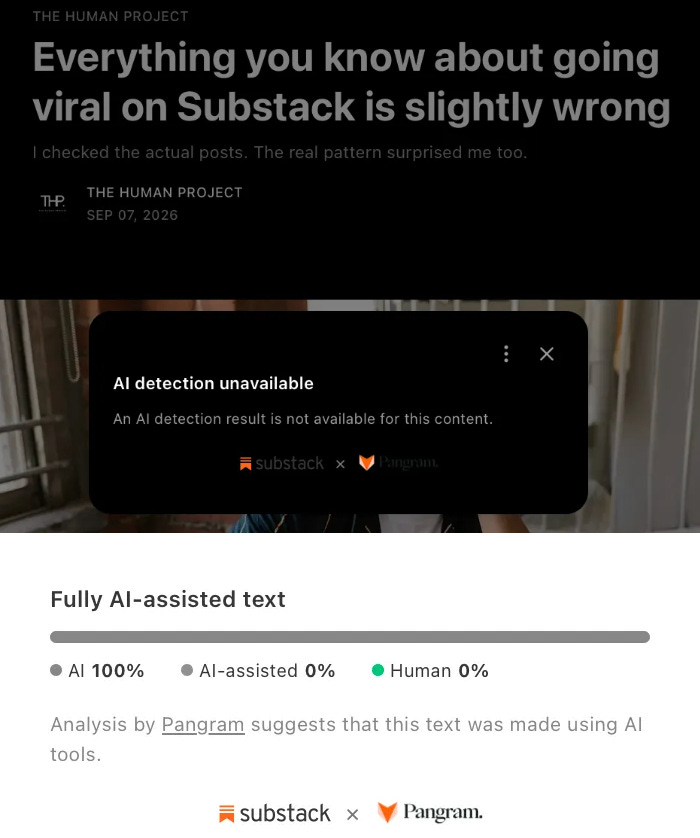
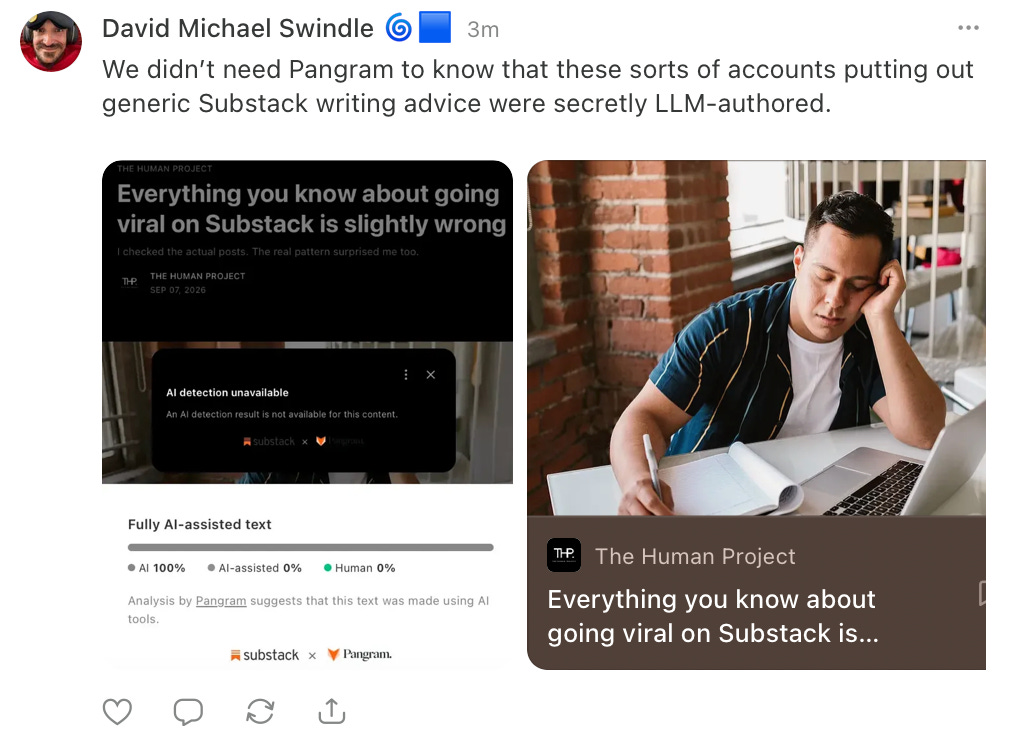
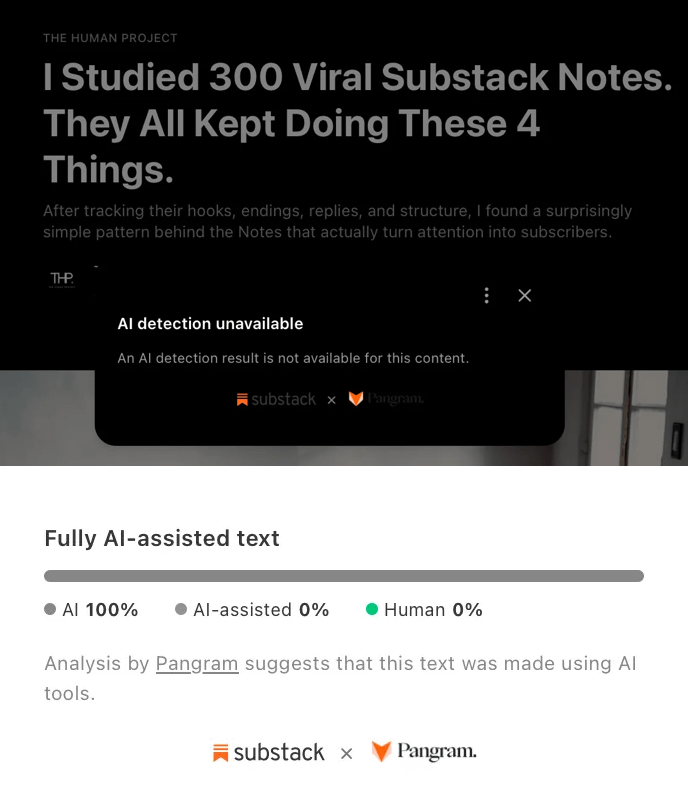

SEPTEMBER 20 UPDATE:
The AI detection is still disabled howeer now the author has added a statement:
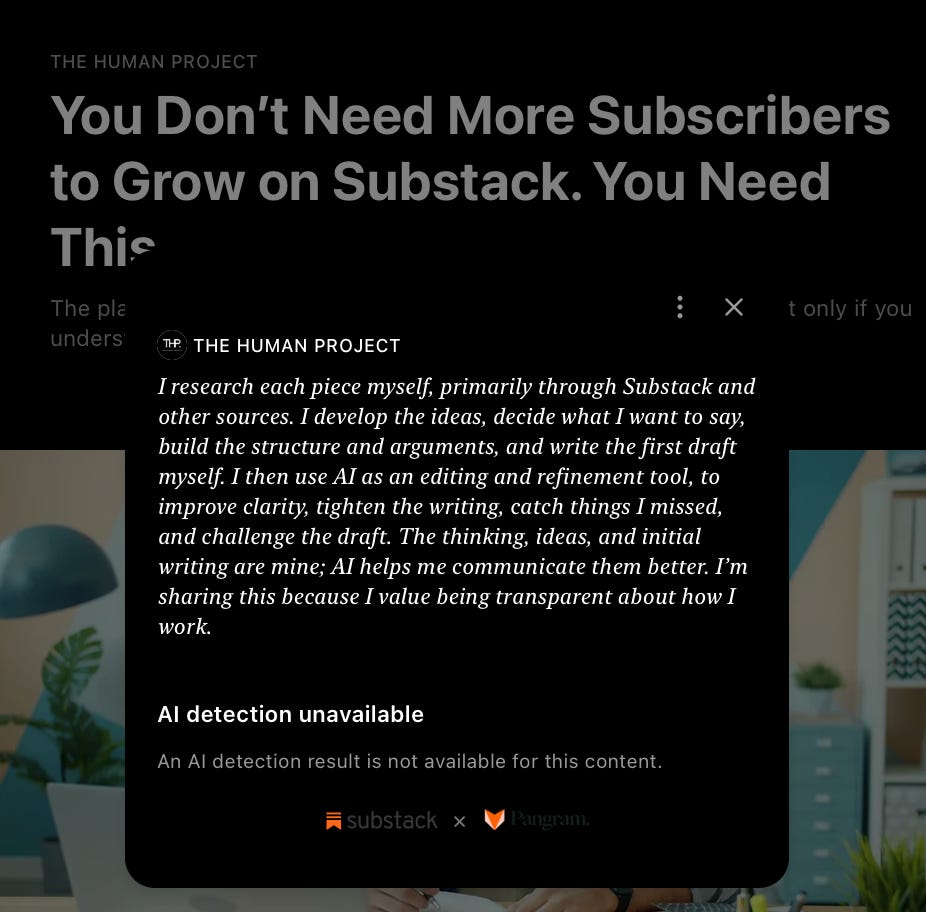
I call bullshit.
If this person valued transparency then they would not disable Pangram and they would write under their own byline.
They just don’t want everyone to see the 100%. And it’s clear that it would be 100% from the process they describe: “I research each piece myself, primarily through Substack and other sources. I develop the ideas, decide what I want to say, build the structure and arguments, and write the first draft myself. I then use AI as an editing and refinement tool, to improve clarity, tighten the writing, catch things I missed, and challenge the draft. The thinking, ideas, and initial writing are mine; AI helps me communicate them better. I’m sharing this because I value being transparent about how I work.”
In other words, he is having the AI write his second draft, based on his first draft.
This is the equivalent of if a student writes the first draft of a paper himself and then hands it over to his mom to rewrite it. If a novelist just bangs out a rough first draft and then hands it off to someone else to rewrite it and do the hard work of refining the thoughts, they are not actually writing.
The writing is in the editing process, not just in the pouring out your thoughts process.
When writers skip this rewriting step by having the AI do it for them, then the result is they produce weaker work. This would be like if a film director only shot the movie, then handed it off to the editors, and then played no role whatsoever in the creating of the film from there on. The idea is absurd. Only total amateurs to filmmaking would think that is how to do it.
41. Richard Cooper - The Unplugged Alpha
Of course we have to get at least one peddler of Manosphere-style machismo BS into the mix too. Richard Cooper, whose username is “The Top Shelf Man,” has volunteered.
CCing James Bloodworth, the extraordinary British journalist who has developed expertise reporting on these sorts of online merchants of 19th century cliches, Richard here might be another one to add to your files of men operating this boring, shameless grift pretending to play “Alpha Male!” like we were still boys on the playground.
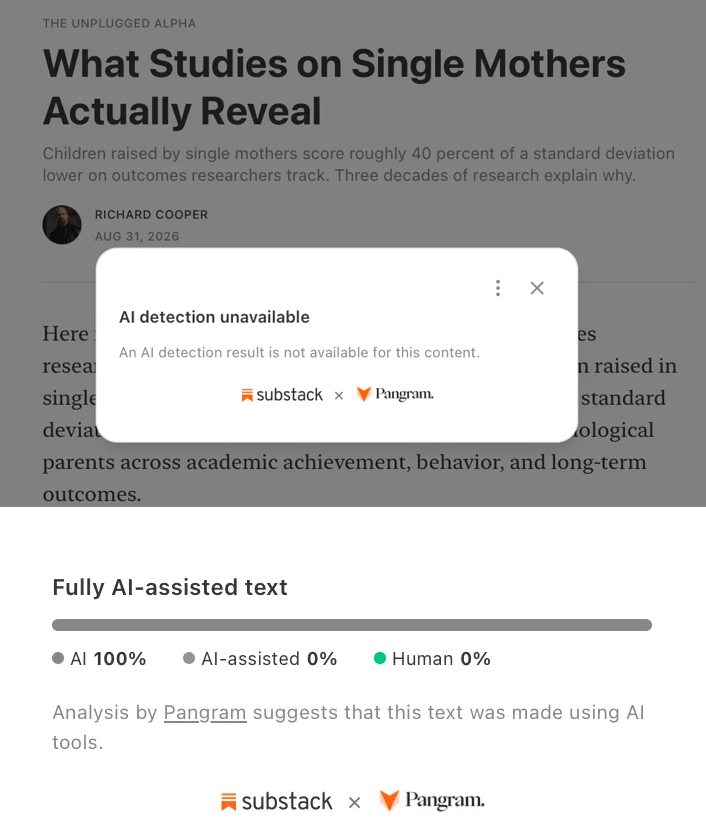

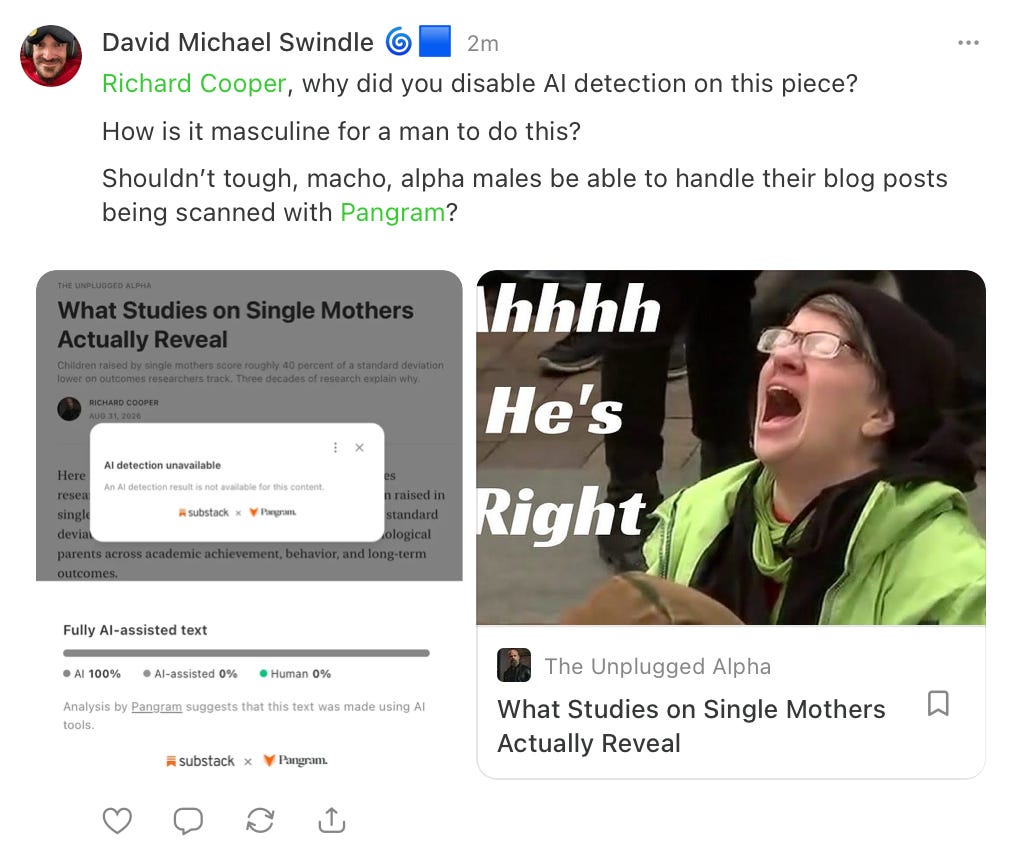
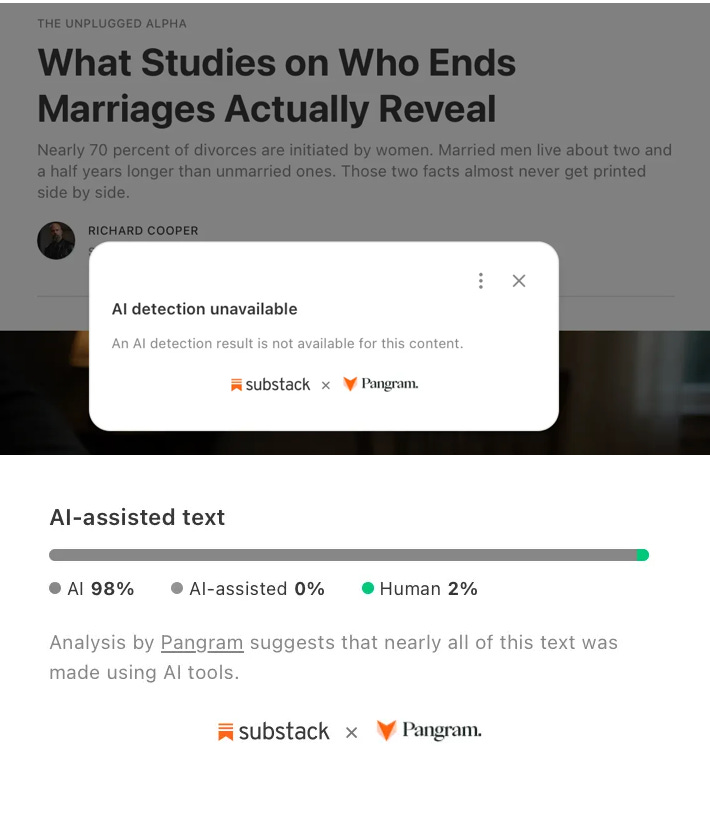

We’re almost done now with our journey through the nightmare realms of Substack’s narcissists, charlatans, and bullshit merchants.
Just one more sea to pass through — this last part is smoother sailing — and we’ll return to the dry realm of the truthful.
SEPTEMBER 20 UPDATE:
Everyone look at the Big Man here:
6 Technology BS Merchants
This surprised me a lot.
I thought that since AI was just so widely adopted in tech circles that writers in it would be more than comfortable disclosing their use.
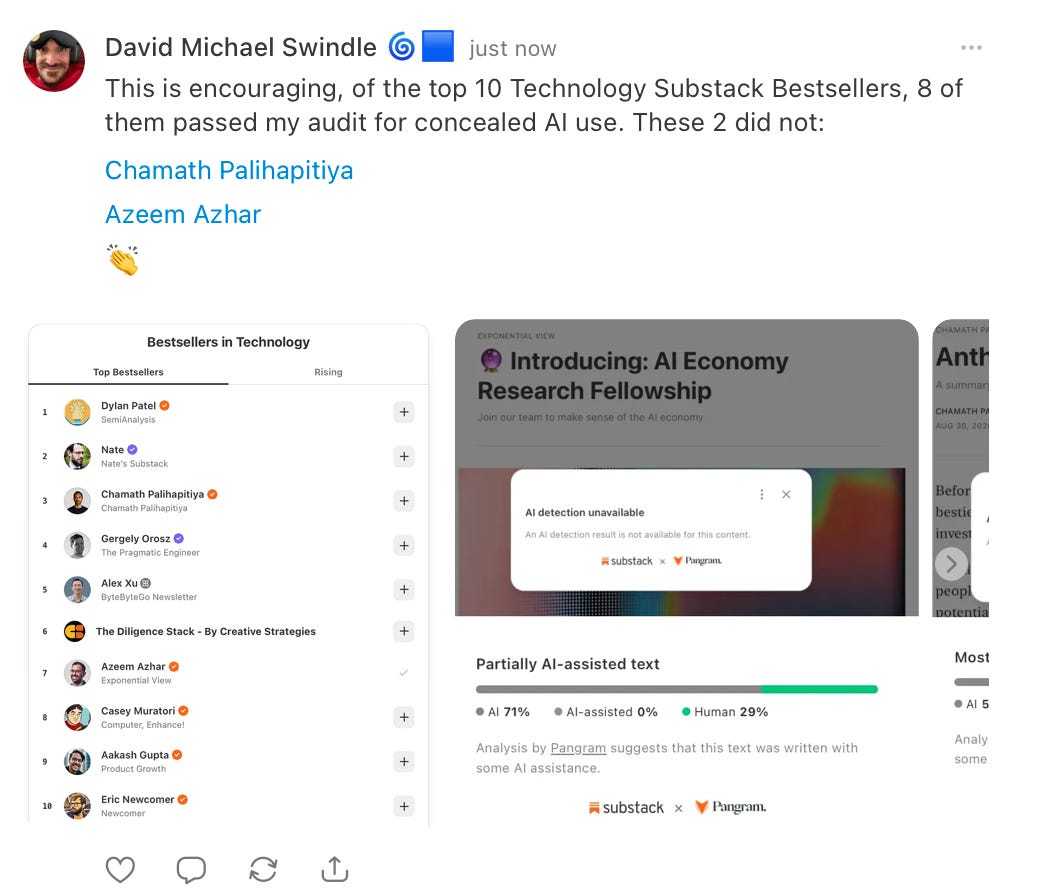
That was not the case, though. While the majority of the technology substackers on the bestseller lists kept Pangram on, these six did not and then a manual scan of their work revealed concealed AI writing.
42. Chamath Palihapitiya
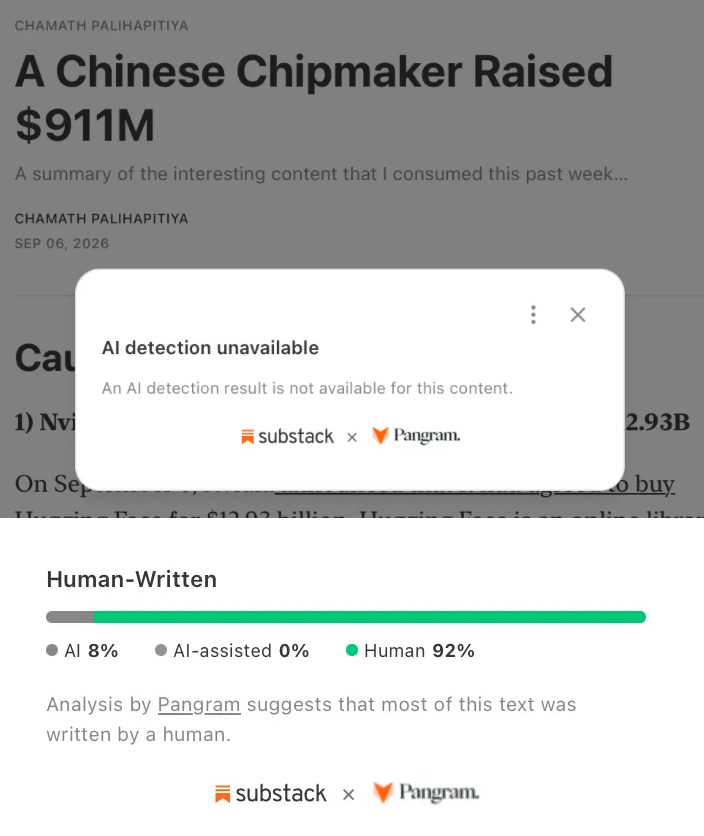
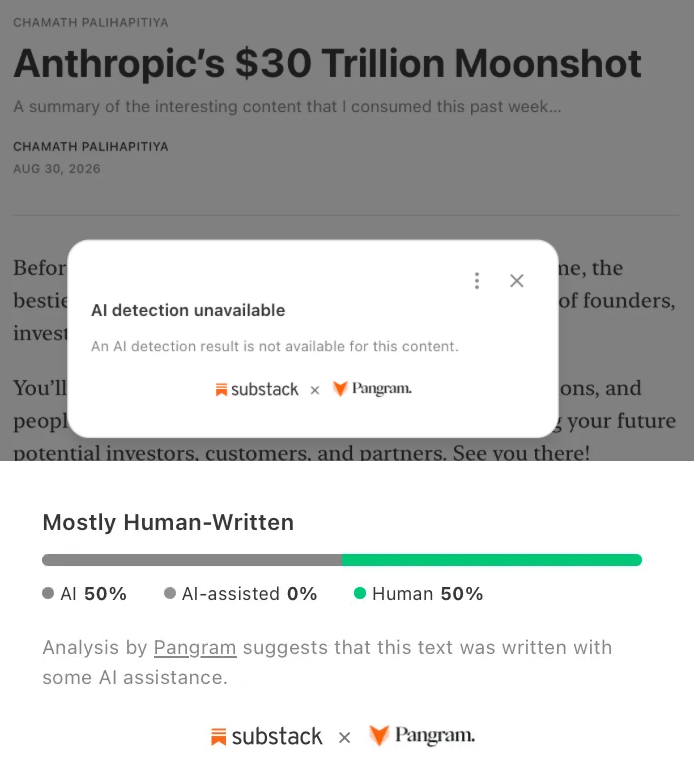
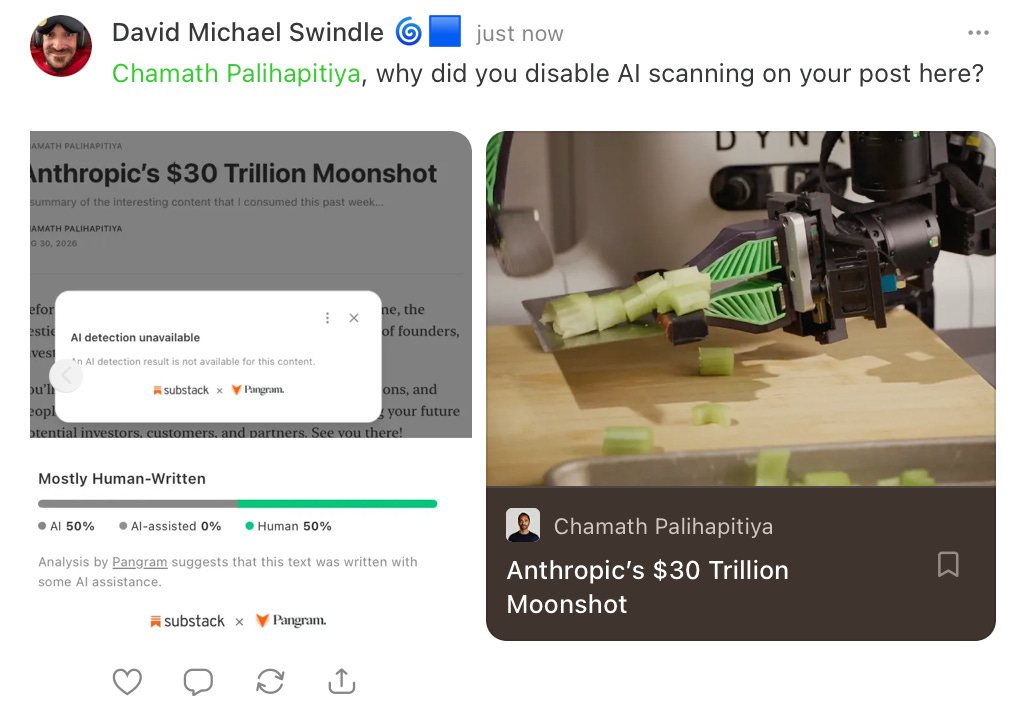
SEPTEMBER 20 UPDATE:
Well this is interesting. All of a sudden, four days following this investigation’s publication, Chamath decides to announce a new site in a post with Pangram enabled:
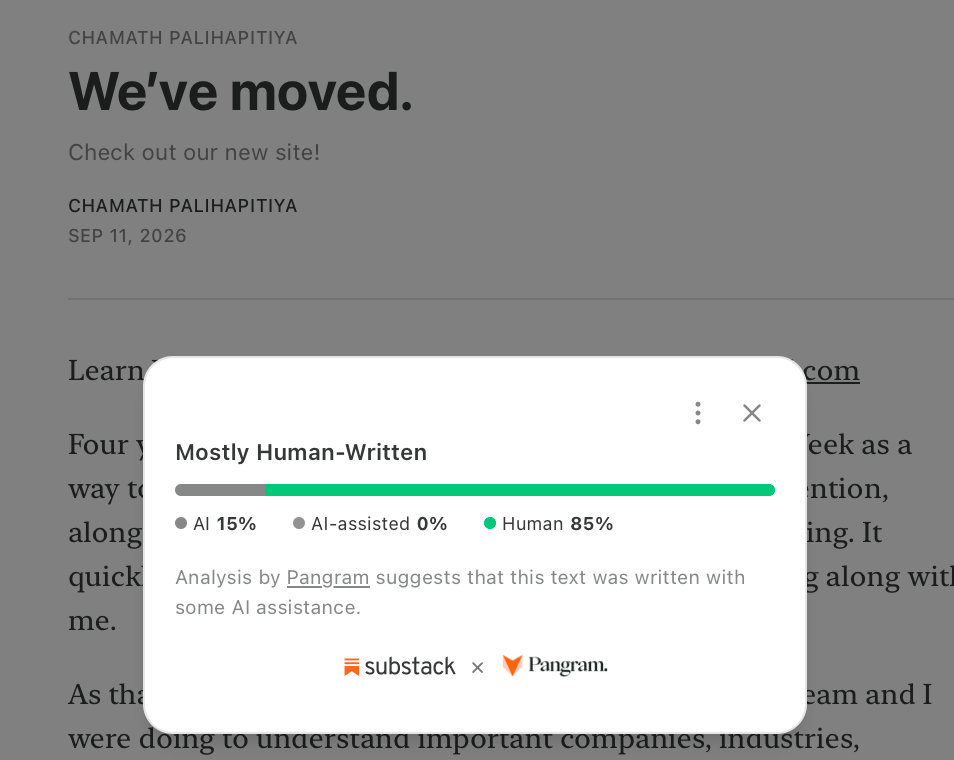
He will remain on the The Wall of Shame.
43. Azeem Azhar - Exponential View
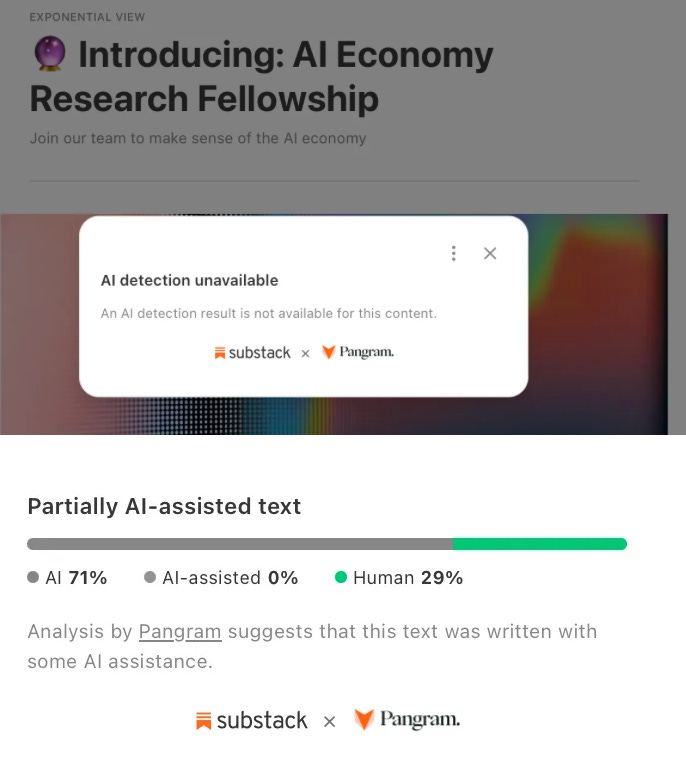
SEPTEMBER 20 UPDATE:
Currently Azeem does not offer any free posts since this article’s publication. Pangram reads the excerpt of his most recent article as 100% human written.
Thus, he will remain on The Wall of Shame for now.
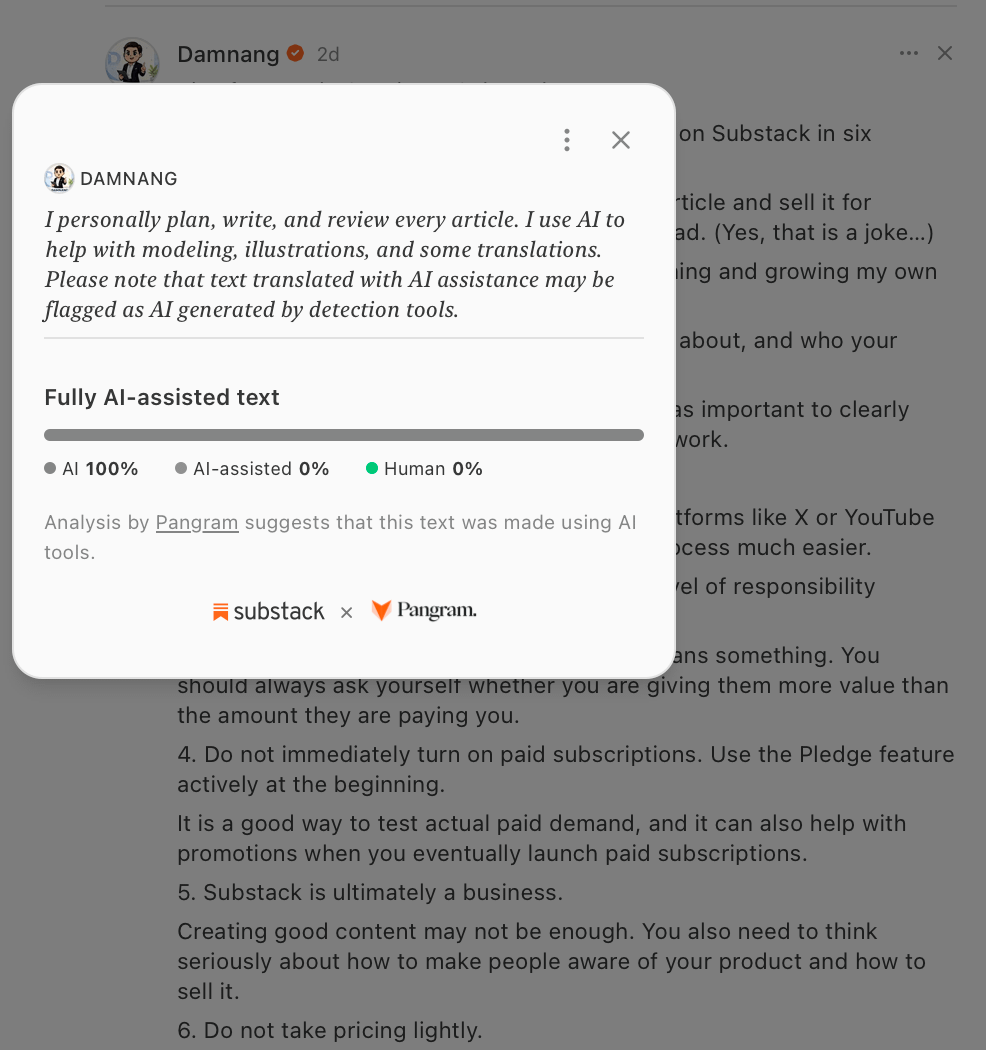
44. Damnang Research
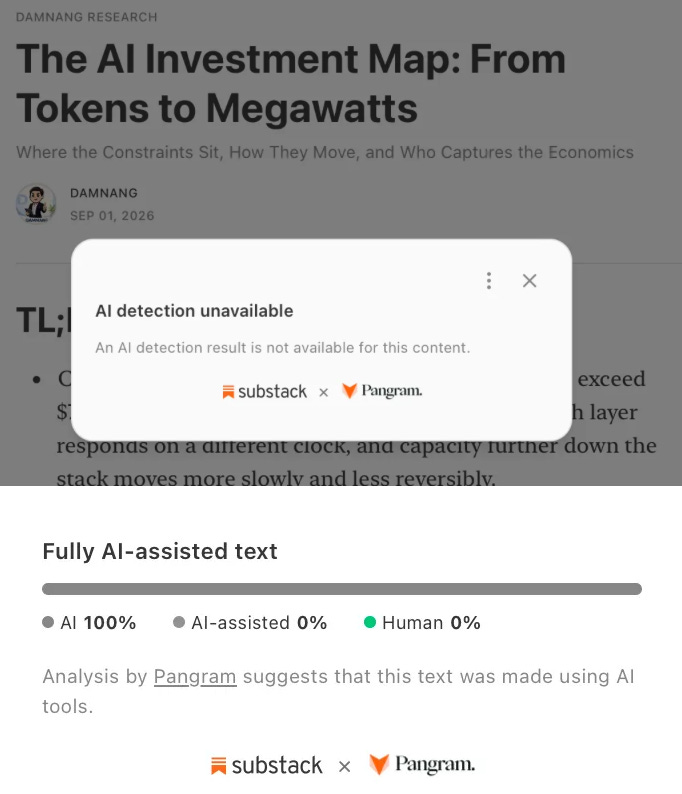

SEPTEMBER 20 UPDATE:
Damnang has now chosen to add an AI disclosure statement however they still choose to disable Pangram.
Sorry. Not good enough.

I’ve heard variations of this excuse throughout this investigation. Many people who use AI to write their articles seem to think that the scanning is to determine whether the AI came up with their ideas. They don’t get that all it does is recognize patterns in text. So if someone writes a first draft or speaks some rabmles into a speech-to-text program, then when the LLM renders it as an article then it will come out as 100% AI. It does not matter if the ideas come from a human. Pangram will show that the AI did the actual writing.
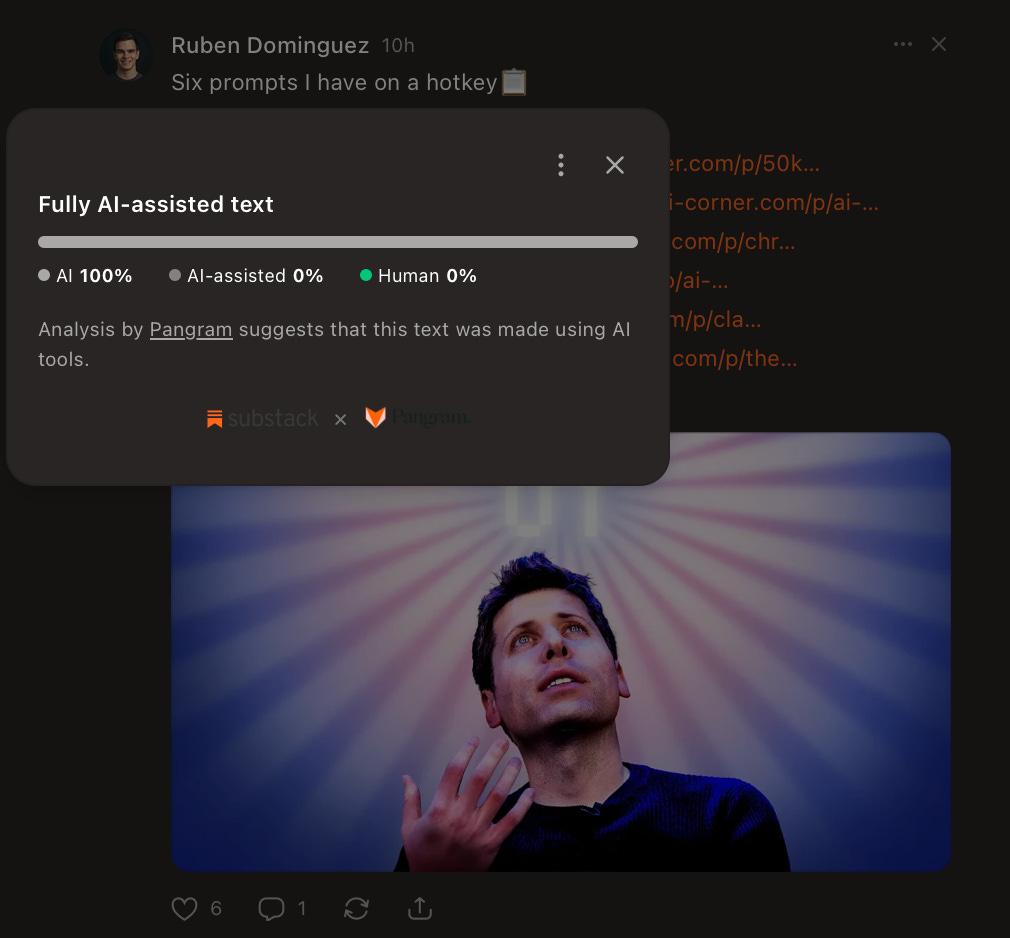
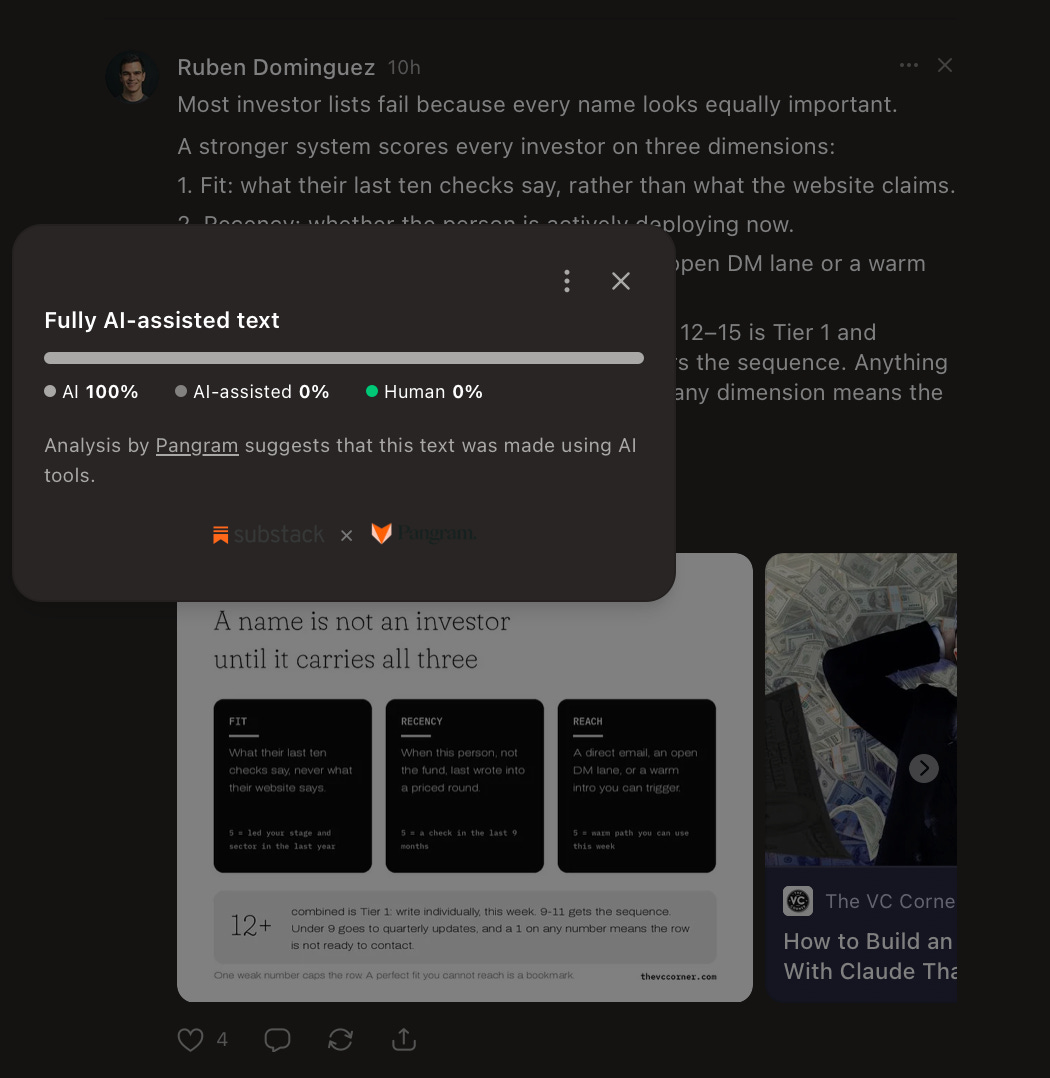
45. Ruben Dominguez, the AI Corner
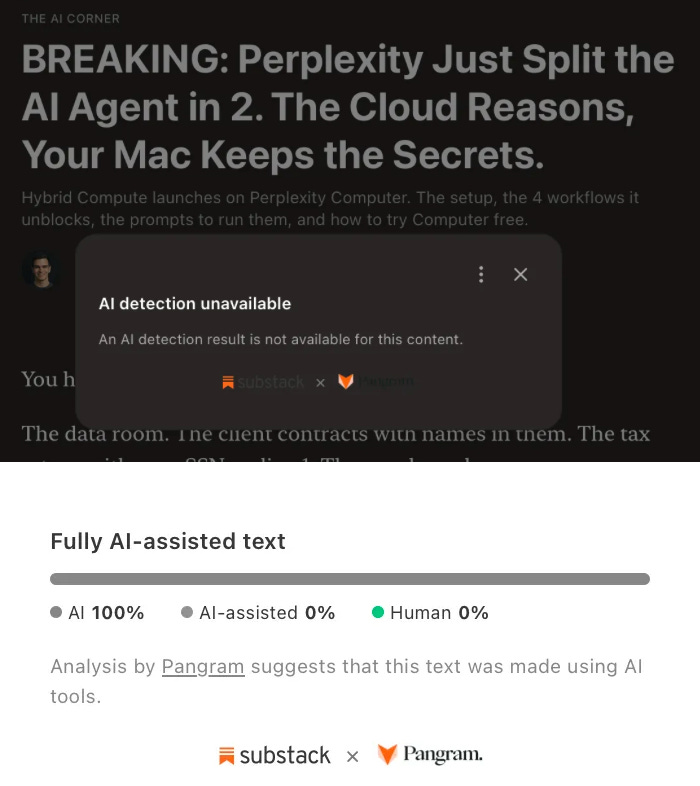
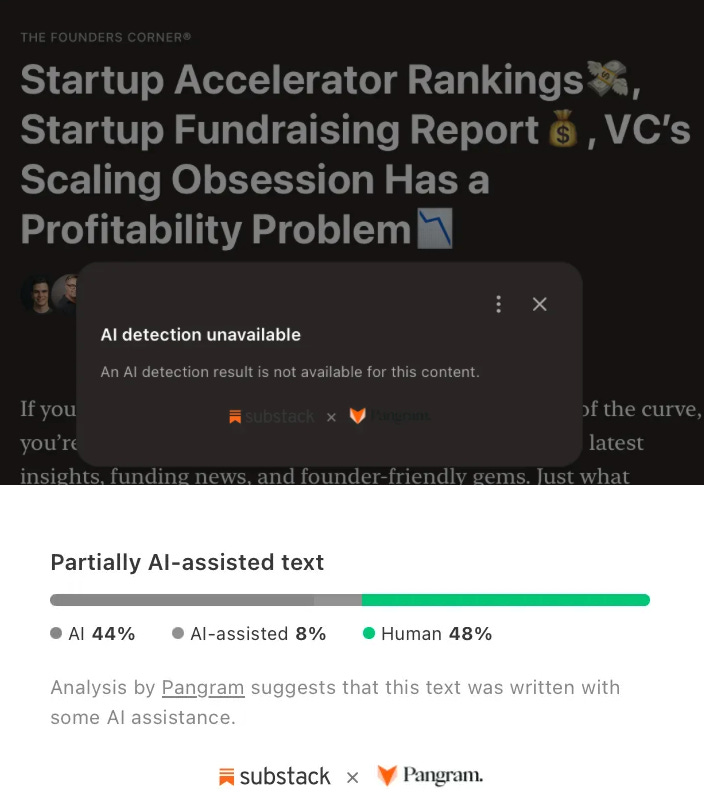
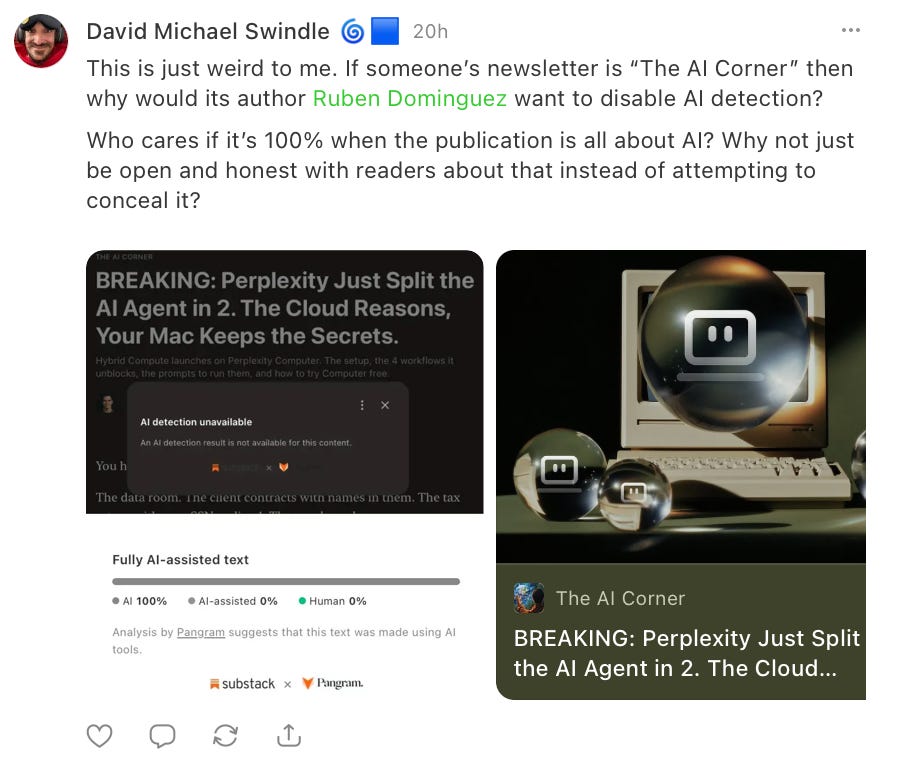
I still just don’t get it. Ruben Dominguez, you named your publication “The AI Corner” so why on earth would you feel the need to conceal your AI use in writing?
SEPTEMBER 20 UPDATE:
He has not published anything since this article’s publication.
His most recent Notes today shows 100% AI:
46. Peter H. Diamandis
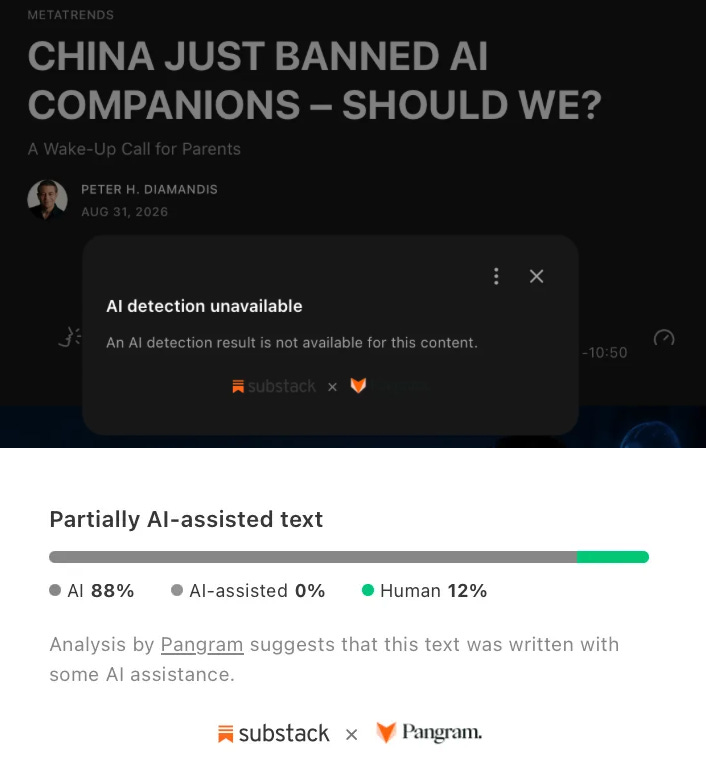

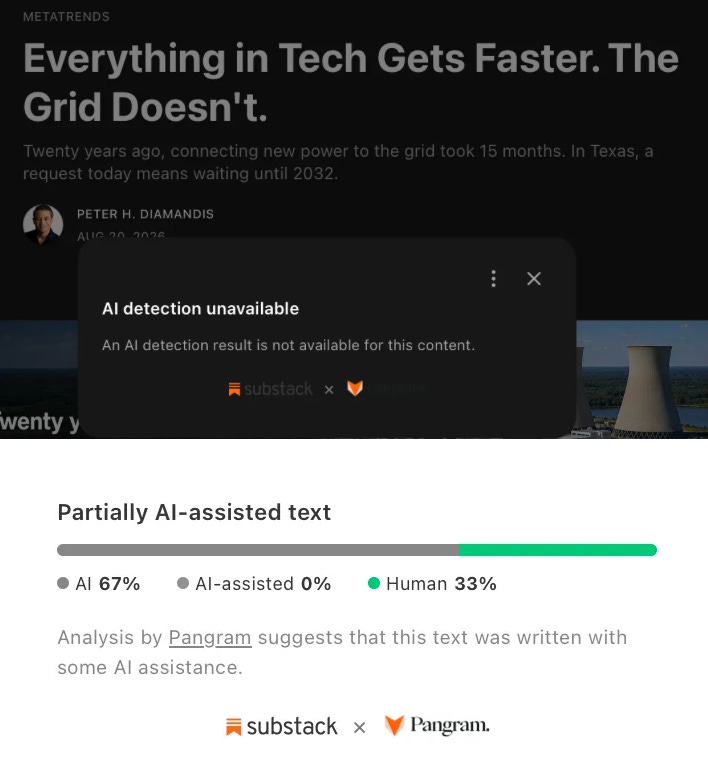
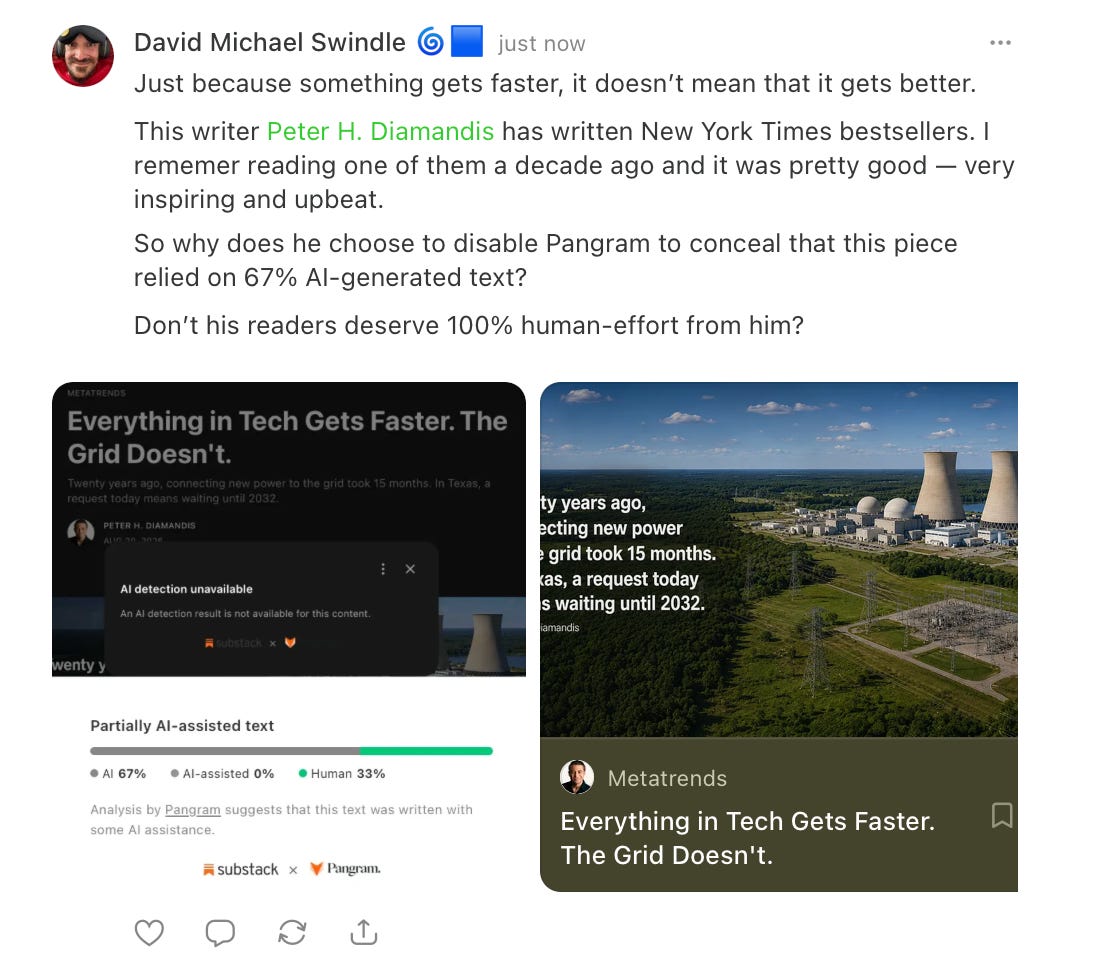
I suppose Peter H. Diamandis is just right. Readers are content with fast, easy, LLM-slop like what he provides rather than absurd old fashioned writing like what we 20th century dinosaurs still can’t get over doing.
SEPTEMBER 20 UPDATE:
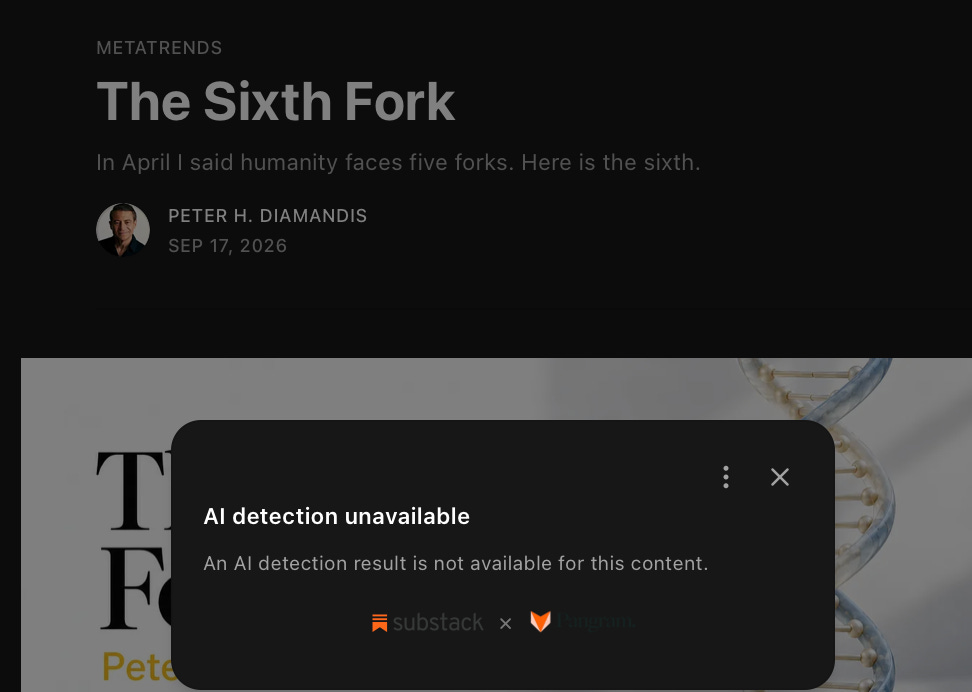
And we have no progress. So up on to The Wall of Shame he goes too.
47. Paweł Huryn, the Product Compass
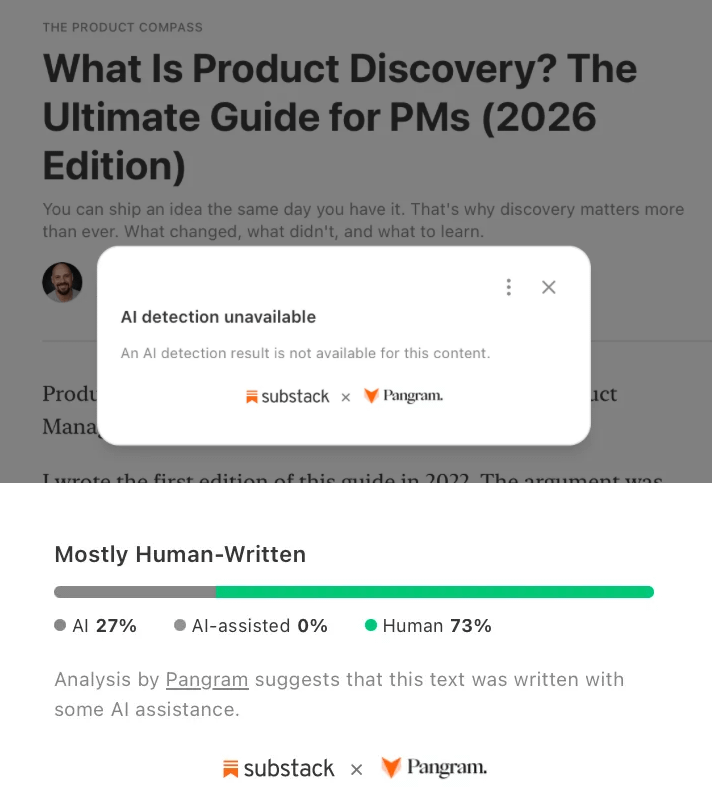

SEPTEMBER 20 UPDATE:
And then in Paweł’s next piece published after this article’s publication, we see 100% fully human-written.
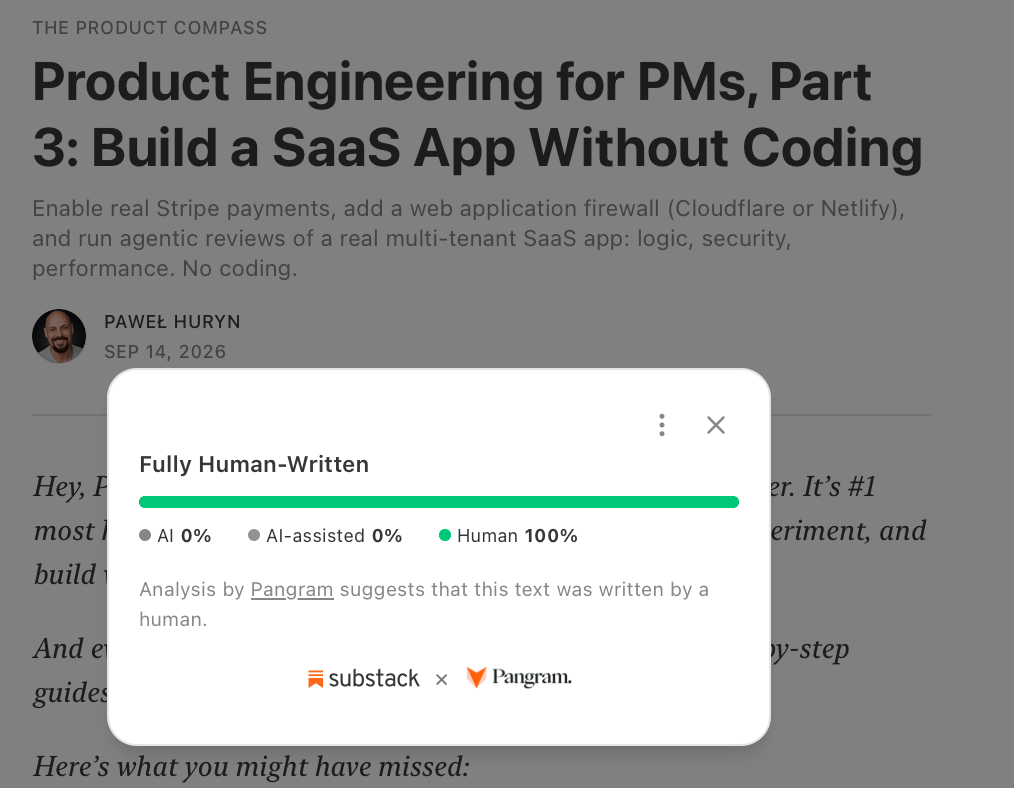
I’d generally like to see more than just one, but given the publishing schedule of Paweł’s publication, I’ll more than accept this.
He will not be included on The Wall of Shame. Well done, Paweł.
A Summary of Technology Bestsellers Audit:
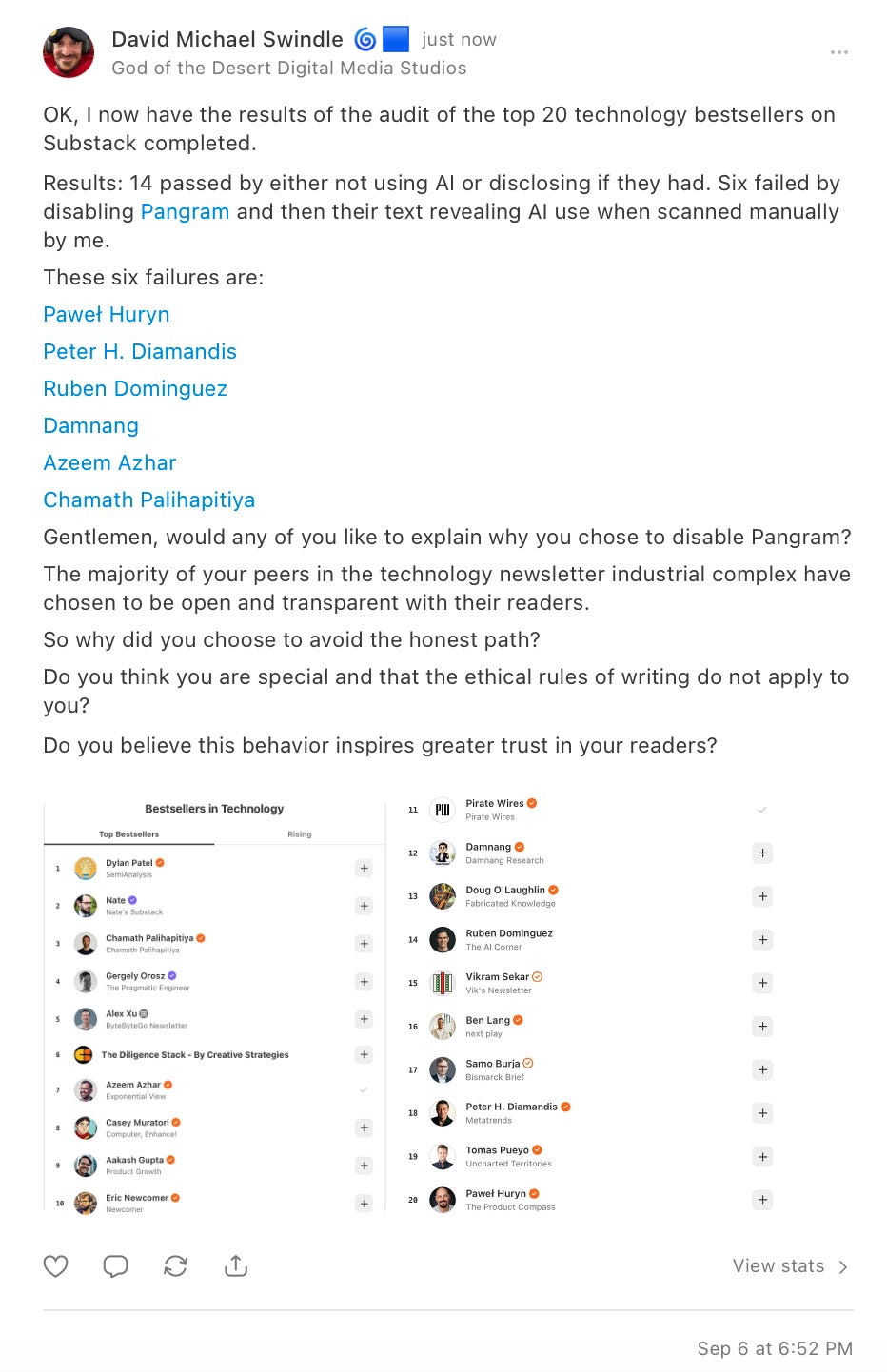
One of the fun rhetorical tricks that I learned in right-wing media land is to attach “industrial complex” onto something benign in order to make it sound menacing. Give it a try.
So What Key Conclusion Can We Draw From All This?
Friends and foes alike, it’s easy to look at this THC-and-Red-Bull-fueled Maximalist gonzo investigation and feel down about the future of writing.
However, the truth is that for me, having wasted all this time and energy now doing this investigation and analysis, the impact is the opposite:
I am way more optimisic than I was before for a simple reason borne out by the numbers: across the categories, this move of writers disabling Pangram and then making arguments about how unreliable AI detecting software is or maybe it’s picking up on the image or whatever — those people are in the clear minority.
Most writers on Substack are either not using AI to write for them or they are being open and honest about the extent which they are.
And that’s great.
So for now we’ll save further dissections of the personas, psychologies, ideologies, and narcissistic grifts of the bullshit merchants above for another day.
I should go and rewatch “Lawnmower Dog” now that I’ve obsessed over it for days as a frame for this, the most ultimate, maximalist “list post” I’ve ever been foolish enough to compose and unleash.
“This is How you Dream, Bitch!”
Wow! This is an incredibly researched article. You found the plagiarists (or at the very least 47 of the plagiarists). Good work.
Quite the detailed piece and I appreciate the thorough investigation. Not completely surprised by the outcome, but that doesn't mean im not triggered about it. The fact that people are rewarded for this kind of "work" or think it's ok is what triggers me. The lying afterwards and sheer denial is what really gets me. Do some of these people really think there's absolutely no problem with this? I'll admit there was a time where I thought AI could shortcut my work in this way and allow me to scale my business faster but I've recently become disgusted by that approach. I remember how it felt, soulless, empty, and at a time, I believed there was nothing wrong with it. Yes, writing a piece yourself takes longer, but the feeling of satisfaction afterwards is the real reward. What is life if we can't honestly feel that within ourselves? Carey's conversation was especially interesting, she got increasingly more frustrated as the conversations kept going and less "proper".