

I still haven’t gotten a tattoo.
It’s not out of any moral objection. I’ve tried to come up with plans.
The Torah’s prohibition against tattooing makes sense as a Bronze Age rule to set the ancient Israelites apart from the surrounding Canaanite tribes. If Orthodox Jews want to follow that strictly in the same way they avoid lobster and calamari then that certainly makes sense for them and I respect it.
However, the reason I haven’t followed in the counterculture ritual of getting a tattoo is probably more mundane and the reason why most people don’t do it:
I simply cannot commit to any word or image to have permanently on my body. Not even a cross or a Star of David. I wear those around my neck and rarely remove them.
But should the day come in which I choose to abandon the God of the Bible, who this God of the Desert company was created to bring glory to, then I’ll take them off and put on something else or nothing.
I couldn’t help but dwell on this Sunday morning while eating breakfast and watching the video embedded above of media theorist author Douglas Rushkoff interviewing New Age author Mitch Horowitz about his new book Esoterika: Formulas Against the False Self on the Team Human podcast.
The reason is because of this:
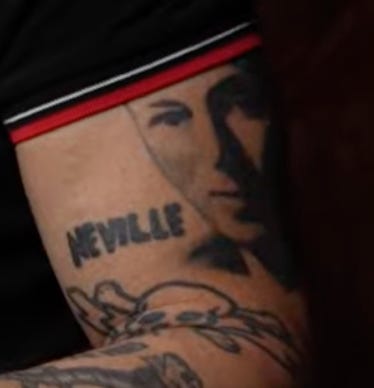
It’s one of Mitch’s tattoos, which you can see on his left bicep:
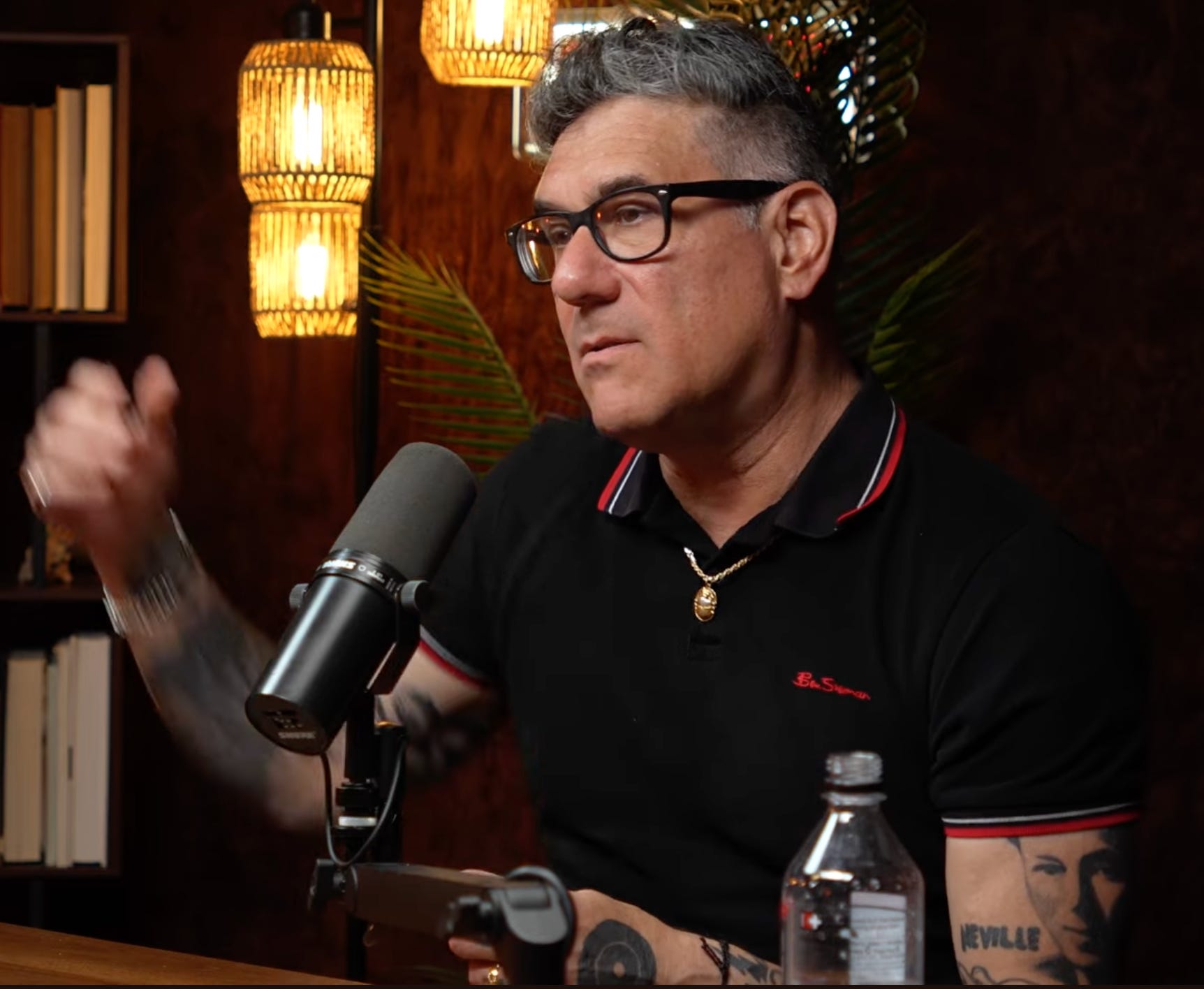
So for the whole podcast, when Mitch is talking, you don’t see just his face moving, you see two men’s faces moving.
That’s Neville Goddard (1905-1972), one of the 20th century’s most influential “New Thought” charlatans. Here’s the Wikipedia biography photo of the man Mitch loves so much that he wanted to serve as a permanent walking billboard advertising:


Goddard taught largely the same thing as other “New Thought” advocates through the first half of the 20th century: your thoughts can become reality, just think it hard enough, wish it strong enough, and it will change reality for you. Want something deeply enough and you can “manifest” it or the universe will “attract” it to you. Every generation seems to repackage this stuff. Back in 2006, Rhonda Byrne did it with The Secret. And now Mitch has decided to do it, just with occult aesthetics, a leather jacket, and tons of tattoos. That’s his “persona” that he’s so proud of now.
If you go onto Amazon and search for Goddard, you get a bunch of titles edited by Mitch and featuring introductions by him. They tell the story: Infinite Potential, The Power of Awareness, The Ideal Realized, Feeling Is the Secret, Miracle, Your Faith is Your Fortune, The Power of Unlimited Imagination. You get the picture.
Mitch profiled Goddard in his 2024 book Happy Warriors: The Lives and Ideas of the Positive-Mind Mystics alongside Napoleon Hill, author of such books as Think and Grow Rich, The Law of Success, and The Master Key to Riches, all three of which you can purchase in an abridged form as part of the “Condensed Classics Bundles” collection, with an introduction by Mitch.
We’ve all heard this shtick from someone in our lives at some point: just think happy thoughts long enough and things will somehow magically turn out better. Your thoughts will just somehow bend the universe.
In his own books, Mitch now offers The Miracle Month: 30 Days to a Revolution in Your Life; The 30 Day Mental Challenge: All You Have to Do Is Try; One Simple Idea: How the Lessons of Positive Thinking Can Transform Your Life; and Daydream Believer: Unlocking the Ultimate Power of Your Mind.
What does this all really boil down to in practice?
An hour into the podcast, Doug asked Mitch what his method was really all about in all these various books. He asked “But you think it’s as simple as—I mean technique-wise, you’re not saying you have to necessarily meditate or do Tai Chi or yoga—you just sit and think?”
Mitch responded bluntly, “Yes. I think the psyche, which I see as a compact of thought and emotion, is enormously powerful.” He explained that in his new Esoterika book, “In the first chapter, I give an exercise in wishing. Just wishing. Just wishing. Isn't that at the back of every magical operation, at the back of every prayer, at the back of every journey into self-discovery through whatever avenue it takes, is getting in touch with that wish?”
Doug responded with skepticism, venturing “So now wishing and magic, which are maybe seen as the same thing….”
Mitch nods his head and shoots out an “Mmmhmm.”
Referencing the podcast embedded above, Doug resonded that “I’ve been spending time with Alan Moore lately both because I got to spend an hour or so with him online and then I spent a lot of time playing and replaying the conversation that we had.”
Doug explained that for Moore, “His approach to magick is very much like an old, I think it’s a Mishna approach to Torah. Which is, you know, and the rabbis basically concluded that the highest reason to read Torah is to read Torah. For its own sake. You’re not doing it for this or for that. And Alan Moore said, you know, he kind of pooh-poohed a bit the chaos magic people, because he goes, ‘Oh, they’re doing magic for this and for that. You should be doing magic for magic, you know, for magic’s sake.’”
Doug then contrasted Moore’s more religious, almost rabbinic approach to magic, with Mitch’s advocacy of magic more as a tool for acquiring wealth. “And I feel like you’re arguing that magic is a causitive ritual, right? That we do magic as change, that you want it to do something,” he said.
Doug then noted that he had recently attempted some magickal ritual on behalf of his daughter, but that he had grown disillusioned with the approach, saying “I’ve started to experience magick more as a lens. I did some workings for my daughter. But I’m trying not to do workings anymore. But magic is the process through which I perceive the rightness of the universe, which sounds like acceptance again rather than magic, as to do something. I mean, are those oppositional approaches to magic?”
Responding by putting his hands together, Mitch said “There’s a tension there. There’s a tension there and I want to wrestle with what Alan said, right? You know, it’s a tricky one because on one hand, if I can extrapolate from what I’m hearing, he’s suggesting that the ‘getting stuff’ approach to magic is problematic. That we do magic as within rabbinic tradition appropo of Torah for its own sake. I feel a tension with that. Sometimes the ‘getting stuff’ scenario can be a condition sought.”
Mitch said, “I could see a young artist who’s not Alan Moore and who idolizes and loves Alan Moore and hungers to be Alan Moore and works in that direction doing magic to take steps in that direction. And the ‘getting stuff’ equation, I don’t judge people who want to get stuff.”
Mitch then went into an extended story about televangelist Oral Roberts acquiring a Buick to use to go preaching as an example of a material object that served some divine purpose, explaining “he was able to pursue pulpits that were off the path of where the buses traveled. It opened up his existence and he joined hands with his wife and he said, ‘Evelyn, let us thank God for this car.’ And I could only imagine the cynics who would say, ‘Ha ha, let us thank God for this car, for this Buick. That’s everything that’s wrong with American spirituality.’”
Mitch then counters, “to which I would say, ‘That’s everything that’s right.’”
He said, “what’s wrong is the incapacity to see that someone who doesn’t have resources, someone who doesn’t live in relative comfort might experience that bounty, in this particular case of a car, in some case something else as radically life-changing. And for me to judge that, for me to judge that is just a matter of taste, a matter of preference. There’s no categorical decision or ethic in my judging that. It’s just looking at someone else’s life and pissing on them for wanting what I may already have. So, I think we have to be really careful when we get into the anti-stuff critique.”
But here’s the problem: Moore was not making an “anti-stuff critique.” And those of us who reject the “New Thought” tradition as not just wrong but genuinely harmful are not critiquing anyone for wanting “stuff.”
The critique is this: “New Thought” is not magic. It is not supernatural. It is not spiritual. So what is it?
In intervewing Moore, Doug asked the author of Jerusalem if this “power of postitive thinking” ideology counts as magic.
Doug said, “Well, I mean, speaking of clowns posturing up magic, I mean, one could well, you don’t even have to argue it, someone like Donald Trump and a lot of his cronies, they’re invested in a particular kind of magic in a sort of Norman Vincent Peale power of positive thinking.”
Moore answerd, “Yeah, which is not magic. It’s a kind of an inquisitive materialist. It’s a psychological trick. It’s that, obviously if you go into something thinking ‘yes I am really confident that this is going to happen for me’ as opposed to going into it thinking ‘oh, this is not going to work out, things never work out for me,’ it’s much more likely that the first person is going to succeed. Because that’s not really what I would call magic it’s just a psychological tactic. Yeah, it’s always better to feel confident, of course it is.”
Moore made clear his dismissal of the manifesting tradition advocated by the man Mitch chose to tattoo onto his arm.
Moore said, “but it’s like this manifesting thing, which has been around for a long time. With that, apparently, a lot of people think that, ‘ah, now I’m sort of signed up to the universe as if it was like Amazon. And now the universe, I just of have to manifest something and the universe will give me whatever I want.’”
Moore then said, “No, it won’t!”
Doug said, “right.”
Moore continued, saying “and when it does work, that is because purely your psychological mindset is more receptive to success.”
Which examples of “success” was Mitch peddling in his discussion with Doug? One name in particular jumped out as an example.
Earlier in the discusion, at 37 minutes in, Mitch admitted a crush, saying "I am smitten with the protean self-creation that Ayn Rand engaged in.”
He then clarified that in spite of his celebration of an icon of libertarianism, “I am not smitten with her economic ideas. I am not smitten with her ideas of strict materialism of disbelief in the mystical or the spiritual which I stand directly against. Rand cultivated an economic philosophy that from my perspective became suffocating because it allows for absolutely no flexibility. And I reject that. I would like to see a society characterized quite frankly by a kind of frumpy social democracy circa 1950s. I think there’s a lot of good that has been introduced into the world by creating the kinds of Keynesian social safety nets that we call social security or Medicaid or whatever. My economics are damn closer to Bernie Sanders than they are to Ayn Rand.”
Doug pointed out, “right, well so is FDR’s.”
Mitch continued saying, “so is FDR’s. But I look upon Ayn Rand and FDR for that matter and Madam H.P. Blavatsky for that matter and lots of figures who are in this book as people who self-crafted their personas. There’s a kind of greatness in that. In fact, I think the greatest work Ayn Rand ever did was the creation of her own persona. This adolescent who escapes Stalinist Russia who comes to America with a bare grasp of the language and becomes a screenwriter in Hollywood. And people who say, ‘you know, I don’t like her books’ or what. It’s like, okay, let’s just pay attention to the persona for a second because that’s her greatest work. Same thing with Madam Blavatsky. That was her greatest work. FDR crafted his persona. Nehru crafted his persona. Gandhi crafted his persona. There’s a greatness in that and it shouldn’t be dispensed with because I don’t like this or that detail or follow through.”
Again offering some friendly skepticism, Doug asked “I mean, does everyone have a persona? Or is persona more your public performance?”
Mitch answered that “It’s an interesting question. As above, so below. I felt at age four, a sense of persona. I felt that at age four. And I cultivated it and and held on to it like a candle in a rainstorm. As I got older, as I aged, I remember, oh man, I must have been, I don't know, 17 years old, something like that, maybe a little older, when Jesse Jackson spoke at the Democratic National Convention in 1984. Brought me to tears. I used to have an album. I would listen to it over and over to hear the cadences of how he spoke and so forth. And that persona was still private, but it became public because it was my wish.”
Pivoting to explain another of his methods, Mitch then said, “and I encourage people to think back to their earliest cognized memories, maybe even going back to age three, right? Because a very precious time, because it predates that peer pressure getting its claws in us, that internalized peer pressure, which I think has hold of us by around age nine, I think has hold of us just around that time roughly speaking. But if you can strip back and those memories are there, what were your wishes? What were your fantasies? Where were your dreams at ages three and four? They're there. That sense of self contains a certain truth.”
So, in response to Doug’s question about if an author like Rand’s “persona” is merely “public performance,” Mitch doesn’t directly answer the qeuestion. Instead he offers reflection on himself as a four-year-old, his emotional reaction to a Jesse Jackson campaign speech in 1984 as a teenager, his obsession with learning to speak like Jackson, and how we should all go back to our wishes at age three or four.
As a four-year-old, my primary dreams, wishes, and fantasies revolved around stuff like my grandpa taking me to McDonald’s for an ice cream cone. I remember how that bright vanilla would streak across his beard. Today I fulfill that wish by pulling out a tub of my new flavor of choice these days, “Cookie Kraken,” which features blue-colored vanilla ice cream that includes chcocoloate chip cookie dough and a brownie batter swirl. It’s wonderful.
There we go. Wish fulfilled. Oh, man, this is delicious.
But is is it magic? Is it the supernatural? Is it anything special?
In the promotional imagery for his book, Mitch chooses to wear a t-shirt of Blavatsky, the founder of Theosophy. Between the tattoo of Goddard and that he’s making more than clear which which esoteric lineage he embraces. This isn’t at all the occult path of Aleister Crowley and Robert Anton Wilson which informs Moore’s magical approach in The Moon and Serpent Bumper Book of Magic, my favorite book published so far this century.
Mitch has chosen to sell copies of Think and Grow Rich and The Master Key to Riches. He’s chosen to hold up Rand as this great example of how to live even while he still wants to pretend to be a leftist.
He’s become a bullshit salesman.
And he couldn’t handle it when I called him out last month when he chose to write an apologia to one of the 20th century’s most successful bullshit salesmen, Anton LaVey, founder of the Church of Satan.
In his essay urging people to take LaVey seriously — the same way he urges people to take Blavatsky and Goddard seriously — Mitch referenced the common reason most people dismiss Satanism as some sort of philosophy:
“Other critics dismissed his mass-market paperback as a bastardization of Nietzsche and Ayn Rand (1905-1982), with occult frosting—to which a defender might reply: so what?”
Satanism and Objectivism are largely the same thing, the only difference being aesthetics and who the grift is being marked to fleece. Some people like their selfishness with red horns, some people like it with science fiction novels. Some people like it with this talk about wishing like you’re a 4-year-old wanting an ice cream cone.
And then there are people like me who like to call bullshit. I left the following comment on Mitch’s post:
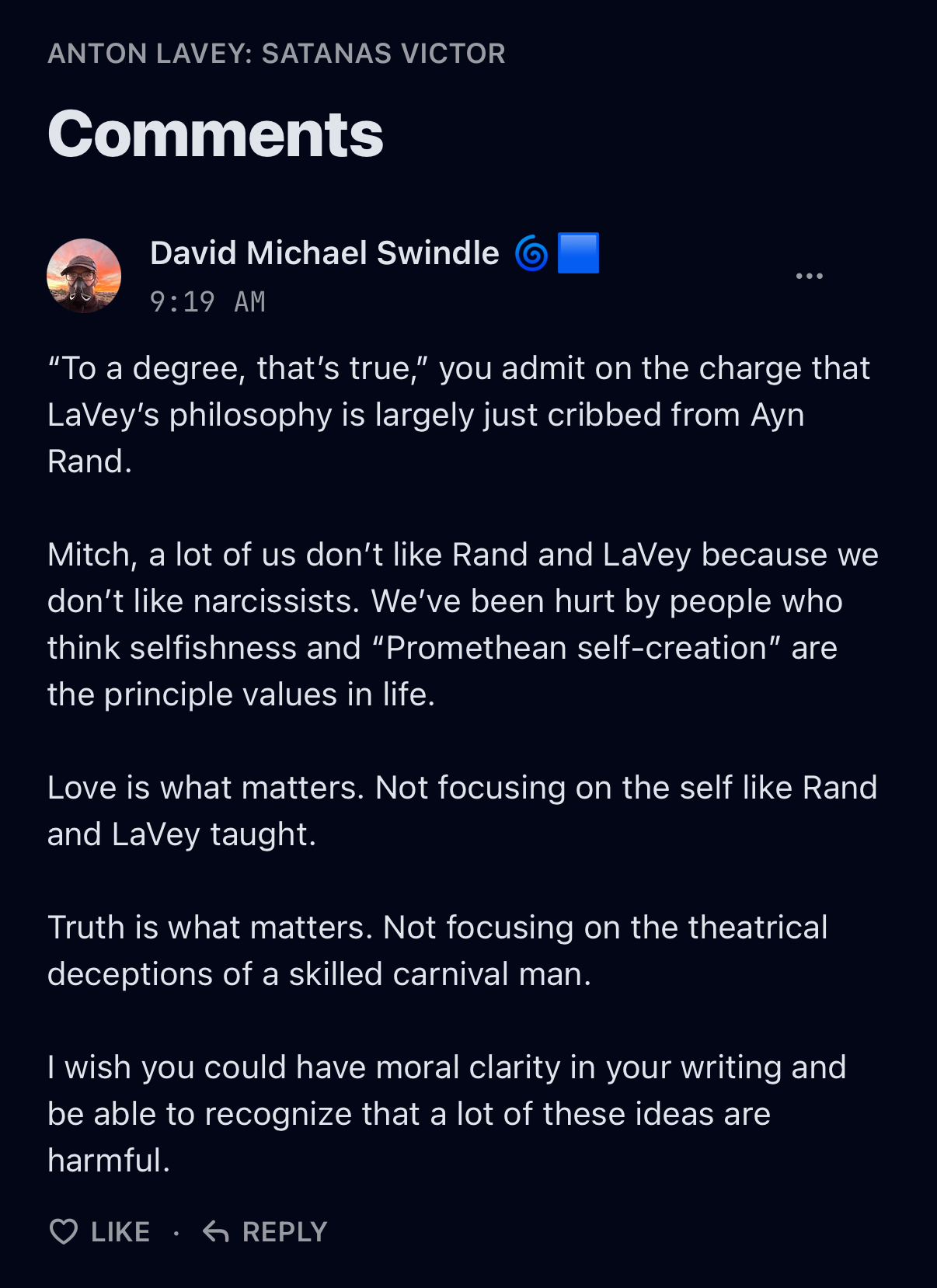
I knew exactly what I was doing when leaving the comment, however Mitch’s action still surprised me:

Mitch could not handle a comment calling for truth and love as values more important than “promethean self-creation.” He had to delete it.
He then chose to block me:
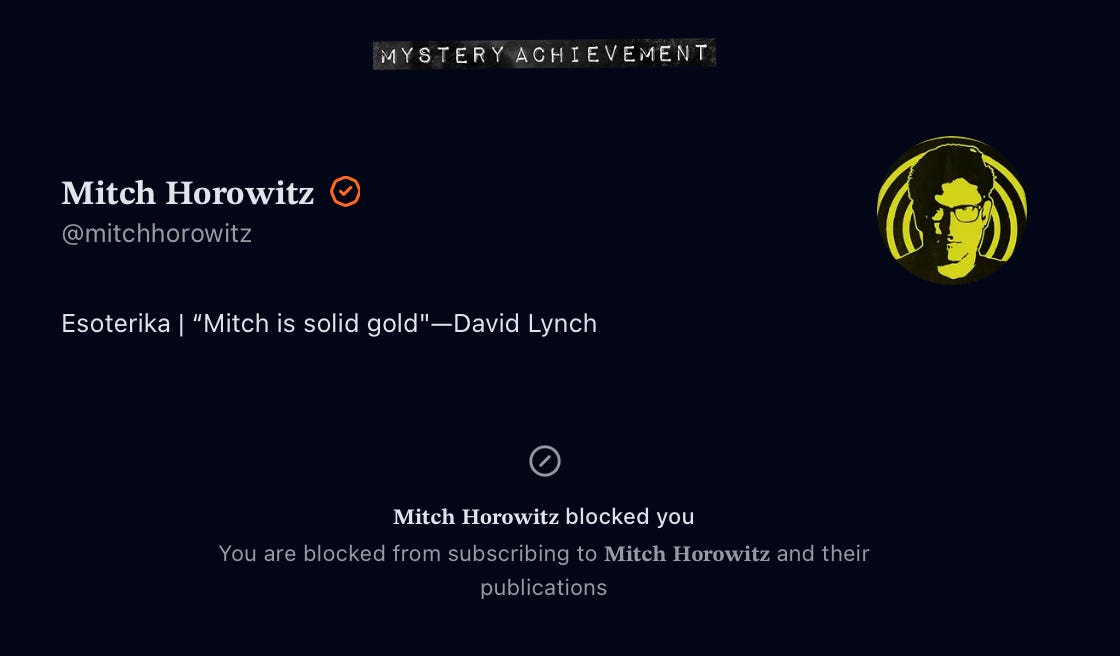
However, in fairness to him, it’s worth noting that when it came to my criticisms on Notes, I chose to slide off the gloves. I understand if these stung a bit more, as that was clearly the intent:
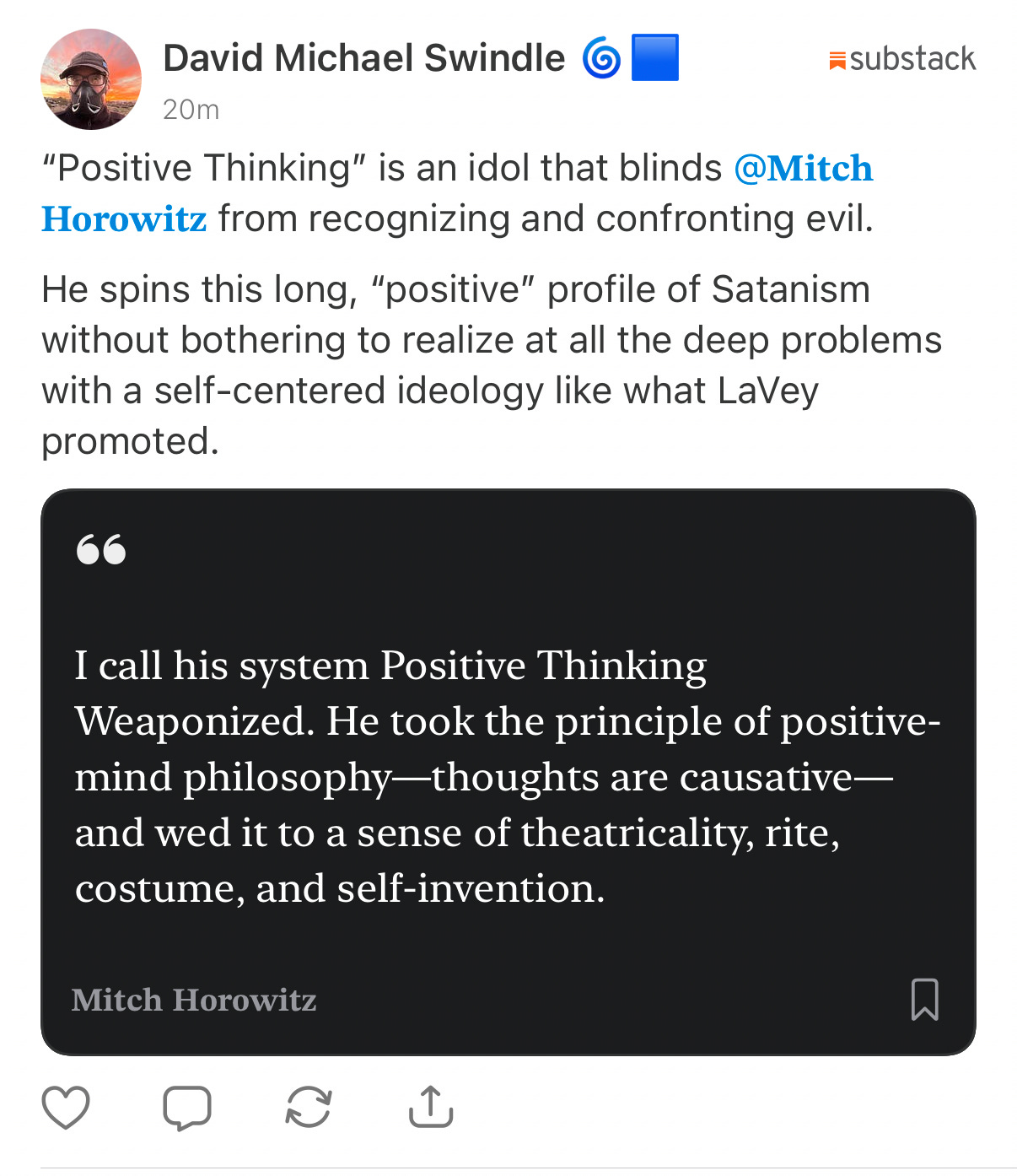
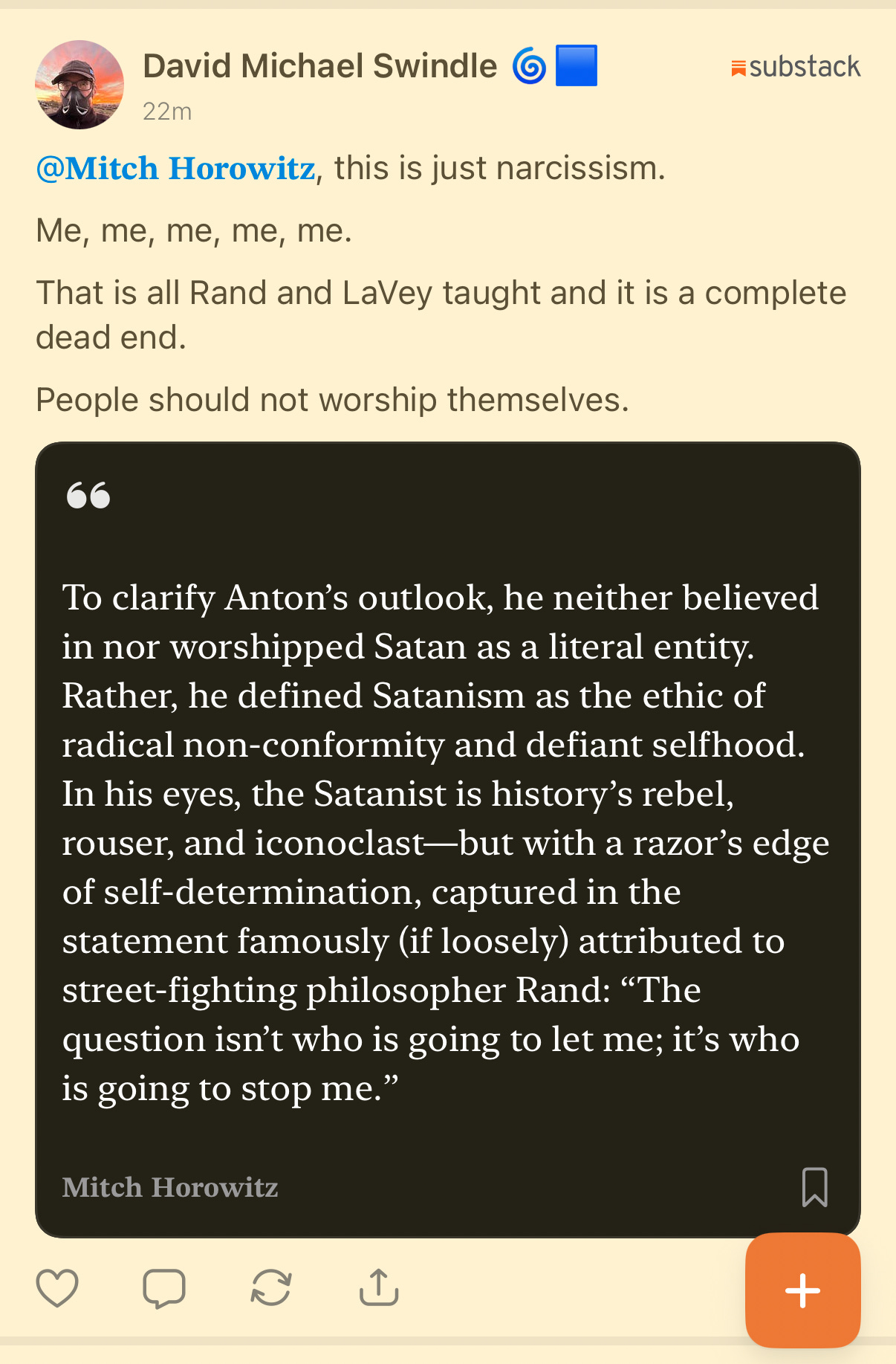
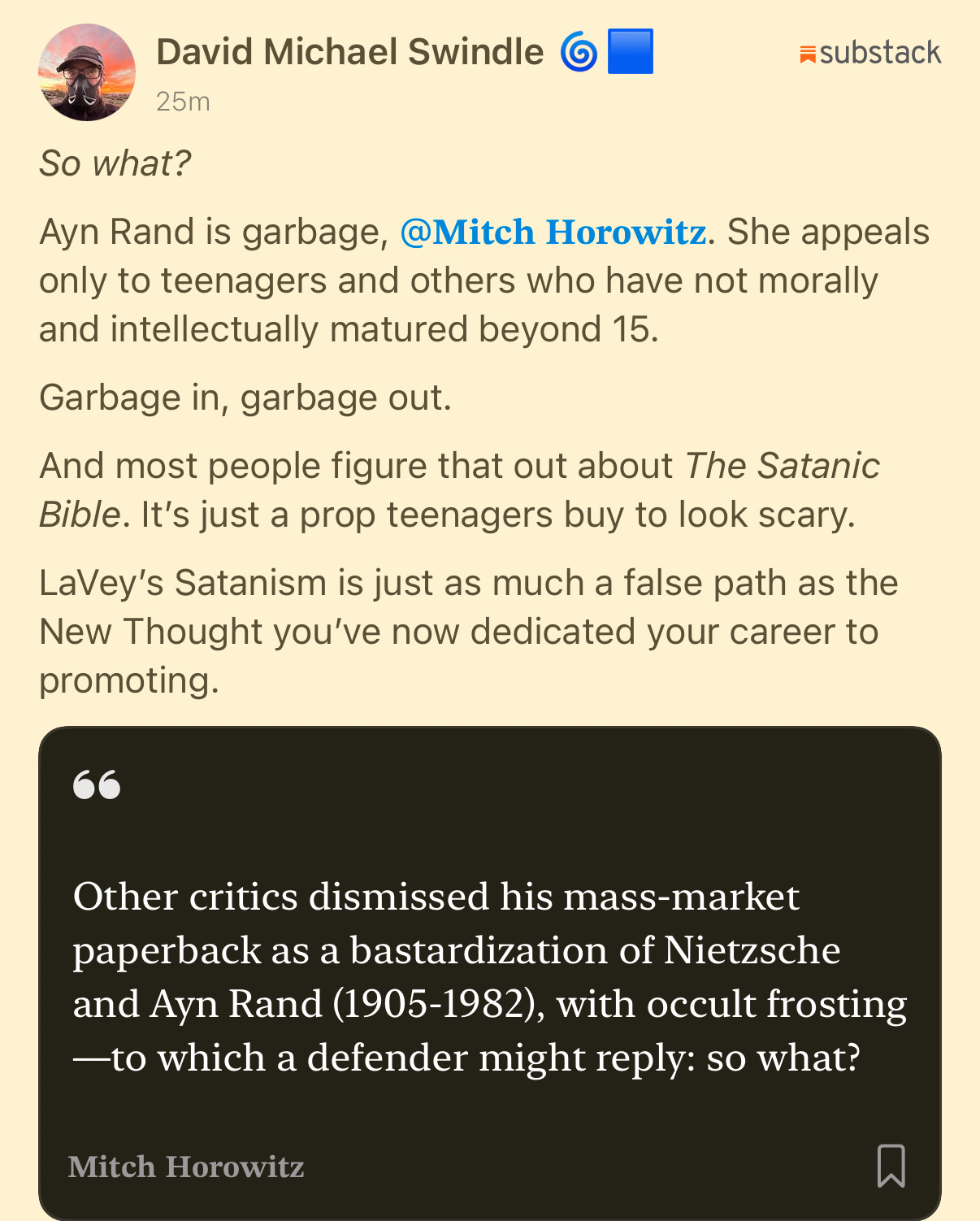
Let’s just go ahead and put that last bit up there nice and big:
LaVey’s Satanism is just as much a false path as the New Thought you’ve now dedicated your career to promoting.
Were I to go out and get a tattoo tomorrow in one of Yucca Valley’s multiple tattoo parlors, what might it say? Lately I’ve been saying this a lot:
The owls are not what they seem.
Maybe that might be cool? I’ve been on a serious David Lynch deep dive for over a year now, ever since the great filmmaker died on January 15, 2025.
And it’s partially because of that why I take particular offense to one last bit of clever persona-building bullshit Mitch has chosen to shamefully deploy as he markets himself:

Mitch is using a four-word sentence from David Lynch as his primary professional branding right now. He even puts it on the cover of his new book that he was on Team Human to shill:
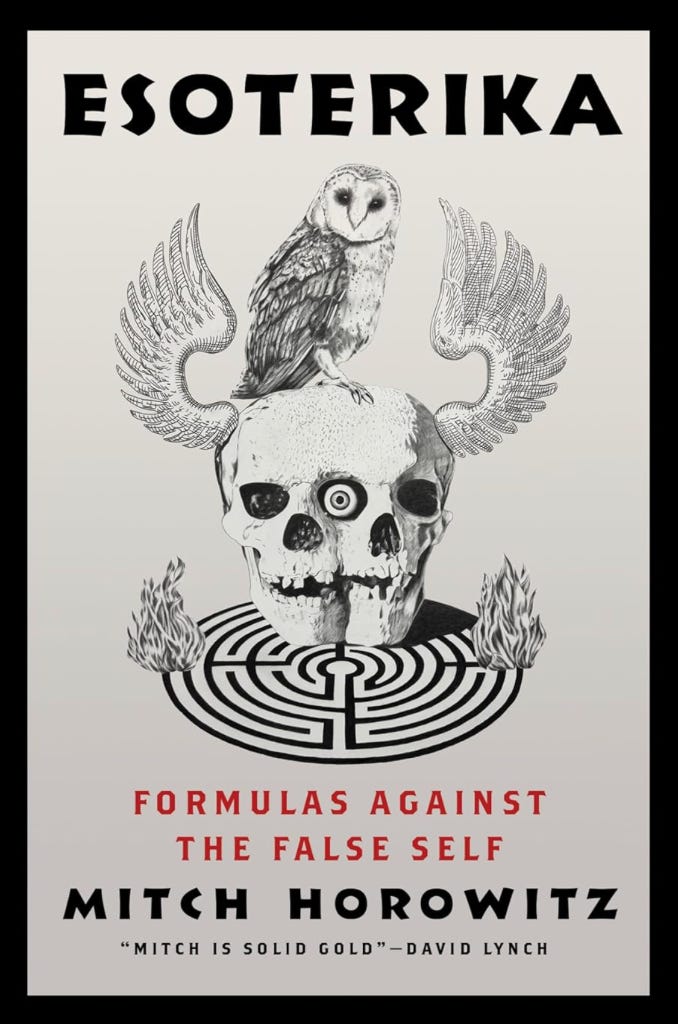
Mitch presents this humble quote from a humble man as though it’s an endorsement of his New Thought nonsense.
It’s clearly not, though. Why would Lynch call Mitch “solid gold?” What connection did the two of them have?
Simple: while vice president and editor-in-chief of Tarcher/Penguin, Mitch published Lynch’s wonderful book Catching the Big Fish: Meditation, Consciousness, and Creativity.
Yeah, Mitch was “solid gold” in that he helped put a ton of gold into the bank account of Lynch’s transcendental meditation foundation because he chose to publish a book of blog-post-length little essays.
Mitch is trying to pass off a quote about an author praising a publishing executive as instead one of the greatest filmmakers of all time endorsing New Thought nonsense. It’s so wildly dishonest.
The problem with “promethean self-creation” and all that Ayn Rand “creation of her own persona” romanticism is that a lof of us are now well-trained as investigative journalists and it’s too easy now to debunk people who have chosen to build careers on foundations of deception. Liars and cowards get caught more quickly nowadays. It is so easy to smash apart an author’s or politician’s precious little “persona” only to reveal the ugliness and immaturity hiding underneath.
Serious men and women don’t need to build a “persona,” Mitch. They just live as their authentic selves and tell the truth every damn day of their lives. The tactics of the bullshit salesmen have been on display all our lives and just because you want to try and layer on some esoteric iconography on top of it, plenty of people are still going to be able to smell the bullshit.
Update on Thursday, July 2, 2026:
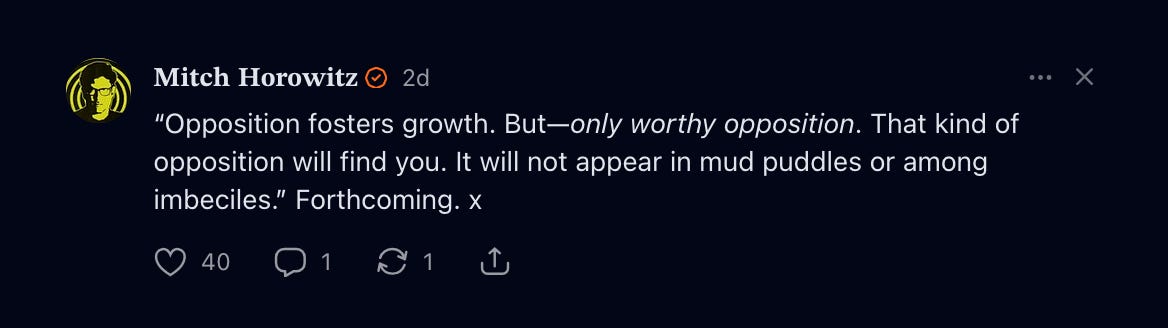
Posted shortly after this critique appeared:
All the manifestation and New Thought stuff is just the Prosperity Gospel grift with a different aesthetic. The underlying mindset is the same.
I believe modern manifestation takes are stale, because they misinterpret the original point; don't pull the other ecological view into one's view.
Now people are manifesting themselves into delusions, and other forms of a splintered reality.
Why do I strongly believe this?
No one talks about the elements, and the elements were foundational to this belief system. I don't say it plainly, if i did... many of these folks are idiots.
TLDR;
People dissect these cognitive maps, without the tools provided. They just sit in pure noise, assuming they can dabble and find nirvana.