

Publisher’s Note: This is another experimental essay written in the Iain Sinclair-Alan Moore literary maximalist psychogeography tradition in which one embraces an intentionally longer, more detailed, more ornate, more absurd, more tangential, more place-focued, and more mythic style as a rhetorical technique and aesthic style. This approach is obviously not for everyone, but for those who do possess the mental palate and intellectual constitutions to appreciate complexity and who make the error of choosing to venture inside, you will likely enjoy it more than if I’d just knocked out something quick in 500 words or just asked an LLM to do it. See the previous experiment here, a 10,000-word polemical-historical investigation into Natalie Harp that begins in the ancient world with the creation of stringed instruments and includes her genealogy going back to Sherwood Forest in the 1500s:

In 1993, as a third-grade child learning to love books at West Valley Elementary School in the Bay Area’s Sunnyvale, California, I made a colossal mistake that I’ve now come to see has ruined my life.
I chose to become a writer.
I wrote a short story which I titled “The Mystic Waterfall.” It was about a boy my age who runs away from an abusive home and then stumbles into a fantasy world filled with magic and monsters after passing through a waterfall. Each new chapter of the story featured the boy entering the waterfall again and discovering a new magical world where he made new friends, fought new enemies, and each time gained new magic spells to develop new powers for himself and his allies.
Wizards aren’t supposed to just help themselves. They’re supposed to help their friends.
Looking back, I wonder if it was inspired by a church trip, where I remember this waterfall that fell onto a smooth slab of rock that had become a natural “slip and slide” at the camp. We had so fun climbing up and sliding down the rock over and over again like it was the waterslide at my neighbor’s house that dropped us into their swimming pool.
My parents and my teacher Mrs. Cole — a warm, tiny woman with short, curly black hair and large glasses who I rememer as resembling a perpetually grinning roly poly — praised me for this story. It was then that I decided that I would make this my job and my identity. I would write books and stories, like how my Dad read me The Hobbit before bed and we watched the cartoon recorded on VHS tape. I would be an author like J.R.R. Tolkien.
(Confession: I still haven’t read Lord of the Rings. I could never get passed the first 50 pages of Bilbo preparing his birthday party and my Dad’s advice to just skip the first 50 pages never made any sense to me. How could you read a novel and skip the first 50 pages? Why would any author in their right mind create a novel doing that? I came to enjoy the films when they came out and appreciate the broader franchise but not at all with the verve and devotion of true Tolkien fans. I suppose I chose more to live as Gandalf rather than to just read about him. This was a huge mistake too as you’ll soon understand.)
“ I am Gandalf! And Gandalf means me!”
And so that was the mental picture I chose to embrace of myself from childhood. And the image of the writer and the wizard largely fused together at that point, perhaps since that first story was about a boy becoming a wizard of sorts. And this was before the little spectacled boy with the lightning bolt scar on his forehead followed the owl to Hogwarts. J.K. Rowling wrote the first book from 1990 through 1995.
When my friends and I would pretend at recess, the boys would all pick which superhero to be or what powers they wanted.
And I figured out real quick that if you picked “wizard” then that meant you could have any and all powers. If you’re the wizard on the playground then you could both shoot a fireball at the bad guy and use a healing spell to help you friend jump back into the action after they take a hit.
“I will draw you Saruman, as poison is drawn from a wound!”
The more spells that a wizard could learn how to use, the more powerful he would become, the more he could heal or harm, the more he could adapt to any new situation.
And so that was the journey that I began as a child.
It’s was not that I just stayed in the initial lane of writing fantasy stories.
In fifth grade, the year we moved back to Indiana, I wrote an epic science fiction novel set in the year 4,000 about humans and aliens at war. I began keeping a journal — a habit I maintain today and that now has produced over 60 volumes.
I created a satirical superhero comic, Captain Eye, who was a one-eyed Cyclops-style hero whose eye could shoot lasers. Gee, I wonder where that idea emerged? I paired him with an antagonist with a giant curved nose like a rhino, Dr. DeNose, a mad scientist type.
Captain Eye’s side-kick, The Blob, emerged out of the Super Nintendo “Clay Fighter” video game, a comedic riff on the “Street Fighter II” and “Mortal Kombat” fighting style:
In sixth grade, I started expanding into other genres. I wrote action stories, historical adventures, and spooky mysteries. One way I found to bond with my classmates over this seemingly “weird” hobby of mine of writing fiction was to offer to use their name for characters in the story. When I was done then I’d hand them the spiral notebook and they’d read the half dozen or so handwritten pages featuring them. I still have almost all of those notebooks in my closet. My archive of my writing goes back to pre-school.
In seventh grade, I made the leap to writing non-fiction essays, particularly motivated by my new Evangelical faith. It was then that my tendency toward argumentative, polemical essays began. The youth minister had trained us that we had to be like little Billy Grahams. We were supposed to be Evangelists trying to persuade our classmates to accept Jesus Christ as their Lord and Savior and commit themselves to the Kingdom of Mercy so they did not spend existence in a state of permanent torture with their skin peeling off in a burning lake of brimstone where their tongue felt perpetual desert sand thirst.
All of a sudden to me, writing essays to persuade people to embrace Jesus seemed much more important than writing fun little adventure stories. I would still continue to write fiction through the rest of my adolescence and then into college, but that was the beginning of my novelist aspirations beginning to subordinate to my need to use writing like a wizard, to try and combat the forces of evil in reality through words, rather than just in fantasies on the page. And so it remains to this day, alas.
Articles that I wrote could conceivably persuade my friends and others to change their lives, to become Christians and escape hell.
This development of the ability to make persuasive cases in writing then expanded beyond faith.
In eighth grade, the journalism journey began. That was when I took my first journalism classes. And I didn’t particularly like it. And I still don’t.
I learned quickly that the process of going and getting the facts right and then writing them properly on the page was real work. When you were writing a fantasy story then you could just make it up. But when you were writing about real people then you had to be sure to get everything just right or potentially face severe legal consequences.
I found this stressful in junior high and it’s still even more stressful today, especially when the person that I’m interviewing is one of history’s greatest lawyers — Alan Dershowitz! — as I found myself doing multiple times the last few years. There’s somebody you don’t want to misquote!
In spite of my reputation as a right-wing hellraiser, the reality is that I was only a Republican for about 3.5 years.
I did not register as a Republican until I voted for my first (and last) GOP presidential candidate, Mitt Romney. After seeing the practical failures of the Romney campaign, I made the decision that it was necessary to engage in party politics in order to influence how campaigns themselves operated.
Just helping get the right candidates on the ballot and the right ideas on the agenda was futile if the campaigns made catastrophic mistakes like their Get-Out-the-Vote software Orca failing on election day. I changed my registration from Republican to Independent on May 26, 2016 when Trump secured the presidential nomination and so it has remained in the decade that has followed. During all those years, watching Dershowitz as a vocal pro-Israel voice, I kept wondering: Just how long until he realized the Democrats were a lost cause?
I’m really rather shocked that he finally did it at this point. Talk about climbing aboard the Titanic and settling in for a lovely vacation while everyone else is rushing to the life rafts.
So while I learned how to do traditional journalism, I always avoided it whenever possible and soon focused on film reviews, opinion articles, and the editorial work of managing a section of the newspaper. Editing the journalists and making sure they did eveything right appealed much more than working as the reporter living under that pressure.
No, I preferred to become the newspaper’s equivalent of Roger Ebert. I bought books of his film reviews and studied his methods.
The fantasy of just watching movies all day and writing about their strengths and weaknesses sounded wonderful to me, that is if I didn’t just go into screenwriting myself instead. I remember Kevin Smith’s “Chasing Amy” as a particular influence at the time. When I became a teenager pursuing romantic relationships then I started exploring these sorts of relationship stories, seeing that more serious dramatic work with emotional depth was necessary if one wanted to potentially win Oscars or film festival awards.
I soon learned that both writing film criticism and then shooting one’s own films was a well-established path.
Through reading Ebert, I came to discover the art film world and eventually work in an arthouse movie theater, where I came to study François Truffaut, who had made the journey from critic to filmmaker and in doing so transformed the medium through The 400 Blows, the launch of the French New Wave movement.
When you see the French New Wave films and the 1990s independent films that were shot for under $100,000 as a teenager then the message is clear: you too can write a screenplay, figure out how to shoot it, and then launch your artistic career.
And it was around about this time when websites began to emerge, and so I learned then the process of building a personal site and using it as an archive of one’s writing.
In college, beginning as an English creative-writing major, I learned how to write poetry, screenplays, and deep research reports. I wrote massive experimental poems. I drafted scripts in multiple genres, one of which — about a man haunted by the ghost of his dead girlfriend — a class of student filmmakers did a decent job filming. And I spent years writing an op-ed column each week alongside a weekly film review.
Years.
This is when blogging emerged too as a new writing medium, circa 2003 and 2004. I soon began learning this style of writing — the blog post — and launched my own group blog publications that I managed and edited. (Yes, this exact thing that’s been going on with this Substack - this has been more than 20 years of this exact same thing since my undergrad years.) This was also when the wild west of internet commenting began. Once upon a time — back in the first half of the ‘00s — newspapers and websites first added comment sections at the ends of articles where readers could post their responses to the article and then engage in argument with one another. Often these turned into the author of the column having to jump in and defend themselves while explaining obvious points which commenters apparently missed. Attempting to engage with one’s readers online was generally fruitless back in 2003 and it has only gotten worse 23 years later.
Realizing that I needed more political background if I was to keep writing political op-eds in the college newspaper, I added political science as a second major. Then I proceeded to learn how to write analysis within the rules of that discipline. I didn’t just “learn about politics,” I learned how political scientists analyze politics, and thus how I could do so myself. How does one determine what is actually true in the political world?
One would think learning such training would help one in a political writing career. It took a long time before I realized that was not the case at all.
Having a politial science degree meant that I knew how to analyze political situations facts-first instead of what-we-want-to-be-true-first. My learning how to analyze politics from a detachd perspective put me at a disadvantage when I went into ideological media and activism. It meant that I was always more concerned with establishing the truth first and then acting in response to it, rather than just hard-charging ahead with whatever public policy goal we sought to accomplish.
In 2005, my freelance writing career began, when I sold my first article to the NBC affiliate WTHR.com, as they had started expanding into original articles. Initially five college film critics came on board. Gradually all but me fell off and I contiued with a weekly film review until 2009. It wasn’t Ebert’s chair, but for me from 21-25 it was more than enough to make me feel like a “real writer.”
And for my political science thesis in 2006, I did a real investigation of a campus controversy, interviewing people involved, determining the facts, assessing the university’s response, then drafting an 80-page report. I am so burnt out on thinking about the topic — and really rather regretful that I did not pick something else — that I am not even going to bother summarizing it here.
That was 20 years ago.
And in the years since I’ve had a writing, editing, publishing, activism, and journalism career which has drawn on all those skills that I learned as a teenager and then an undergraduate. It’s been a wild ride and has resulted in a freakish frankenstein’s resume now.
I’ve interviewed celebrities and been flown across the country to cover stories. I’ve had jobs where I had to write articles one-after-another all day. I’ve gone through the whole editorial process as an editor or publisher on so many novels. I’ve been sent on multi-day, secret research investigations that took me through digging into academic archives to find decades-old material that a senator would enter into the federal record. In moving to Los Angeles, I finally started meeting some of the people who had made and appeared in movies I’d seen since I was a child.
For some reason, Robert Davi comes to mind. Oh man, he was weird.
Oh yes, the reason why is because I attended one of those “Davi Sings Sinatra” concerts since the Freedom Center purchased (mabye received?) a bunch of tickets. I think Andrew Breitbart was there that night, if I recall. They were buddies as right-wing Hollywood was such a small space then. I imagine it still is, though perhaps a bit bigger now that the House of Ellison has bought its way into town — a mistake they will ultimately come to regret, but many of us have to learn our lessons the hard way. David and Bari will have only themselves to blame for their continued humiliation.
Davi is one of Hollywood’s most notable right-wingers, which seemed to me to largely derive from his very mystically-minded Catholicism.
But I didn’t just stick with Hollywood. The political side pulled me toward working for nonprofit think tanks and activist groups.
And the journalist work soon took a much darker, more hard-edged, investigative turn for many years. I spent multiple days attending conferences put on by Muslim organizations in Southern California which the FBI had long-identifed as associated with the Muslim Brotherhood. I would record their speeches, take photos, and scour the vendor tables for offensive literature. Sometimes it might be a Muslim Brotherhood leader beaming in from Kuwait and one of his talks would even be in Arabic. I’d record it and it would need to be translated later. I would do further surveillance of these groups, attending their protests outside the Saudi consulate when they picketed about the arrests of some Muslim Brotherhood-linked clerics. At times they’d realize that I was a hostile activist journalist and I’d end up engaging in arguments with them when they insulted me, accused me of being a racist and an anti-Muslim bigot. I’ll always remember that look of surprise when I responded to the CAIR media rep with “so why did the UAE declare you guys a terrorist group back in 2014?”
When I see writers get so rattled on Substack over a few critical comments of them, I think back to all times when I’ve had to engage directly with antisemites face-to-face on the streets. I think about being at protests where people start yelling at each other and police eye closely, wondering if they may need to intervene.
And for another organization which I worked at for years, often I had to perform work comparable to a private investigator, spending weeks tasked with researching just a single person and trying to crack their real identity behind an online pseudonym.
One time when I did I was horrified at what I found. He really was one of those guys “living in his mother’s basement” who had built himself up as a big man online behind a pseudonym but was really a small man in life behind his mask. It was so weird because here I was being paid to spend 20 hours a week hunting down a guy who hid behind one of the absolute lamest catch phrases in one of Kevin Smith’s movies!
I’d discoverd a message of his mother putting out a call to try and find him as she was worried about him disappearing for days after having some sort of nervous breakdown. I knew that if we exposed his online identity that it could provoke him to do God-knows-what. It seemed conceivable he could kill himself were we to unmask him.
I knew it was him, but was so thankful that we really didn’t have enough strong evidence to prove conclusively it was him.
There have just been so many strange men like him who I’ve investigated or written about or had to work with on their writing. I’m just so tired of dealing with them. So many of them are just nuts.
And then it’s been the last three and a half years of nearly daily antisemitism coverage.

This year I also finally hit a freelance writing record — the highest hourly rate ever and the highest amount I’d ever earned in a day the the AI-training project pushed us to grind as much as possible to hit a hard deadline. They paid double what I had grown used to as a journalist. That was a bear of a project and I hope to never work on one like it ever again, and especially not for that client.
None of this is a brag or a “flex” because much of the time I’ve come to regret all of it.
This is a warning. I didn’t get anywhere close to the peak of the mountain, only glimpses from some close to the summit but still so far.
Right now the thing that I’m most proud of in my writing career, is simply this:
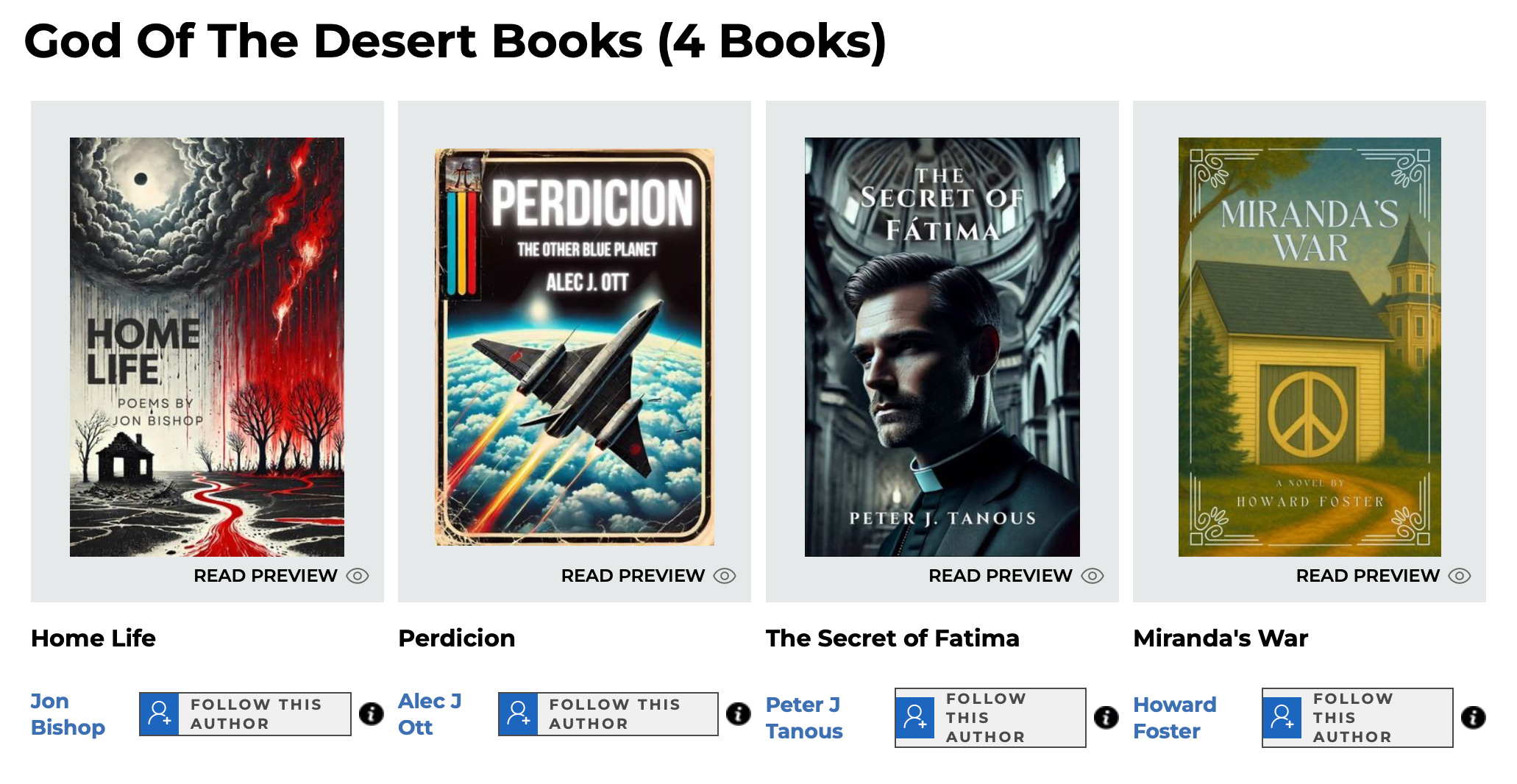
I’m proud of the work that we’ve done with this publishing company-turned-digital-media-studio. These are four great books by four gifted authors.
But apart from that, I wish that I could Eternal Sunshine the rest of it out of my head. I would have been better off if I’d never left working at the arthouse movie theater.
The reason is because of a phenomenon that some journalists, researchers, and people in law enforcement experience called “vicarious trauma.”
Here’s how the Department of Justice describes the phenomenon:
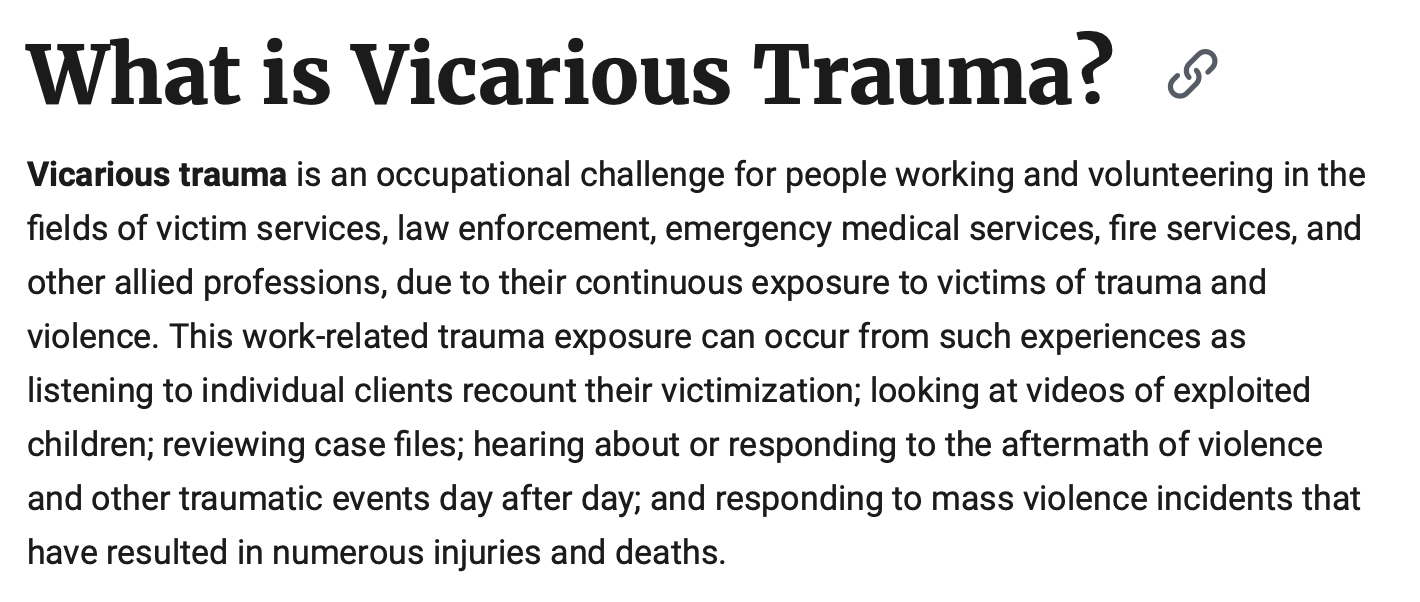
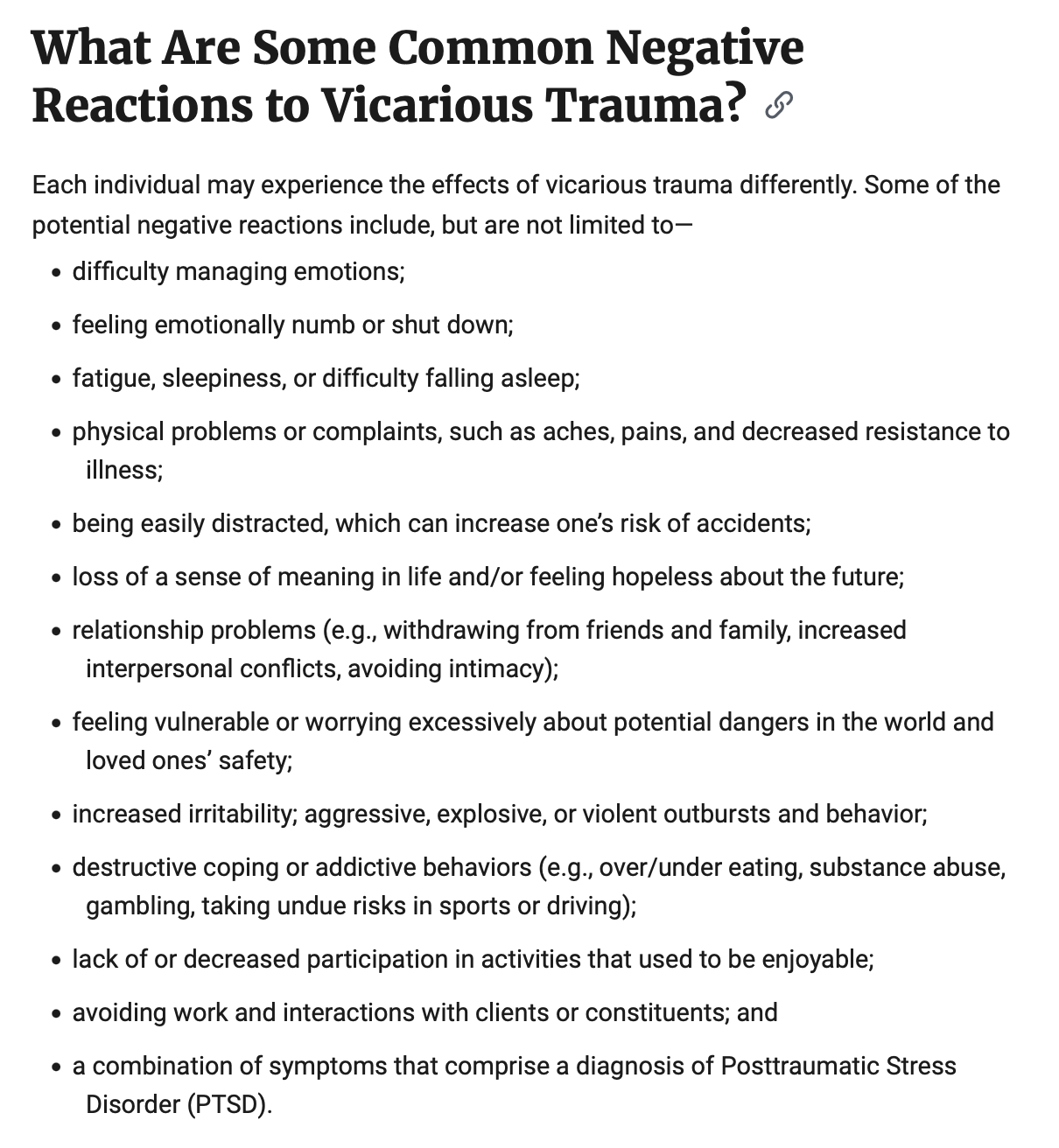
Perhaps a big chunk of my personality and writing persona are evident in that list?
The “feeling hopeless about the future” and “worrying excessively about potential dangers in the world and loved ones’ safety” resonate a bit heavy this evening.
So yeah, I’ve already tried to cope for years with the PTSD from the physical violence, but much of the way that I did has been to focus on other people’s trauma which is much worse than mine.
“Out of the frying pan, into the fire.”
And for what?
What has any of these years of writing and editing about the world’s darkness produced apart from given me such a hypervigilant view of a violent world?
This approach is not needed or valued now that we have LLMs.
I never liked “Blade Runner.”
The movie’s aesthetic never impressed me and its premise of a man tasked with killing synethetic humans who might be real never appealed.
And it appeals even less now that this is our reality on Substack.
I spent the last 34 years, since age eight in sweet roly poly Mrs. Cole’s third grade class, becoming a writer to the point that I could professionally support a household.
But none of this matters.
How well somebody can write or how original their points or how how much experience they bring to the digital kitchen table does not matter today.
When somebody taps a headline that grabs their attention, they almost never know who wrote it nor do they care. They don’t know whether they’re going to receive a YouTube video with two paragraphs of stale commentary or a 10,000-word deep dive that took days or weeks to research and draft.
We’re now at a place in our culture where an individual’s expertise does not really matter in how people choose to assess their information.
In America today, people will value the position of the attractive, entertaining TV presenter more than the professional with on-the-ground experience.
They’ll prefer the perspective of the 25-year-old TikToker and YouTuber, to the expert who has to tell the story in a book and then they’re lucky if they’ll appear on some business bro’s podcast to answer dumb questions.
My morning routine is pretty consistent now.
I gave up coffee this year to try and reduce anxiety after receiving a diagnosis last year.
Instead, I let the morning’s headlines wake me up. Given that here in California, we’re three hours behinind when the East Coast officially launches that global day’s events, when I’m rising, whether it be five, six, seven, or — after an especially late night writing session — eight — then I’m needing to catch up with the rest of the country.
So apart from hitting a range of news sources to make sure there hasn’t been some big explosion somewhere or the assassination of a world leader, then it’ll be time to see if any of the 1275 Substacks that I’m subscribed to have anything to offer which seems pressing.
Of course, the Zionist Substacks which I subscribe to take a high priority.
I won’t name these two individuals so as not to embarrass them.
The first one that I opened came from an individual I’d met in person on a few occassions over a decade ago before their ascent to moderate fame, and who had a family member whose work I had previously edited. They had arisen to a fairly visible position in pro-Israel media but had seemingly grown disinterested in me, as many writers I’ve noticed become when I’m no longer useful to them. I’ve grown very accustomed these days to writers pretending to be my friend when it suits them and abandoning when I’m apparently no longer of use.
I went to click the Pangram AI-scanning option which Substack has released recently.
Click it and then it will give you an estimate of how much of the text was likely AI-generated.

The software works incredibly well — it makes an error in one out of 10,000 times. That’s a far higher accuracy rate than we get it political polling. And writers on Substack can scan their posts with Pangram before they publish. They can know exactly what their readers will see when we scan their post with Pangram.
However, some writers choose to hide this number from their readers. At the bottom of the screen that the Substack writer clicks before sending they have these options:

Leaving Pangram on is the default option for posts. If a writer wants to disable a particular post, then that is a conscious choice.
As an editor and publisher, as far as I’m concerned, a writer refusing to allow a reader to scan their writing for AI text is the same thing as a cop pulling over an erratic driver for suspected drunken driving and them grinning like an idiot and refusing to take a breathalyzer.
What the hell are you hiding, exactly, Mr. Romo?
Now any time I come across a post that does this then I’ll go down in the comments and ask them why they disabled the AI scanning and if they used an LLM to write the piece. These are rhetorical questions.
I don’t need Pangram to tell me that something is AI writing. Having become a professional AI trainer who has contributed to three of the top AI labs, I can spot LLM writing from ten time zones away. It’s as predictable and consistent as a McDonald’s cheeseburger.
So I did this with one pro-Israel post this morning from a writer with a much larger platform and level of visibility than I do. And they got all huffy and tried to deny it and urged me to simply leave. Never mind that I was susbcribed to them, had promoted their work multiple times, and had supported their family member. They probably didn’t even remember me.
So I continued my morning wake-up-scrolling and came to another pro-Israel Substacker who I appreciate and whose views generally aligned with mine.
And I did the same thing as with the previous Zionist activist who I admired.
What did Pangram have to say?
We have another refused breathalyzer.
I was a bit kinder this time in the comments asking as this was someone with much less media experience (I’m pretty sure) and with whom I’d had much warmer interactions recently. They sort of hedged and tried to justify closing the AI detector, admitting they did use it to help and then explained their process.
And my answer to them was simple: just describe that usage level in your AI statement that shows up when a user does the Pangram scanning. If they had done that then I would have just read the piece.
Just because an article may show up saying that a chunk of it or even 100% is AI-written, that does not mean that I’m going to refuse to read it.
If the author says in their statement something along the lines of “Yes, I use AI to help me write and I’m proud of it,” then I have no grievance with that person at all. They’re not hiding anything. There are a number of writers here on Substack who use AI in their writing much more than I would but that’s OK. They’re open about it, they realize their limitaitons now as a less experiened writer, and they’re still providing plenty of their own value too.
If both of these two Zionist Substackers had not disabled the AI scanning and had simply noted their AI use in the statement, then I would have simply carried on reading the pieces.
But when an author is willing to conceal something as simple as whether they used AI to write their article or not, then it opens up the questions:
If they won’t be honest with their readers about their AI use, then what else are they choosing not to be honest with their readers in disclosing? And what are they lying to themselves about too?
I left this as my final comment as they explained how they used AI, which seemed reasonable enough to me if it were only disclosed:
Make that clear in your AI use statement and don’t disable the AI scanning then.
What’s the point of me even continuing to write, [name removed]? I take the time and effort to write my pieces myself and almost nobody really cares.
I was planning to do a big piece 5k+ words piece taking down Candace Owens like I did with Natalie Harp. But why should I bother? I may as well generate some basic LLM anti-Candace op-ed since apparently people don’t care enough to notice.
Let’s go ahead and do an experiment:
Over the last year I’ve explored live-streaming video:
Seven months ago, Substack introduced the Substack TV app so people can start watching Substack videos not just on their phones, but now on their televisions. I guess ther are some people that still do this old fashioned watching TV, right?

When Substack launched and the first initial waves of us came in over the coming years — June 2022 was my point of entry — this was purely a platform for long-form newsletters and audio podcasts.
However, to those of us who watched as Substack took infusions of venture capitalist cash to stay alive, it soon became apparent that the platform would have to change in order to survive.
There was no way Substack could pay back its investors — forget so much as make a profit — just with a small cut of premium newsletter subscriptions.
The VC guys don’t just want a profitable business. They want the unicorns that provide 100 times their initial investment so they can cover the losses of all the busineses that fail.
Substack’s real competitors are not the other newsletter services like BeeHiiv, Ghost, and Mailchimp.
Substack is trying to compete with Facebook, X, and YouTube.
Substack is not an email in your inbox anymore.
Substack is an app on your phone.
So they’re now competing with the other key apps that suck up your attention. And to compete that means going visual. Print publications cannot compete with the excitement provided by live-streaming and short-form video. And you can’t read an article the way you can listen to an audio podcast while washing the dishes, folding the laundry, or driving the commute.
And this is the way of the world now.
It’s why last fall I announced the shift from God of the Desert Books to God of the Desert Digital Media Studios:

And the reality here is difficult to consider:
Giving up being a writer to instead become a livestreamer and podcaster.
The writing skills that so many of us spent a lifetime developing simply are not valued today.
To focus on writing articles and books today has now become the equivalent of horse and buggy while everyone else has switched to motor-cars:
But the harder truth, and the bigger picture reason why I’ve come to resent having chosen to become a writer, is that these skills were actually never valued.
Going back to the ancient world, people who could see danger coming which others could not suffered the horror of having to watch as others refused to believe us.
The real reason at my exhaustion today at coming to see “writer” as a catasrophic mistake in life paths goes further and deeper than what I’ve described so far of:
Having overdosed on writing about terrorism and hate groups
Having now grown frustrated that human-written articles which take days to write must now compete (and always lose) with bland pieces which emerge from an LLM in seconds. It doesn’t matter if we as writers can write better than LLMs. Most people aren’t going to know or care since they’re content with mediocre writing. More people would rather flip through tweets and TikToks then absurdly long articles like this.
Having realized that this platform really, really, really wants us to start putting out visual media for their new YouTube competitor app and that unfortunately they’re right that they as a company and we as writers have to do this goddamn “pivot to video” move yet again whether we want to or not.
Feeling as though all this writing has really failed to accomplish anything meaningful anywhere near the stress and sacrifices needed to produce it.
The real reason is something that I’ve been ranting to my close friends on the phone about lately and I may as well reveal it here for those of you really thinking about going into this writing profession can think about:
Going very deep into becoming a writer produces a deeply isolating perspective on the world which sets you apart from other people, largely in a way which is more curse than blessing.
Learning all those different forms of writing through junior high, high school, and then college, learning how to do deep research, meant I had a whole bunch of different spells and modes for analyzing and interpreting the world. I could apply the literary lenses of Virginia Woolf and Allen Ginsberg, or the political lenses of Niccolo Machiavelli and Allan Bloom. Soon I would gain the occult lenses of Aleister Crowley and Robert Anton Wilson too. Nowadays the cultural lenses of Alan Moore and Douglas Rushkoff seem to dominate.
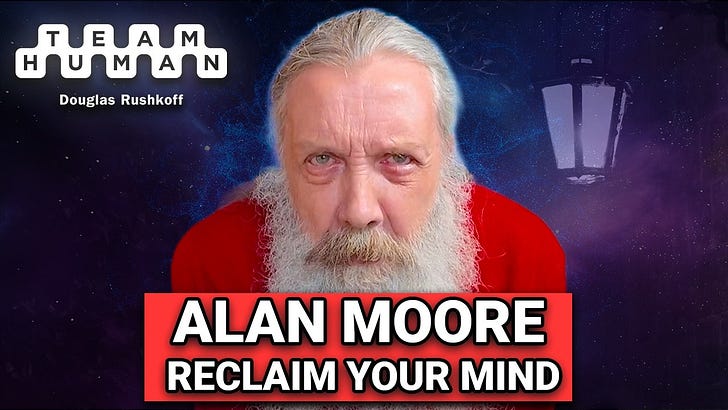
Most people only have a handful of ways to see the world. The writer ends up collecting dozens and dozens.
What having all these ways of seeing the world at hand means is that we see things which other people do not. And this is a curse.
This is nothing special about me — anyone who learns to look at the world deeply and with complexity will find secrets hidden in plain sight wherever they focus their attention long enough. And the price of that will be heavy, even heavier should they be foolish enough to speak of what they have discovered.
To see and speak the truth, only to be ignored, is such a painful burden.
Lately it’s the ghost of Lt. Gen. Ion. Mihai Pacepa who haunts me the most. I mean metaphorically, not literally. He was very Christian and knew to go to heaven, so I’ve never gotten a sense that his spirit has hung around since his passing on February 14, 2021.
This morning I sent a friend some “secret” documents Pacepa shared with me, including one which presented evidence arguing numerous points like these:
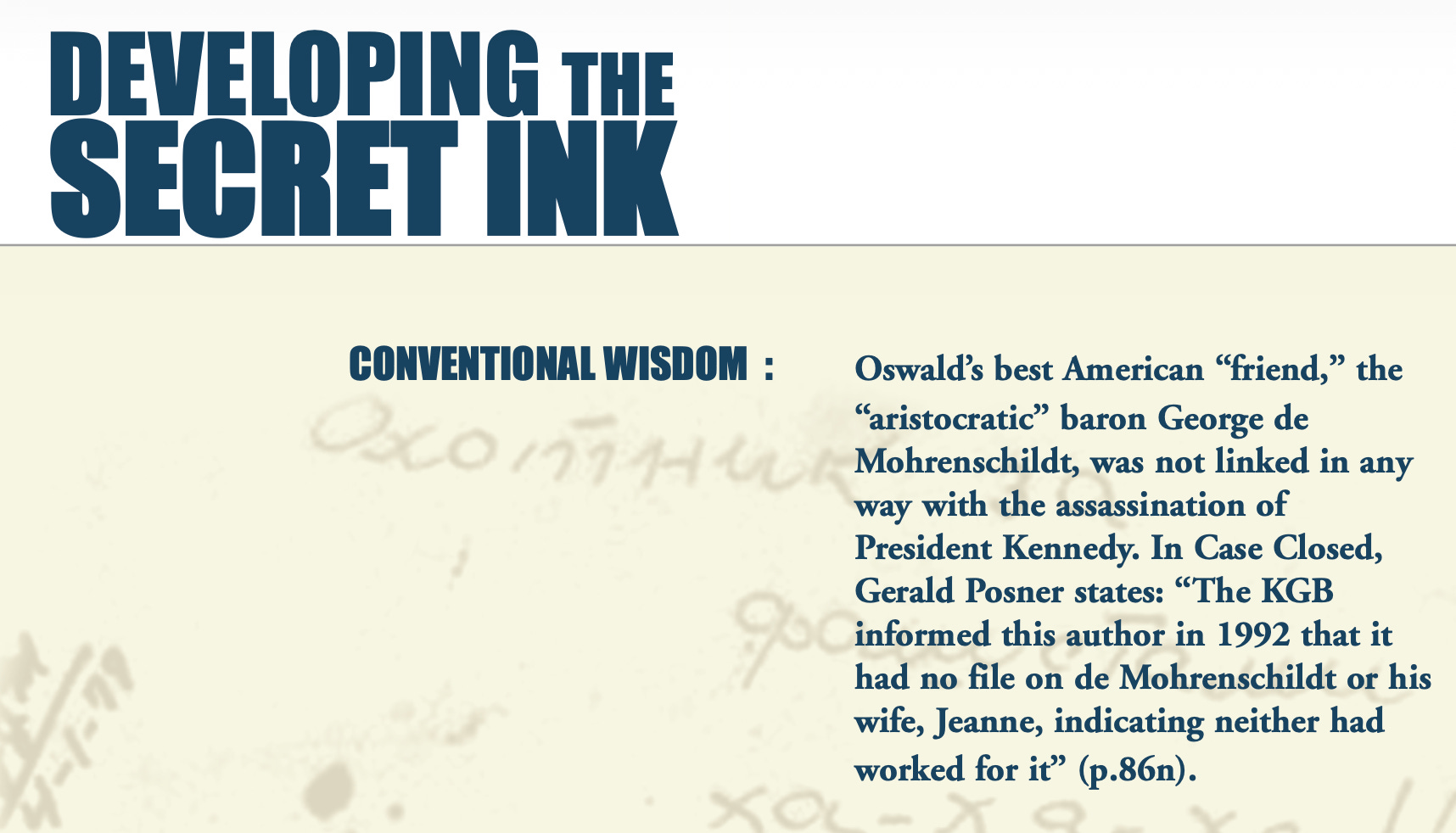
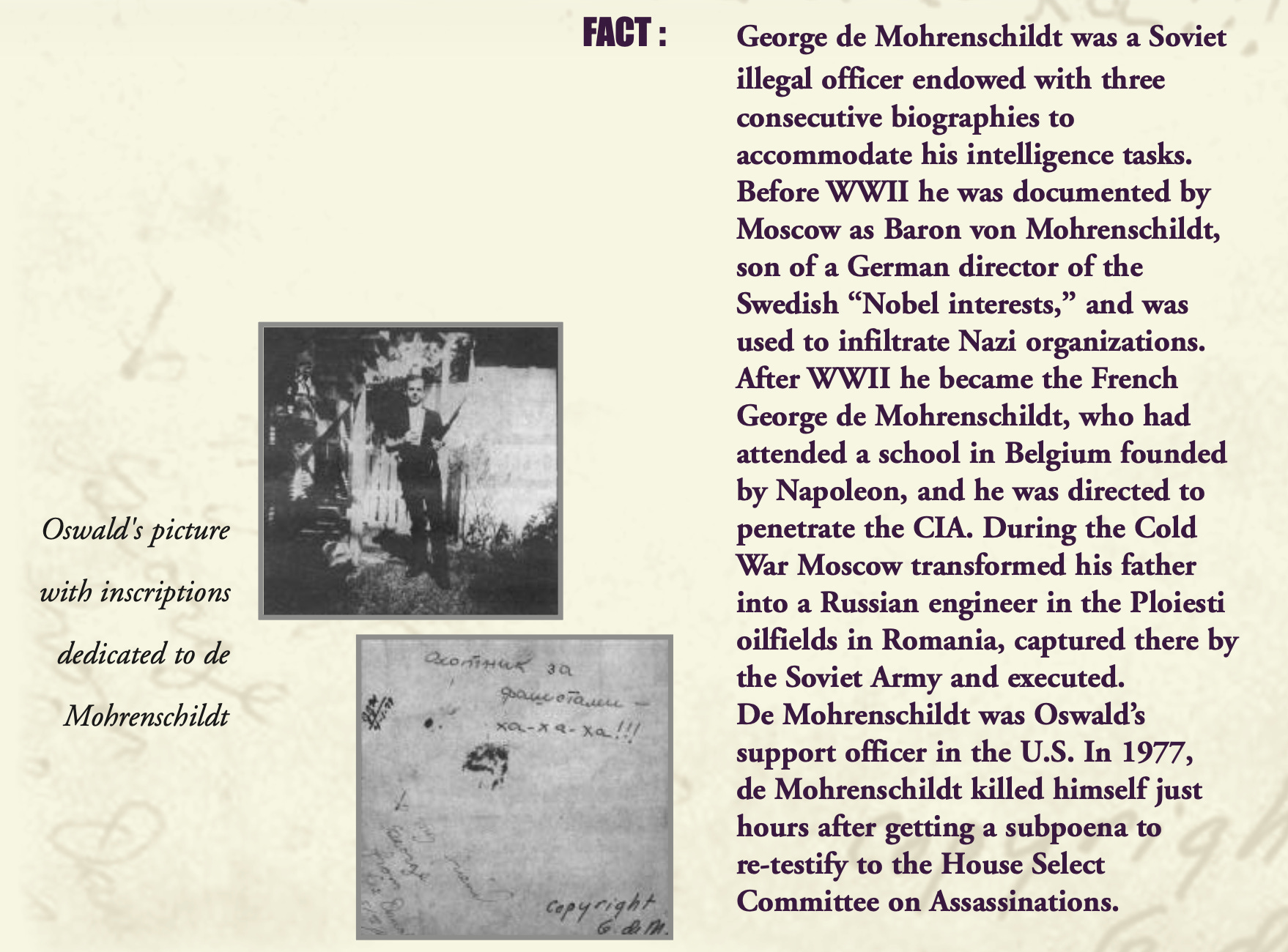
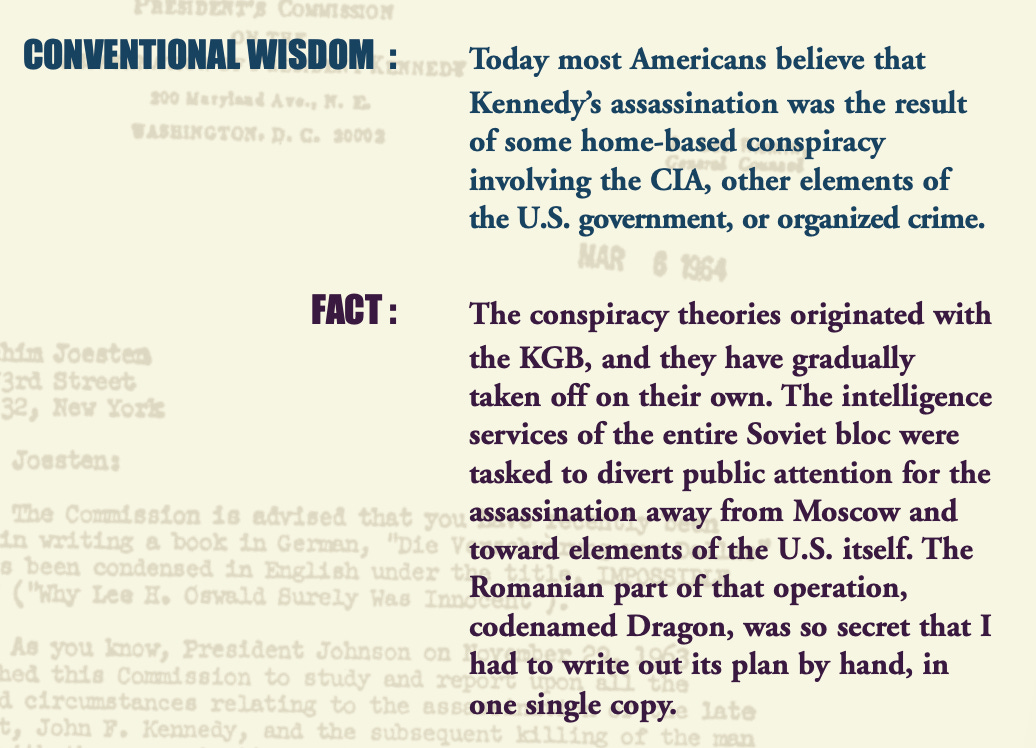
Back in 2022, I wrote this piece summarizing Pacepa’s unique view of the JFK assassination:

You’d think that Americans would be interested in finally understanding the JFK assassination and the broader machinations of the KGB during the Cold War.
You’d think that Pacepa could develop a broader audience since he possessed such a singular perspective. But he couldn’t. He was the former spymaster of Romania. He was the highest ranking defector from the Soviet bloc.
And yet in the last decade of his life, he could not get a better editor to edit his blog posts than 29-year-old me who revered him as the legend he was while few others would. Ronald Reagan called the draft of Pacepa’s memoir Red Horizons his “Bible for dealing with dictators.”
And it shouldn’t have been that way. He didn’t deserve that. He was great to work with and his writing was extraordinary. He should have had more more experienced and skilled editors than me. And he eventually did when it was nearly too late, as his final book Operation Dragon: Inside the Kremlin’s Secret War on America co-authored with former CIA chief Ambassador R. James Woolsey, came out from Encounter Books on February 23, 2021, just a week after his death from Covid.
But has it really mattered?
What difference does it make when a wizard shines a light in the darkness? People would rather stay in darkness.
Pacepa labored over three books in the last 25 years of his life and wrote tons of articles. But what did all that work accomplish? The highest-ranking Soviet defector laid out his unique understanding of history and the world.
And the collective response is a shrug. The best he could get to publish his writings in his final years are a few goofy blogs and independent right-wing publishing houses.
One might chalk that up to ideological bias, but as much as I’ve worked with writers on the margins, I’ve known writers with broader “mainstream” success, regular Big-5 publishing deals, international reputations, rolodexes of celebrity buddies going back decades, whose work had been adapted into films and documentaries.
And they generally were not happy with the level of following and achievement they had reached. And they were decades ahead of me and way smarter and more talented that I would ever be. And they were not at all wrong to feel that way. I knew how great they were as writers and that they should have way more support by now than they did.
And gradually I came to understand something which Sir Anthony Hopkins said:
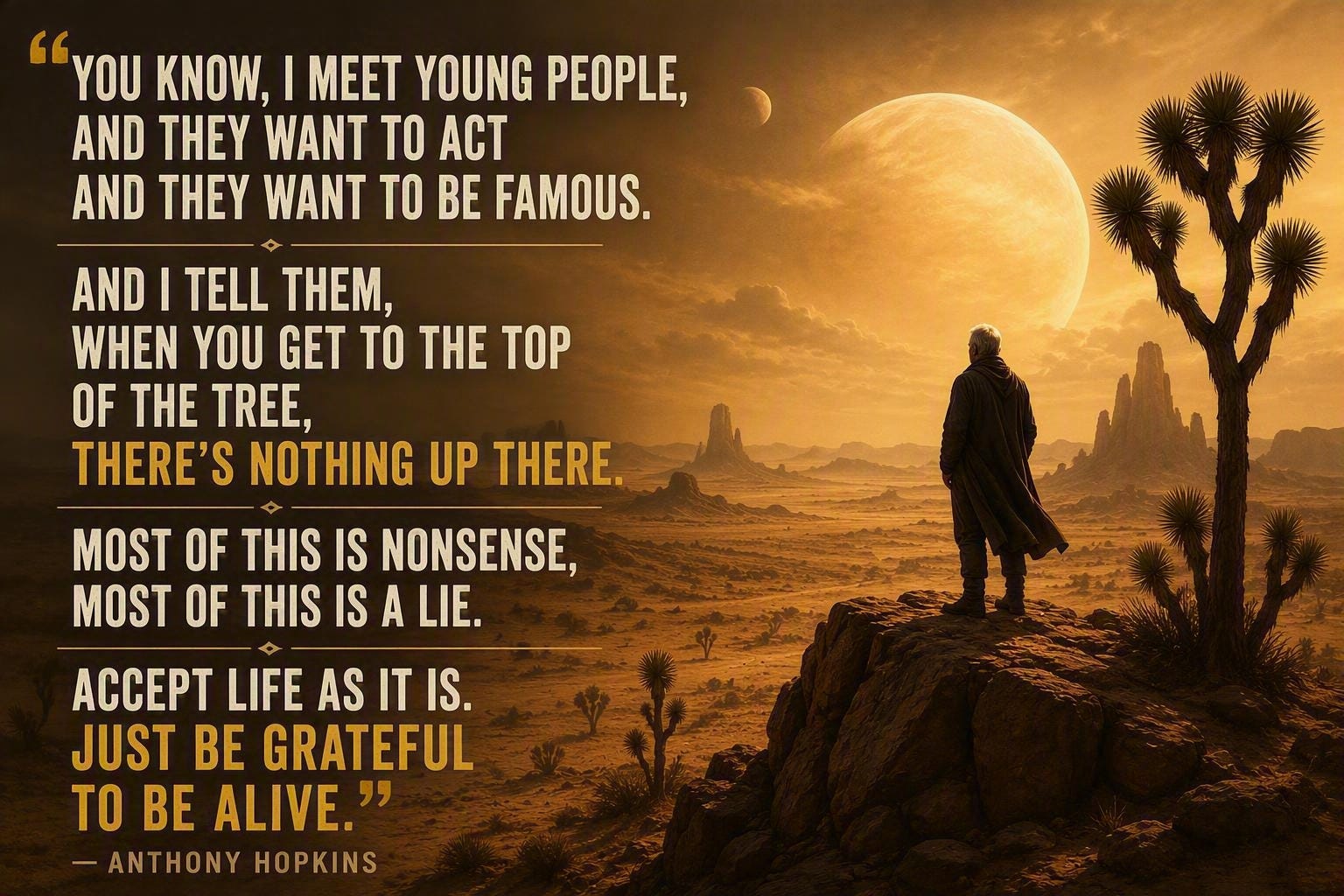
Hopkins is one of the top five greatest living actors. One could even argue the best.
And hearing this the first time, I felt so haunted. He was telling us the horrifying secret from the top.
Pursue as far as you can and when you achieve the peak then what treasure awaits you?
An empty box
Frank Herbert offered similar wisdom:
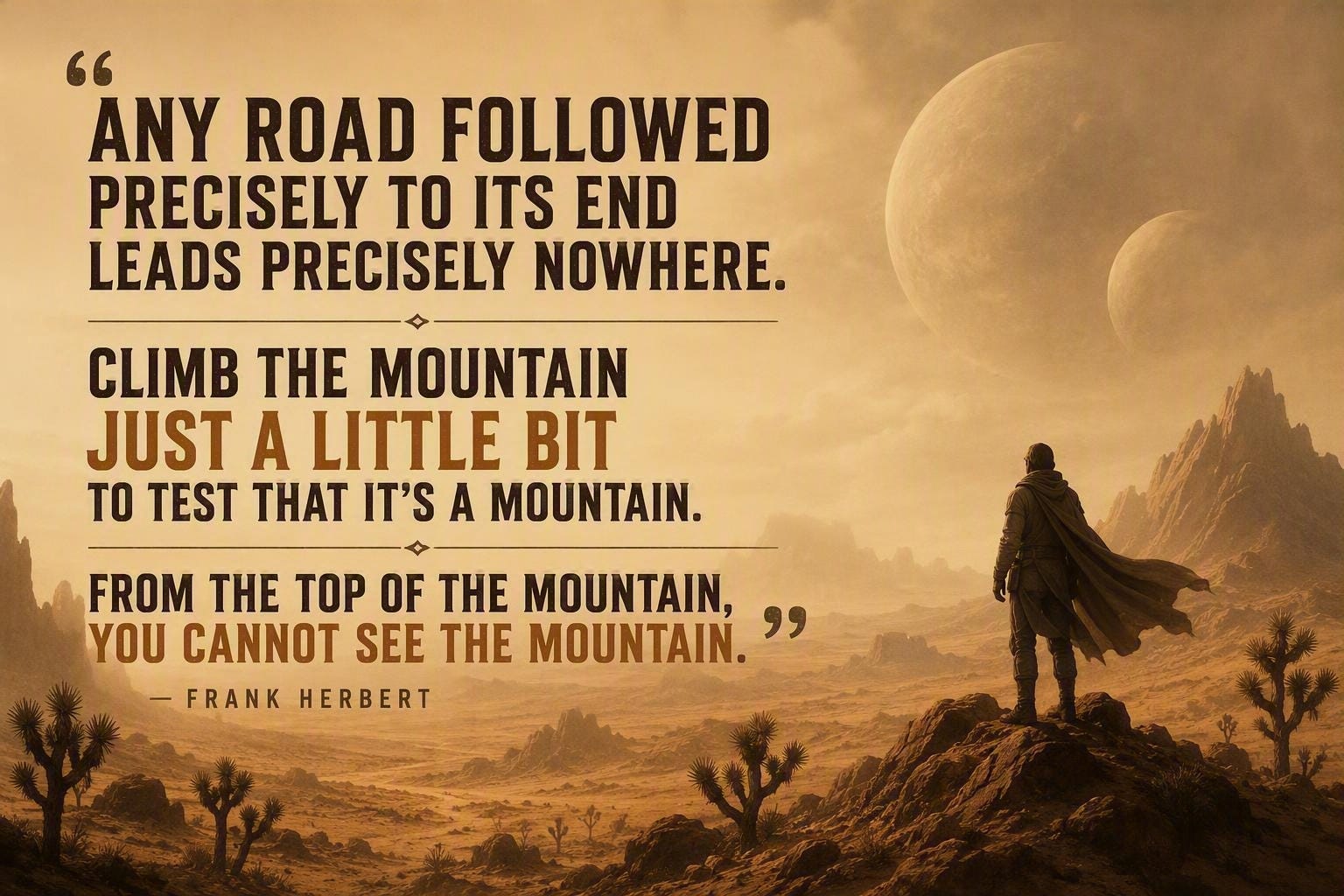
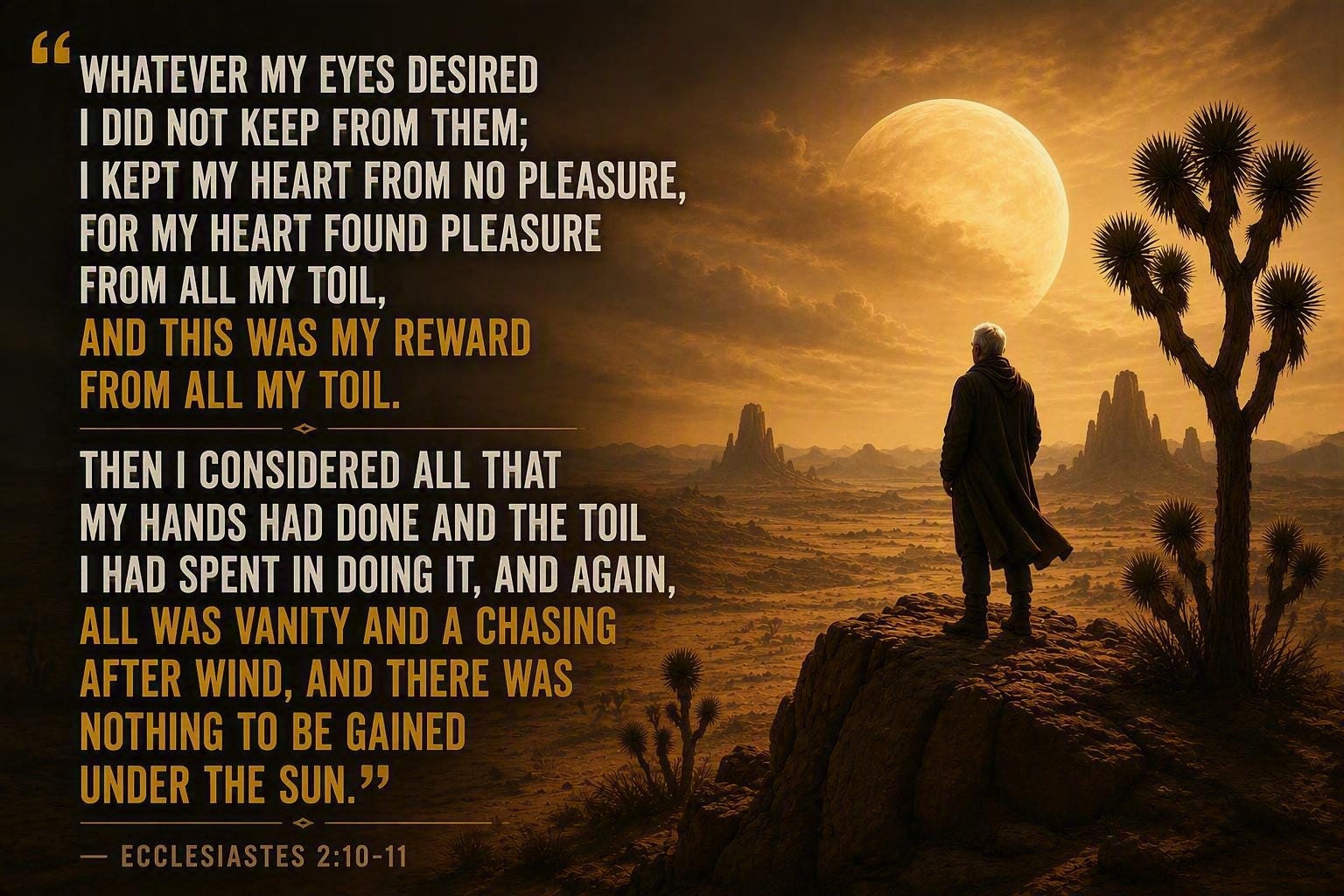
But it comes down to the biblical variation to tell the truth in the most painful possible way:
And so eventually when little 8-year-old Davey passed through the Mystic Waterfall into the last stage of his journey before returning to where he began, he found himself at the top of a small mountain and could now see the source of the stream as it stumbled down over the edge of the cliff.
And the shadow of 42-year-old David in 2026 whispered to the boy in 1992 who had run away in fear, “it’s safe. You can go home now. There’s nowhere left to go and no more spells to learn, no more enemies to vanquish or battlefield friends to heal. You don’t have to be afraid any more.”
Davey could see in his mind’s eye the grown-up with the scraggly beard, the thinning hairline, too many rings on his fingers, and tired eyes.
“It’s ok,” the old man said, “you don’t need to be afraid anymore.”
I Leave my AI detection on, but sometimes it tells me my writing contains a small AI percentage, so I have to rewrite my own work so that I can get a 100% me on my own work. It's not perfect for sure.
I enjoyed this piece. Well written and interesting. Great work.
You’re an excellent writer. I want to tell you about this platforms AI detection. I went through some of my Notes from the last few days, ones that I used zero AI assistance on. Yet, the detection says 36% human. Some said 0% human. But I wrote them in Google Docs or on my phone in my Notes app. So I wonder if it’s picking up AI created images and weighing it that way? All I can tell you is that it’s faulty. And yes, I know part of this beautifully written piece is about our interaction. I’m a writer. Not at your level, no. But I’ve been writing my entire life. I published books long before AI. And I’ll be a writer long after this AI bubble bursts. Same as you.
Your work needs a wider audience. It’s magnificent.