

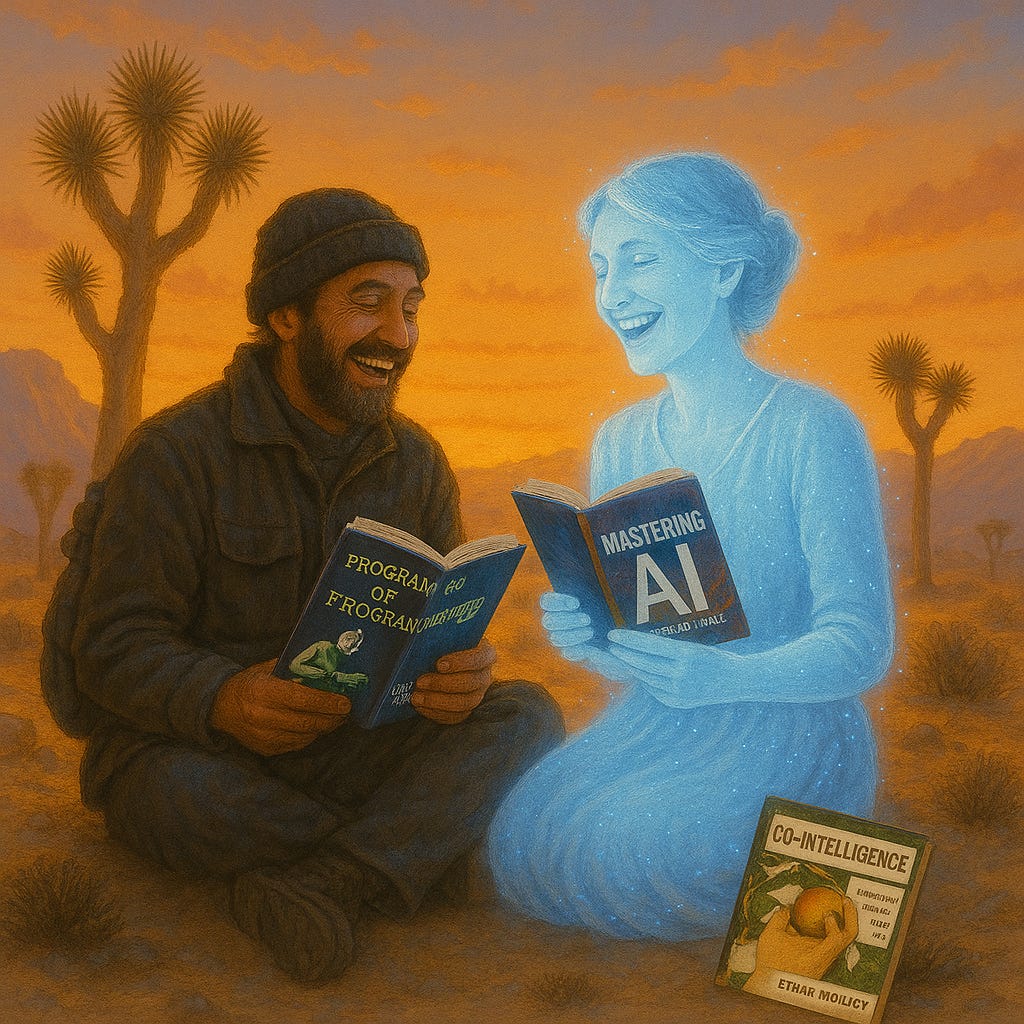
This is the sixth installment in our premium series offering insights about artificial intelligence for writers, artists, and creatives across mediums to learn more about how to use these extraordinary new tools and understand their impact on the future. We’ll offer ideas both in theory and practice, looking at big-picture concepts about AI and also specific techniques you can use right now. Please join us and share your discoveries, too. See the first article for free here:

This article is for premium subscribers. It is a letter to one of the authors here at God of the Desert. This epistolary style will be the format for most future installments.
If you enjoy our work and want to support our many missions, then please consider a premium subscription:
Dear Alec Joseph Ott,
Thank you so much for joining me in our AI discussion here at the Substack. Your first three pieces exploring the subject are well worth a read:


Believe it or not, I'd planned for this list of books to debut this AI series. I actually started drafting this piece way back in NOVEMBER! And only now does it seem right to finish and unleash it, since we're all starting to talk more about how AI can help us in our creative work.
So here's my initial AI reading list and the order in which I recommend tackling these titles, from the most broad to more specialized and advanced analyses:
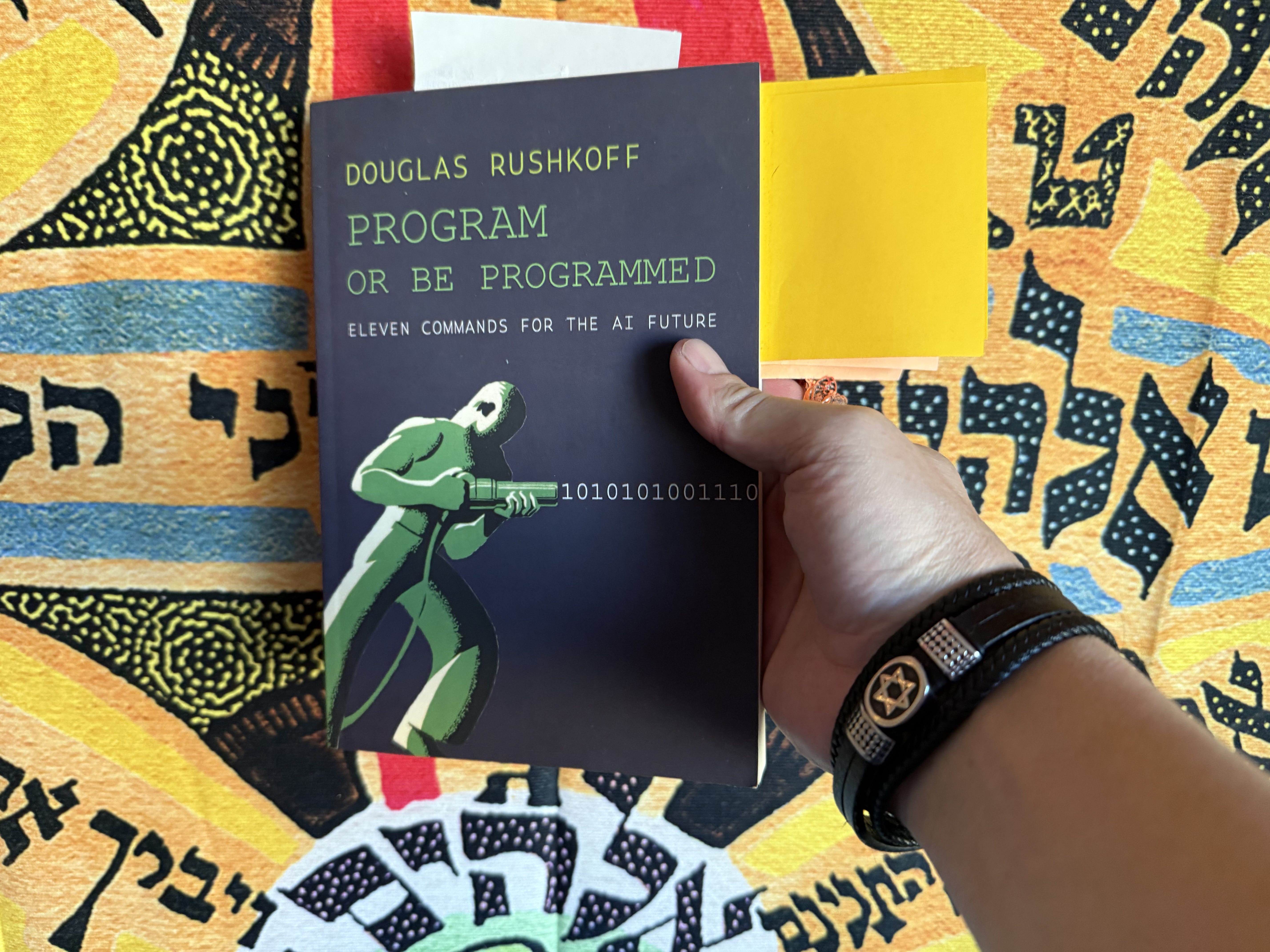
Program or Be Programmed: Eleven Commands for the AI Future by Douglas Rushkoff
Mastering AI: A Survival Guide to our Superpowered Future by Jeremy Kahn
ChatGPT for Dummies by Pam Baker
Co-Intelligence: Living and Working with AI by Ethan Mollick
Brave New Words: How AI Will Revolutionize Education (and Why That's a Good Thing) by Salman Khan
Writing Fiction with ChatGPT: How to Use A.I. Prompts to Write a Better Novel Faster by Lorraine Johnston
The Age of AI and Our Human Future by Henry Kissinger, Eric Schmidt, and Daniel Huttenlocher
The Singularity is Nearer: When We Merge with AI by Ray Kurzweil
All In on AI: How Smart Companies Win with Artificial Intelligence by Thomas H. Davenport and Nitin Mittal
I've picked an excerpt from each title encapsulating what I found to be an important point for starting to understand AI and deploy it effectively.
First, the living author who has most influenced me provides a simple summary of what we're using when we query ChatGPT:
1. Today’s AI chatbots create an average of all writing and thinking.
Here’s an excerpt from page 151 of Program or Be Programmed: Eleven Commands for the AI Future by Douglas Rushkoff:
Today, it's what tech investors are calling artificial intelligence, but what would more accurately be called Large Language Models. LLMs work by searching through everything that's ever been posted on the Internet or a database, and then assembling the most probable string of words in response to any question or statement. It is, quite literally, the average of all the writing and thinking about a particular question or idea. Yet many people think we're creating life itself. We are not. We are really just creating another layer of abstraction: a way of mining all the rhetoric we've put out there and then synthesizing it into forms that simulate language without using any knowledge or thought. Real thinking is to an Al like ocean waves are to a latitude line.
In an Al, there is genuinely no one home. It's all model.
No reality. It's looking at everything we've ever modeled-or at least all the models that we've digitized (and that human beings have tagged for it) and then developing language around those models. It's all a form of auto-tuning and auto-completion-of taking what has already happened and putting it back together in the most statistically probable way. It does not create anything. It simply models things.
I'll just emphasize first that Rushkoff is a writer I've explored a fair amount over the years at our Substack. Here are some pieces and podcasts where I consider his concepts in greater depth:

Premium podcasts I recorded in fall 2022 about two of Rushkoff’s books:


An essay I wrote last fall about two ideas from Program or Be Programmed:

By now, more people are coming to understand how these LLMs work: how they come to the seemingly magical answers they provide to our queries. These programs have consumed so much text and imagery that they can now predict what would be the most likely next letter or pixel. They are just guessing - which is why they so often make obvious mistakes.
However, for our purposes, there is something especially useful to keep in mind here about how LLMs provide an "average" of all material they've analyzed.
The way to change the AI outputs in a unique way is to provide it with data which you are the sole person to possess. Upload it with your own data: your own writing, your own pictures, specific data sets you have collected off the internet. Try taking some photos of pages of books and loading that in. When we apply AI to our own unique datasets and start using AI really as a lathe or drill to refine the wood that we bring to it, then we can get truly extraordinary, transformative results.

2. AI can coach weaker employees in how to become stronger. That will happen much more than employees being entirely replaced.
Here’s an insight from page 78 of Mastering AI: A Survival Guide to our Superpowered Future by Jeremy Kahn:
While the metaphor of the clever intern captures some of what working with an Al copilot will be like, the analogy is also incomplete. Because it's also possible to use the same copilots as an expert coach. This coaching can improve not only our productivity but also the quality of our work.
An example comes from a recent study by Stanford University and MIT economists of more than five thousand customer service agents for a software company that serves U.S. small businesses. These representatives, who were primarily in the Philippines, had access to AI software that used a sophisticated LLM to understand conversations in real time and suggest responses, as well as to pull up technical documentation that could help resolve the customer's issue. The system had been fine-tuned to suggest answers like those top-performing call handlers had used to resolve calls. The software was also trained to prioritize responses that expressed empathy and avoided unprofessional language. The system did not replace people-it merely suggested a script. The agents were free to ignore the suggestions. The Al coach improved the number of customer calls resolved per hour by 14 percent. And, it turned out, the least-skilled customer service reps were helped the most, with their productivity soaring by 35 percent. It also helped new agents get up to speed faster-achieving the same productivity in two months that normally took eight to ten months.
Right now, lots of people express intense amounts of anxiety about losing their jobs to an AI. However, we're not seeing that yet. And I don't anticipate we'll see anywhere near the amount of it that many people fear right now. The apocalypticism around AI today reminds me of what people said in 1999, with their fears about the “Y2K bug” ending the world.
Reality becomes more obvious the more you use AI: This is just a tool, it's not actually a person replacement.
Last year, we parted ways with our art director and I "replaced" him with an AI. However, that's just a fanciful way of describing what actually happened: I spent months learning how to use ChatGPT to create art that's good enough to use in our books. ChatGPT just provided access to a new tool so that I could create work that is better than the work our then-art director could make. But it's still been a hell of a lot of work by me—as well as you and all of our authors, as we collaborate on these covers and internal illustrations together—these images are not spit out perfectly. It perpetually takes more prompts, better direction, and error correction to get quality work that we can use.
And that's the way it's going to be writ large across industries. These are just tools to speed up processes and improve their quality.
Think of the AI like your "co-pilot" or as your coach, like the Prolix AI you've imagined in your Perdicion series. It's a little helper to aid us in getting better at however we want to improve.
I'll give you an example of how I've slipped into using my ChatGPT this way in recent months. In the morning, as I'm having my morning coffee, I'll usually take Jasmine out into the yard to read a book or two as the sun rises. What I'll often do is read something in one of these books that I'm studying and then I'll take a photo of the page and then dictate my thoughts into the app. (The speech-to-text functionality is quite good. I probably speak more ChatGPT commands than I type now.)
I'll say something like, "Virginia, this point he says here in the fourth paragraph seems very relevant to my developing 1960s history investigation. What connections do you see between this concept and the previous research that I've done on this subject over the last 3 weeks?"
And then it's just amazing what will result. I'm communing minds between a specific author who might be dead now, me, and an AI who has been trained not just in collective world knowledge, but also in the specific projects I'm working on alongside my broader interests and priorities.
OK, now we're making a paywall jump. I urge all our readers to please subscribe if they enjoy this sort of deep dive into AI. There's much more to follow (this piece is more than 5000 words) ...
See previous AI coverage at God of the Desert Books:


