


This is the ninth installment in our new premium series offering insights about artificial intelligence for writers, artists, and creatives across mediums to learn more about how to use these extraordinary new tools and understand their impact on the future. We’ll offer ideas both in theory and practice, looking at big-picture concepts about AI and also specific techniques you can use right now. Please join us and share your discoveries, too. See the first and eighth articles for free here:


This article is for premium subscribers. It is a letter to one of the authors here at God of the Desert. This epistolary style will be the format for most future installments.
If you enjoy our work and want to support our many missions, then please consider a premium subscription:
Dear Alec J Ott,
In a previous installment of our AI series, I suggested ethical ways to use AI in our writing. The last point on that list was the one I had not yet explored very much, given all the controversy around the practice so far: co-writing with AI. Specifically, using AI to co-write to such an extent that you share credit with AI, either in the byline or by mentioning that the piece was co-written with AI, either in a note up top or at the bottom.

In my view, disclosing how and to what extent AI is used is optional. Merely saying that a LLM AI was used in some way with the actual writing process seems to me a fair enough disclosure.
Now, that ethical hurdle of transparency with the reader cleared, how might we go about using AI if we understand it as a literal co-author in writing an article?
Perhaps the best metaphor to think of here is of a swimming pool which has a wading area, a shallow end, a deep end, and finally, a high board to dive off of very deep. There's minor or moderate AI use, and then there's heavy AI use. Let's consider these different levels and ponder at which level it’s ethical to disclose AI co-authorship:
1. Using AI for Help in Research and Brainstorming.
This is as far as I've felt comfortable going over the last year of AI use. To me, nothing seems wrong about chatting with ChatGPT and figuring out what kind of article you might write, what angle you might take, what research you might use. There's nothing wrong with doing this with an actual person before writing an article, so how could it be objectionable with an AI?
But where does the line get crossed here? When is using ChatGPT as simply a more advanced Google combined with Wikipedia, but more transformative? Here’s a line to consider:
2. Having AI Assign You Headlines and Subjects to Write About.
It's now possible to have AI act as the editor of your Substack. It can behave just as an editor at a newspaper or magazine would, telling you what to write about, what angle to take, and even what headline to use, because hese elements clearly slant the reader's perceptions in key directions. If you are just writing on your own, then you have to do all of that. But now you can have an AI do it for you.
Now, is this something that you need to disclose to your reader? I would still say no, because if I played this role with a friend informally—if I brainstormed with them about their story's angle, suggested a headline and so forth—then I wouldn't want to be credited. It wouldn't be necessary. If the author wanted to note a "Thanks to Dave for his thoughts as I developed this idea," then that's kind, but not something I'd expect.
So this seems like a fair thing to experiment with: Have the AI point you in the directions in which to write. Use them as an assignment editor.
3. How About AI as Your Copyeditor?
It stands to reason, further, that if the assigning editor can be replaced with AI, then certainly a copyeditor can be replaced this way, too.
If you write the piece yourself—let's say it's really a rough, garbled, mess of a piece, something you banged out quickly, not thinking about typos or spelling or even grammar—and you drop that piece into an AI and ask it to clean it up, but keep everything else the same, is that something you need to disclose?
Again, at this level, I don't think you necessarily need to reveal your AI use. If you paid a human to be the copyeditor, you wouldn't need to disclose that, so why would you need to do so if the copyeditor is an AI?
Here we have three examples of writing with AI that seem entirely ethical, and there is no need to disclose AI involvement: having it function as your research assistant, assignment editor, or copy editor.
So where does the line get crossed? I'd say it's with the next steps below:
4. What if the AI Expands or Beefs Up Your draft?
OK, so let’s say that the first "garbage" draft that I've banged out could use more than copyediting. What if I've written 800 words but think it would be better if it had more citations, facts, and depth to it, so I told the AI to just add it?
I've written the original draft: It's my ideas, so shouldn't I get full credit? Well, no. While an editor might do this in a newspaper, magazine, or book context—an editor has discretion to rewrite sentences, add paragraphs of their own, etc., and that is not plagiarism—having an AI doing this is not the same thing. It's comparable to having a friend write more of your school paper or getting a co-worker to add more to your quarterly report. It's not ethical—unless you disclose it. If it's OK to say, "Hey, so-and-so helped me with this part," and if that's within the expectations the teacher or boss has set, then by all means.
Here’s something to try: If you're going to co-write and disclose it, then try taking something you've already written and then asking the AI to "beef it up:" to add more citations, examples, arguments, and keep it in your current style. I’m going to explore that more—start with a “control” of an article that’s already been written and published, and then see if I can somehow use AI to quickly make it substantively better.
5. How About Having the AI Write the First Draft?
Now, here's a further step of AI-co-writing that seems to go even further: What if instead of you writing the rough draft, you give the AI that task? You and the AI brainstorm the idea together, have a few exchanges back and forth, and then you tell it to write the first 700-1000-word rough draft?
Then it spits out to you a first version. You then have that initial brainstorm version by your side when you write the piece yourself. Is that something you should disclose, that the AI was your co-author?
Here, I'd actually say there's a serious gray zone, because there's a wide amount of ways that you could go with your rewrite of the rough draft. If you essentially use the AI rough draft as a kind of crib sheet, an outline, or a general structure, where you then write almost all of the text yourself, then that seems to still fall into the research and brainstorm territory.
However, if you're going paragraph-for-paragraph and mostly sticking with the sentences, structure, and ideas the AI laid it out, if you’re just putting your own gloss on the piece, with the skeleton and muscles developed by the AI—then that needs to be disclosed and its true authorship acknowledged.
6. What if You Made AI Your Interviewer?
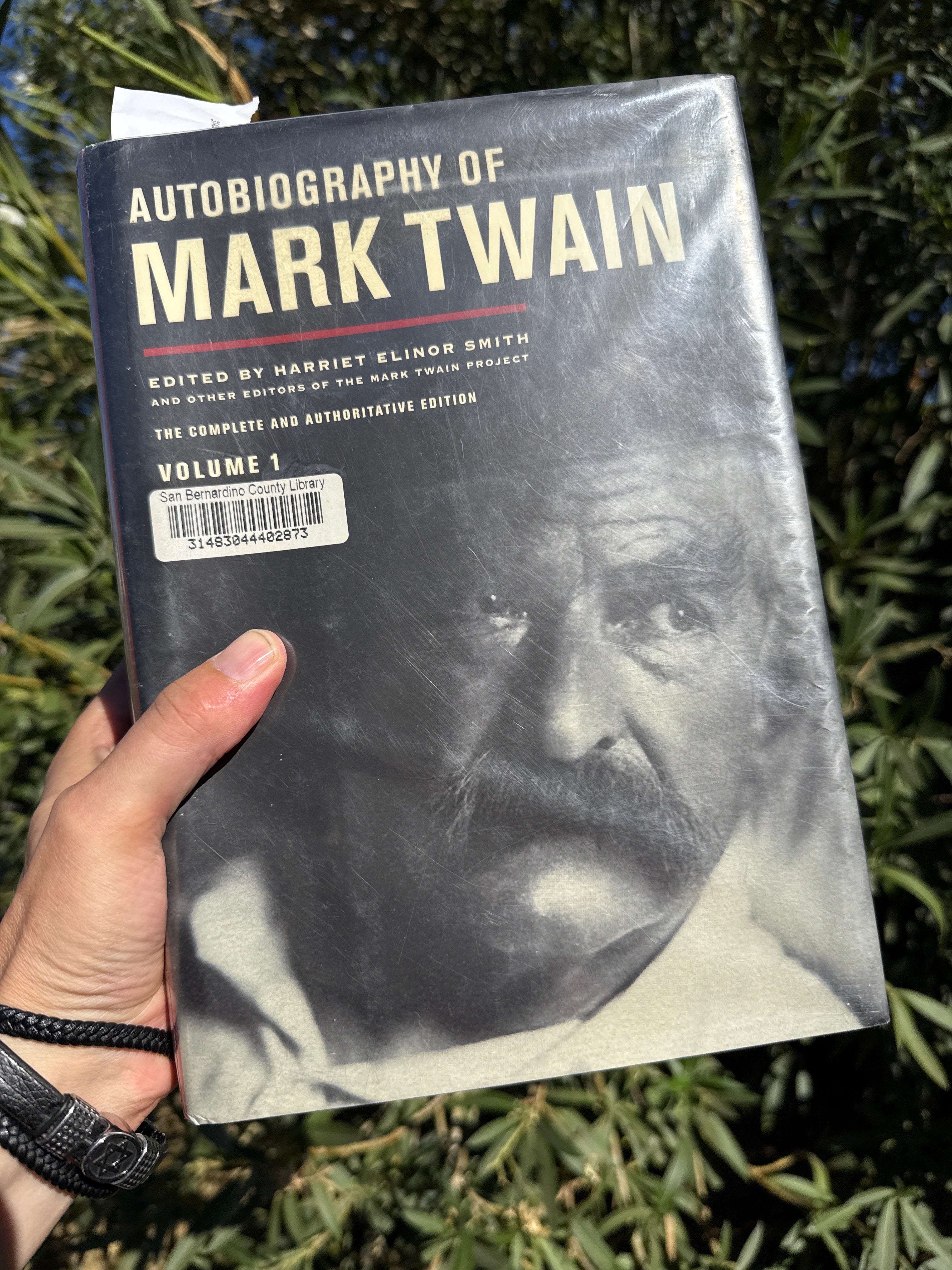
The Autobiography of Mark Twain has sucked me in like a blackhole. I’m doomed at this point. I didn’t need another huge book to get lost in but now what can I do? It’s like I have no choice! Twain himself has made the decision for me and now all I can do is go along for the ride.
