


Today I would like to invite you to join a distinguished literary tradition and to begin applying its principles to your own creative work in whichever medium you find yourself today or tomorrow.
I would like to invite you to join us in the the Modernist tradition, particularly by embracing its revival today in Metamodernism and through the teachings of its most successful practitioner, Alan Moore, the pathbreaking comics writer of the 1980s and 1990s who has now transformed himself into the most innovative and exciting fiction writer today.
Let’s start with some periods and definitions so we’re all on the same page, for those who did not make the mistake that I did by becoming an English major.
We can see the English novel as running through four periods over the last 200 years:
The Victorian Realist Period: 1840-1900
The Modernist Movement: 1900-1945
The Postmodernist Collapse: 1945-2001
The Metamodernist Revival: 2001-Present
Stereotypically, when one imagines the archetypal novelist and novel, usually it’s going to be Charles Dickens with Oliver Twist, David Copperfield, and A Tale of Two Cities. Perhaps Charlotte Brontë’s Jane Eyre or William Makepeace Thackeray’s Vanity Fair come to mind. That’s what a novel conventionally is understood as: one primary character, one omniscient perspective, one journey from beginning to end.
One objective truth. This is the Naive Realist perspective. What I see is reality.
The inherent problem with novels of this style and period becomes apparent quickly: they have an artificial quality to them. They are not really trying to depict the reality of the human experience. Thus, there are limits to how deeply one can emotionally engage with them.
The writers of the Modernist period rebelled against the Victorian conventions and instead sought to more accurately replicate the human experience on the page. One way they did this was by taking the perspective out of the godlike space and putting it into the characters’ heads. Virginia Woolf developed the stream-of-consciousness writing technique which enabled the readers to experience a character’s direct thoughts, bringing them far closer. In the opposite direction, James Joyce took the novel to epic scope with a multiplicity of styles, perspectives, and mythological parallels to show the chaos in just three characters across one day in Dublin. I embraced the Modernist tradition with both arms 23 years ago as an undergraduate. To me, Mrs. Dalloway and Ulysses are the standards by which all further novels are to be judged. Woolf and Joyce are two friends every writer needs to spend a lifetime coming to understand and appreciate. They are creative wells who never run dry.
World War II murdered Modernism.
The literary visions exemplified in Joyce and Woolf dreamed that art and literature could capture important truths about the universe and human experience. The novel was not just an entertainment to pass the time, but a medium which could communicate transcendence.
The collective human trauma of World War II bent culture away from Modernist dreams. In the postmodernist literature (Thomas Pynchon and Don DeLillo) and philosophy (Jacques Derrida and Michel Foucault) which emerged next, more and more authors and thinkers sought not to better depict truth, but instead to attack the very idea of truth and the significance of meaning.
If the modernist period was characterized by pursuing truth too deeply, then the postmodernist shifted the opposite direction, by attacking truth too viciously.
To the modernist, everything matters, to the postmodernist, nothing matters.
To the 1800s-style realist, only what they can see right now matters.
The resolution to this conflict of positions has arrived in this century, in the philosophy now described as metamodernism. The keyword which metamodernist philosophers have used to describe this approach is “oscillating.” As in, the metamodernist shifts back and forth between modernist sincerity and postmodernist irony.
I described this in March of 2025 in my essay “A Simple Explanation of the Case for Metamodernism”:

The hallmark of Metamodernism is the choice to jump back and forth between Modernism and Postmodernism.
The usual dualism that Metamodernists discuss is a key one here: jumping between sincerity and irony. The Metamodernist does believe in ideas sincerely and passionately like a Modernist, but they have taken the Postmodernist critique seriously, and recognize its frequent legitimacy against Modernist concepts. There is a lot of bullshit Modernism out there, and the BS-detecting Postmodernism is frequently correct to counter it.
However, the nature of Postmodernism is entirely destructive, and left unchecked, it becomes a snake eating its own tail. What happens when Postmodernism’s need to deconstruct, ridicule, and break apart everything is turned on itself? Then it reveals that a Postmodern approach alone devolves into nihilism, confusion, chaos, and ultimate self-destruction.
We need beliefs to survive, and we also need the ability to chop down those beliefs when they start killing us.
The metamodernist resolves the conflicts between realism, modernism, and postmodernism, by choosing to embrace all three, shifting and blending between them as needed.
All three reality tunnels offer valuable ways to approach our worlds.
And in my view, today the writer who has most mastered this balance to the greatest literary effect and impact, is Moore. He has internalized the ethos of Woolf and Joyce, but also the tools of the realists and the postmodernists. This blend creates a distinct richness in theme, style, and emotional impact.
I’ve been digging into Moore’s work more systematically for two years now.
Last year I published this list naming 13 creative ideas I had gained from four of his books and a biography of him:

1. Kill the Superheroes and Grow the Fuck Up
2. Juxtapose Narratives
3. Magick is Great for Fueling Creativity
4. The Power of the Provocative Prose
5. Psychogeography
6. Interacting with Entities
7. Ideaspace
8. Channeling Characters
9. Immersive Research
10. Absurdly Detailed Scripts
11. Symmetry in Storytelling
12. Writing as a Physical Act: He Fucking Breaks Keyboards!
13. A Path Not Taken: Rediscovering the 1900-1930s Golden Age of Sci-Fi and Fantasy
I was tempted to shoehorn in some of these concepts as well as others from further Moore books that I’d like to discuss, but when the number of key quotes I’d unearthed from his BBC Maestro course rang in at 23, then I knew that was the univese saying this was the complete, secret spell magick formula here.
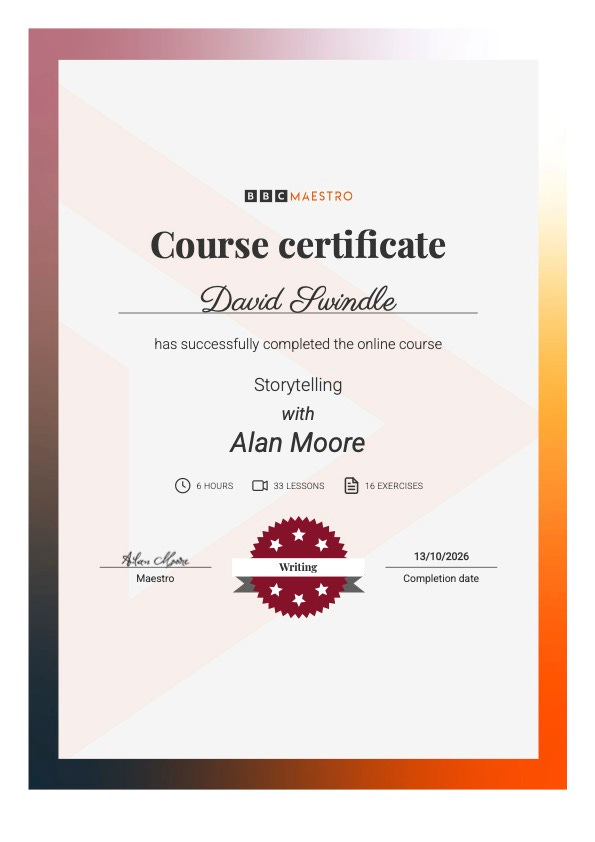
I urge everyone to sign up for BBC Maestro for a year. Moore’s course alone is worth the price. Marco Pierre White’s cooking courses have also been life-changing for me. And now when you complete a course they give you a little certificate and direct you where to add it as a certification on LinkedIn. (Very clever marketing there, guys, but I’ll play along. This does technically count as something to put on the CV.)
The course is six hours long and includes 33 lessons. Here are 23 concepts and corresponding quotes from the series, each featuring a related YouTube video and brief commentary by me. As tempting and appropriate as it is to go maximalist further, let’s not dilute the master’s message further:
1. Perform Any Writing Work You Can.
“As for practical advice for a writing career, here’s mine: accept any work you’re offered that’s legal and morally tolerable, try to do as good a job as you can and learn from the resultant mess.”
This pragmatic mentality is vital for all writers and creatives. Be willing to stretch and adapt. Go outside you comfort zone and learn new skills.
2. Recognize That Since Writing and Magic are One and the Same, If You Are a Writer Then You Are A Magician. Whether You Want To Be One Or Not Does Not Matter.
“The early gods of writing, the scribe gods like Odin, Thoth or Hermes, were also the gods of magic. I don’t believe that that is entirely a coincidence. In my estimation, writing and magic are practically the same thing.”
“You are part of this society stretching back through the ages of shamans, magicians and writers who have done so much to shape the development of the human story. You can become part of this marvellous tradition and play your own part, however small, however large, in this marvellous enterprise of expanding the capacity of what human beings can think, or feel, or do, or say, along with the number of ways in which they can say it. So, in conclusion, I would like to welcome every single one of you to this enormously important and transformative human tradition.”
Moore’s whole “writing is magic” schtick is not just hip branding. He’s sincere about it and so am I. Spelling a word in a sentence and speaking a magic spell from a grimoire are at root the same concept. When we speak or write words then that impacts other people’s consciousness and changes the world.
3. Wield the Four Magical Weapons as Your Writing Tools: Will, Emotion, Intellect, and the Physical World.
The first of these concepts is the four weapons – four symbolic tools or weapons that any magician is advised to ensure they possess a full complement of before commencing their magical career. These are the four suits of the Tarot deck: coins (or discs, pentacles), swords, cups and wands. Each of these one of the four classical elements, and a human quality or ability, that is necessary if you wish to be a magician or a writer. I advise you not to neglect any single one of them.
In the Western occult tradition, the four magical weapons and four suits of the Tarot cards represent aspects of ourselves and aspects of reality. Being able to manipulate and balance the four concepts means the abilty to shift and adapt to the needs of the changing circumstances. This corresponds with the Metamodernist oscillitating between sincerity and irony as needed.
4. Always Remember Your Writing Can Change Human History.
“Stand tall with your pen. You should never think of yourself as purely an entertainer for hire who is lucky to have the work. You should remember that a writer can change the world. Think of the books that have completely changed human history. See yourself in that light. Because if you are a writer, then you are having an effect upon human history. And the entirety of the human future.”
This is a fire we must always light again when it dies down dim.
We feel so often that the words we write mean nothing, that nobody is listening, that they will have no impact.
But we don’t really know. We can’t know. We can only throw them out into the wind.
5. Satirize Your Enemies
“But if a bard puts a satire upon you, then that will destroy you in the eyes of your friends, your family and potentially your own eyes. And if it’s a good enough satire, if it is finely worded enough, then even two or three hundred years after you’re dead, people might still be laughing at you and your absurdity.”
One of the aspects of Moore’s work which many so often overlook is that he’s deeply a satirist. His most impactful work, Watchmen, delivered a satirical blow so lethal that no superhero story since has ever bested it.
To embrace metamodernism, we slip into satire and humor almost by second nature. In shifting between multiple modes often in a single piece or a single paragraph, we reveal the absurdity of life.
6. Embrace James Joyce, Ulysses, Finnegans Wake, and a Love for Unusual Language
“More than that, you’re going to need a love of language, of new and unusual words. There wasn’t a lot of that around in the working-class neighbourhoods that I grew up in. Nevertheless, my mother particularly enjoyed unusual words, as if they belonged to better-off people but that she had somehow got hold of them… Unusual language alters the reader’s consciousness. Where James Joyce uses intricate techniques with the words themselves, so we don’t fully understand, our minds go into a different, much more receptive state. Believers in magic will use ‘barbarous tongues’ (a language that you do not personally understand) for spells, to induce a receptive trance-state.”
Being a writer means actively cultivating and developing a love of language. We need to actively take the effort to expand and develop our vocabularies. This includes taking in books and writers from across time periods and cultures.
7. Perform Maximalism in Language to Expand the Consciousness of Both the Reader and the Writer
“I fear that this may be true, that the less language you have, the more limited you are in what you can think. But must not the converse also be true? Must not an expanded use of language and vocabulary raise the consciousness, both of the author and of the reader? It is certainly something to think about.”
As writers, we are so continuosly told to constrain ourselves, to cut ourselves down to the bare minimum, to respect our reader’s time and so on. Moore provides us with a model for how to subvert those stereotypical demands. He shows a way to use langauge expansively to show the depth and complexity of the universe. And a big source of where he gets it is his friend, the author Iain Sinclair who he describes as his favorite author. While Moore draws many lessons from Sinclair, the foremost I’ll emphasize is the idea of Maximalism, which starts here and contiues in the next point.
Moore urges us to go long and to go big — give the reader depth, challenge, and complexity. And much of this comes from Sinclair’s example.
8. Say Goodbye to Ernest Fucking Hemingway
“Attic writers (like Hemingway) use simple, blunt sentences and plain English.
Asiatic writers (like Baudelaire*) decorate language like a bombast’s wedding cake and use every linguistic trick at their disposal.
(*And me)
Attic writing is popular and has its place in instruction manuals, while Asiatic writing gives you the opportunity to influence and affect the reader through the perfumed spell you are casting with your language.”
Writing in a deeply complex literary way casts a particular spell over the reader which very few people genuinely understand.
The reason why I’ve become hooked on Moore’s writing is because he forces you to read each sentence slowly. You can’t breeze through and skim his books. The goal with them is not to get through as fast as possible to get to the next one. It’s to savor the book as long as you like.
What difference does it make whether it takes someone a week to read a book or a year? Who has really enjoyed or understood the book better? The concentrated dose or the year-long, slow-drip? I would encourage you to take a deep sip of Moore’s slow-drip and you’ll see.
9. Combine the Ancient and Modern in the Same Breath
“Théophile Gaultier said that decadent writing (a form of Asiatic writing) should be unafraid of borrowing from the most ancient mythologies and the most modern technical vocabularies. I agree. You have the whole of literature at your disposal. Combine the Epic of Gilgamesh from ancient Mesopotamia and the latest issue of New Scientist for a luscious broth.”
It’s very important to draw in ancient history and mythology into our writing today, especially when juxaposed with contemporary concepts. Doing that triggers archetypal feelings within the reader’s subconscious.
10. Embrace Allen Ginsberg, Jack Kerouac, the Beat Tradition, Jazz, and the Power of Reading Your Writing Aloud
“Rhythm is a key implement in creating the mesmeric trance in which the reader should be suspended. It’s hypnotic. You can carry a lot of material on just the rhythm of the thing. There is a multiplicity of rhythmic devices that you can employ in your prose. Know what you’re using and know its effect, and your writing will be immeasurably enriched.
I cannot stress enough how important it is to read your work aloud to yourself. Embody the writers of the Beat movement (like Jack Kerouac and Allen Ginsberg), who attempted to capture the spontaneous free-flowing energy of jazz and bebop.”
The Beats represent an American form of Modernism. The same literary goals of authentic human experience which Woolf and Joyce pursued, Ginsberg and Kerouac did too. Their work is worth taking in completely and revisiting regularly.
I know it feels silly to read things aloud. But push yourself to do it a few times and you’ll find so much.
11. Embrace Raymond Chandler by Killing the Cliches and Surpising Your Readers With Startling Juxtapositions.
“Try to avoid using phrases that every other writer has used. There are ways of constantly making your language more adventurous.
Grab their attention with a surprising image or a startling use of words.
A great way to do this is by putting together words that seem to be discordant but together sometimes effect a beautiful disfigurement – as in the phrase ‘beautiful disfigurement’.”
One of the techniques that Moore uses to such impact is simply sticking together words and concepts which don’t seem to naturally fit together at first. In the course he cites Raymond Chandler, the master of the hard boiled detective genre, whose novels he populated with unusual juxtapositions of words and feelings which make the reader just halt on the page in wonder. We should do that with our language. Jangle people.
12. Embrace the Stand-Up Comedy Tradition to Discover Your Sense of Timing.
“A good way to learn the sense of timing is by studying comedians. Timing is crucial in telling a joke or delivering a routine. Look at some of the old silent screen comedians like Buster Keaton and examine how he times a joke. Eventually, you will start to get a sense of how you can bring this element of timing to your stories and make them a beautiful ride for the reader, or an excursion at breakneck pace if you feel like it.”
It is important for writers to understand comedians first and foremost as our fellow writers. They are writers first, performers second. But we need to respect their genre and discipline to be not just as legitimate as any of the others, but more so. The fact that they have to write knowing they will perform the material transforms the act of writing it. They are creating a singular type of writing. And thus we can learn from it.
The key ones to study which most embody our Metamodernist tradition are:
The Marx Brothers
George Carlin
Bill Hicks
Right now, Ruby is the comedian I’m most seeing who has this metamodernist-style shift between irony and sincerity in his work.
13. Channel Your Characters.
“You are going to be inhabiting these characters and you want to do it with conviction because you are trying to convince your readers that these are real people. So, let them be real people.
You should come to know your characters so well that you will reach moments you had plotted that you now realise they would never do. This is the point where your characters are almost alive. Even if it throws your plot off, you should always listen to what your characters are saying.
The point where your characters start dictating to you can be quite a surprising and eerie experience. When I was writing Watchmen, writing as the semi-psychotic, right-wing vigilante Rorschach, it occurred to me that he hates himself and wants to die. So I had to refigure the ending based on what the character had told me about himself. Listen to your characters and what they’re trying to tell you with their words and actions because it can be very surprising.”
What these modernist and metamodernist techniques are all about is delivering a more organic, authentic, lively quality to the writing. By channeling our characters like spirits, or acting like our characters as a method actor would, we’re able to generate more unpredictability into our stories. In a nonfiction sense this applies too, in that by empathizing with our real world characters deeply we can then uncover unique perspectives on writing about them.
14. Embrace Iain Sinclair, Lud Heat, and the Practice of Psychogeography.
“Place is incredibly important. Understanding place will greatly help your story and help you understand the psychology of your characters. The world in which a character spends their life has its effects upon them. The method for investigating real places is perhaps a little bit complex and time consuming but it certainly pays off. There is a popular term called psychogeography or ‘walking with an agenda’ as Iain Sinclair calls it, that explores people’s experiences and history with a place.”
“Psychogeography” broadly, in a practical sense means an intense focus on place when writing. Research deeply everything about a specific location going back as far and wide as possible. You will then layer in that material and it will reveal elements and the nature of the story in ways which you never could have imagined.
However, if you want to do psychogeography in the more literal, traditional sense, then you ery much should.
Here’s how: the term is called “the dérive,” this is French for “drift.”
This means a kind of “intentional wandering.” You go for a stroll in a specific location which you want to understand and study. You just wander through the territory, writing down your details, experiences, and feelings. This again produces a very organic quality to the writing, both in the information presented and how it’s presented.
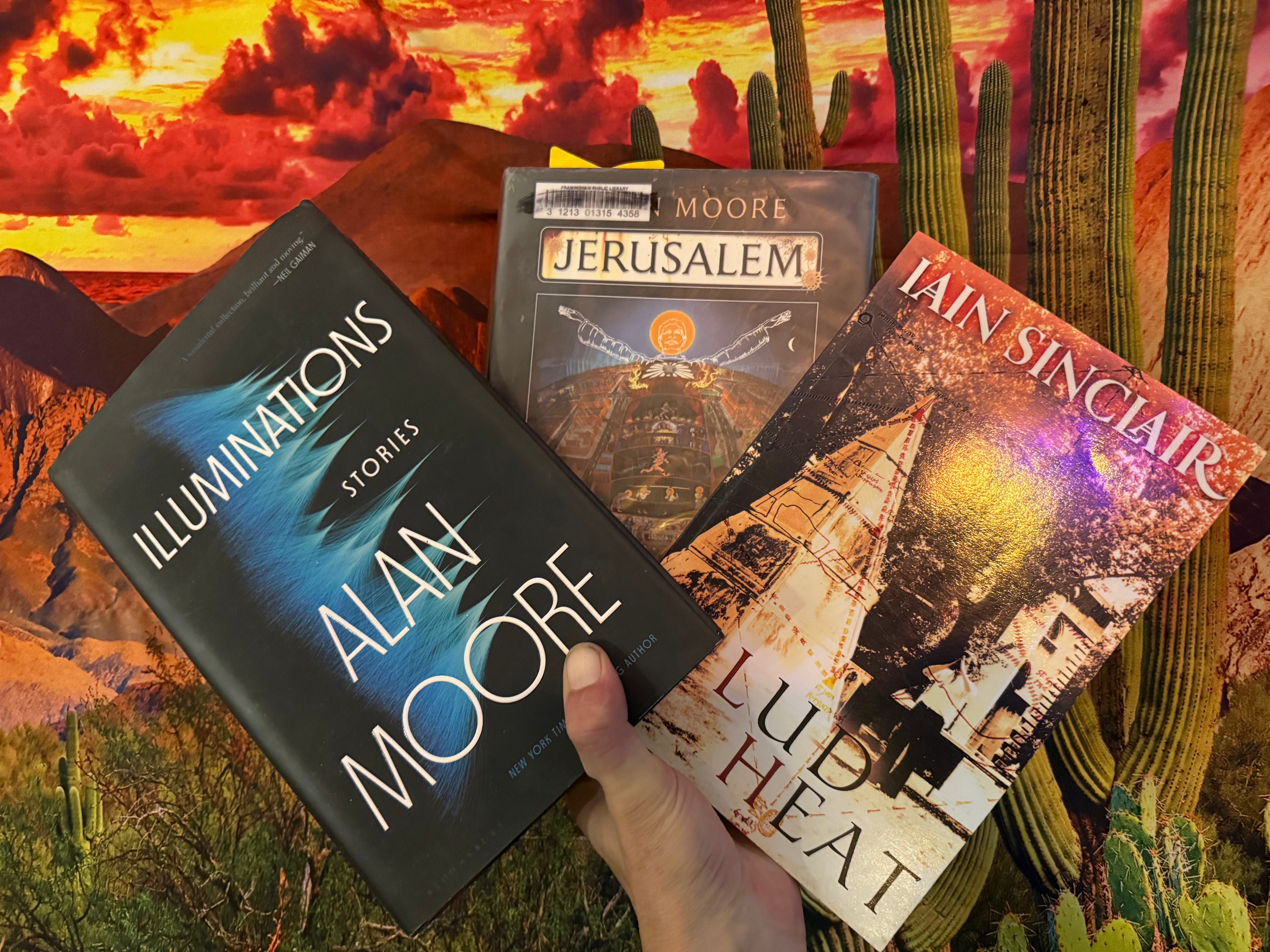
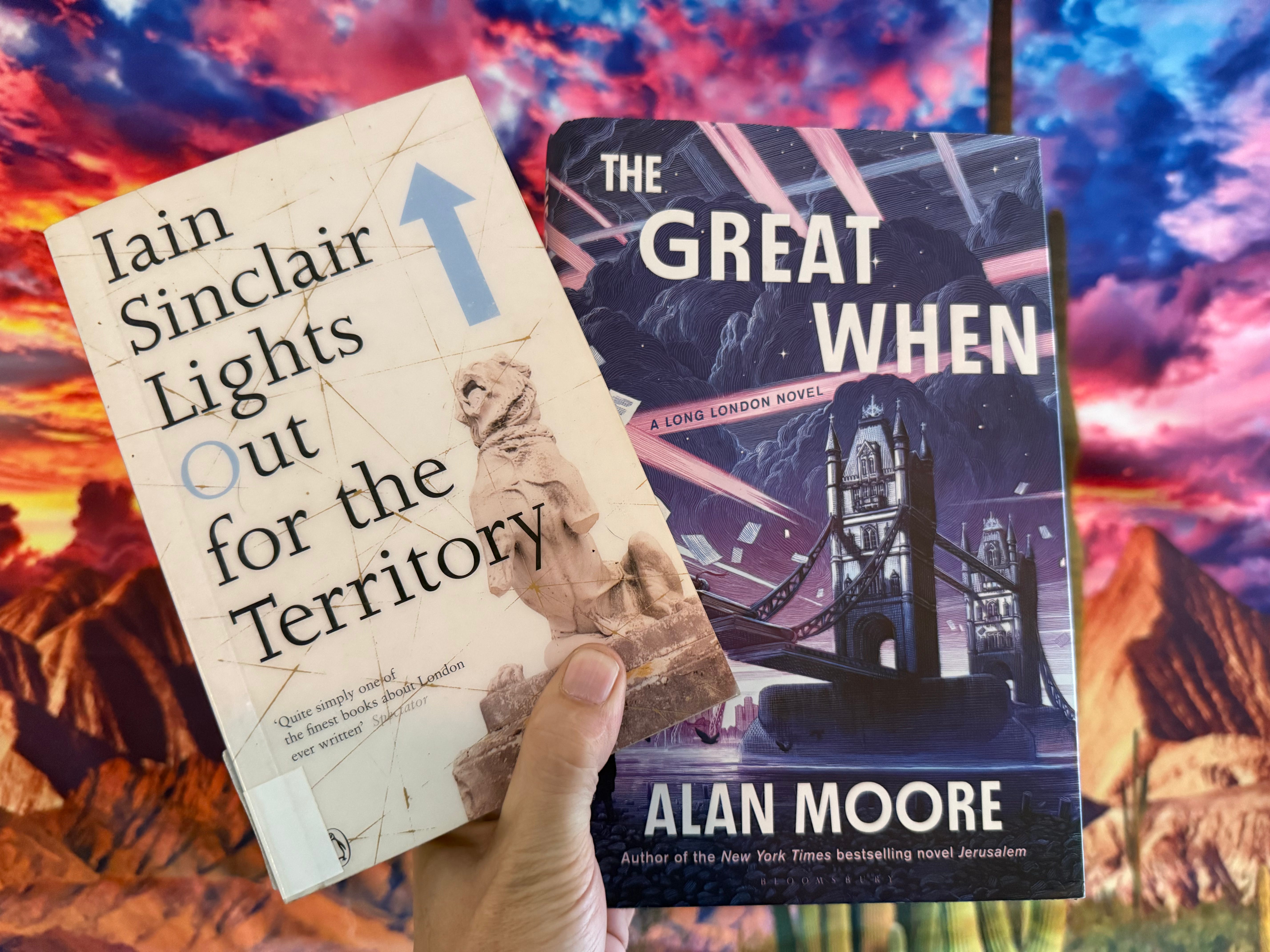
Sinclair’s Lud Heat is the origin of his approach and it’s a must-buy. Reading it gave me the same reaction as when I read Illuminations: “oh my God, I need to read all of his books.” His more mature form of it is 1997’s Lights Out for the Territory which I’m exploring now. His 1987 novel White Chappell, Scarlet Tracings on the Jack the Ripper murders, directly inspired Moore’s own From Hell which employed the same approach, except adapting to the comics medium. Moore’s epic novel Jerusalem is then this concept stretched beyond absurdity into 1200 pages of Northampton across time and space. This is what we should aspire to as writers.
15. Make Your Conclusion a Mirror of Your Beginning.
“This is something that I have less experience of, although I did write a projected five-season television series which will almost certainly never be made. It did, however, give me some idea how you should lay these things out. Foremost was that I knew the ending before I started - what the last shot in the last episode of the last season was going to be.
I cannot underline how important this is. I have given up on boxsets where it becomes apparent that the writers are making it up as they go along. The shapeless narrative drift is a terrible experience for both the writer and for the viewer, having invested hours watching to discover that there wasn’t any meaningful ending. It is important in any medium to know your ending first, but in something as long form as television it is vital.”
This is a regular principle that Moore discusses and you see across his works. The most memorable and impactful is the smiley face with the red blood drop in Watchmen. Moore positions it as both opening and closing with the symbolic meaning of it shifting from start to finish.
I now more consciously try to to do that when writing articles. That whatever concept I may use to open a piece, I’ll intend for that to be returned to at the end again, now taking on a new meaning.
16. Avoid Falling Into a “Golden Rut” Through Perpetual Innovation.
“One way that this death can occur, is the ‘golden rut’ that can afflict successful writers who have found a winning formula and then, effectively, choose to repeat it forever. This will probably lead to diminishing returns for the readership, but enough readers will want the same comforting book to maintain the author’s career. However, their writing will stagnate. All of those other books that they might have written will never exist. I think it is a big mistake to rest upon your laurels, however tempting it is.
A tactic I have found most useful is to immediately drop a device as soon as you become aware you have used it before. This means that you will have to go the trouble of coming up with new devices for every story, which is a tremendous amount of work, but you will be progressing.”
This is a spiked pill to swallow: we cannot simply find our magic winning formula for writing and then repeat it for the rest of our lives. What may work for one book may not again for another and the result of regular repeats will simply be a stale taste for the reader. We have to keep pushing and innovating and trying new things.
And right now that new thing, I’m sorry to say, seems to be livestreaming. How we as writers will adapt this emerging medium is an open question but one that I’ve begun exploring, reluctantly.
17. Apply Avant Garde Literary Techniques and Postmodernist Methods with Precision.
“The work needs to move forward as well as the individual as a writer. You need to have a progressive edge to writing that is constantly progressing. There has been a fairly comprehensive failure by most of the avant-garde to engage readers because much of the material is deliberately dissonant. However, I believe there are ways to use avant-garde techniques that will greatly enrich a story without turning the audience away in droves.
It is necessary to have a progressive attitude to writing because the rate of change is accelerating. I believe that in the present day, we will have more information in the next year than has existed in the whole of previous human history. The world around us is changing all the time so it is important for you as a writer to stay on top of that, and continue to move forward in your thinking and writing if you wish to survive the evolutionary changes that are already upon us.”
Much of Moore’s success is that in as much as he innovates and challenges, he still strives to provide engaging narratives and characters for his readers.
This is part of the balancing of the four magical elements again.
18. Embrace Virginia Woolf, Mrs. Dalloway, and the original Modernist Stream of Consciousness Technique.
“Another example would be Virginia Woolf’s Mrs Dalloway, in which she introduced the ‘stream of consciousness’ writing technique. This is where you are inside a character’s head, pursuing thought followed by thought. It is a very compelling rush of experience that, since Virginia Woolf, has been used by everybody from the Beat writers to the cyberpunks. It is now a technique at the centre of literature and is there for any writer to employ whenever they wish.”
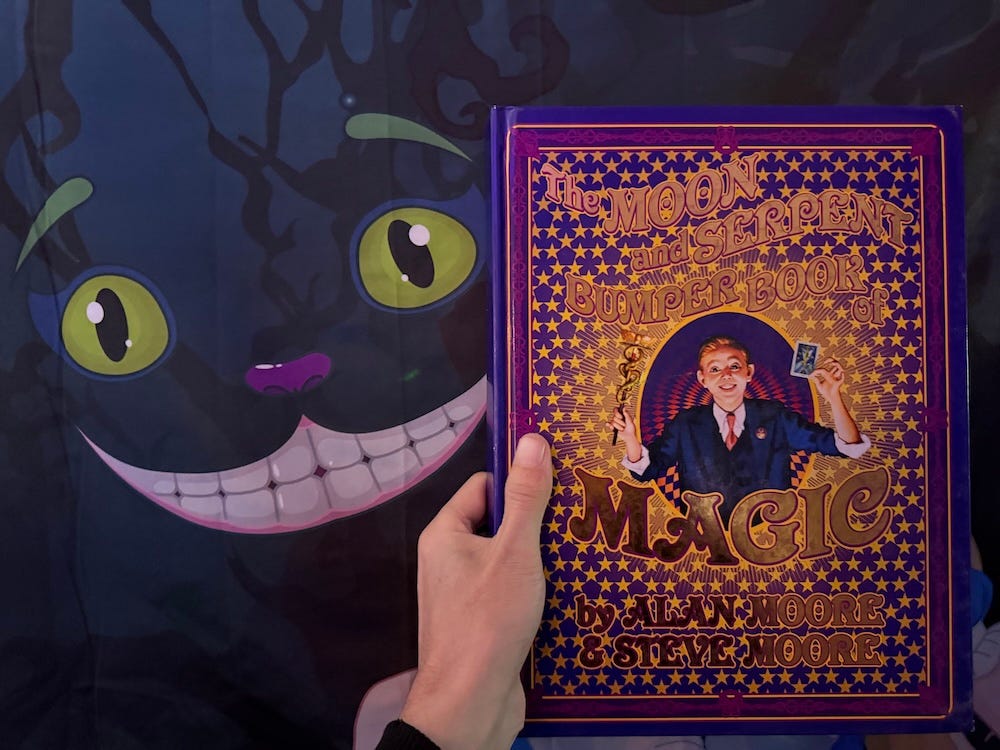
Woolf really is foundational in 20th century literary culture and method. And Moore is her heir today. This becomes particularly apparent to those who read The Moon and Serpent Bumper Book of Magic, where one of the interlaced narratives in the book is set in the 1920s, features Woolf as a character, and its prose reads as a warm homage of her Modernist style. Yes, you should get to the point where, like Moore, you know Woolf so well that you can satirize her. I’m not there yet.
19. Make Your Work Intentionally Difficult Even if It Alientes Your Audience and Shrinks Your Readership.
“This is an idea I only heard about relatively recently, which I had been practising for most of my career. In writing Voice of the Fire, I wrote the first chapter in an impenetrable invented Neolithic language and many readers would have been put off. This is the idea of literary difficulty, whereby a writer uses a technique that she knows will reduce her audience, but will force those readers who remain to engage with the work on a deeper, more satisfying level.”
This is a hard one for many readers to take and not for others:
Be willing to lose readers.
A writer should not try and write for “everyone.” The result is then plain oatmeal. We as writers can choose our audiences by what and how we write. And it’s OK to self-select for a smaller, more passionate audience, than a broader, generic audience. Today, the former is generally regarded as the smarter strategy for a media company, the so-called “1000-True Fans” formula.
20. Embrace David Foster Wallace, Infinite Jest, and Force Your Reader to Engage With Your Writing on Your Own Unique Terms
“One of my favourite discoveries, one that many people had made long before me, is the writer David Foster Wallace, author of Infinite Jest. Wallace likes to take a basic institution, in this case a sports college training tennis players, but makes it represent the whole of society. The beauty of his work is his perverse sense of humour in the way that he relates with his readers. There are numerous footnotes, so you have to flip to the back of the book where the footnotes are there in order. Many people will miss this out, but you miss an awful lot of the narrative if you do so. At around page 400, I came to a character using a very unusual turn of phrase, so I turned to the footnote, which read, ‘No clue.’ I realised at that point that David Foster Wallace was, in fact, trying to annoy me and at that point I was in on the joke and really enjoyed it. He’s employing literary difficulty to make the novel a challenge for the average reader, but that forces the reader to engage with the novel in a different way. All of David Foster Wallace’s work is fascinating and a suitably enquiring and progressive writer will find much of value there.”
I — like many — own an unfinished copy of Infinite Jest. The thick paperback has journeyed with me for decades now, always with a plan of “oh, I’ll get back to this eventually, maybe.”
I suppose it’s time. Because now I’ve got a different mentality in mind with books:
Being difficult is the point.
If a book is hard to read or difficult to understand, that’s not a reason to skip it. That’s a reason to take your time with it instead of trying to rush through.
There is no points system in life for the number of books one can read or the speed with which one can read them.
21. Embrace William S. Burroughs and Inject an Element of Randomness.
“I remember the first time that I read the writings of William Burroughs, the Beat writer who famously pioneered the cut-up technique. This is where you cut texts up and then put them together mismatched so that you get these accidental sentences emerging with completely exotic uses of words and grammar that can be very striking. Some of them will be junk, but the joy is in the selecting. The first time I read it I found it completely alienating, but I slowly started to see the poetry in it and how one might add a random element to storytelling.”
One of the perpetual enigmas and singular creativs of 20th century literature is William S. Burroughs, the infamous junky outlaw author of Naked Lunch. His method of cutting up texts to produce jumbled, poetic expressions can often alienate readers. That’s part of the intent. People struggle with randomness. Hence why small elements of it can aid in the creative process when applied with precision. They throw off the reader’s expectations, which in turn replicates real world experience.
22. Write in Silence
“Unlike some writers, I cannot go and sit in a coffee shop to create. I need complete silence and no interruptions, which leads to a condition of pretty much permanent isolation. In fact, when lockdown started, I thought that if the virus was created in a lab, it would have been by a writer. Lockdown is normal for writers like me. Never seeing your friends, never going out, hearing from people over the phone intermittently, being in a room on your own in complete silence – this is our existence.
That brings me on to writing to music. I used to enjoy listening to music when I was a cartoonist but that’s a different thing entirely. Cartooning can be done by some sort of vestigial brain that you have in your wrists. I used to listen to the John Peel show and it wouldn’t affect my cartooning at all. Once you start writing, that all changes. I realised that I couldn’t listen to anything with lyrics because it would interfere with the words that I was trying to write. I moved on to purely instrumental pieces but was halfway through an album by John McLaughlin when the music was interfering with the rhythms that I was trying to write in. Listening to ambient music lasted a couple of months before I realised that was affecting the atmospheres I was creating. Some of my comic strips from that period feature huge captions focused on the way things sound, all because I was listening to a lot of Brian Eno and Harold Budd. Eventually I gave in to the silence.”
The other day I went to Home Depot and bought a pair of these noise-cancelling ear muffs for $10. They’re awesome:
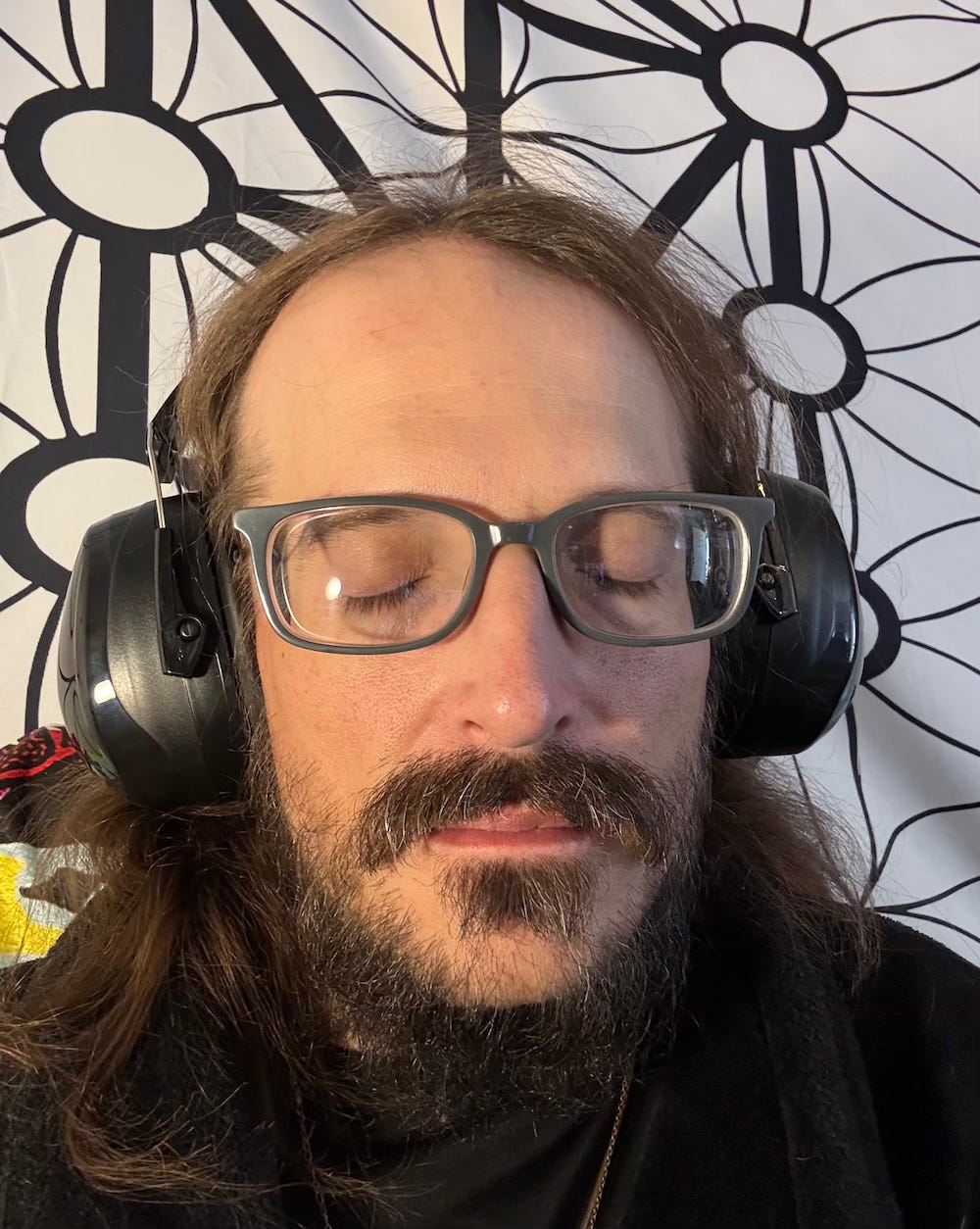
Sometimes I won’t just put them on for writing, but just leave them on while walking around the apartment for hours.
23. Know and Write From Your Moral Foundation
“The foremost and most important instrument in a writer’s toolkit is the writer herself. To develop as a writer will almost certainly entail developing as a person. It will be necessary to acquire a properly thought-through moral standpoint, and perhaps an equally well-reasoned political position from which to observe and weigh the world that is being written about.
I am not saying that those should be left-wing, right-wing or (my own personal preference) an anarchist opinion. The important thing is to have a moral or political platform from which to look at the world and hopefully understand it. One whereby you can employ compassion and empathy to look at someone who has ideas that are completely foreign to your own and yet perhaps understand why they have them.
Understand that you yourself, brought up in slightly different circumstances, may have had exactly those ideas. And be flexible because the ground will inevitably change underneath you, politically and morally.”
And perhaps here is the foundation finally where the writer’s real power and clarity lies: through seeing the world from a moral position.
If the writer cannot make any sense of right and wrong for themselves, then how could they ever figure out those problems for their characters?
At the center of the creative, literary, journalistic, media experience are those two words: Compassion and Empathy.
When we tell stories about other people, even terrible people who do horrible things, we are innately engaging in compassion and empathy. We are creating a medium through which human beings can come to understand one another and feel each other’s subjective experience.
And in pursuing that goal, of using our art and our words to bridge the distance between human minds divided across time, borders, and cultures, too much is never enough.