

Publisher’s Note: This is another experimental essay written in the Alan Moore Maximalist Mode of intentionally a much longer, layered, discursive, baroque, and absurd style than is necessary or justifiable by any sane human being. Just fair warning that labyrinths are built for the enjoyment of those foolish enough to wander inside, not their annoyance. I’m killing the “kill your darlings” cliche and invite others to do so also. Ernest Hemingway is dead and let him rot. We have infinite space and have no idea whether a reader glances over for 10 seconds or three hours. Write what thou wilt shall be the whole of the law.
In the twenty-first century, minimalism is out, maximalism is in. Postmodernism is out, Meta-modernism is in. Be not afraid, this will be much more fun.
“So save your prayers / For when we’re really gonna need them / Throw out your cares and fly / Wanna go for a ride?” - Billy Corgan, the Smashing Pumpkins, in “Zero”
One of my favorite writers on Substack published a real knockout piece this morning and I urge everyone to give it a read and him a subscribe:

Reading Ed Latimore this year — I included him in last month’s round-up of my picks for the 75 Substacks who have most impressed so far in 2026 — I thought he surely had at least 5-10 years on me. Nope. Turns out he’s actually a year younger:
Ed liked the comment and responded:
Why did I think Ed was a Gen-Xer instead of a millennial?
Because when you learn about Ed’s life then you see that he’s lived more, suffered more, and achieved more than most millennials. He’s lived a life more like an Xer than a millennial:
Raised by a single mom, Ed rose from poverty in the ghetto to transform himself into a boxing champion, to enlist in the army, to earn a physics degree, to teach high school students, to tutor teenagers in the subjects he once failed in, to become a father, to write a book, to launch a successful podcast, and to provide us with thoughtful, motivating Substack reflections on Notes.
I’m usually not a fan of the type of motivational, self-help style since so many people do it so poorly and inauthentically. It’s rare to find writers like Ed who can pull it off with conviction and consitent quality:
Ed’s key lesson here is the one listed as number one in the third note above. It’s so important that I’m going to ask Copilot to turn it into a quote meme he can use:
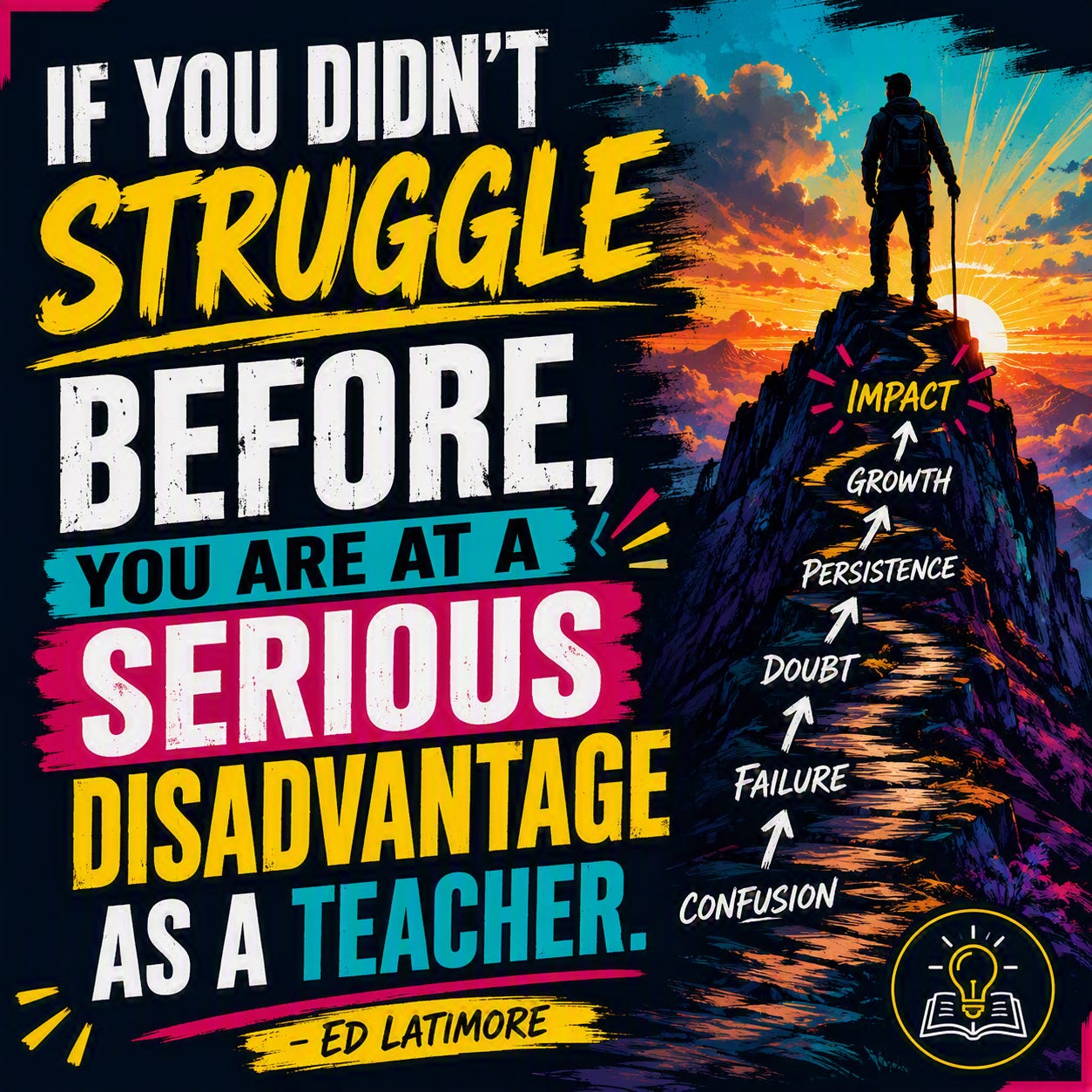
Ed frames this point in the context of his work as a teacher of both physics and boxing, arguing that teachers who have struggled to learn in a subject rather than immediately grasping it will know how help their students better.
“But if your path there wasn’t rocky, uncertain, and required a fair amount of catch-up at some point, you’re gonna have trouble breaking down beginners’ mistakes,” Ed wrote July 30 on Substack Notes.
However, this principle goes well beyond the classroom and applies to life more broadly: we must suffer if we are to gain the wisdom to help others.
Those who live comfortable lives without deep dosages of both physical and pyschological pain usually fail to understand most of the human experience, just like how those who only swim on the surface do not know what’s down there when you dare to dive into the cold sea.
The book of Ecclesiastes said it like this:

There is an uncomfortable relationship between the increase of wisdom and knowledge with the physical experiences of grief, suffering, poverty, violence, and fear.
For the mind to prepare itself to see the truth, the body must break first.
So what does this all have to do with my seemingly absurd belief that Ed and I are not really millennials?
Why do I say that we are not “elder millennials” and wince at the term as though Ed smacked me bare knuckle in the front of my skull?
Here’s the meme circulating around like a confused pigeon, which defines us apparently:
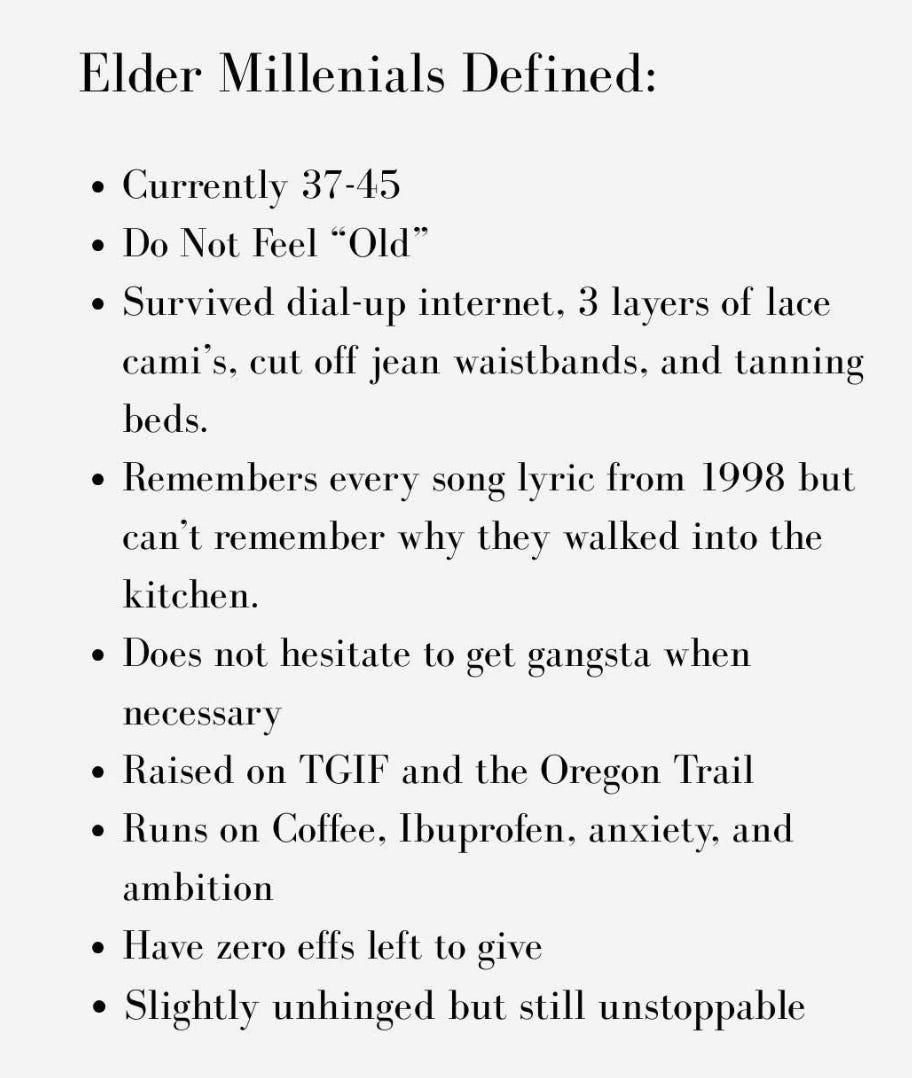
OK, then let’s “get gangsta” now. It’s necessary.
Here’s my case for why those of us born 1981-1987 should no longer see ourselves as meaningfully attached to the millennial generation.
It’s time to “shake it off,” as the millennials’ most celebrated and most shallow songwriter Taylor Swift popularized.
We are not Elder Millennials.
We are not Xennials.
We are Baby Xers.
Here’s why the dividing line is 1988 and what our cohort’s most destructive member, Mark Zuckerberg, had to do with it.
“Only God can judge me / Only God can judge me / Only God can judge me, only God…” - Tupac Shakur
When Tupac Shakur died at age 25 in Las Vegas on September 13, 1996, I was 12 years, 7 months, and 15 days old.
I don’t think I had any idea who he was.
But I would soon find out, because the next year Andrea — my ultra-cool Gen-X former babysitter next door who was about seven years older than me — would instruct me to purchase Tupac’s All Eyez on Me, because she assured me he was the greatest rapper and it was his best album.
It is now 30 years later. Andrea was right then and she’s still right today. Many extraordinary rappers have emerged since Tupac’s murder and created their own legendary work. But none have reached his level of singular artistic achievement and sustained cultural impact, as all of them would certainly admit themselves. I still haven’t found a rap album that really competes with All Eyez on Me.
In my view, the only other Gen-X musician at a comparable level of singular creative genius as Tupac is Billy Corgan.
While the standard narrative is to cite Nirvana’s Nevermind in 1991 as the defining and most influential rock album of the era with Kurt Cobain as the generation’s icon, looking back now, I’d argue that the Smashing Pumpkins and 1995’s Mellon Collie and the Infinite Sadness deserve the title instead. Corgan has conquered.
The reason is simple and a form of infinite sadness most Xers probably don’t want to talk about: Nirvana eventually grows old and withers away into the wind. You do mature out of it. How many times can you listen to “Smells Like Teen Spirit” before it starts to seem as silly as Weird Al’s parody? Even Cobain ended up getting sick of it!
Meanwhile, the Smashing Pumpkins’ work remains engaging and artistically rich because it’s simply better music. Corgan was both a stronger songwriter and performer than Cobain. He provides richer thematic and emotional range. Would Cobain have evolved as an artist if he had not chosen to to kill himself?
It’s certainly possible. But I suspect it’s more likely that Nirvana would have gone the way of any other band. Maybe they would have broken up after just those first few albums and then Dave Grohl would have gone on to do an awesome arena rock band like what Foo Fighters has become.
“What if I say I'm not like the others? / What if I say I'm not just another one of your plays? / You're the pretender / What if I say I will never surrender?” - Dave Grohl
All of this to say, those of us born in the first half of the 1980s took in a heavy dose of Gen-X culture. Perhaps one could say an overdose. I grew up in the 1990s looking up to my super-cool babysitter Andrea and then taking in Gen-X’s music, edgy books, and wild independent films.
At the same time as Gen-Xers would redefine music in the 1990s, they would also do so with film:
And the climax in 2000, the film that reached this movement’s zenith, culturally defined my young adulthood, and set the standard for what I would pursue with art to this day:
My collective cultural experience of growing up in the 1990s in the shadow of Generation-X’s cultural influence in music, film, and broader attitude is simply this:
Tell the fucking truth.
No more of this baby boomer bullshit like what I grew up on as a child in the 1980s, like this monstrosity which came out a few months after I was born, in May 1984:
And who has this one etched into their brain from childhood too?
And seriously, if I ever had to hear this goddamn “Hip to Be Square” song again then I hope someone comes and smacks me in the face with the businesman’s side of an axe:
This had to be done, the song had to be revealed as the true muderous atrocity that it is:
Growing up as an adolescent in the 1990s meant learning that telling the truth in a bold, uncompromising way was a virtue and a necessary corrective to the 1980s baby boomer culture of bullshit.
To be cool in the 1990s and in Generation X culture meant to TELL THE FUCKING TRUTH.
But not all of us learned this lesson.
Mark Zuckerberg did not.
He was too busy coding, hacking, and stealing to learn the lessons that come from Tupac’s albums and Darren Aronofsky’s films.
I’ve come to the conclusion that the most important decision Zuck made about Facebook in 2006 is what really caused the final division between Generation X and the millennials.
It was originally called “The Facebook.”
And its original purpose was to help college students have sex with each other.
That was the real purpose of Facebook.
It wasn’t to just connect with your friends and put up a little page defining you.
It was so you can make connections to set up dates in the real world.
My first marriage happened because in 2005 my future-first-wife “Facebook stalked” me after seeing me give a talk in her English class about the website I had made to host links to the columns I’d written for the school newspaper. She reached out to me, and little did I know that over a decade of marriage would result.
How many marriages happened and how many children were born because of the launch of Facebook into the college ecosystem in 2004?
When Facebook began, you needed your college’s .edu email address in order to create an account and connect with your campus’s network.
The result of this is that these were genuinely social networks. The people on the site were the actual people you would see in the geographic location where you lived. The purpose of the site was to faciliate real-world activities, not to be a place where people build their lives and make money.
The only people who knew this experience of Facebook were those of us at college in 2004, 2005, and the first half of 2006.
Zuckerberg decided in September of 2006 to open up Facebook to anyone age 13 and older with a valid email address.
This changed the platform in five obvious ways:
Now high schoolers could join.
Now your parents could join.
Now some anonymous misogynist or scammer on the other side of the world could join to prey on people.
Now a site meant to facilitate real world connections with people you know, would instead facilitate connections all around the world with strangers and people who were often unknown.
Now Zuckerberg began to see that his big money billionaire opportunity was not in building a social network to connect people wanting to go out and do things in the real world, but creating a website to hold people on as long as possible to serve them as many ads as possible. In November 2007, Zuck would launch Facebook Ads and Facebook Pages for businesses. The gold rush had begun and he was the internet’s Al Swearengen now playing the pimp and offering up his users to advertisers like the women working the backrooms of the Gem saloon.
So now, a website launched to help college students get laid, was being transformed into a billion-dollar corportion with hundreds — soon thousands — of employees which would do its job so effectively to emotionally manipulate its users that the next generation would end up wanting to have less sex rather than more.
The Facebook experience which those of us in college in 2006 knew for three years, disappeared for the younger generation of millennials who were still in high school, only to be replaced by something insidious and harmful, especially when Instagram emerged too.
And we can know the exact dividing line: 1988. Those born in that year could still be in college that year, while those born in 1989 could not. Those starting college in 2006 did not have Facebook in high school. Those younger did.
The stereotype about millennials is that they are the “social media” generation, that they just grew up with Facebook as an ever-part of their lives and it shaped how they saw themselves and their whole existence.
But that’s really only the case for the millennials who were still in high school after 2006. And further, what they experienced, we now understand was not really social media, but algorithmic media.
The original social media that we experienced in college 2004-2006, was genuinely social media. The people you knew on there you knew in real life and the website helped faciliate you with connecting with people in real life.
Starting in 2007, the purpose of Facebook shifted to serving ads to people based on mining their data. Zuck realized that the private information people provided to the website could be monetized in order to emotionally manipulate them. This created the most effective advertising platform in human history. Now adertisers could target the exact typs of people they wanted.
And so began the great race to the bottom which we now all know so well and that has produed our algorithimic media President Donald John Trump and his collection of ICE concentration camps.
For those of us who graduated high school before 2006, our social reality was never formed through algorithims designed to emotionally manipulate us into seeing more advertisements.
That was not the case with the group I’ve come to refer to in recent years as “the pure-blood millennials,” in reference to their beloved holy text, Harry Potter.
Us so-called “elder millennials” of the 1980s have known for a long time that the millennials born in the 1990s are distinctly different from us and that they’re the ones who are much more likely to embody the various millennial stereotypes that started circulating about 15 years ago when we were first emerging into the workplace.
They are the “pure” millennials — like how in the Harry Potter universe the villains think they’re better because of their supposed magical blood uncontaminated with non-magical “muggles” — whereas those of us born in the 1980s blend with the Xers the earlier we were born. We’re “mud-bloods,” apparently.
The Millennial stereotypes are well-established at this point and “Family Guy” hit them surprisingly well:
Millennial Stereotype: First, I’d like to not thank you for hiring me because I just expect good things to happen to me without working for them. Second I'd like to give you all a list of my trigger warnings
Co-worker: What's a trigger warning?
Millennial Stereotype: Actually bruh, asking me what a trigger warning is is one of my triggers, bruh. I feel traumatized bruh and now I'm tweeting about you bruh and now you're trending bruh and now your life is ruined bruh and now you're fired bruh.
The millennials who exploded into the popular imagination during the 2010s were weak and fragile as fuck.
The trigger warnings, the safe spaces, the cancel culture — that all really began not with those of us born in the 1980s, but the millennials born in the 1990s.
During the 2010s, when Xer satirists like Seth MacFarlane would mock millennials, those of us in the elder cohort wouldn’t get insulted, we’d laugh, know exactly who they were talking about, and then come up with ways to distinguish ourselves from our younger siblings and peers, such as with the whole “elder millennial” differential, or what I’ve advocated more recently, Xennials, which I laid out as all 1980s-born millennials and the younger Xers:

And the reason should be apparent.
When you’re a teenager in the 1990s and pick Tupac Shakur, Billy Corgan, Samuel L. Jackson, Keanu Reeves, and Tyler Durden as your fantasy models of masculinity then you don’t need a safe space.
When you’re a teenager in the 2000s and pick Harry Potter, Ron Weasley, Neville Longbottom, and Draco Malfoy then you sure as fuck do.
One of the games the pureblood millennials like to play is to ask “which Hogwarts house are you in?” Are you Gryffindor, Ravenclaw, Hufflepuff, or Slytherin?
I’ve come up with the perfect answer to this that all of us Baby Xers should now embrace:
I never read the Harry Potter books. I was too old for them. My millennial brother (born 1990) and sister (born 1993) received them for Christmas. I still remember vividly the Christmas my brother unwrapped the first one. But I was too old at that point and interested in the edgy Xer books instead. I kept saying that I would eventually get around to reading them when it came time to focus on a fantasy project. But a quarter century later, that day has yet to arrive. Maybe it will eventually.
I do respect the films, though. The whole Harry Potter series of movies is excellent.
But for me, I watched them through the lens of a film critic. When the first emerged in 2001, I was a senior in high school writing film reviews for the Carmel High School HiLite, where I wrote about it in the paper. By the time the last emerged in 2011, I was working full time as an editor and would soon assign writers to draft articles about the movies for the PJ Lifestyle blog I would shepherd over the first half of the 2010s.
In the years since, I’ve probably watched the whole series again at least four or even five or six times — not my idea, but when your spouse suggests the series as a binge-watch, then it’s not worth an argument. They really hold up as movies. And I’ve come to develop a lot of respect for Daniel Radcliffe, Rupert Grint, and Emma Watson as artists. The three of them really sacrificed a lot to carry those movies and those characters for so long and to still bear the weight of their influence on the millennial generation. And they’re genuinely very talented.
Thus, having pondered the Harry Potter series far more than I ever wished, I can say with confidence that the character I most embrace is the Sorting Hat. I even have one. My millennial sister who has made Harry Potter her religion even bought me one for Christmas one year.
The reason is simple:
I AM A JUDGMENTAL BASTARD. JUDGING OTHERS IS WHAT I DO. GO AHEAD AND JUDGE ME FOR IT. THAT WOULD MAKE SENSE, RIGHT?
Baby Xers, this is now what we have to do. We have to judge and speak the truth about what we see before our eyes.
It’s time to start saying it:
The millennials who grew up in sheltered, helicopter-parenting culture in the ‘00s and then experienced their teenage years’ socialization mediated through screens just ended up much weaker than those of us who experienced an analog upbringing and/or lived through some genuine hard times in poverty and/or violence.
Let’s conclude now where we began, with the awesomeness of Ed Latimore. Here’s a quote from the video above which he released yesterday as part of his Stoic Street Smarts podcast:
“Human beings need resistance.
We need physical resistance to develop strength.
We need intellectual resistance to develop intelligence.
We need emotional resistance to develop composure.
We need social resistance to develop confidence.
If you remove every obstacle, inconvenience, risk, and unpleasant emotion from a person’s life, you don’t create a permanently happy person.
You create a person who has no idea how to function in the face of even the mildest adversity.”
Of course, it needs to be said, that this tendency toward a life of weakness and fragility, in which algorithmic media defines someone’s existence, is not exclusive to the pure-blood millennials, Gen-Zers, and Gen-Alpha.
Ed and I could have ended up down the same well-trod path too if we had made different choices. There are plenty of people our age who are weak and fragile too, who have immersed themslves in too much internet, just as there are Xers and Boomers who also managed to experience lives with very minimal levels of suffering.
But there aren’t as many. And they’re dying off only to be replaced by a generation which cannot handle an adversity so mild as being stripped of their holy tablet while sitting in class.
We Are the Baby Xers.
We Are the Last Gasp of Twentieth Century Sanity
And so, my fellow so-called Xennials and Elder Millennials, I think the time has now come to cast ourselves off from our younger cohort and instead make our alliance with our Xer elders much more firm and overt.
Too many of those born after 1988 have fallen into the dark pools of algorithmic media, video game addiction, and infinite internet pornography, weakening their ability to function in the real world and to confront unpleasant truths.
Those of us who managed to learn twentieth century social skills and the Enlightenment tradition which built our nation must recognize that we’re now a dying breed.
If you were born in the 1980s and don’t feel like a millennial, you don’t have to be one. Reject the designation and flip it around.
It is now up to us to be the Xers telling the young ones they need to speak the truth, and prepare for the experience of violence, danger, crime, and poverty.
They must toughen the fuck up and learn to take the punches.
Maybe some will listen. Most will not. But a few will and then maybe they’ll save themselves.
“And you know you’re never sure / But you’re sure you could be right / If you held yourself up to the light.” - Billy Corgan
A deleterious result of Facebooking people seems to have also been the fragmenting of peoples' identities down into the smallest slivers of definitions and sub-definitions. As a slightly older GenX (1976) I grew up surrounded by a different ethos, which was that we're all one human family, don't label yourself because labels are limits, etc. Sorting people was "bad." Now we've got people who happily sort themselves into as many fragmented sub-cultures as you can imagine. Rather like how the explosion of different musical genres and varieties in the 70s and 80s destroyed Top 40 radio. You can't really have a top 40 off *all* music.
But Zuck handed everyone a Sorting Hat and people happily crammed that thing onto their heads. Meanwhile I'm so diligent about tracking cookies and surveillance that sites have no idea what kind of ads to serve me, so I get some unintentionally hilarious results.
This is some damn fine writing.