
The Surprising Way Removing Social Media From My Phone Shifted My Worldview
How to make your world taste different.

About a month ago I proclaimed my intent to remove the Substack app from my phone. It was the last vestige of algorithm-based, infinite scroll, emotional-manipulation distraction programming eating up attention like an anteater slurping its tongue into your ear, suctioning up every last bit of your will to remain a functioning human on this planet.
So what has happened since then?
Well, first, it's worth noting that I haven't given up social media entirely. I just treat it like email—a task to do for a bit while I'm at the laptop working, but not something that should snatch up my attention when I'm otherwise away from the desk.
And likewise, my phone still offers distractions—email, web surfing, and now, of course, ChatGPT, which has become my primary tool of choice for seemingly everything.
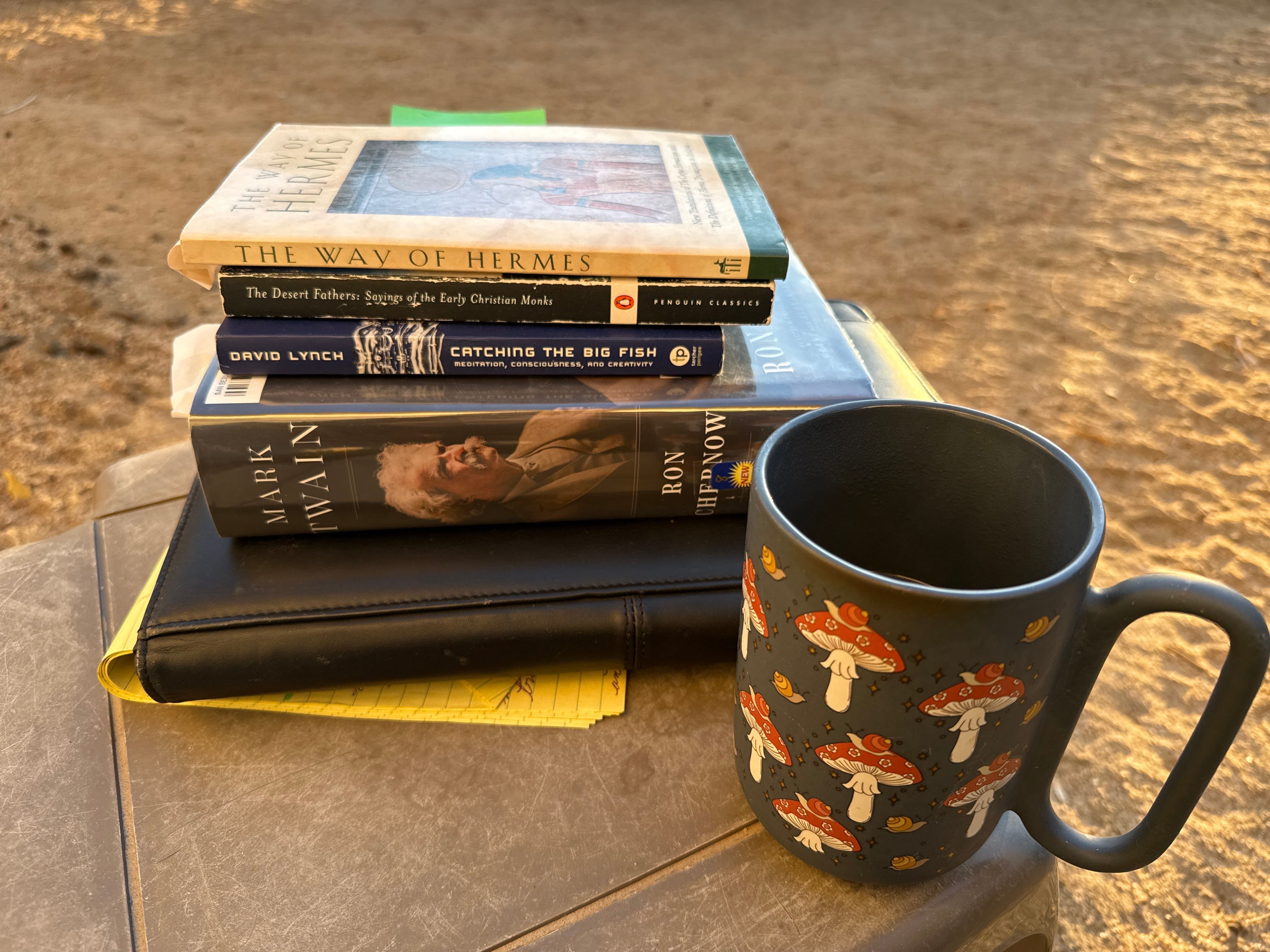
So it's not as though I've made an entirely clean break from social media. I've just cut it off from daily consciousness. Now it's the Mark Twain and Alan Moore books I gravitate toward.


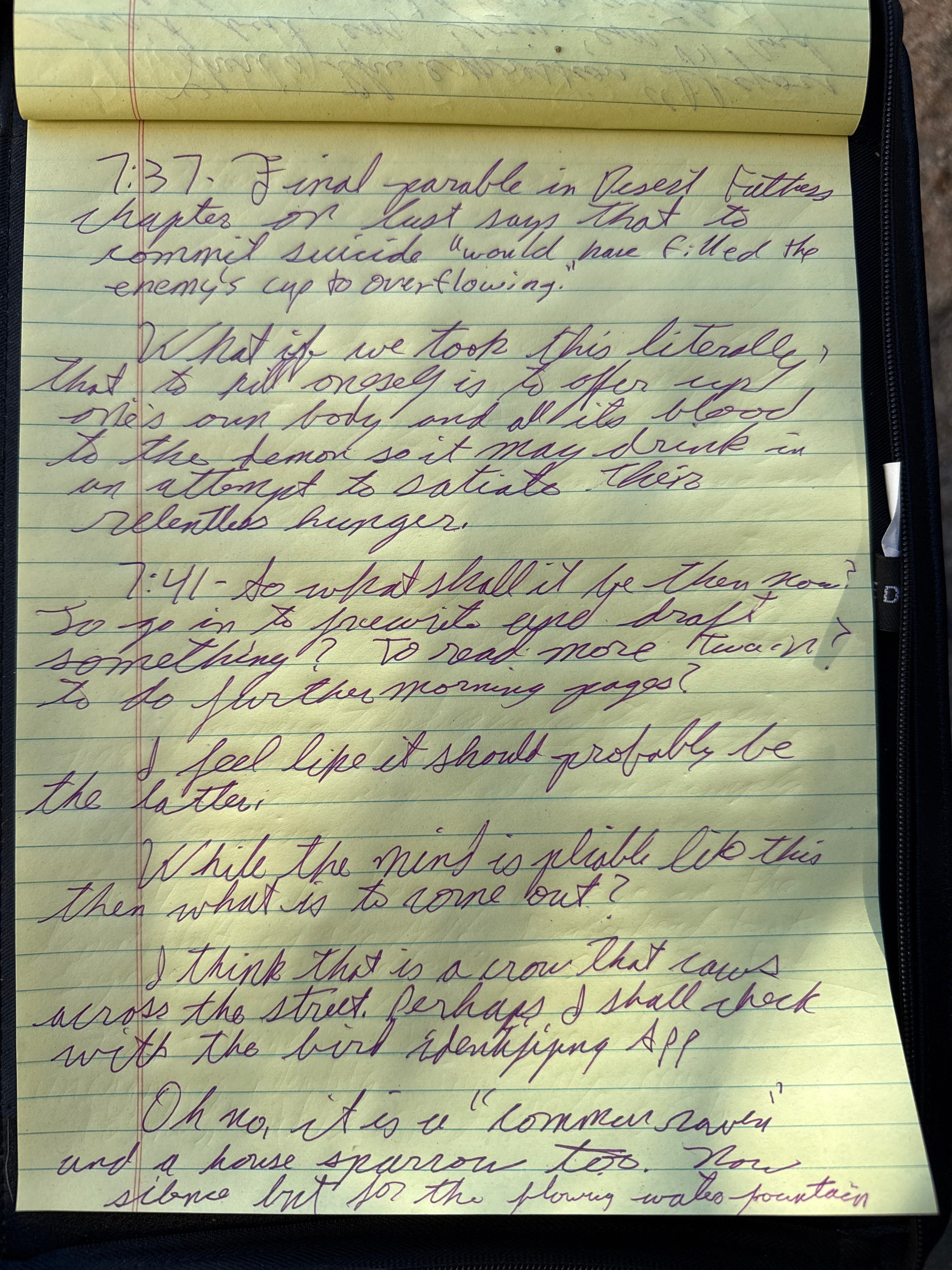
It's the yellow legal pads where I've started "free-writing" again each morning, synthesizing concepts from my regular morning readings of the “Corpus Hermetica,” “The Desert Fathers: Sayings of the Early Christian Monks,” and David Lynch's “Catching the Big Fish,” all three of which I'm reading together and scrutinizing closely.
After a few weeks of this, I started to notice something: When I did go onto social media, either Facebook, Substack Notes or LinkedIn (the only three which I use regularly), they suddenly seemed different. As in: even worse than I already knew they were.
Since I'd shifted my media diet toward classic literature and history books, I began using AI to help me make sense of them. I've developed the habit of taking a picture of a page, sometimes making a relevant note in my journal and then taking a photo of both, then dictating a question or observation of some sort. Often I'll ask it something specific to what I've been researching—the AI will already know what I'm looking to find and how I'm trying to study various subjects.
That's where my head's at now during the day: not in the Epstein saga or in some little debate with some anonymous idiot who is sure he understands politics better than those of us who have degrees in it, who have made our living studying and writing about it for the last 15 years. There is no benefit to choosing to live plugged in to the 24/7 news cycle at all times.
Why not take the same approach to the news as I'm advocating with social media? After all, the two are entirely entwined and interdependent today.
Remember how it used to be that you'd get the morning news in the morning newspaper at breakfast, and then in the evening you'd get 30 minutes of the local news, 30 minutes of the national news, and then if you wanted it, 30 minutes of entertainment news (Access Hollywood!), 30 minutes of crime and gossip news (A Current Affair!), or later, an hour of serious investigative journalism (20/20! Dateline! etc.)?
I feel like I'm shifting back now to that 1990s or even 1980s media diet: back to the way things were before cable news. When you checked in briefly, then unplugged and focused on better things that you could have some meaningful impact in improving, like what is going on right now where you live.
It's sort of the same phenomena as when you go with eating healthier foods for an extended period of time. For example, years ago my ex-wife and I tried that "Fat, Sick, and Nearly Dead" week-long juice fast routine. It was awesome, and it totally works. Everyone should try it—regardless of whether you need to lose weight—just to see that your body can do it and feel great consuming nothing but homemade fruit and vegetable juice for a week.
(Editor’s Note: The views expressed in this essay are the author's own and do not necessarily reflect the views of the publication in general. Editorial leadership points out that you have kidneys and a liver for “cleansing," and neither man nor woman should live on juice alone. -SSS)
After we finished the cleanse and had our first bit of fast food—a footlong job from Subway—it tasted like no sandwich I've ever had before or since. A standard sub that I'd had perhaps hundreds of times now tasted unbearably salty. Eventually they started tasting normal again as the "detox" wore off, and I became re-acclimated to normal, processed food.
But I've seen a similar thing happen with a less drastic diet change: simply moving away from eating as much meat, processed items, and fast food. Nowadays, when I do occasionally indulge in some Popeyes or have a burger after shifting to a more vegetarian-based diet, it's as though my digestive system revolts. "Hey! We thought you were done shoveling in this garbage! What gives? This time, you're going to regret it, buddy! It might have tasted great going down, but it's going to hurt like hell coming out!"
Nowadays, my reaction to some burgers ends up being so unpleasant that it's enough to dissuade me from eating them when the craving strikes. (Not always, though! Occasionally I do think to myself, "Well, maybe this one will be different. Maybe the last one was just too greasy ..." And then I have to learn the lesson the hard way again.)
I think it's safe to say that our media diets are much the same as our actual food diets. The more fruits and vegetables we take in, then the more noticeable it becomes when we taste the junk food. And the burgers of the mind just don't taste as good anymore.
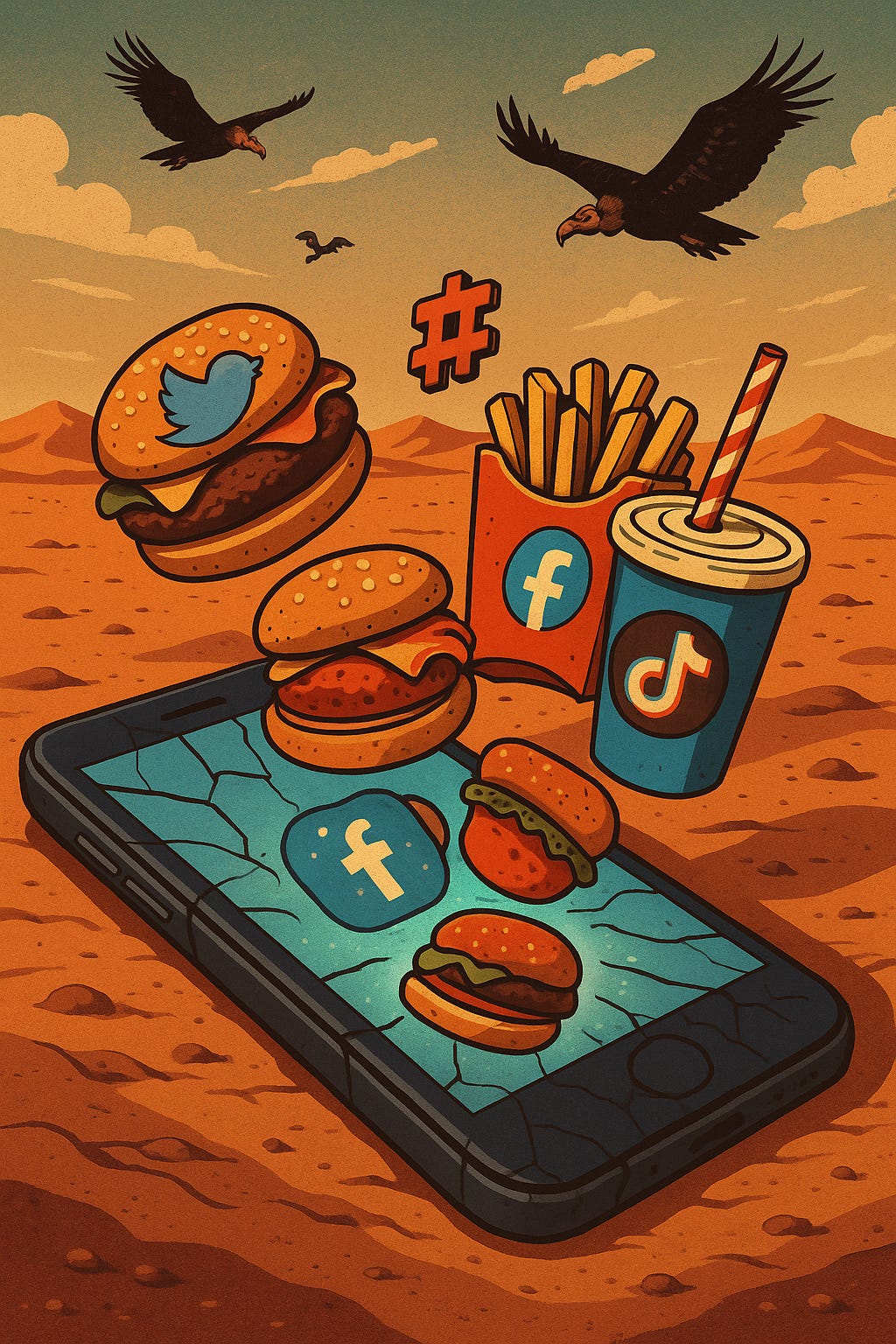
But now, this concept has gone a step further. Having grown more disgusted at social media-algorithm-based culture, I'm turned off by the political sphere built on it, too.
Politics seems even dumber now than it did just a month ago, because I can see with greater clarity how political and cultural leaders performing for an audience (not a constituency) drenched in social media addiction has also broadly degraded the culture.
Being plugged in with a smartphone keeping you alert to the evils of the world at all times changes your consciousness. It introduces a voice, the chants of the mob that called for Barabbas over Jesus. That's what social media is—the mass of faces, the legion of unmet desires and unreached aspirations.
And that is now what has been projected onto the heads of political, cultural, educational, and industrial leaders: a need to respond, perpetually and around the clock, to the twists of a hydra on a treadmill.
This need to move fast prevents deeper thought.
That's what I've grown so excited to rediscover more the last month: just focusing on pages of a book, focusing on writing by hand and letting the ideas flow and wander.
This is something old-fashioned now, and the idea has nearly been lost. But it's time to bring it back in a totally reinvented way. So here is what I'm advocating and encouraging everyone to try:
Remove any and all social media from your phone. Only engage with it during limited times on your laptop.
Go and get some big-ass books, like this “Autobiography of Mark Twain” that I'm obsessed with. Or how about “Ulysses” or “Jerusalem” or Paul Johnson's “A History of the Jews” or “A History of the American People?” Go big and go home—to read! And go for several big books at a time, so you can draw connections between them.
Write by hand. Do the Julia Cameron "Morning Pages" routine, where you force yourself to write three pages by hand first thing after you're up and moving. I've gotten into this discipline now, and it's amazing! It's like clearing out the cobwebs, knocking the gunk out of clogged pipes—and then by midway through the second page, or certainly by the third, you've now squeezed enough that the juice can drip out onto the page.
Photograph excerpts from what you read and your notes about it and feed it into ChatGPT. Create a specific project for your morning readings and pages and instruct it in the kind of analysis and feedback you're looking for.
Keep thinking more deeply. Try turning on the Advanced Voice mode of ChatGPT and having direct discussions with it about the books you're reading and the ideas you're exploring.
And then go have a real conversation with a real human being in a real place. Or, at the very least, look someone in the eye while you’re having a Zoom conversation, or listen carefully to every word they’re saying in that phone call you’ve been putting off too long, since we’re all just so endlessly “busy.”
Go deep. Think harder. Stop chasing retweets and efforts to "go viral." With AI, we should aim for greater quality in the work we do, instead of continuing this misguided pursuit of more quantity and speed.
This is the future that could potentially be coming. I think that gradually, more people may come to the same realization that I have—that social media, algorithms, even our phone-centric lifestyle no longer serve us well, and it's time to move on from them. The harm that comes from too much use of these technologies is too clearly demonstrated to ignore now.
This is very true and once we're plugged in, it can be difficult to get out of the numerous distractions that social media offers but it is very much possible too. 💯
Sometimes, taking a step back to disconnect and just observe does great wonders by offering us a clarity we couldn't possibly have found in the mess of today's social climate.
This is as good a place as any to suggest that if you do your own baking, don't use American flour. Use E.U. flour if you can get it (mostly French or Italian flour where we are).
Whatever it is about American flour—the hybridization, the pesticides, SOMETHING—it is noticeably harsher on your body. Often people who believe they are gluten-sensitive find that they can eat all the baked goods they want while traveling in Europe.
And yes, social media is poison that rewards addictive behavior and ragebait.