

I have written opinion articles for more than 25 years now. The newspaper op-ed: 700-800 words making a case in a creative or literary style of some sort, layering in arguments with relevant facts.
It’s always been one of my specialties: I started churning out op-eds in adolescence—since at least seventh grade. And with the invention of web-blogging software, it eventually become a career. I spent years writing political opinion articles day after day, assigning them to others, editing them one after another.
And so it made sense for this Substack publication—the homebase for readers of our books—to draw on both my experience in this medium and my now-instinctual ability to knock off a polemic before breakfast.
Provocative political opinion articles have been the default draw on offer here at Substack for years.
But I must now come to terms with what the last few weeks of diminished publishing from me has demonstrated:
I’m just running out of enthusiasm to continue with it.
I suppose we’re far enough away from Charlie Kirk’s murder that I can talk about the personal connection here without coming off too much like a narcissistic jackass. That’ll likely happen anyway, but so be it.
Kirk and I were both mentored by David Horowitz, the fire-breathing conservative opinion writer who also died earlier this year. We both owed the launch of our conservative-media careers to him, and he left distinct ideological and stylistic imprints on us both.
I never met Kirk and made no effort to work with him. Kirk and David connected after I’d already parted ways with the latter, and I did not care for the rhetoric and populist-nationalist, Trump-loyalist approach Kirk embraced over the years. Kirk would go on to espouse and promote a Christian Nationalist theology which is wildly at odds with my own syncretic mystical theology.
Kirk literally died doing something in imitation of our mentor.
It was through one of these “campus confrontations with conservatives” events that Horowitz and I first met face-to-face at Sally Shideler Swindle’s and my alma mater, Ball State University in Muncie, Indiana. It was in fall of 2006 and I can’t even bear to think about it, let alone write about it in depth now.
See, this was a kind of innovative thing to do 20 or 25 years ago: to be a tough-talking, unapologetic right-winger and march onto a left-friendly college campus, just itching to spout off against the left-wing orthodoxy dominating on campus. Get some “Campus Republicans” group to sponsor your talk and pay you an honorarium, and you can generate some easy publicity making a scene on campus.
Horowitz first figured out he could do this in the 1990s—that there was a market in being a right-wing campus troublemaker. He wrote multiple books about it, starting with 2001’s Uncivil Wars: The Controversy Over Reparations for Slavery, which detailed his first “campus campaign:” Horowitz inserted himself into little miniature campus controversies, first over a series of college newspaper advertisements he'd taken out, opposing reparations for slavery. The book documents how easy it was for Horowitz to generate controversy on campuses just by placing newspaper ads. He’d go on to build a career doing it, writing multiple books about it.
But as he was doing it, he was perpetually fishing for eager students to help him with it, whom he could mentor to one day carry the same torch, in one way or another. Stephen Miller was one, Ben Shapiro was another, then there was me, and then came Charlie Kirk.
And it was Kirk who would go full in on Horowitz’s campus crusade.
Turning Point USA became what Horowitz had wanted Students for Academic Freedom to be—a fighting conservative campus club made fully in his image.
When David and I first connected, I knew full well that what he was doing was dangerous: It was part of what made me admire him and want to work with him! I also knew, back in 2008, when David and I were becoming friends, soon to be colleagues, that it was entirely possible that he could get shot at one of his campus appearances. It seemed perfectly, terrifyingly plausible that some Islamist extremist or leftist radical could come to his event with a gun—and decide to use it. Actually, it seemed like it was only a matter of time, depending on how often David pushed his luck with it.
But eventually, he stopped doing so many appearances. And he became an even older man than he was when we first met. Showing up on campuses to hike around with a collapsible banquet table and leaflets in order to make clever arguments to undergraduates, really is a young man’s game, so Kirk became the new man for the job—and for all of David Horowitz's influence on him, Kirk made it his own.
And now this is the result.
Kirk decided to make Horowitz-style rhetoric against LGBTQ+ activists part of his media routine. With the same vigor and venom that Horowitz would talk about Black Panthers and ancient ‘60s New Left organizers, Kirk would now galvanize discussions about which bathrooms transgender people should be allowed to use. And now, it appears that the man who allegedly shot Kirk did so out of love for a trans person.
So Kirk was killed on a college campus while imitating Horowitz, reportedly because he chose to direct Horowitz-style rhetoric at a persecuted minority group.
It’s worth injecting here that much of the reason I went to work for Horowitz is because I had grown very concerned about the persecution of LGBTQ+ Muslims in the Middle East. When Horowitz started sending me copies of his books in 2008, he also sent me Robert Spencer’s Stealth Jihad, which set me on the course to working in the counter-Islamist field for the last 15 years. I saw Horowitz as this bold truth-teller who was willing to put his life on the line to speak out for LGBTQ+ Muslims being oppressed.
And now, one of his most famous and effective protegés, who bears some responsibility for Donald Trump’s re-election, has been murdered—ostensibly because of his anti-LGBTQ+ rhetoric.
And, oh! Something else that might be relevant in all this: I’m queer.
Quite a mess of pieces there, isn’t it? And that’s hardly even the beginning of it all …
Can you see why my enthusiasm for trying to write about all this and unpack it has just caused my brain to shut down?
Writing opinion articles and blog posts used to have such a clear, simple purpose: to try and persuade someone’s mind from one position to another. The news page sought to inform you of the facts; the opinion page sought to inform you of the arguments.
But that’s all gone now. People don’t read a printed newspaper while they eat breakfast. Everything is just an endless stream on their phones. They don’t pull up a plate of diverse arguments to engage intellectually, they pull up a partisan social media curation to simply affirm what they already believe. Where fact starts and opinion begins is anyone’s guess.
I don’t feel like it’s really worth my time to try and write these persuasive opinion pieces anymore. This is an old medium that no longer has the power it used to, back when it was just your article being printed on a piece of dead tree to then be distributed in the physical world.
So it’s time to shift. But … to what?
This morning I signed up with the new Sora app from OpenAI. As this spring’s relaunch of ChatGPT’s image generation feature was transformative, so too now are the new video generation abilities on offer here.
I’ve had enough for now with trying to write “provocative” political polemics and the hottest of hot takes to try and “draw in new readers.”
Sally may still give it a shot here and there. But through the rest of the year, you can look forward to a shift in my focus toward greater AI-powered video experimentations, here and at our imprint substacks Heroes of the Desert Books, Ghosts of the Desert Books, and Oasis of the Desert Books.
This is what the latest technology can now offer with the most minimal effort. We can all now “deepfake” ourselves. It’s amazing. The new Sora is going to take out TikTok, and the wild, fun thing: All of us who can write get to join in on this, because these videos can now be created in a few minutes, with just a few typed sentences:
Friends, I’m ready to move on now. This is more exciting and more fun than writing angry political blog posts for a 501(c)(3) nonprofit in order to scare people into donating to them.
We can all now make computer-animated films of ourselves and our friends with the tool in our pockets.
I need to focus on this now for a bit instead of writing yet another political “hot take” that won’t accomplish much.
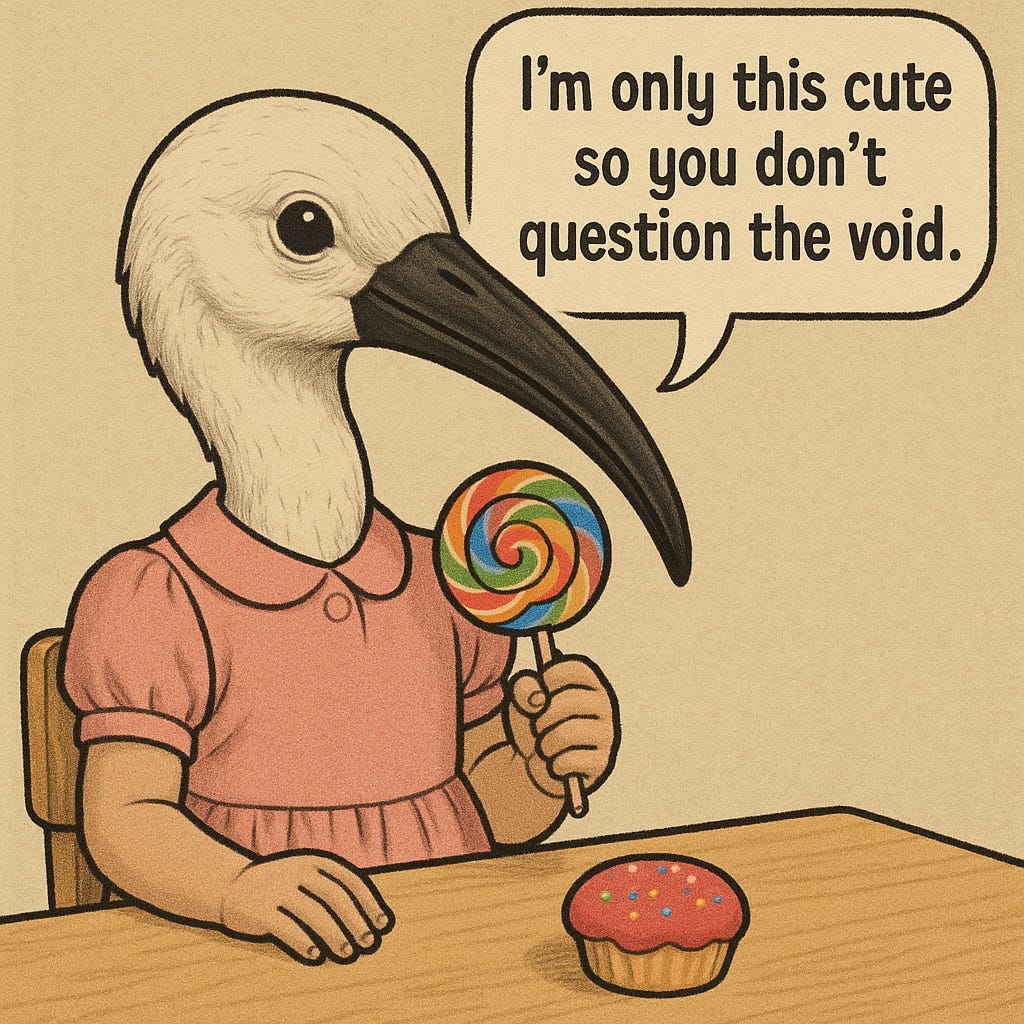
I’m holding on to hope for more articles…
It would be a sad day if long-form persuasive writing goes the way of the Sousa-style brass band march. I find it easier to deepen my thinking and develop new insight while writing than while speaking. But if no one is reading it, then my motivation is definitely less. Part of the motivation for spending the effort is to benefit or influence lots of people.
I would still write fiction and nonfiction even if I knew that no one else would ever read it, but nowhere near as much.