

Last month, in my satirical article “How I Persuaded Sam Altman to Shut Down Sora and Resign from OpenAI,” I opened by making some points meant entirely sincerely:
One cannot separate Paul McCartney’s billionaire-level musical success from his half a century of embracing the daily marijuana smoker lifestyle. The joy of his music since the 1960s has been fueled by weed, and fortune has followed.
I too attest to this lifestyle choice and affirm the creative energy that flows from it. I advocate this path for all: daily cannabis consumption. However, with a key caveat: at a responsible level.
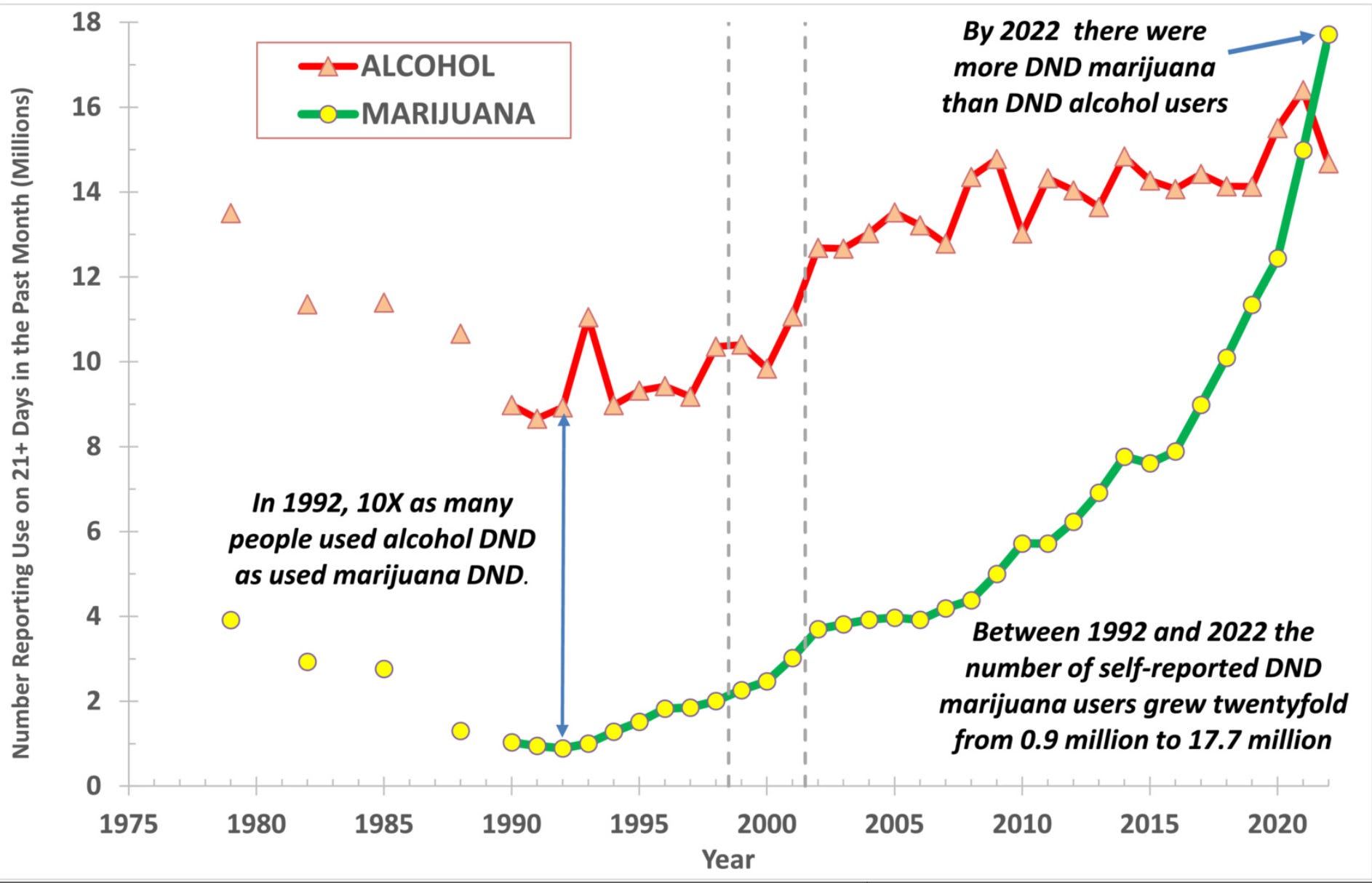
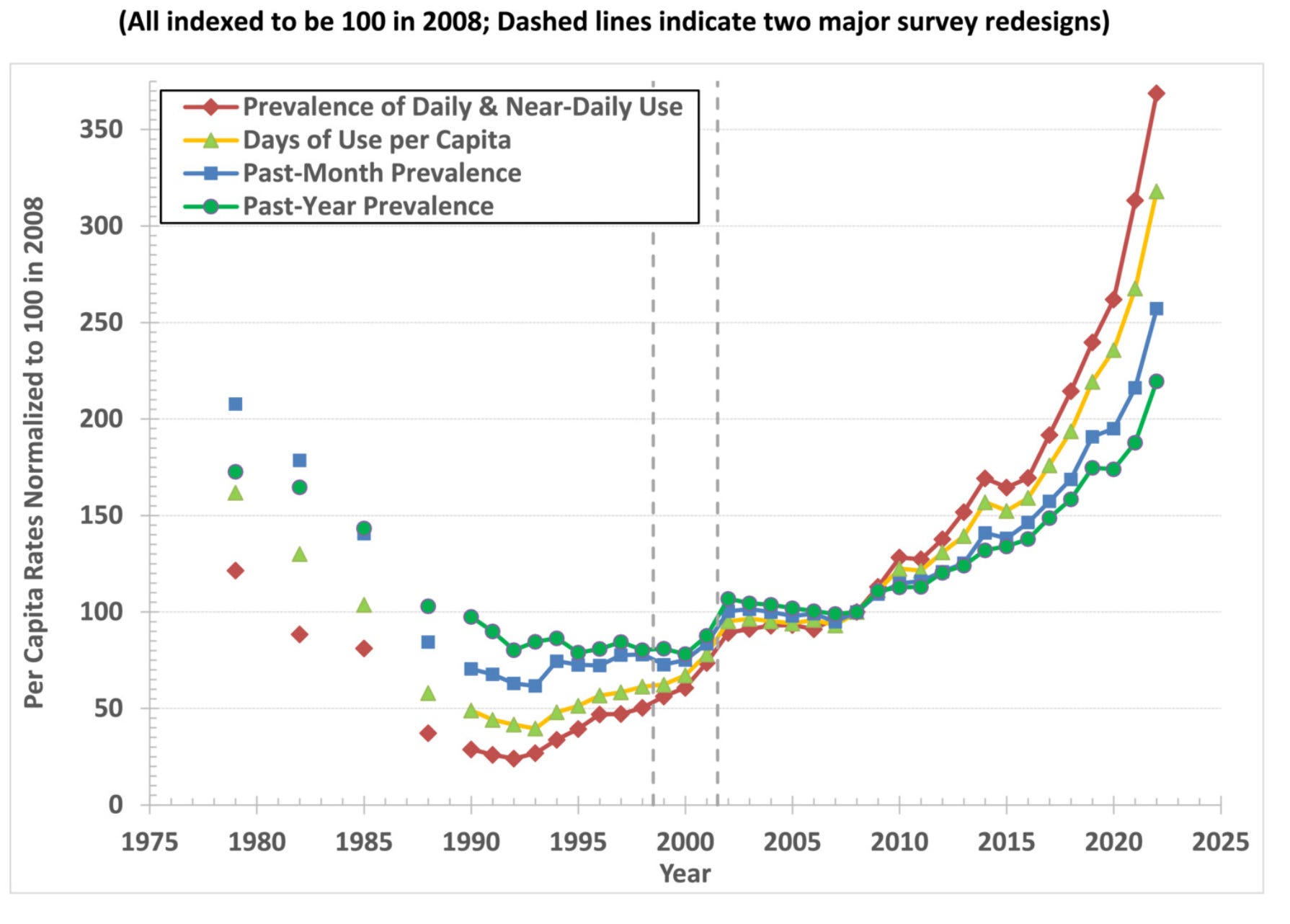
In 2024, Carnegie Mellon University published research depicted in the chart above, finding that in 2022 the number of daily cannabis users in American (17.7 million) had now surpassed daily alcohol users (14.7 million). This is a 15x increase from 1992 when 900,000 Americans admitted daily weed use, compared to 8.9 million daily drinkers.
As one of these 17.7 million for about 16 years now, I’m very encouraged by these developments. I’ve been saying for years that this was eventually going to happen as legalization proceeded: more people would come to realize that weed beat alcohol in every way and offered a variety of benefits to all sorts of conditions. For me, in particular it’s been vital as a PTSD treatment and for countering the chronic nausea which has fueled years of what amounts to an eating disorder. I’ve struggled to enjoy eating for so long now.
Lots of people all over the world are on all sorts of of drugs and attempting therapies and treatments of all kinds attempting to deal with anxiety, stress, depression, and all manner of nebulous conditions. And so many could be aided by a mature and moderate cannabis habit. What does that look like?
It doesn’t look like what many people are now doing around America today where state governments have legalized cannabis. There are a variety of trends happening right now in the world of weed that are alarming to those of us who are “veterans” (I started after graduating high school in 2002) and “traditionalists” (those who still cling to weed’s 1960s hippie ethos sincerely.) I even used to work for a dispensary for a year — Pot on the Spot! — doing deliveries in Southern California to earn some extra cash. So I’ve seen this from the inside.
Over the years I’ve had to advise friends and acquaintances as they’ve started experimenting. And I’ve had to warn them about mistakes they were making.
Here’s a collection of many of the points I’ve had to tell people. Perhaps you will pick up the general trend that I’m advising…
1. They use vape cartidges instead of sticking with flower.
One of the biggest innovations we’ve seen in both tobacco and marijuana use this century is vaping.
The advantages are obvious: people are taking in water vapor instead of smoke while still gaining the effects of the drug.
Or are they?
I have always preferred smoking the traditional way, but I did spend much of the last decade exploring various THC vapping products and methods. And I don’t bother with any of them anymore.
The primary reason is because THC is not the only chemical in cannabis. When you’re smoking cannabis flower then there are other compounds in it which also impact the experience and temper the effects of the THC.
When vape products are made that extract just the THC then those other aspects of the experience get lost. It functionally becomes a different drug. It’s like drinking a shot of straight caffeine instead of a little bit in a whole cup of coffee.
And one of the problems with how this drug works is that it’s much easier and quicker to use than smoking cannabis. When you have a vape you can use it almost anywhere and quickly. Pull it out, suck on it for a moment, expel water vapor and feel better.
This ease of use means that people are going to consume more. When smoking weed conventionally, there are steps one has to take which slow down the amount one can consume. Each new bowl has to be packed manually, weed has to be ground periodically, the potential harshness of the smoke then too can limit how much you consume. And likewise, one cannot smoke anywhere and everywhere like one can with vaping.
So the seeming advantages which vaping provide ultimately end up being liabilities: the product one is consuming is not as good and one is more likely to consume too much of it.
2. They smoke joints instead of using a water pipe.
I have never been a fan of smoking joints. All these 24 years now of experience and it’s never been my preferred method of consumption. The reason is simple: when smoking a joint it is much harder to control how much THC you are taking into your body. Usually when a joint is lit, you or the group you’re with are going to smoke the entire joint. One can unlight a joint or put it back into a little container to stop the smoke, but this is never an ideal and is a rather annoying process where you’re always going to lose some. That’s the other aspect of joint smoking: the weed gets burned more quickly.
Also too, when smoking a joint, one has to deal with the smoke and the flame, both which can sometimes provide more anxiety than relief. The solution has always been the bong, or “water pipe” if we want to sound more sophisticated. Here you get filtration that mitigates the harshness of the smoke, while still allowing consumption of the entire flower.
And in going and purchasing a new bong periodically (they usually do not last that long) you can choose how to express yourself. At smoke shops they always have a variety of creative options and colors so you can find something that just makes you feel good to look at and hold. My most recent one that I bought just the other week to replace one that cracked features a green alien smoking a joint in a UFO.
3. They try and buy the weed with the highest levels of THC they can find.
Just as the popular methods of consuming weed have changed this century, so too the plant has radically transformed as inventive growers have developed new strains of cannabis that are monumentally more powerful than those in the past. Today there are strains with THC levels higher than 40%. A “normal” level today is generally between 18-24%.
Now, just for historical comparison: 1990s-era average weed was 3-4%, 2000 was 6-8%, the 2010s was 12-15%.
Here are a few realities to understand about these high THC-level strains:
First, taking in a whole lot of THC does not make you “more high.” Instead, what it will do is make you more paranoid. When people tell me they don’t like weed because it makes them paranoid, then I always respond the same way, “Oh, that’s not you, that happens to everyone when we overdose. Did I ever tell you about that time my ex-wife and I took too big of an edible at DisneyLand? Oh man, you don’t want to overdose on THC when you’re in Toontown!” April and I were really paranoid and worried for about a half hour but it eventually wore off and we could enjoy the rest of the day. Yo ho, yo ho, a pirate’s life for me!
I usually prefer to emphasize how weed is different from alcohol, but on the question of overconsumption, this is probably something that most people can understand.
You know how when you’re going out to a bar with friends or having drinks at dinner there is this abstract line between buzzed and drunk, that you want to try and hit precisely? You want to get just the right amount of alcohol so that you’re having a good time but that you’ve still got enough of your wits about you and you’ll be able to drive home safely without breaking the law.
Weed is much the same way. You want to get that line just right, you want to nail just the right quantity, because a key piece of wisdom applies not just here but in all of life: the difference between medicine and poison is dosage.
Second, this is very weird, but true: the level of THC does not correlate with the “intensity” of the experience. If you want to “get more high” then actually the answer is often to smoke particular strains that have lower levels of THC.
The reason this happens is for the same reason mentioned in point 1: there are other chemicals in the weed than just THC and it is the interaction between them which generates the unique effects, causing one form of weed to feel so different than another.
I’ll give you the central example here. The strongest, most intense weed I’ve ever smoked is a strain called Super Boof.
Oh wow, does it ever give quite the quick of energy and euphoria. It’s so strong that I’ll only get it periodically, realizing after it’s gone that I’m ready for a break for something easier. When I looked it up I was shocked to find that Super Boof actually has less or equal THC than the more milder, calming weed that I’ve been focusing on this year, Horchata. So the same levels of THC can provoke totally different experiences.
4. They do not care about how their weed was grown or where they buy it.
When you are considering a dispensary to start buying from regularly there are two words that you want to look for: vertically integrated. Meaning, you want to buy from somewhere which grows its own product and does so in a way which creates a high quality, healthy product. This also eliminates the cost increase that a middle man selling weed to the dispensary would demand.
There’s a lot of cheap weed going around and who knows what chemicals have been sprayed on it over the course of its growth. And who knows how long it’s been sitting around or if it’s really what it’s labeled as.
Whether the weed is grown in a traditional way or a chemically-enhanced way will impact the quality of your experience, especially most often I’ve found in the nature of the smoke. The more natural the weed, the smoother it usually goes.
But I can’t really argue this point so much as just tell people to try it themselves. Do a compare/contrast of cheap stuff bought in any dispensary, versus traditionally grown, organic weed. The difference becomes very clear very quickly. Don’t take my word for it. “Do you own research.”
5. They fail to understand and engage in proper weed buying etiquette: your dealer or budtender is your friend, you make meaningful small talk when purchasing, and then tip generously.
One of the things that you may find when you first start buying weed is that the people you buy it from often are not in any particular rush. If your dealer arrives at your house to deliver, then chances are they may want to chat and catch up for 10-15 minutes before leaving. When going to the dispensary, these often turn into social occasions, the budtender at the counter and the “patient” making the purchase discussing their shared tastes and preferences or whatever happens to be on their minds that day.
The classic stoner comedy “Pineapple Express” parodies this trope a bit, this odd dividing line between being a friend and also being a customer and the ambiguities that ensue. This all seems to derive from weed’s place in hippie culture with its often anti-capitalist ethos. The weed dealer was not some salesman in a suit doing a transaction, they’re your buddy coming to hang and oh, here’s some weed, by the way.
These are the cultural traditions, so if you’re going to join in, I urge you to embrace them too. Be friendly with those who provide you with your weed, and tip generously. Nobody in the weed business is making a whole lot of money right now.
6. They fail to experiment with a variety of strains to see what best matches with them personally and what fits at certain times of day.
Over the years I’ve explained to my Dad how weed is like wine now. Growing up, he taught me about the different types of wine and how different grapes yield different results. Weed now has that sort of diversity too. The way that one might have a few dozen bottles of different vintages in their cellar, one can now hold onto a dozen types of marijuana products at once, to match with whateer the day demands.
The key distintion here in varieties is best understood as between Sativa strains and Indicas. Sativas come from the tropical regions and they tend to provide energy, euphoria and a “high.” Indicas come from colder regions. Hindu Kush originated in the mountains of Afghanistan and Pakistan. These strains will cause one to get relaxed, tired, and thus “stoned.” And then, of course, there are “hybrids” which mix together plants from both sides to create a more middle-ground, even experience.
When you are first starting out, it is important to explore the range of possibilities. Try both energetic Sativas and sedating Indicas. And as you do, you may realize naturally, “Oh, this helps me get going in the morning, this helps me fall asleep at night.” Among Indicas, the conventional ones to cool down after a hard day’s work are Granddaddy Purple, Northern Lights, and Bubba Kush. For Sativas, three that will give you quite the energetic kick are Sour Diesel, Jack Herer, and Durban Poison. Maui Wowie is also something to really try, a Hawaii-creation that lives up to its name.
Ultimately, though, as I’ve been advocating for balance and moderation throughout this whole essay, I do so too with strains now. The three best strains that I most recommend are XJ-13, Blue Dream, and my gold standard now, Horchata. The hybrids will neither push you with too much energy or sink you down into the couch. They provide clear-headed focus and motivation to get the day’s work done. XJ-13 in particular has a special creative energy. It will help you come up with innovative ideas. Horchata is a mood stabilizer in weed form, noted as particularly helpful for those with PTSD. And that’s precisely what it does. It’ve been going on it almost exclusively all year.
Now, understand this extra wrinkle too: what works for one person will not work for another.
If you are seriously considering a daily weed habit, then chances are you are not doing so “recreationally,” but because of one physical problem, psychological issue, or perhaps both that you need help enduring. You need to know specifically what problem you need help with and then match the weed to it. For example, if nausea is a big problem, some strains will give you “the munchies” much more than others, particularly the strong Indicas like Granddaddy Purple. Alternatively, some very strong Sativas like Durban Poison, can have the opposite effect, with THCV acting as an appetite suppressant.
In other words: one weed that will make one person better may make someone else worse. This is more complicated now that just “smoke plant, feel good.”
7. They do not take periodic breaks from smoking.
I know this is especially something a lot of people aren’t going to want to hear, but just trust me on it. Periodically — ideally a few times a year — just take a break for two weeks or so, maybe more. Give yourself a detox, let your mind get into a different place again, and then when you choose to come back to weed, your tolerance will be reset. And you will also have great confidence in yourself as you realize and know: you’re not addicted to weed like an alcoholic is addicted to alcohol. You are in control here. You are the one choosing how much you consume, when, and why.
8. They mix weed with alcohol and/or other drugs.
This will just confuse your nervous system. It will usually not enhance the experience, though I will offer one exception.
Combining weed with caffeine is usually going to be a winning combination. Want to really fuel the writing? Get some extra high caffeine coffee and some Durban Poison and see what happens.
Now, the one exception I will give for an instance of how to combine THC and alcohol is this recipe from Robert Anton Wilson:
Silver Haze weed + Jamieson’s Irish Whiskey + Lapsang Souchong black tea from China.
If you can get just the right ratio of Sativa-leaning weed, liquor, and caffeine then that can give you a strong creative charge. But again, it’s all about the balance. And most people when they’re mixing weed and alcohol aren’t doing that. They’re going out to party rather than staying in to work.
9. They continue drinking alcohol.
The buzz that one gets from alcohol simply cannot compete with the high from weed. Why continue to drink? Switch to non-alcoholic beer instead. With no alcohol, beer becomes much more refreshing.
As this trend continues, then it will change America. As more people switch from alcohol to weed—especially young people—the result will be less violent crime. As alcohol receeds from America, we will become a safer and happier country.
10. They have yet to learn how to combine weed and sex.
With all the previous items on this list I’ve advocated moderation and restraint. Here, I’ll give you encouragement to cut loose in the opposite direction, though:
Couples need to incorporate weed into their sex lives. How to do so?

In this article, I have not discussed edible marijuana products much beyond that Toontown anecdote.
And the ultimate reason for that is that after all these years of experimenting, I’m just really not that big of a fan. Edibles tend to be difficult to dose properly and hard to control. They also almost never taste good. It’s seemingly impossible to get the weed taste removed.
But the big problem is the reality that you don’t necessarily know when exactly it’s going to hit or how long it’s going to last. Some edibles are easier to dose than others, and if you use one regularly then you can probably gradually figure out what dose levels may help you. I certainly have some THC chocolate on hand “in case of emergency” and have bought many varieties of gummies over the years, but right now I’m just not in a situation any more where I turn to them. When my PTSD was at its worst back in 2022 and 2023 then heavier doses were very helpful, but now they’re not a go-to at all.
So given this variability of THC edibles, one should be careful when taking them. You don’t want to take too much somewhere out in public. So where is the safe place to experiment? In the bedroom with someone you love. Just as weed makes food taste better, music sound more exciting, and colors appear more vivid, it makes sex more intense and intimate.
Most people don’t know about this or factor it into the discussion about weed’s merits and what broader legalization could mean. Greater availability of weed and the further de-stigmatization of it in culture means that more couples who have potentially struggled sexually in their marriages for years could all of a sudden have a whole new way of experiencing the world and each other.
Doesn’t that soaring rainbow just look beautiful?
We’re coming to a point in history now that many of us dreamed about for decades: the fall of Big Booze, and its replacement with full marijuana legalization.
But will Big Booze just be replaced with Big Weed? While there will likely be some huge marijuana corporations to emerge as full legalization begins and some alcohol companies will be smart enough to pivot, I suspect that more people will learn the lessons I explained above which I’ve learned over the last 24 years. Big corporations are going to move in and do what they always do to try and extract value, but this is a product that people can grow themselves in their garage. And why go and buy corporate weed when the all-natural stuff grown in small batches is better? Your neighborhood dispensary can just grow their own inventory.
The big problems before us here are plain enough: these are powerful chemicals and too many people are going to use them in irresponsible ways which render them poison instead of medicine. And so it’s time to start having the adult conversations like this one here about what mature, moderate marijuana use looks like.
What do you think? What are your experiences with marijuana? What do you recommend? What have you seen in the culture today with how some people are using it responsibly or recklessly?