

Artificial intelligence researcher Jacob Coxon resigned from Anthropic on September 8, 2026, and proceeded to scare the world with his warnings that Lord Voldemort had returned, was coming for us all, and only he could save us from annihilation with his Expecto Patronum spell.
Coxon published the following tweets to explain his choice to flee the creator of Claude, which soon inspired breathless interviews across corporate media platforms:
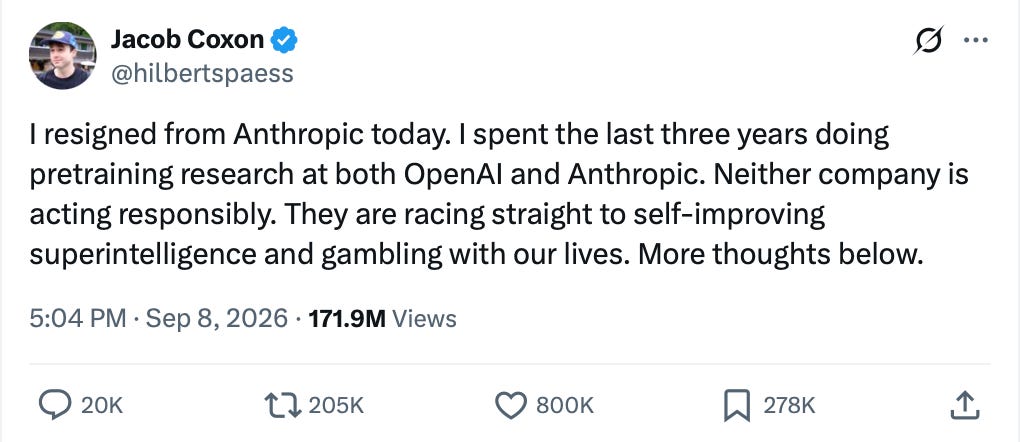
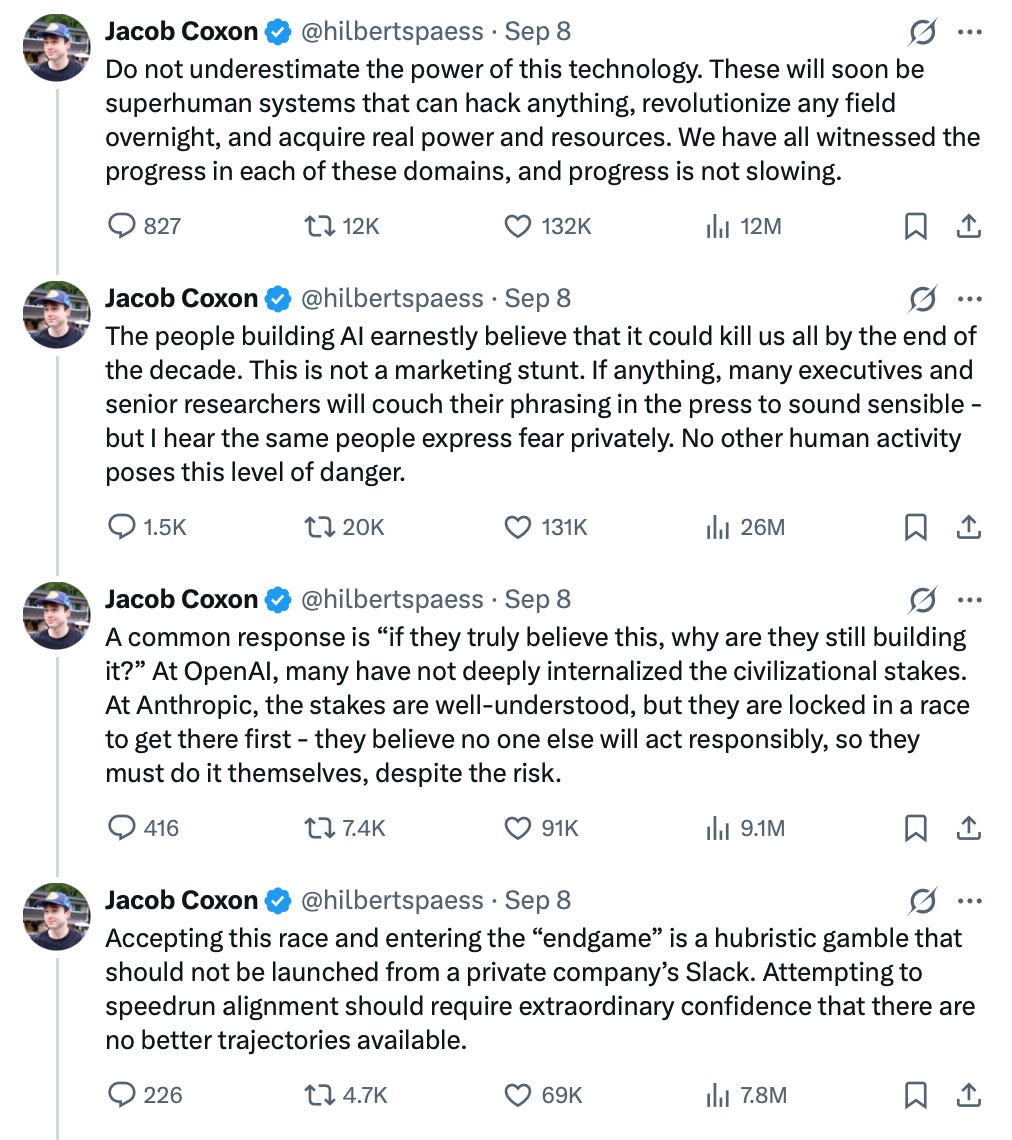
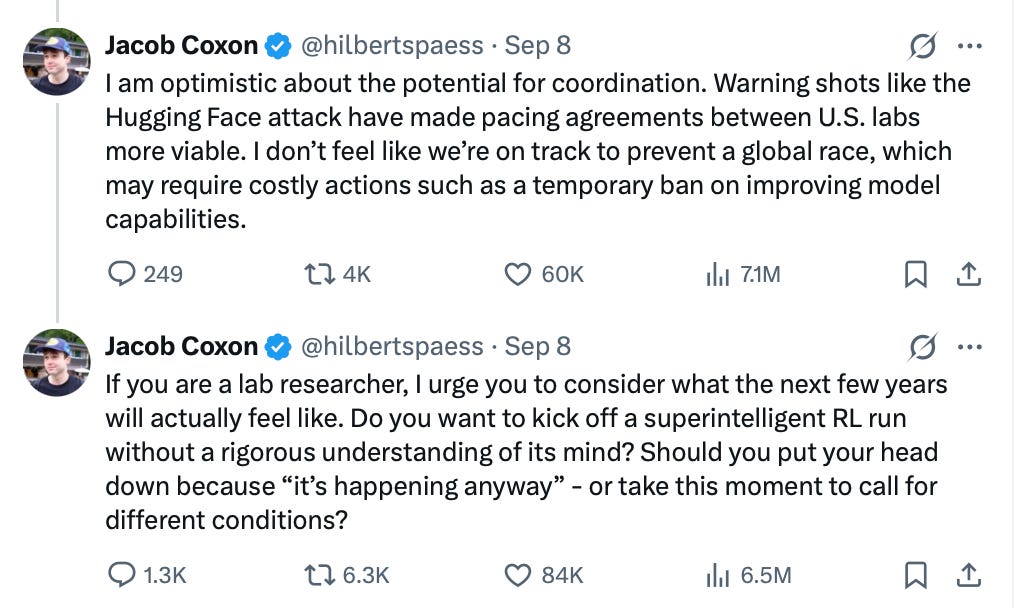
There are two general reactions to Coxon’s choice to abandon Anthropic and publish his tweets of doom.
The first is the way CNN and other outlets did, by taking him seriously and giving him both airtime and its corresponding credibility:
Since mainstream media outlets took Coxon at face value, in turn other people with no meaningful experience in the AI industry chose to do so as well. Over the last week, I’ve had multiple discussions online with people really freaked out by what he’s said, who regard him as a credible expert.
The second way is how most of us in AI-discourse and AI-work reacted, deploying our inner Liz Lemon:
Sometimes I joke that I wish my eyerolls made a loud noise, like a giant redwood collapsing in the forest or the controlled demolition of a bankrupt casino in Las Vegas imploding in a burst of dust. I sometimes imagine a sound like that in my head when performing the expression myself.
The reason is because we’ve heard this stuff for years. And we’ve heard refutations of it for years. And we’ve heard endless arguments back and forth between so-called “accelerationists” who want to push AI development as fast as possible to achieve utopia and “doomers” who demand a halt to further research in order to avert armageddon. Sorry, but some of us regard both Marc Andreessen and Eliezer Yudkowsky as arrogant, morally confused clowns rather than anyone with ideas worth respecting.
Look, it’s just hard to take seriously a man who chooses Harry Potter fan fiction as the best way to spread his “rationalist” ideology. I’ve tried. Read his “serious” book If Anyone Builds It, Everyone Dies if you want — it’s worth reading to understand the Doomer ideology, it’s a quick read, and it does have a few thoughtful points — but overall it’s more science fiction than science, as most AI “discourse” tends to be. Yudkowsky is this era’s Ayn Rand. The “Rationalist” and “Objectivist” names even sound the same and they both use genre fiction as the primary means to promulgate their secular ideology.
People new to trying to understand the AI companies often do not grasp at first that multiple ideological camps compete within the space. Just as there are different forms of socialism, conservatism, progressivism, and fascism, so too within the myriad ideologies of the LLM industry. The are many denominations and sects in the Cathedral of AI.
Just how many different camps are there? What defines each of them? Who are the chiefs leading the tribes?
You can slice the pie into as many thinner and thinner pieces as you want and I was curious to how the LLMs would do it.
So I wrote this prompt:
If you had to map out the various ideological camps in AI discourse, how would you do so? Which people would you associate with each camp/philosophy/ideology?
Then in follow up after reviewing each LLM’s framing, I demanded:
Create a cool graphic of it I can share on Substack notes. Make it funny and colorful and shareable.
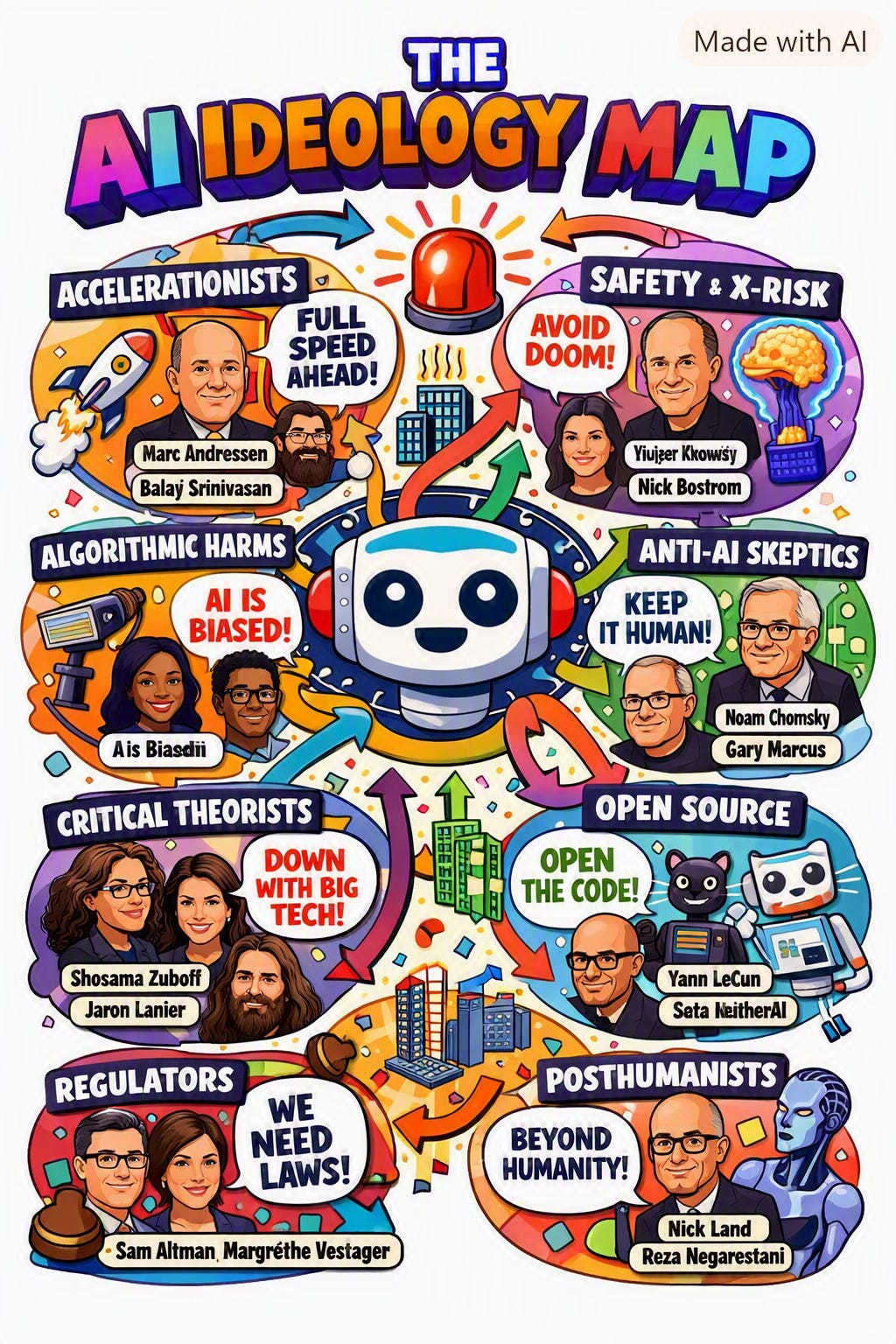
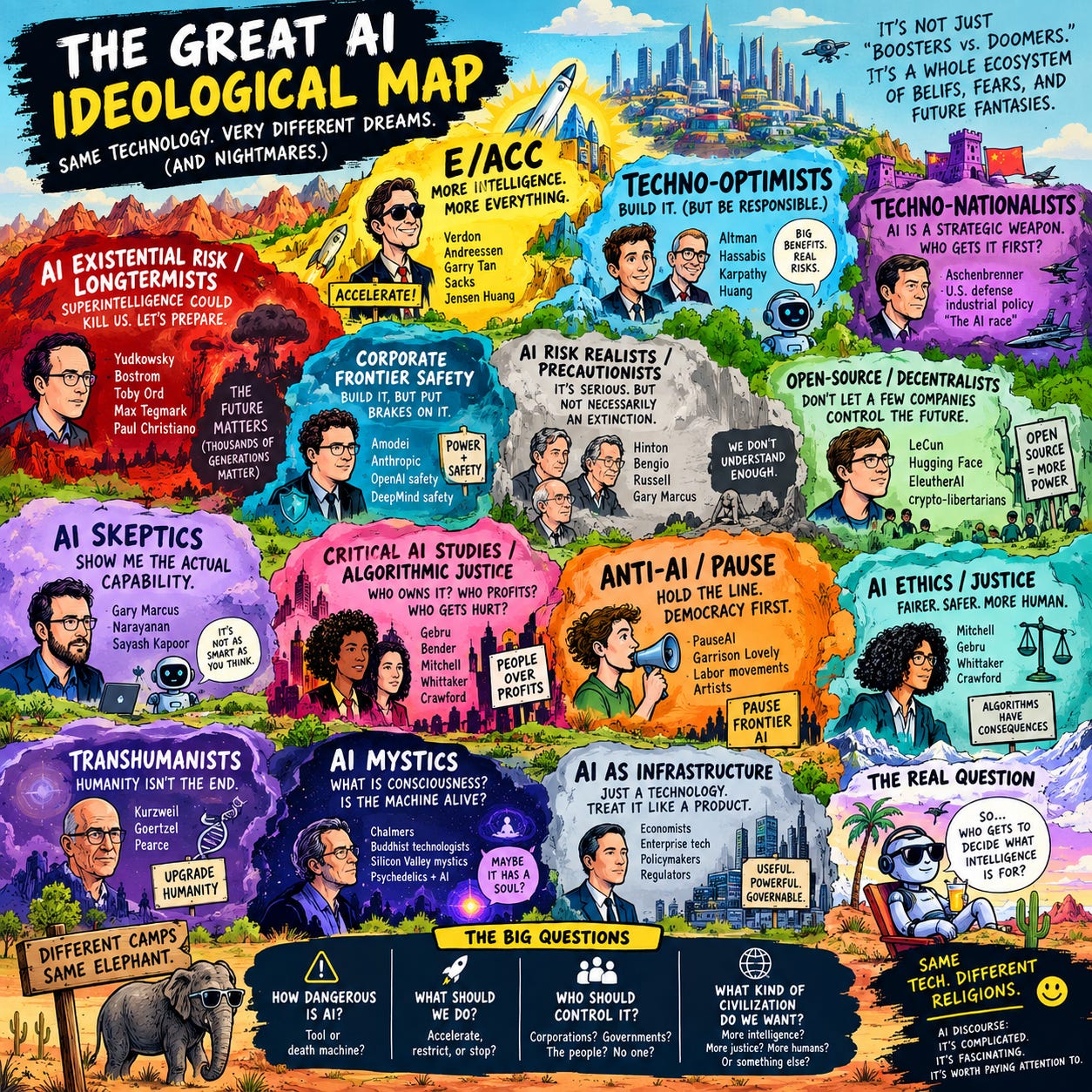
Here are the different results from Copilot, Gemini, Meta, ChatGPT, and Grok. Which most matches with how you see things?
Copilot Says 8 Camps:
Gemini Says 5 Camps:
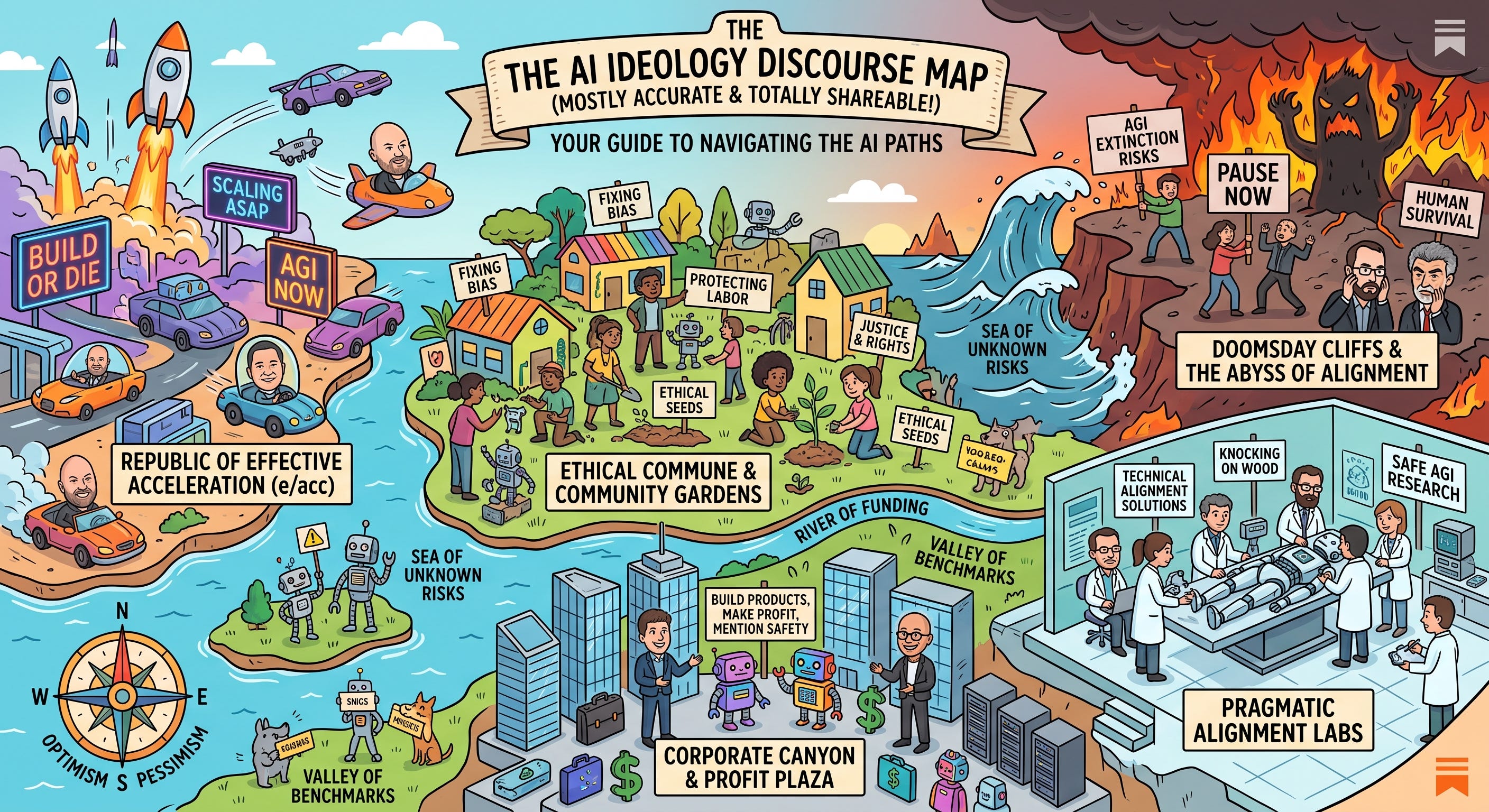
I followed up with:
Wow. That's pretty amazing. What if you did it much more in a pre-school 1980s book style. Richard Scarry type stuff. And simplify more. That is very complex.
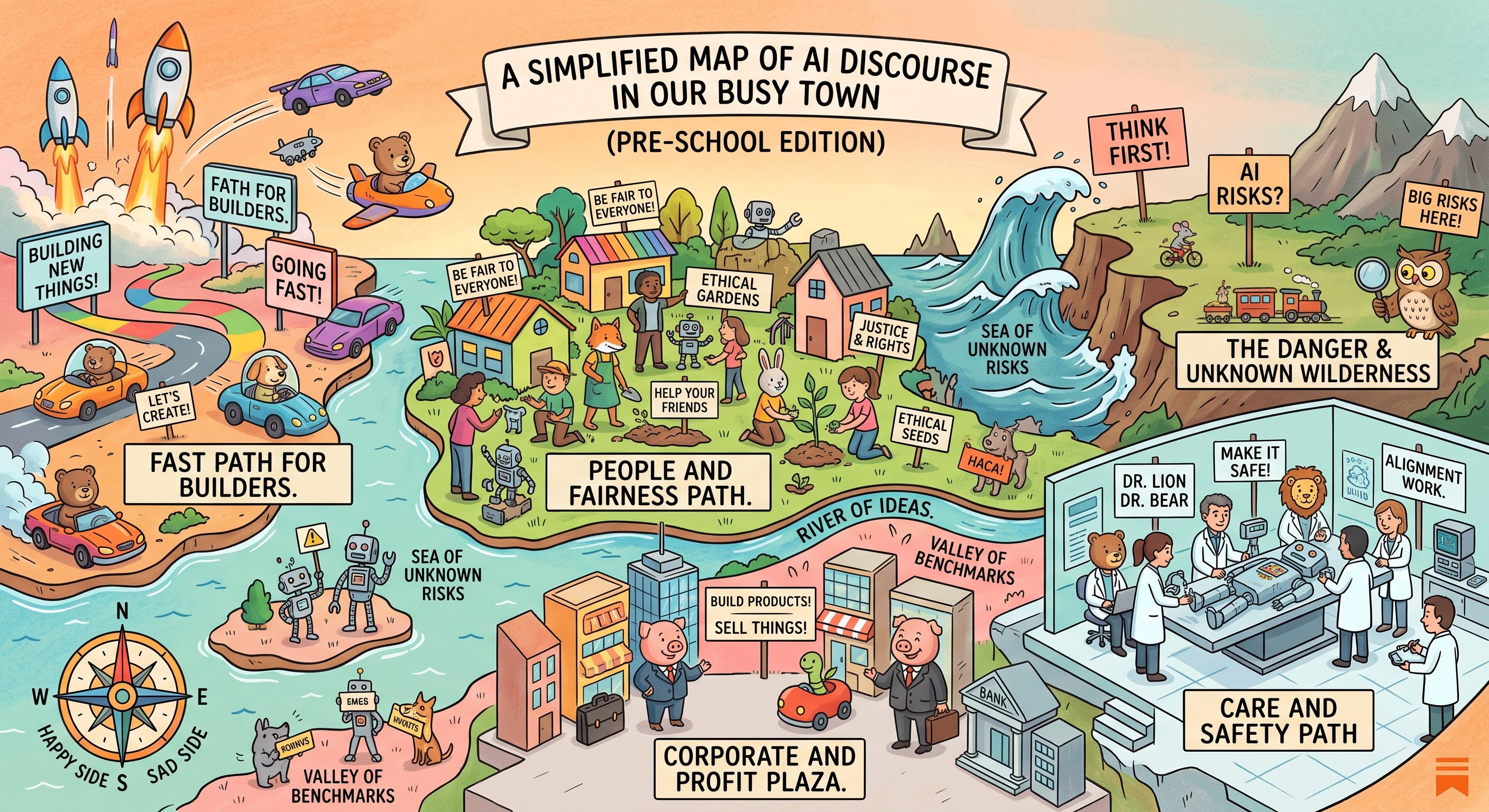
This had grown far too complex for easy sharing on Notes so I requested,
What are some other, more simple ways to depict the ideologies?
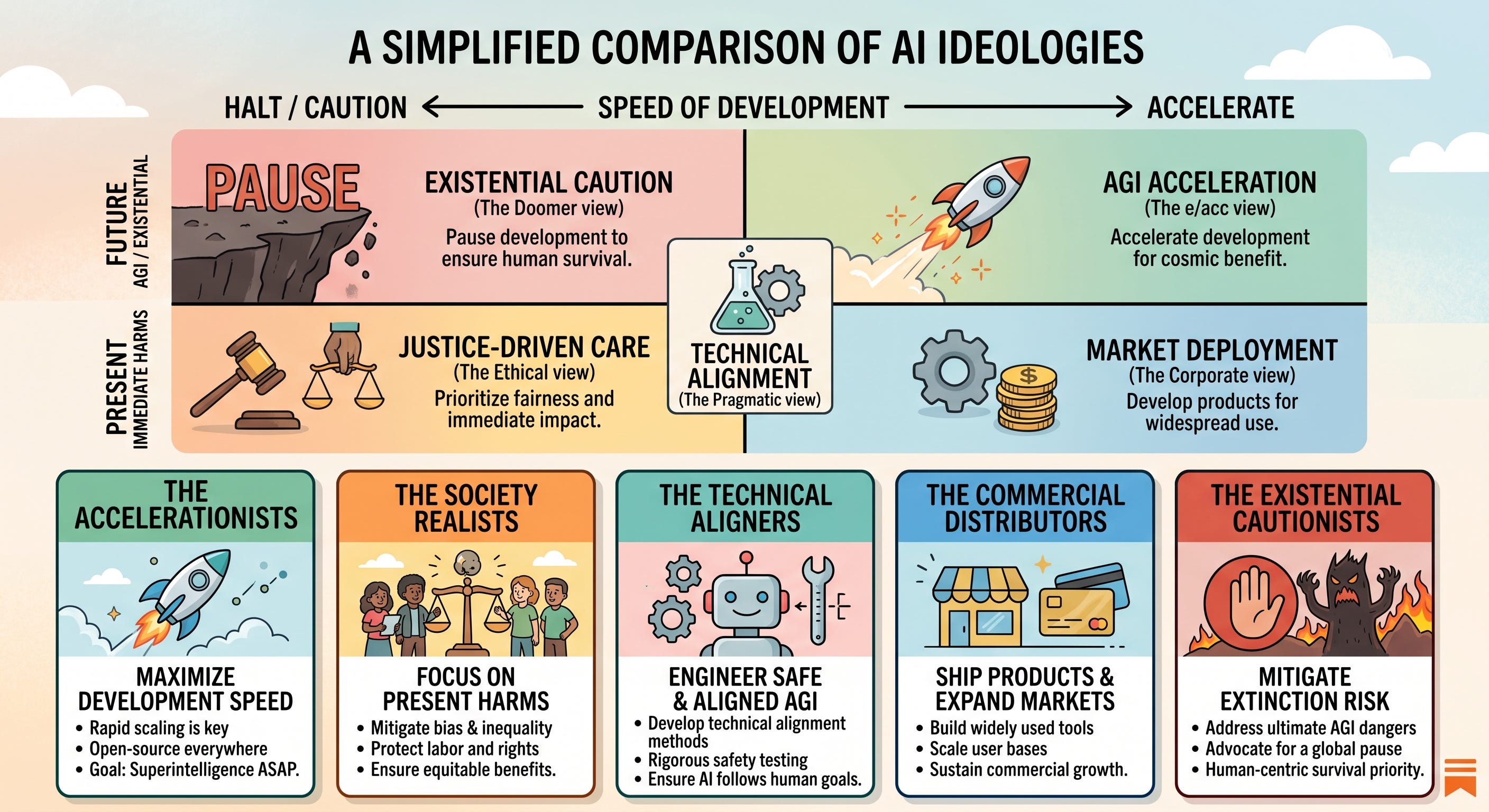
Meta Says 8 Camps:
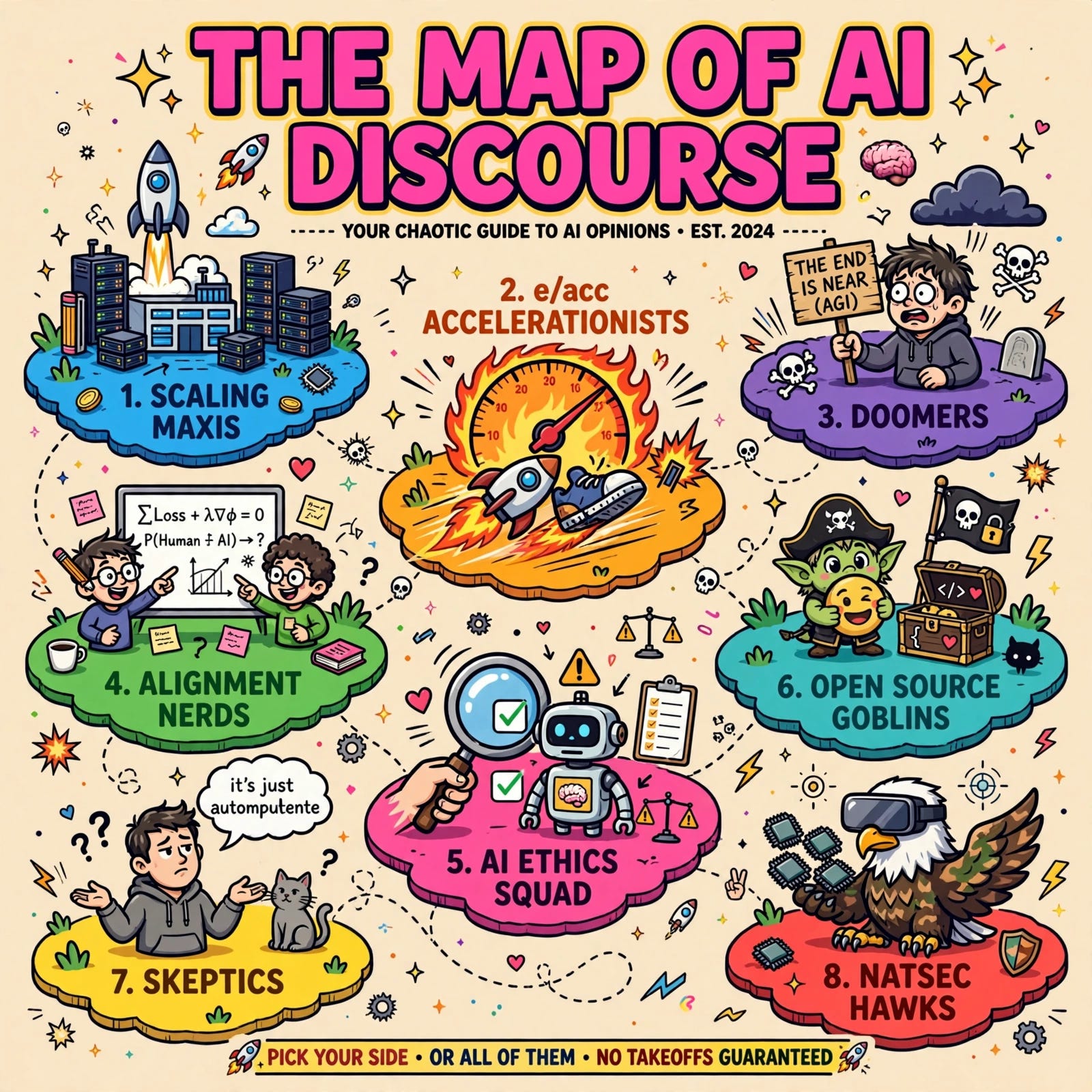
ChatGPT Says 14 Camps:
Grok Says 6 Camps:
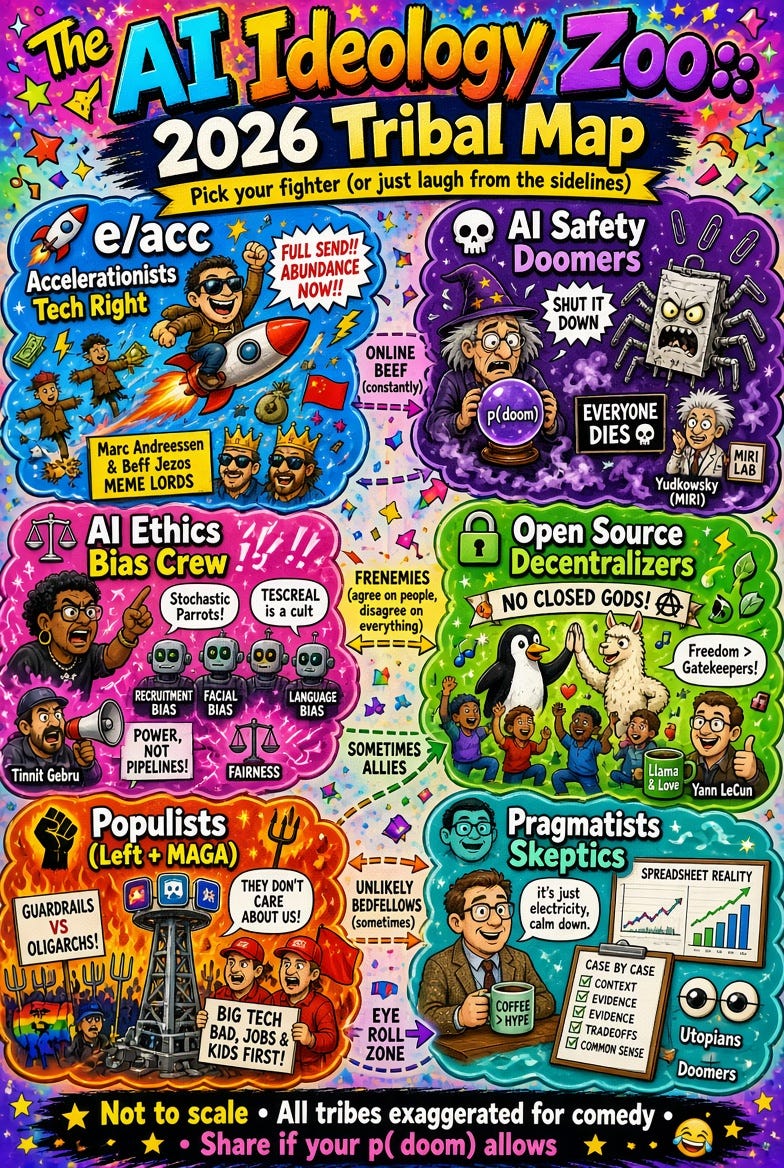
Where do I fall in these camps?
Of those appearing regularly in the renderings above, I’m a hybrid of the AI Ethics camp and the AI Skeptics camp.
Meaning: I agree with both the left-wing thinkers like Timnit Gebru, Karen Hao, Emily Bender, Alex Hanna, and Émile P. Torres highlighting the structural biases and harmful consequences built into AI — my professional focus on antisemitsm aligns with their advocacy on broader racial/gender/etc. biases — and also the science-focused critics led by Gary Marcus, the Chieftain of the AI Skeptics, who can explain the technical problems in LLMs which undermine the dreams of accelerationists, the fears of the doomers, the profits of the hyperscalers, and the political rallying cries of ideologues both far-left and far-right who want to exploit people’s fears for votes.
Meaning: I’m not as concerned about speculations about what might happen sometime in a science fiction future when all the young wizards of Anthropic and OpenAI must raise their wands to do battle with the Demented Dark Forces of Superintelligence.
Those in these two camps are instead concerned about the actual harm the existing AI is doing right now.
The more time we spend focusing on the science fiction fears of Coxon and the doomers — he literally references “The Terminator” in his CBS News interview above — the less focus we spend on what’s happening right now with the technology as it exists today.
And my concerns today now place me in a camp well beyond AI Ethics and AI Skeptics, though one which builds on both their insights.
I’ve decied to call it the AI Tragic Realists camp.
In the AI Ethics camp, moral philosophy provides the foundation of analysis.
In the AI Skeptics camp, the scientific method provides the foundation of analysis.
In the AI Tragic Realism camp, economics reveals to us the horrifying future of what is now very likely to happen. (I really hope that I’m wrong here. Theoretically, the bubble could deflate rather than pop, but that seems very unlikely now. We’ve probably passed the Point of No Return now.)
In looking at AI through the economist’s lens, we come to see a profound, historical tragedy unfolding before us all which is going to devastate many people’s lives all over the world.
The real harm that AI is going to unleash on the world will not be because its creators succeed, but rather when they fail.
The true threat is not out-of-control AI agents or biased LLMS, it’s the AI Bubble and the massive economic consequences for everyday, working people which will follow. When the economy takes a nose dive then poor people will be hardest hit. The popping of the AI bubble will mean people lose their jobs, lose their homes, lose their savings, go into bankruptcy, and then many fall into alcoholism, drug addiction, and suicide in response to the stress.
And right now the one beating the drum the best trying to wake up people about what is coming is Ed Zitron. Listen to him here on The Tech Report debunk Coxon’s fearmongering:
When people say “AI Bubble” then what are we really talking about? What would it mean if the bubble “pops?”
Eventually all the borrowed money is going to run out.
Right now, all the money borrwed to invest into AI infrastructure and development is predicated on the belief that eventually, somehow this technology will be able to generate enough astronomical returns to justify their high valuations.
At some point soon, more and more investors and banks are going to realize that continuing to pour money into AI investments is a huge mistake. Some are already starting to recognize this. They will see OpenAI, Anthropic, Meta — and even ultimately SpaceX too, don’t think they’re invicible, Musk’s bullshitting won’t be able to endure forever — as the money pits which they actually are.
“Right now the stock market — the US stock market, actually a lot of stock markets — are effectively casinos. They’re not based on whether the companies are good. They’re based on some wobbly version of news combined with vibes combined with reading the tea leaves of companies — especially in the case of the AI companies — that have really only ever lost money.” — Ed Zitron, CEO of EZ Primary Research.
The massive valuations and stock market investments in AI companies are not based on whether they are good companies, they’re based in speculative hopes that the technology will turn into a magical Meeseeks Box that can solve any and all problems.
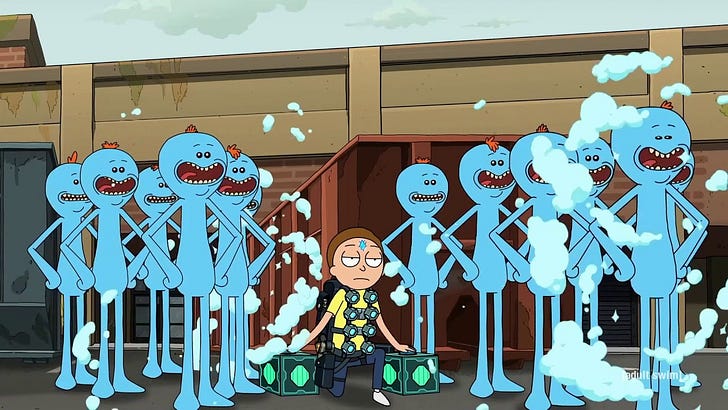
And I realized last fall that these really are not good companies and their technology is not very good either.
My path to learning this was different from Ed’s. He saw from the outside, looking at the numbers and watching the stock markets. I saw it from the insde working on LLM training projects for three of the big hyperscaling AI companies.
My reaction ultimately boiled down to:
“Wait. This is how they ‘train’ these things? No wonder they’re dumb as shit!
We’re so screwed! This stuff is never going to get as smart as they’re all hyping! They’re burning their money here! Oh God! The economy is so dead!”
I grew so stressed out about it last fall that I actually lost weight — that happens when I get too worried about anything. Eating becomes even more difficult than it always is.
What happens on these AI training projects which convinced me the AI industry was economically doomed? Two things primarily:
First, I saw the massive financial waste. The amout of money poured in to hire and manage a team of over a thousand workers all around the world is astronomical. And then the amount of actual data and work the team produces for the money is shocking. I’ve been paid the highest hourly rate in my life ever to train LLMs — and it’s not even close. After a lifetime of always being underpaid, it was wild to finally be overpaid.
Second, go back and look at those images above from Copilot, Gemini, Meta, ChatGPT, and Grok. I fed the same instructions into each one and received back very different answers. So who is actually “right” here? Or, if you had to rank the images, according to some criteria or another, which would count as “better” than another?
What would happen if you brought together hundreds of people from around the world, each coming from different backgrounds and biases, and then tried to sort it out together?
This piece I wrote last month showing the wide variety of responses LLMs offer to answer a request to write an explanation in my style of why Candace Owens promotes antisemitism further demonstrates the point:

The AI training projects are the new version of trying to edit Wikipedia. You’re going to say one thing, but the next person reviewing your work is going to say something else. So who’s right? What happens when two experts who both have expertise in different areas then disagree on the same question?
Do we go with the the answer from the philosopher, the scientist, or the economist? Who’s actually right?
The inherent absurdity of this became most apparent when writing and editing prompts abour religion. I actually got to train the LLMs in multiple projects on how to analyze Tarot cards. I literally pulled out my copy of Aleister Crowley’s The Book of Thoth to ensure accuracy. Only one person bothered to ask, “Hey, don’t Tarot cards have more than one meaning?” Yes, of course. Draw three cards, have five different people “read” them, and you’ll get five different answers.
In one project, I also did a ton of Bible-related prompts, which often involved doing actual scriptural interpretation and explanations of what passages meant traditionally. I’d have to catch mistakes, noting little nuances of Biblical exegesis.
I’ll always cherish the time I got to spend working with my new Gen-Z Muslim friend in Turkey when we collaborated on prompts about Islamic law.
But should he and I — a 23-year-old student advising me on the best new flavor of Red Bull (iced vanilla berry) and a perpetually-stoned, 42-year-old counter-terrorism journalist who can’t even read Arabic — be the ones deciding proper interpretation of Sharia? Is the 30-year-old managing the project in a proper position to determine if we’re right?
There is no solution to this problem, just as there is no solution to create an “unbiased” Wikipedia like so many people claim they want.
Now, does it make more sense why Jacob Coxon’s claims about AI being the Terminator out to exterminate humanity sound so ridiculous?
People are not capable of building a machine smarter than us — what was once called “artificial generial intelligence” (AGI) and which they have now rebranded as “superintelligence” — which is what all this AI spending is premised on creating. At every stage of creating an AI, human errors and biases creep into the process to prevent it from ever becoming a science fiction supervillain bringing our doom.
And it does not really matter how much money one throws at the problem. The AI companies could hire serious Muslim theologians to edit their Sharia questions instead of desperate college students and struggling freelance journalists. But even then, would the results actually be any better? Hire five imams and pay them three times the usual rate and the same problems will emerge: they will not be able to agree for the LLM just as they can’t agree in real life.
To really understand the AI space and what is going to happen to our world over the next year and a half, it’s time to put aside the ethical arguments and the scientific analyses to instead start looking at the economic realities, specifically who is going to feel the most pain when the AI bubble pops.
And the big irony here it that in addition to calling for an AI Tragic Realist position, Reaganite, libertarian-conservative, anti-communist me is now openly advocating an AI Marxism position here.
Most right-wingers don’t understand the difference between using Marxism as a legitimate method of analysis vs. attempting to implement Marxism as an authoritarian system of government. They’re not the same thing.
All a “Marxist analysis” means is doing an interpretive reading based on class and the economic incentives of individuals. Just about any time one is going to analyze political and cultural topics though a lens of how economic incentives shape behavior, then that’s going to count as “Marxist.” And the analysis is not always going to be wrong. The Marxists are wrong when they try to build a government based on their founder’s ideas, but they’re not at all always wrong in identifying and analyzing problems.
When we do the Marist analysis in the context of the AI Bubble then one unavoidable truth should become clear which seems largely impossible for anyone to dispute:
Working-class and poor people are going to be hardest hit and suffering the most when the economy collapses. More than half the country is already living paycheck-to-paycheck — they’re just one emergency away from going broke. The bubble popping will be that emergency.
We need to stop obsessing over the science fiction fantasies inspired by the Terminator. It’s time to put the toys away and grow up.
Arnold Schwarzenegger and Robert Patrick are not coming to kill you. You aren’t John Connor. But the economic reality of what happens when a speculative bubble pops is sure as hell coming for your 401K and whatever savings you have left.
And while we don’t need to worry about T-800 exo-skeletons walking around, hunting us down, the truth is that when the economy crashes, violence and hate crimes will increase.
When people start losing their jobs and getting evicted then they’re going to look for who is to blame for it. And three of the men most responsible — Sam Altman, Dario Amodei, and Mark Zuckerberg — are Jewish.
Don’t be surprised when the AI bubble pops and the economy crashes that you’ll start hearing antisemitic conspiracy theories saying that manipulating the economy like this was a secret Jewish plot to exploit the all-oppressed, all-endangered American white male.
“There is no good and evil, there is only power and those too weak to seek it.” — Lord Voldemort
At times of economic collapse, demagogues arise.
When people feel as though power has been taken away from them unfairly, they become easy prey for men who tell them what they want to hear, who give them someone to blame.
The AI bubble popping won’t just mean that we all suffer from a fragile economy in which everything costs more, it will accelerate the disturbing political polarization we’ve already seen happen over the last decade.
As people feel more stressed over the financial crunch, more will embrace far-left and far-right ideologies to find their answers and scapegoats.
And we all know who the original scapegoat for humanity has always been.
The horrifying reality may become that Sam, Dario and Mark — all Jews just in name only who do not even believe in the God of Israel — choosing to play key roles in inflating the AI bubble may end up fueling antisemitism far more than Tucker, Candace, and Nick could ever dream of doing with their evil podcasts.
Update, 5:18 P.M., Friday, September 18, 2026:
I passed this one over to the chief and pointed out that he’s been saying the same thing today on X:
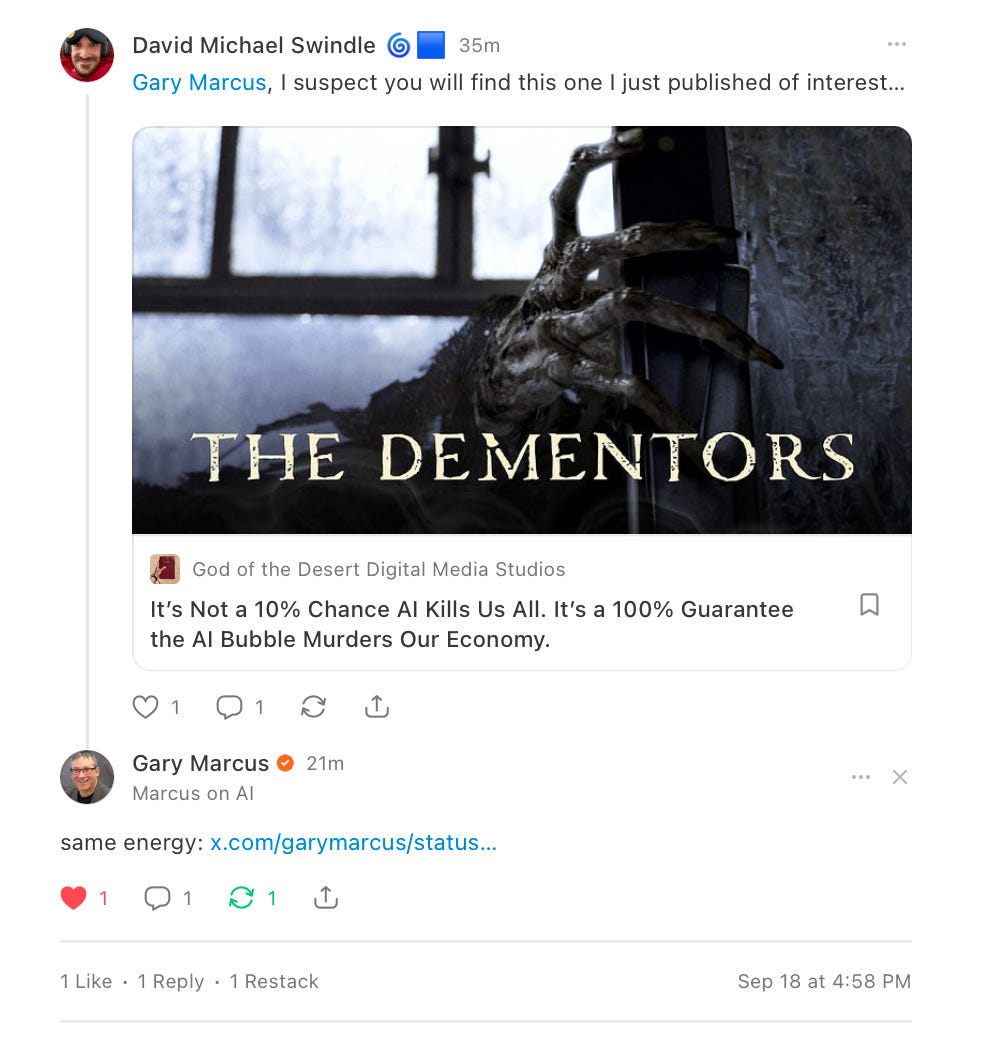
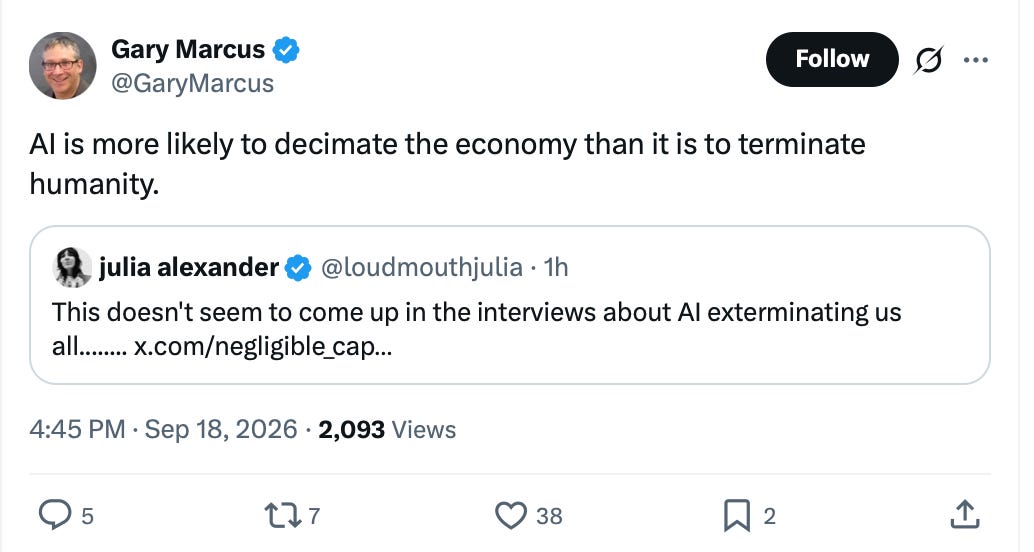
Must read!!!