
I'm Losing My Mind Over the Return of "King of the Hill"
Don't cry for me, Arlentinos! The truth is, I never left you.

All of the 1990s TV show reboots and spin-offs over the last decade have been quite a mixed bag. As millennials age, the theory goes, we both long to share the stories of our childhood with our children and have plenty of resources with which to do so.
And as more and more of us opt not to have children, marketers figure we're eager to slip into some nostalgia ourselves and spend time in familiar places, with familiar characters.
Since Hollywood's been cranking out new entertainment based on existing IP for rather a long while now, too, getting the band back together must have seemed like the best idea all the former teen idols had heard in years.
It started with the spin-off "Girl Meets World” in 2014, and soon “Fuller House" joined the list. In 2016, our favorite FBI agents, Mulder and Scully, were reunited once again in new "X-Files" episodes. In 2017, full-cast reboots of juggernauts "Twin Peaks: The Return” and "Will & Grace” debuted. 2018 brought back “Roseanne," briefly, then mutated into the long-running "The Conners,” starring, well, everybody else, when she got herself dismissed from her own landmark project. 2019 saw the long-awaited “Deadwood: The Movie," coda to the beloved Western that had ended more than 15 years before.
In 2021, “Sex and the City" returned—sort of—in a continuation* called "And Just Like That.” And in a 2024 fever dream, “Frasier" himself returned to the airwaves in largely lackluster new episodes that I watched out of devotion to the original, which is my Favorite Show Emeritus.
And let's not forget all the Disney live-action remakes! They're a big part of this nostalgia wave, too.
But the whole time, as announcement after announcement cropped up and the show aired, proving tepid at best, there was one show we kept hearing rumors about. They were just rumors, though, and we could only sigh and say, "Yeah, wouldn't that be great!”
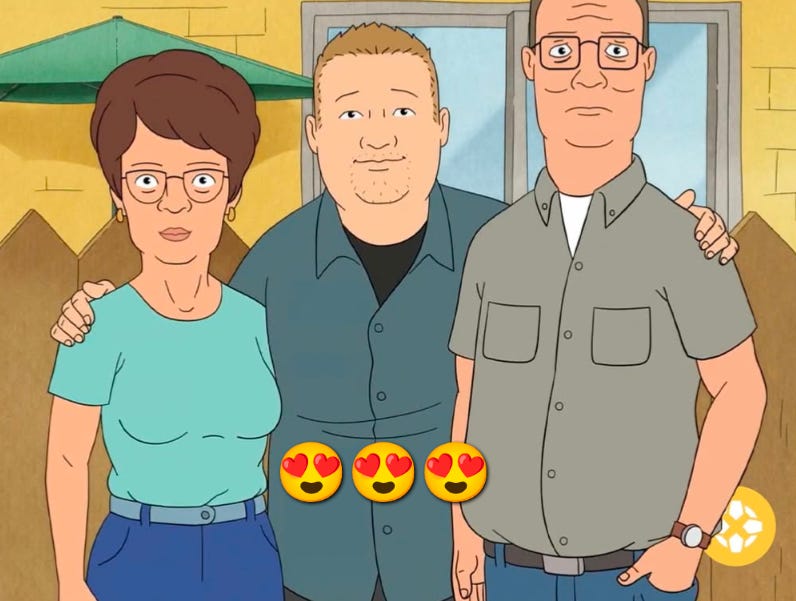
Now, however, it's established fact. It's true. It's coming. And nobody can take it away from me (I hope): On August 4, 2025, “King of the Hill" will be returning to TV via Hulu. The episodes are already in there as Season 14, following 2010’s Season 13 curtain call, covered with a horrid little lock icon that I can't wait to see disappear.
And unlike the others, pre-screenings have given the revival a 100% Fresh score on Rotten Tomatoes.
“King of the Hill?" Me? Really?
You're got-dang right. I have so much affection for this show that it's hard to put into words. Let me back up.
When I was a kid, I lived with my mother and father, who were both English majors. (I know!! There should be laws about how many English majors can live in one household!) It was—well, I can't say "awful,” because it wasn’t. And in so many ways, that formative time made me who I am: a reader, a writer, and an editor.
But it was certainly … intense. What I'm trying to say is that I didn't really get to watch much TV.
By my teen years, when my parents had each remarried to nice, normal folks who had not been English majors, it was too late: Though each of my parents’ homes now contained a big-screen TV—which object, at the time, was roughly the size of a dining room table— I had already been trained to read or write or play my instruments when I was bored. I didn't watch TV.
I did take copious mental notes at friends' houses, where we watched “Pop-Up Video” on VH1 and “Singled Out" and “Total Request Live"—”TRL," if you please— on MTV. But that, along with "Nick at Nite” at my father’s house, whatever Nickelodeon I picked up from my younger brothers or "South Park” I picked up from my older stepbrothers, was pretty much it.
So “King of the Hill” surprised me. The show centers on a working-class Texas family and their assorted friends, foes, and family, and it's easily read as a genuine love letter to one of America's most, er, distinctive states—and to a certain kind of life.
Sitting there in our parents’ family room, as my brothers flicked through the channels and settled on an episode of this landmark show, I scowled: I’d assumed that "adult animation” simply wasn't for me.
I refused on principle to watch “The Simpsons," convinced as I was that “bad kids” watched that (I knew precisely two "bad kids" who watched that). I hated “Beavis and Butthead”—incidentally, another Mike Judge project—and was unimpressed with “South Park," fool that I was at twenty, and I figured anything else animated but clearly not for children would be nothing but a profane and plotless series of fart jokes.
Yeah, I had no clue what I was talking about at all.
"King of the Hill,” while being a comedy, is a lovely show about people in a changing world who are doing their damnedest. (Yeah, I got over the profanity aversion.) And got-dang it, as protagonist Hank Hill would say, the show just makes me happy to watch.
It's not that I love Texas so much: I've only been once, and while it was lovely (Galveston!), it's not on the list of locations I continually bother my husband about.
And it's not quite that I relate to it. I'm not conservative. I went to college; I don't have a "work on the car” husband (anymore). I don't have children—though if I did, I'd want them to be like Bobby. And I certainly don't live across the street or next door from my three best high-school friends.
But what's strange is that I recognize elements of the Texas culture portrayed in the show from my Midwest upbring. And even as I have lived all over the world, settling in California, which is so very different from my home state of Indiana, I'm comforted to see elements of the show that I remember from my ‘80s and ‘90s childhood there.
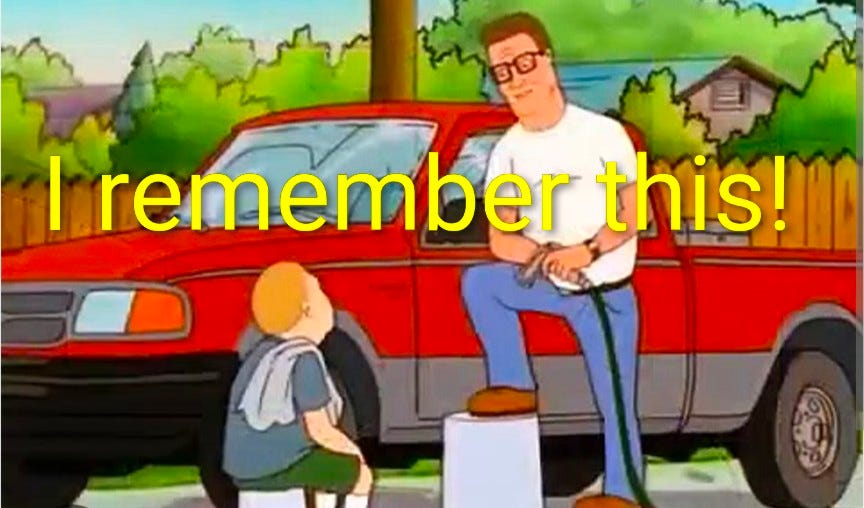
Men gathered outside, working on someone's car: I remember that. Helping out with some local event and watching it morph into someone's pet project, a world away from where it started: yeah. Having something weird happen at church, dealing with big-box stores moving in and changing the local market: also familiar.
Watching people my own age delight in New technologies, while older people are first mystified and then irritated by having to acknowledge and understand it? That resonates, too. In fact, watching the 21st century sweep daily life ever further away from the world of our parents’ childhood and our grandparents’ heyday: Yeah, that strikes a deep chord in me, whether I'm watching it in Texas, Indiana, or anywhere else.
Co-creator Mike Judge would not be surprised. In a recent interview with Texas Monthly, he explained, “I’ve been all over the country. There are suburbs in the Midwest where dudes are sitting around looking at engines. It’s universal.”
It really is. OK, protagonist Hank Hill is neither my father nor my stepdad, though he shares some characteristics with both. But I know people like him. Wife Peggy is neither me nor my mother, but I know her nevertheless. Son Bobby? Funny, secure, self-aware, a little bit odd, keen to please his parents but in thrall to the beat of a different drum: I knew kids like Bobby, too.
Again, Judge agrees, telling Texas Monthly, “They’re really good characters. Watching it again after having some distance from it, I was like, ‘Wow, we really had something here.’ Also, we weren’t trying to be young and hip back then, so I feel like it’s still relevant, still likable.”
And that's the key to the show, right there. These people aren't hip. They're in their 40s—or they were during the show’s initial run—and they spend their time on their families, their careers, their friends and neighbors, and their hobbies as they confront the rapidly changing American landscape.
My brother has pointed out to me many times how much change the average Midwestern Baby Boomer has seen in their lifetime. They started out in the sunny, optimistic years immediately following World War II, when America was both heroic on the world stage and the uncontested locus of all technological progress and innovation. It brought a better quality of life to middle-class Americans, and the prosperity of the period meant stability. That lent itself to the kind of mythologizing we've always heard in nostalgia for the 1950s: when America was the greatest country in the world.
Of course, that ignores the negative experiences of minorities. Black Americans were still living with overt Jim Crow laws in the South and unspoken segregation as the norm elsewhere. It was illegal to have a sex life if you were gay, and being outed was ruinous.
Hispanic workers had come in smaller numbers from 1942-1965 in the Bracero Program, which invited them here for temporary work, mostly in agriculture. They worked in terrible conditions and were even subject to a mass deportation operation in 1954, under President Eisenhower: “Operation W**back," which even deported young children who were citizens.
And other minorities were even less visible, simply because they were banned or severely limited in the country until LBJ’s Immigration and Nationality Act of 1965. This did away with racial and nationalized quotas and allowed anyone to immigrate.
So yeah, there are a couple reasons for folks to wax poetic about those days, and some, I believe, are innocent: You did not have to have a smartphone that cost thousands of dollars and download an app to it in order to access your bank account. You didn't have to watch what you said in order not to accidentally offend a minority group. No one was asking you to assess the pH balance or net carb count of a meal you'd always considered perfectly healthy.
In short, the perception is that things that seemed simple have become more complicated.
It's funny, because in real life, I have no patience for this. Being annoyed by seeing minorities everywhere looks to me like racism. Questioning why someone shares their pronouns looks to me like intolerance, and flinching when two men kiss in public looks to me like homophobia. Being affronted by someone with blue hair looks to me like pitiful rudeness.
And waving away inexcusable sexual misbehavior looks to me like victim-blaming, apologia, and even misogyny.
I just expect more. I have had to adapt to all kinds of changes in my own life, from where I was living to who I could consider safe. So I expect others to do so, too, and to understand that prioritizing the well-being of minorities means better conditions for all—not that anyone has had anything taken away.
But my brother has made me remember many times that, regardless of what people “should" do, it means little to be correct in such situations, and it means everything to have patience. He's right, of course.
And so for some reason, I'm able to watch Hank Hill and his friends confront and thread the needle on, for instance, the punk-rock Christian music scene of the 2000s, drag shows, MySpace, fusion cuisine, weed, and other trappings of the future that was on its way.
Am I so cruel and absolute in my beliefs that I can only accept this hesitancy, this feeling that everything has changed and nothing is familiar anymore, from cartoon characters? Can I not spare some understanding for the real, three-dimensional, flesh-and-blood people whom I know to be good?
I hope that's not the case. But I'll work on it anyway. And Hank Hill and company will be back to help me do it on August 4, via Hulu.
It's going to be got-dang great.
*It has since been announced that the current Season 3 of “And Just Like That" will be its last.