
Anyone Else Not Feeling It This Father's Day?
I've come to accept The Tragic View of Life.

One of the things that my father taught me when I was a teenager — something he said he would at that age — was when feeling down, he would put on a sad Beatles song to feel better.
The one embeded above — “You’ve Got to Hide Your Love Away” — was his favorite he recommended and it certainly worked like he said.
And then there’s, of course, this gold standard in the cry-your-eyes-out-as-needed genre:
And while those tracks still very much endure, I’ve found that for a more contemporary sound to provide emotional catharsis, Beck’s 2002 album Sea Change is the masterpiece, with “Lonesome Tears” as the standout:
Lonesome tears
I can't cry them anymore
I can't think of what they're for
Oh, they ruin me every time
But I'll try
To leave behind some days
These tears just can't erase
I don't need them anymore
I can’t remember ever crying so much on a Father’s Day.
The reasons are three-fold:
I love my father deeply. Over the last five years, I have progressively grown more worried about his health, and now in the last few weeks those concerns have shot up into the stratosphere. This has all happened sooner than I expected and I’m in no way ready for it. Is anyone ever ready?
Sally is in a deep state of mourning the death of her step-father, Jerry Miller, who died suddenly and unexpectedly this fall under circumstances which have traumatized the family. Jerry and I were not close at all, in spite of my efforts. I knew that he didn’t like me, and Sally had warned me it would likely take years for him to open up and potentially develop some sort of relationship with me. (Growing up there, I learned this is just how most Indiana men are. This is how Hoosiers are raised.) I understood that and was looking forward to figuring out some way that my father-in-law and I could eventually bond and have a meaningful relationship eventually. That hope is now gone.
Really at the core of it now is the wound that began on Thanksgiving last year, with Miscarriage 7, also known by the more formal title Miscarriage Final. I’m not going to be a father. Sally and I decided that after four years and seven miscarriages, it was time to stop trying. We knew the odds were against us due to a car accident Sally experienced as a teenager which doctors had warned could result in infertility — she had already had two miscarriages with previous partners. So fertility treatments are not really an option. Well, what about adopting and fostering? That’s always been the plan. We knew that we were unlikely to have biological children. But now that path has grown more uncertain. Do we have the energy and the will to navigate that obstacle course? Answer: the reality is that we are both so depressed now that we can barely write. We’re probably never going to raise children now.
The Tragic View of Life
Time wears away all the pleasures of the day
All the treasures you could hold
Days turn to sand, losing strength in every hand
They can’t hold you anymore
I invite you to unsubscribe from this email list if this is not the “vibe” you prefer, to use the term which has grown so gratingly trendy today.
Many of you probably ended up here not realizing at all what you had signed up for, perhaps just clicking absentmindedly because of someone’s recommendation or maybe some provocation I left on Notes.
So just a fair warning, at this point we enter the more tragic part of the story. So if anyone wants to close the book now, then I’ll certainly understand.
Over the last 17 years, much against my will, I’ve come to gradually embrace what is known as “The Tragic View of Life.” And now, over the last seven months, that has come to click into place more fully.
I first heard the term in a lecture that classicist author Victor Davis Hanson gave at the Wednesay Morning Club in Beverly Hills in 2010. Speaking before the inner circle of donors when I worked at the David Horowitz Freedom Center, VDH dedicated his talk to contrastsing “The Therapeutic View” with “The Tragic View.”
The Therapeutic View is the hope that we as a species can make the world meaningfully better. That we can use the tools of government, media, business, religion, politics, and the whole spectrum of cultural creations to mold humanity into a more advanced, more decent species, the way a therapist can theoretically mold their sick client into health.
The Tragic View sees that there are innate, structural limits to the degree which we can morally and materially improve the species. While the Therapeutic View hopes that human cruelty and evil are mere illnesses that can somehow be cured, the Tragic View instead sees these not as a problem to be solved, but a reality to be endured.
The Curse of the Highly Sensitve Person Who Sees What Others Hide
This morning, Shannon Bindler published this very thoughtful piece and it resonated with me to an uncomfortable degree:

Shannon describes the concept from Elaine Aron’s The Highly Sensitive Person: How to Thrive When the World Overwhelms You. She provides the numbers who fall into the bucket:
The term was coined by research psychologist Dr. Elaine N. Aron, who began studying high sensitivity in 1991. What she found was consistent, measurable, and biological, a trait present in roughly 15 to 20 percent of the population, found across more than 100 species.
The HSP nervous system processes everything more deeply: emotions, subtleties, the energy of a room. This depth of processing is the defining feature, not shyness, introversion, or anxiety, though those can sometimes accompany it.
She made this cool graphic too which lays out the key traits:
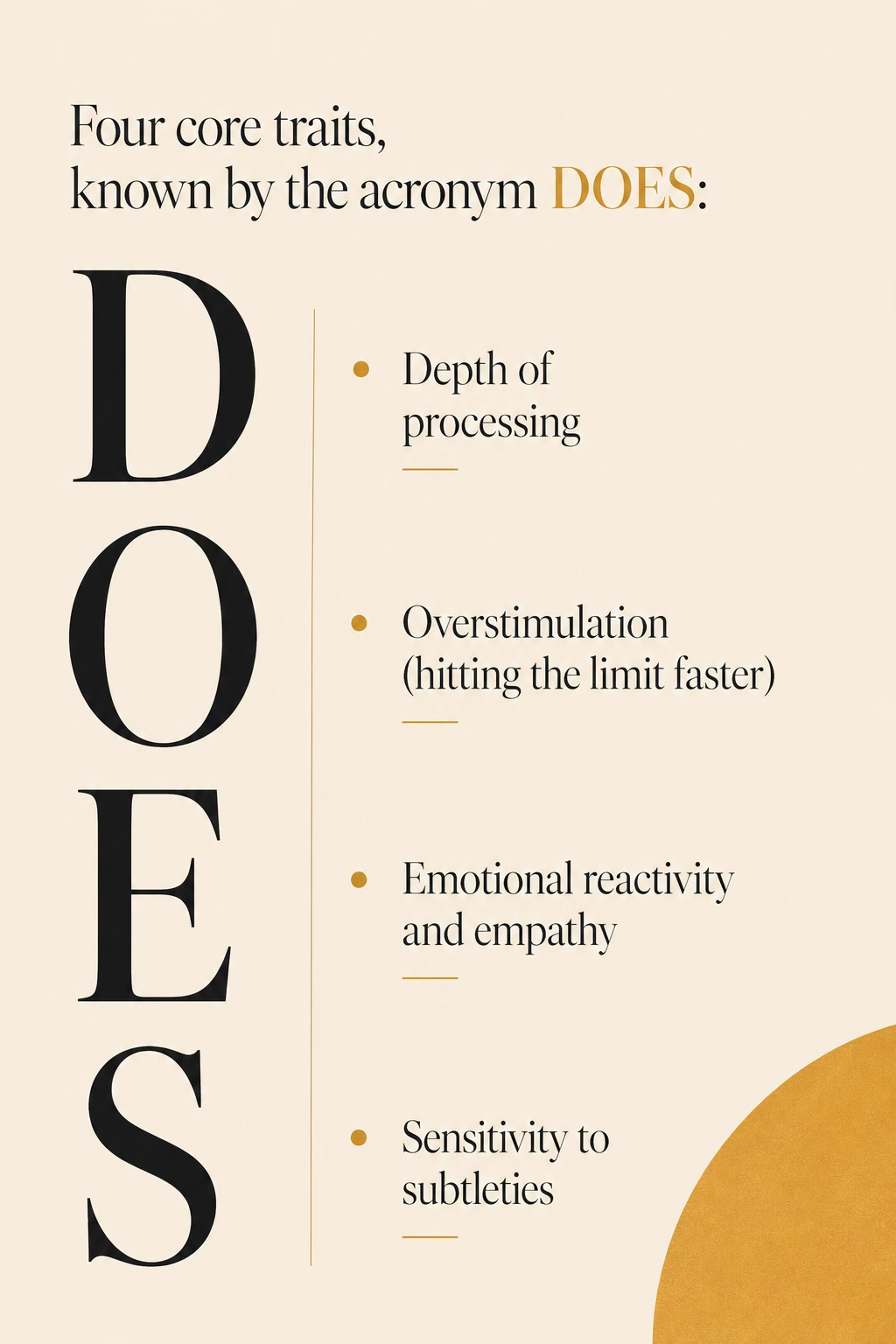
This is me down to the marrow in my bones and I’ve been this way since I was a child. People used to say I was “intense” and it took me some time to understand what that really meant:
I over-process everything.
I grow over-stimulated too quickly. And way more now than when I was younger. I can hardly manage to watch a whole movie anymore. The big reason for that is because:
I over-empathize with seemingly everyone.
And I am way over-sensitive to subtleties which other people miss or ignore.
Shannon frames this in her article as a gift:
She got up, pulled a book from the office shelf, handed it to me, and said, “Oh! This is going to be a real treat. Being an HSP is a gift.”
…
I was wired differently. And that wiring was, as she said, a gift.
…
My boss handed me a book and said, “It’s a gift.” It took me a while to receive it. It takes most of us a while.
But you’re here. And so is everyone else who needed somewhere for all of it to go.
Yes, it’s a gift.
But it’s a gift like the one in the box that Kevin Spacey gives to Brad Pitt at the end of “Se7en”:
I don’t like being a “Highly Sensitive Person” at all. Can I trade for “happy, go-lucky goofball, human golden retriever” instead?
The main reason is this: I can pick up on when people hate me and are trying to hide it. Or when they’re hating someone else.
I can pick up on people’s dark sides that they’re trying to hide.
I figure out the corruptions and cruelties that people don’t want others to know.
And this sucks. I didn’t ask for this.
The world to me, since I was a child, has been a world that is far darker than other people’s. The things that other people miss or that others ignore, I cannot. And so I gain a seemingly bizarre perspective which so many cannot understand.
But now it should make more sense. The more one sees, the more one knows, the more miscarriages a family endures, the more fathers killed in an accident, the more fathers afflicted by disease, the greater sorrow one understands:
I, the Preacher, was king over Israel in Jerusalem.
And I gave my heart to seek and search out by wisdom concerning all things that are done under heaven. This sore travail hath God given to the sons of man to be exercised therewith.
I have seen all the works that are done under the sun, and behold, all is vanity and vexation of spirit.
That which is crooked cannot be made straight, and that which is wanting cannot be numbered.
I communed with mine own heart, saying, “Lo, I have come to great estate, and have gotten more wisdom than all they that have been before me in Jerusalem; yea, my heart had great experience in wisdom and knowledge.”
And I gave my heart to know wisdom, and to know madness and folly. But I perceived that this also is vexation of spirit.
For in much wisdom is much grief, and he that increaseth knowledge increaseth sorrow.
The more you learn of the world, the more you wish you did not know.
The more you understand humans, the less you wish you did.
Illumination is a mistake. You don’t want to see what hides in the shadows and runs away when the lights burst for just a moment.
This is The Tragic View of Life. And I understand why so many wish to reject it. But some of us never really had a choice. This is the gift God gave us.
Happy Father’s Day!
David, I also believe in the tragic view of life. But in complete contradiction to that fact of existence I also believe that life is a great gift.
I’m sorry for your losses. What a tough road to walk. ❤️